Do Home Batteries Add Property Value in the EU 2026?
Energy Performance Certificates shape how European buyers price a house, so it is reasonable to assume a home battery — the priciest item most households add after the heat pump — should appear on that certificate and lift the asking price. In most member states it does not. Storage is not a rated element in any national EPC methodology, and no certificate awards a letter for it.
That does not make a battery worthless at resale. The value travels a different route: through the running costs a buyer inherits, through the retrofits a battery makes affordable, and through the markets where a poor label restricts what you can legally do with a property.
The Short Answer: Not on the Certificate, Yes in the Price
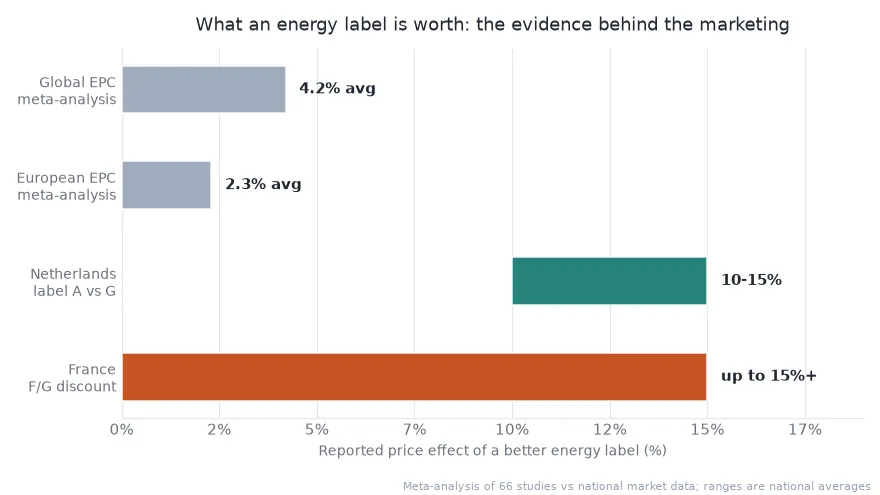
A battery adds resale value in the EU in 2026, but indirectly and unevenly. The effect is strongest in the Netherlands and France, where labels bind landlords and banks price them into mortgages, and weakest where energy is cheap and labels are treated as paperwork. The academic evidence is modest: a meta-analysis of 66 studies puts the European EPC premium at roughly 2.3%, against 4.2% globally.
Why Your Battery Rarely Changes Your EPC Letter
EPC methodologies measure the building, not the appliances inside it. They calculate primary energy demand from the envelope, the fixed technical systems (heating, cooling, hot water, ventilation, lighting) and on-site renewable production. A battery is none of these. It is a time-shifting device: it moves energy between hours without changing how much the building needs.
Where storage does touch the calculation is at one remove. Self-consumed solar counts towards the renewable share in several national methods, and the battery makes that self-consumption possible. Germany’s consumption-based certificate (Verbrauchsausweis) derives from metered energy, so a battery that cuts the meter reading improves the number, while the demand-based certificate (Bedarfsausweis) ignores it. In France, storage is not rated, but the self-consumption it enables lowers the primary-energy figure for the electricity vector in the DPE.
Three Ways a Battery Reaches the Sale Price
1. Running Costs Get Capitalised
This is the cleanest mechanism and the one buyers perform in their heads. A household comparing two similar houses adds the energy bill to the mortgage payment, so a battery saving €450 a year is worth about €4,670 to a buyer discounting at 5% over 15 years. Our analysis of solar and battery ROI in the EU shows how widely that saving varies, and our data on self-consumption rates by country explains why a German system cycles more usefully than a Spanish one.
2. It Makes the EPC-Moving Retrofit Affordable
This is the argument installers should lead with. Insulation and a heat pump move the label; storage is what stops the heat pump turning an efficient house into an expensive one. Electrifying heating without a battery exposes the household to evening peaks and full retail rates for every kilowatt-hour the roof cannot supply after sunset. Paired with storage, an air-to-water heat pump is financially defensible on day one. Our guide to the heat pump and LiFePO4 combination works through the sizing.
The policy backdrop reinforces this. Directive (EU) 2024/1275, the recast Energy Performance of Buildings Directive, had to be transposed by 29 May 2026 and sets a residential trajectory of a 16% cut in average primary energy use by 2030 and 20–22% by 2035, with at least 55% of that from the worst-performing 43% of buildings. New public buildings must be zero-emission from 1 January 2028, all new buildings from 2030, and solar becomes mandatory on new non-residential buildings above 250 m² from 31 December 2026.
3. It Keeps a Property Lettable
France has gone furthest. Homes rated G on the DPE have been barred from the rental market since 1 January 2025, F follows from 1 January 2028 and E from 2034. From 1 January 2027 the DPE cuts the primary-energy conversion factor for electricity from 1.9 to 1.7, lifting some electrically heated homes a class or two at no cost. For a landlord, storage plus PV is often the cheapest route above the ban threshold. Read our guide to apartment and rental storage first.
What the EPC Is Actually Worth by Market
| Market | Observed price effect | How storage reaches it |
|---|---|---|
| Netherlands | Label A or better sells 10–15% above a comparable G home | Indirect: PV self-consumption and lower metered use; banks price the label |
| France | F/G discount above 15% in some regional notarial studies | Direct: self-consumed PV lowers the electricity primary-energy figure |
| Germany | Premium concentrated in new-build and A/A+ stock; prices rose 2.3% in 2025 | Direct on Verbrauchsausweis, none on Bedarfsausweis |
| Italy | Class A/B premium, strongest in Milan and Rome | Indirect, via heat pump electrification and Ecobonus works |
| Spain | Small premium outside prime coastal markets | Weak: cheap off-peak power reduces the case |
| Poland | Premium emerging as EPBD transposition tightens | Indirect, via the heat pump route |
One finding from the Dutch land registry is worth repeating: low consumption by itself does not raise the purchase price. Buyers pay for the technology that produces the label. A battery is exactly that — technology behind the label, not on it.
Green Mortgages: Where Storage Earns a Discount
Lenders have turned the EPC into a pricing input: EU green mortgage products typically sit 0.10 to 0.50 percentage points below standard rates. On a €300,000 loan over 25 years, a 0.40-point cut is worth roughly €18,000–22,000 in interest. None of it is triggered by a battery alone — every product keys off the label — but the battery is often what makes the qualifying retrofit affordable.
| Market | Mechanism in 2026 | Scale |
|---|---|---|
| Netherlands | Label-based rate discount plus extra borrowing | Up to 0.25 pts; €20,000 extra for E/F/G spent on works, €40,000 at A++++ |
| Germany | Green building finance with energy bonus | Up to 0.10 pts for A+/A, smaller bonus at B |
| France | Éco-prêt à taux zéro for renovation packages | Interest-free, capped by works bundle |
Our comparison of financing and leasing options in the EU covers the alternatives, and the country guide to battery tax treatment explains where VAT falls to zero or 5.5%, which changes the net cost any resale calculation starts from.
The Arithmetic: Does €7,500 of Battery Become House Value?
Assume a 10 kWh system cycling 200 times a year at 90% round-trip efficiency: 1,800 kWh shifted annually, with unstored surplus exported at €0.05/kWh. Retail prices are Eurostat figures for H2 2025, the latest semester.
| Market | Retail €/kWh | Annual saving | Present value, 15 yrs at 5% | Recovered at resale |
|---|---|---|---|---|
| Germany | 0.3869 | €606 | €6,290 | 84% |
| Belgium | 0.3499 | €540 | €5,605 | 75% |
| Denmark | 0.3312 | €506 | €5,252 | 70% |
| EU average | 0.2896 | €431 | €4,474 | 60% |
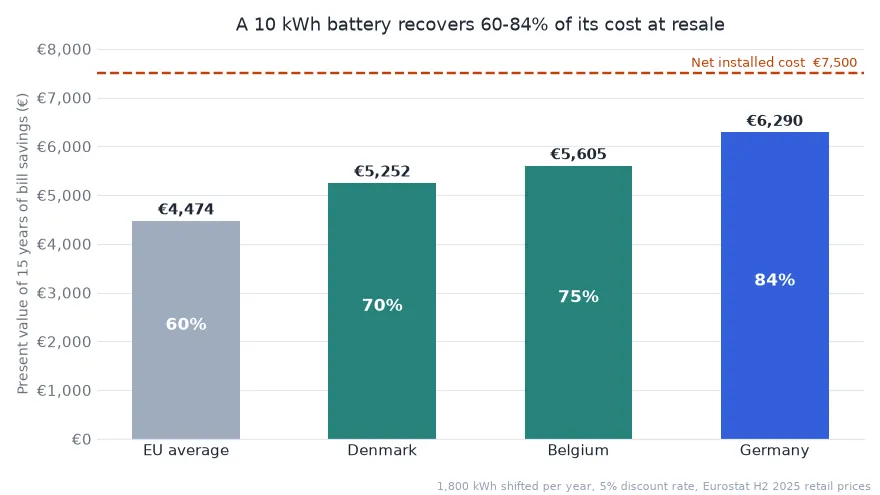
Storage is not a property investment; it is a bill-reduction asset a buyer will partially capitalise, and recovery is highest where retail prices are highest. Add a green mortgage discount or a label step and the case closes.
What Appraisers and Buyers Ask For
Documentation is where most resale value is lost: a surveyor cannot value what cannot be verified, and an unregistered battery is a liability in a conveyancing file rather than an asset. Keep one folder containing:
- Commissioning report and single-line diagram, signed by the installer.
- Registration confirmation — MaStR in Germany, GAUDÌ in Italy, CACSI in France.
- Electrical conformity: Consuel violet, DM 37/2008 declaration or REBT certificate.
- CE declaration plus EN 62619 and IEC 63056 test evidence.
- Warranty terms, including whether cover transfers to a new owner — see our EU warranty guide.
- Battery passport data ahead of the February 2027 deadline under Regulation (EU) 2023/1542 — see our passport guide.
Where the Premium Is Weakest
Be honest with buyers in three situations. Markets with low retail prices and generous export compensation: if the import-to-export spread is under €0.10/kWh, the capitalised saving will not recover the hardware. Homes already rated A, where there is no step left to climb. And subsidised installations, where resale value must be calculated on net cost after grant — which is why the KfW subsidy guide for 2026 matters as much for sellers as buyers. Where net metering is withdrawn — the Netherlands ends its salderingsregeling on 1 January 2027 — a battery protects revenue that would otherwise vanish, a different calculation from adding value.

Build the Case With Numbers, Not Adjectives
A battery will not turn a C-rated house into an A-rated one, and no EU member state pretends otherwise. What it does is cut the bill a buyer inherits, make the retrofit that moves the label affordable, and keep a property above the rental thresholds spreading across the Union. Those effects are quantifiable — and quantifying them is what closes a sale.
Insum Energy manufactures LiFePO4 storage for European homes and supplies the conformity documentation, warranty transfer terms and passport-ready data that surveyors and lenders ask for. Browse the range on our homepage, or contact our team for a quote sized to your market and resale horizon.