
Home Battery Warranty Guide 2026: What EU Consumers Should Look For
A home battery is one of the most significant energy investments a European household will make this decade. A typical 10 kWh LiFePO4 system costs between €4,000 and €8,000 installed, and buyers expect it to perform reliably for 10 to 15 years. Yet many EU consumers focus entirely on capacity and price, barely glancing at the warranty document until something goes wrong.
By 2026, the European regulatory landscape has shifted substantially. The EU Battery Regulation (EU) 2023/1542 is in force, the Right to Repair Directive (EU) 2024/1799 took effect on 31 July 2026, and the harmonised EU GARAN label for commercial durability guarantees becomes mandatory from 27 September 2026. Understanding these layers is no longer optional — it is essential to protecting your investment.
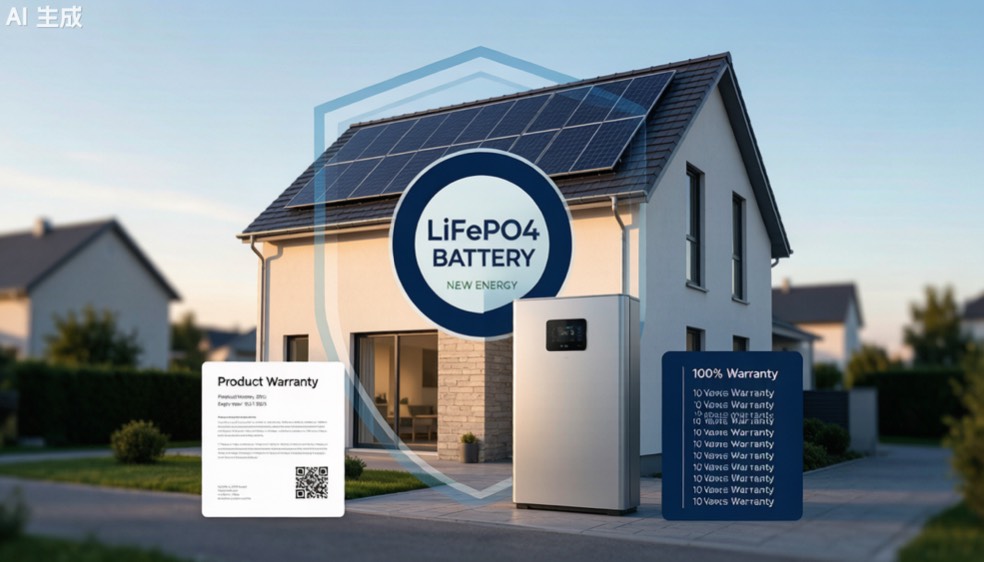
The Three Warranty Layers Protecting EU Battery Buyers
European consumers buying a home battery in 2026 benefit from three distinct but overlapping layers of protection. Understanding how they interact is the foundation of making an informed purchase.
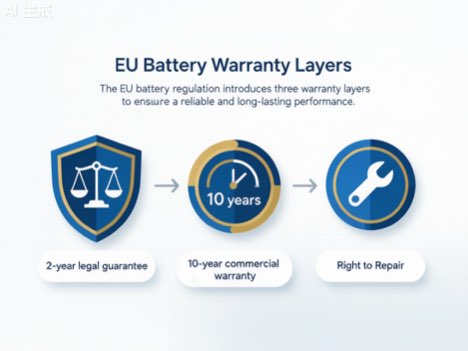
Layer 1: The 2-Year Legal Guarantee (Directive EU 2019/771)
Under the Sale of Goods Directive (EU) 2019/771, every product sold to a consumer in the EU carries a minimum 2-year legal guarantee of conformity. This is statutory law, not an optional warranty offered by the seller. Key points:
- Who is responsible: The seller (the company that sold you the battery), not the manufacturer. The seller cannot simply redirect you to the manufacturer’s customer service.
- What it covers: Any defect that existed at the time of delivery, even if it manifests months later. This includes manufacturing defects, missing features, and products that do not match the description.
- Burden of proof: In the first 12 months, the seller must prove the defect was not present at delivery. From month 13 to 24, the consumer may need to prove it in some countries — though France, Portugal, and several others extend the reversed burden to the full 2 years.
- Remedies: Repair or replacement first; price reduction or full refund if repair is impossible or has failed.
- Country variations: Sweden offers 3 years. The Netherlands uses a “reasonable lifespan” standard. Ireland allows up to 6 years under statute of limitations. France extends the reversed burden of proof to 2 years.
For home batteries, this means that if your LiFePO4 system develops a manufacturing defect — a faulty BMS, a cell imbalance issue, or a connection failure — within 2 years of installation, the seller is legally obligated to repair or replace it at no cost to you.
Layer 2: The Commercial Warranty (Typically 10 Years)
Most reputable LiFePO4 battery manufacturers offer a commercial warranty that extends well beyond the legal minimum. These typically run 10 years or 6,000 cycles (whichever comes first). But not all commercial warranties are created equal. Here is what to scrutinise:
| Brand / Model | Warranty Period | Cycle Limit | End-of-Warranty Capacity | Chemistry |
|---|---|---|---|---|
| Tesla Powerwall 3 | 10 years | Unlimited | 70% | LFP |
| Sonnen eco 10 | 10 years | 10,000 cycles | 80% | LFP |
| BYD Battery-Box | 10 years | 6,000 cycles | 80% | LFP |
| Pylontech Force H2 | 10 years | 6,000 cycles | 70% | LFP |
| Fox ESS ECS/EP | 10 years | 6,000 cycles | 60-70% | LFP |
Table: Warranty comparison of major LiFePO4 home battery brands available in the EU, 2026.
Critical Fine Print to Check
The difference between a good warranty and a worthless one lies in the terms and conditions. Before signing, verify these specifics:
- End-of-warranty capacity floor: A warranty guaranteeing 80% retention after 10 years is significantly more valuable than one guaranteeing 60%. A 10 kWh battery at 80% retention still delivers 8 kWh; at 60%, only 6 kWh.
- Years OR cycles — not both: A “10 years or 6,000 cycles, whichever comes first” clause means the calendar limit usually binds first. At one cycle per day (365/year), 6,000 cycles covers 16.4 years — but the 10-year cap ends coverage first.
- Capacity degradation exclusions: Some warranties exclude “normal capacity loss” — rendering the capacity guarantee nearly meaningless. Look for warranties that explicitly define degradation thresholds.
- Installation requirements: Many warranties require professional installation by a certified electrician, commissioning documentation, and specific environmental conditions. DIY installation can void the warranty entirely.
- Geographic restrictions: Some warranties only apply if the battery is installed in the country of purchase. If you move, coverage may lapse.
- Transferability: If you sell your home, can the new owner assume the warranty? Some brands allow transfer; others do not.
- Company solvency: A warranty is only as strong as the company behind it. The April 2026 administration of GivEnergy in the UK left thousands of homeowners discovering what a 12-year warranty means when the manufacturer no longer exists.
Layer 3: The Right to Repair (Directive EU 2024/1799)
From 31 July 2026, the EU Right to Repair Directive (EU) 2024/1799 is in force across all member states. While home batteries are not yet listed in Annex II of the directive’s mandatory repair categories, the directive amends the Sale of Goods Directive (EU) 2019/771 to add “durability, repairability, functionality, and compatibility” as criteria for conformity. This means:
- If a product cannot be repaired, that itself may constitute a defect under the legal guarantee.
- If you choose repair over replacement during the warranty period, the seller’s liability period is extended by 12 months.
- Manufacturers cannot use software or hardware locks to prevent third-party repairs unless objectively justified.
Additionally, under Regulation (EU) 2023/1542, battery manufacturers must make spare parts available and design batteries for repairability. Article 11 requires that portable batteries be readily removable and replaceable by end-users, while LMT and industrial batteries must be replaceable by independent professionals. Spare parts must remain available for at least 5 years after the last unit of a model is placed on the market.
The EU GARAN Label: A New Standard from September 2026
From 27 September 2026, the EU harmonised GARAN label becomes mandatory for producers offering a voluntary commercial guarantee of durability exceeding 2 years. If a battery manufacturer offers a 10-year warranty that covers the entire product at no additional cost, they must use the GARAN label.
The GARAN label represents a binding commitment that the product will maintain its required functions and performance through normal use for the number of years indicated. If it does not, the producer must repair or replace it at no cost. This gives consumers a standardised, recognisable mark of durability — rather than having to parse dozens of different warranty documents.
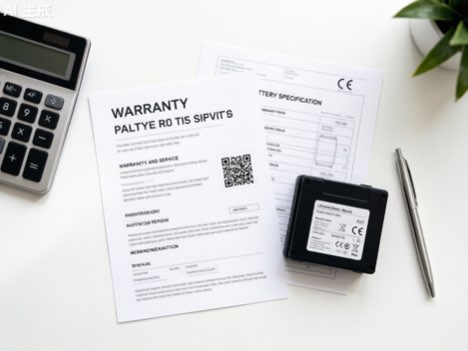
How EU Subsidies Interact With Warranties
Many EU subsidy programmes require specific warranty terms as a condition of eligibility. This creates an additional layer of protection — but also means that choosing a non-compliant battery can cost you thousands in foregone subsidies.
- Germany — KfW Grant 270: Requires a minimum 10-year manufacturer warranty on the battery system.
- France — MaPrimeRénov’ 2026: Battery storage installations must carry CE marking and a minimum 5-year warranty to qualify for the enhanced bonus.
- Italy — Conto Termico 2.0: Thermal storage systems paired with heat pumps require manufacturer warranties of at least 5 years.
- Poland — Mój Prąd 2026: The sixth edition requires battery systems to carry a minimum 10-year warranty and CE conformity documentation.
- Netherlands — ISDE subsidy: Battery storage combined with solar is eligible, with systems requiring conformité CE and manufacturer warranty documentation.
- Czech Republic — NZÚ Programme: New Green Savings programme requires a minimum 7-year warranty for battery storage components.
- Romania — Casa Verde 2026: The relaunched programme requires CE-marked battery systems with at least 5-year manufacturer warranties.
If your battery’s warranty falls short of these thresholds, you may lose subsidy eligibility entirely — turning a €2,000 grant into €0.
Practical Warranty Checklist for EU Buyers
Before purchasing a home battery system, use this checklist to evaluate the warranty:
- Verify the 2-year legal guarantee applies. Buy from an EU-based seller. The legal guarantee does not apply to purchases from private individuals or non-EU sellers without an EU presence.
- Demand the full warranty document before purchase. Not a marketing summary — the actual terms and conditions. If the seller cannot provide it, that is a red flag.
- Check the end-of-warranty capacity guarantee. Look for 70% or higher at 10 years. Be wary of warranties that exclude “normal degradation” without defining it.
- Confirm installation requirements. Does the warranty require certified installation? What documentation must be retained? Is there a commissioning report requirement?
- Review cycle limits vs. your usage. If you plan to participate in a Virtual Power Plant programme or have an EV, your cycle count will be higher. Ensure the warranty covers your expected usage.
- Check transferability. If you might sell your home, ensure the warranty can transfer to the new owner.
- Verify subsidy compatibility. Cross-check the warranty terms against your national subsidy programme’s requirements.
- Keep all documentation. Purchase receipt, warranty certificate, commissioning report, and any service records. Digital copies are acceptable but must be preserved.
- Register the warranty. Many manufacturers require product registration within 30-90 days of installation. Failure to register can void the commercial warranty.
- Understand the claims process. Who do you contact? What is the response time? Is on-site service available, or must the battery be shipped?
What Happens When a Warranty Claim Is Denied?
If a seller refuses a warranty claim that you believe is valid, you have several escalation paths:
- Request the refusal in writing. The seller must provide a written explanation for the denial.
- Contact your national consumer protection authority. Every EU member state has one. They can provide free guidance and, in some cases, intervene directly.
- Use the European Consumer Centre (ECC) network. For cross-border purchases, the ECC in your country can help mediate with a seller in another member state.
- File a complaint via the EU ODR platform (ec.europa.eu/odr) for online dispute resolution.
- Check your home insurance policy. Some household policies cover battery system failures that fall outside warranty terms.
Document every communication. Keep copies of emails, letters, and notes from phone calls. A warranty tracking tool or even a simple spreadsheet can help you manage deadlines and evidence.
The Bottom Line
A home battery warranty in the EU is more than a piece of paper — it is a layered legal and commercial framework that, when properly understood, gives consumers substantial protection. The 2-year legal guarantee, the commercial warranty, the Right to Repair, and the new GARAN label work together to ensure your investment is covered.
But protection only works if you know it exists. Before you buy, read the warranty document. Compare capacity guarantees. Verify subsidy compatibility. And choose a manufacturer with the financial stability to honour a 10-year commitment — because a warranty is only as strong as the company behind it.
Looking for a LiFePO4 battery system with a robust warranty backed by EU compliance? Contact Insum Energy today for a personalised quote, or explore our battery product catalogue to find certified systems with industry-leading warranty terms.


One Comment