Coastal Home Battery Guide 2026: Salt Air & Corrosion
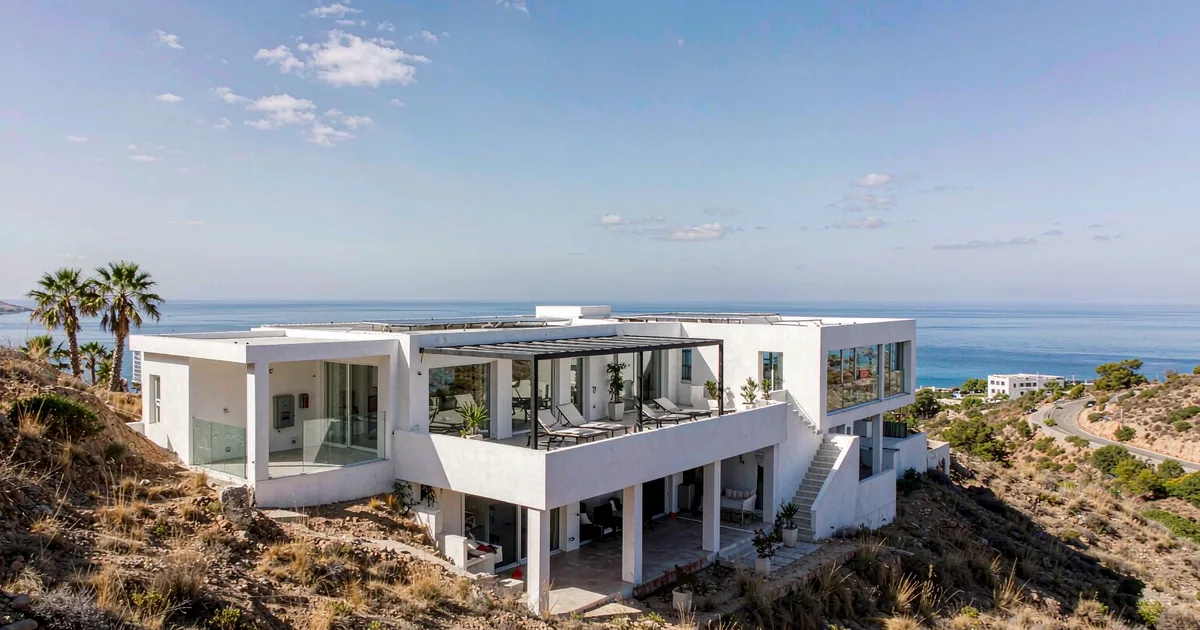
Roughly 95 million Europeans — 21% of the EU population — live along the bloc’s 70,000 kilometres of coastline, across 22 member states. Add the 17 million people on more than 4,000 inhabited islands, and nearly a quarter of the EU’s households sit inside the salt-carrying zone that begins at the shore. When the European Commission adopted its first-ever EU Coastal Communities Strategy in June 2026, it explicitly flagged climate-proofing coastal infrastructure as a priority. For buyers in Valencia, Setúbal, Thessaloniki or on the Frisian islands, salt air is the most underestimated threat to a solar-plus-storage investment — and the fine print lives in warranty documents, not datasheets.
This guide explains what salt air actually attacks, how to judge how corrosive your site is, and which warranty clauses, enclosure ratings and siting decisions keep a coastal battery alive to year ten instead of dying in year four.
What Salt Air Actually Attacks (Hint: Not the Cells)
Start with the reassuring part. In a modern LiFePO4 home battery, the cells are sealed electrochemical packages; sodium chloride does not get inside a healthy cell, so the chemistry that made LFP the EU’s default storage choice is not directly threatened by a sea breeze.
Everything around the cells is another story. Sea salt is hygroscopic — it pulls moisture out of the air even on days that feel merely damp — so exposed metal near the coast carries a thin, conductive electrolyte film for months at a time. On that film, corrosion attacks the hardware that makes the battery work: terminals, busbar joints, connector plating, fasteners, and the hybrid inverter’s electronics. Corrosion raises contact resistance, resistance produces heat, and in the worst case a degraded connection fails. BMS printed circuit boards are especially vulnerable to creep corrosion, where salts crawl across surfaces into places splash can never reach. The classic failure: an enclosure that looks pristine outside while copper-sulfate deposits climb the internal sense wiring.
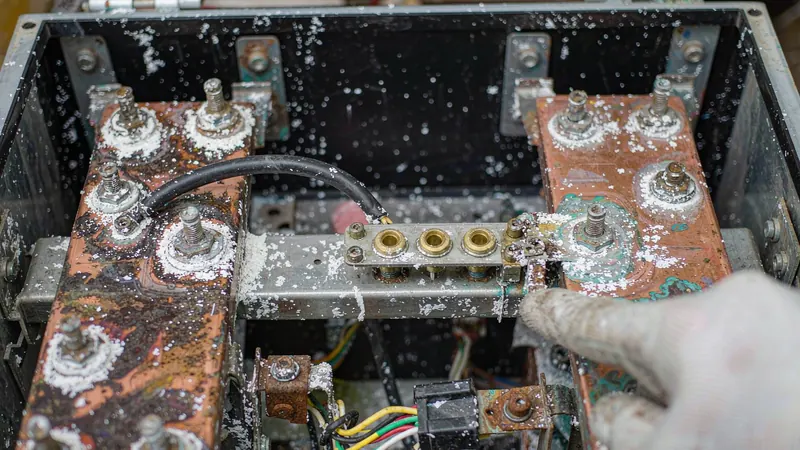
So “will a battery survive near the sea?” is a question about enclosure quality, plating, siting and maintenance — not chemistry.
How Corrosive Is Your Site? Distance, Deposition and ISO 9223
Corrosion engineers grade atmospheres with the ISO 9223 standard, from C1 (dry indoor air) through C5 (very high, industrial-coastal) to the offshore-grade CX category. The dominant variable on a coast is chloride deposition — milligrams per square metre per day — and it falls off with distance from breaking surf faster than buyers expect.
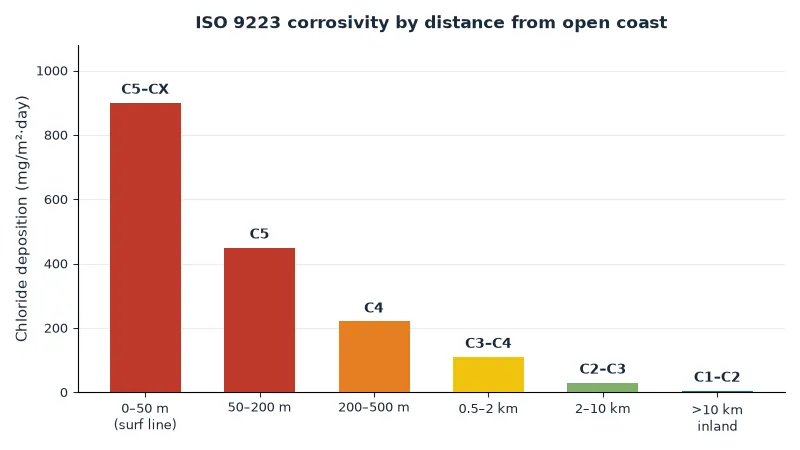
| Distance from open coast | Typical chloride deposition | ISO 9223 band | Practical read |
|---|---|---|---|
| 0–50 m (surf line) | 600–1,500+ mg/m²·day | C5–CX | Marine-grade spec or nothing |
| 50–200 m | 300–600 | C5 | Outdoor install risky |
| 200–500 m | 150–300 | C4 | Many brands’ exclusion zone |
| 500 m–2 km | 60–150 | C3–C4 | Sheltered install + inspections |
| 2–10 km | 10–60 | C2–C3 | Standard install usually fine |
| >10 km inland | below 10 | C1–C2 | No special measures |
Two caveats matter. Prevailing wind direction can shift a site a full category: a house on the leeward side of a headland, 300 metres from the water, can behave like an inland site, while a courtyard 2 km inland can sit in C4 if it funnels sea wind. And seawater pools are corrosion sources in their own right.
The 500-Metre Rule: Warranty Fine Print EU Buyers Miss
Here is what surprises most homeowners: several major inverter and battery manufacturers apply an explicit distance rule around the 500-metre mark, and EU distribution agreements frequently inherit it.
- Sigenergy’s SigenStor guidance calls for at least 500 m from corrosion sources such as the seaside; its warranty excludes rust from harsh environmental conditions.
- Sungrow’s SBH battery manual instructs installers not to mount within 500 m of the coastline or where sea winds are prevalent.
- SolaX specifies at least 500 m from the coast for its outdoor-rated equipment, and its warranty excludes corrosion in corrosive environments.
- GoodWe asks to be consulted before any outdoor installation within 500 m of the shore, and its warranty excludes sea-coast exposure without prior written approval.
- Maxeon’s SunPower Reserve warranty outright excludes products installed within 500 m of a coastline.
The language varies — “salt air”, “aggressive atmospheres”, “corrosive environments” — but the effect is the same: a rusted enclosure or corroded busbar inside the exclusion zone can void a ten-year warranty down to a claim letter. The defence costs nothing. Before ordering, pull the actual warranty document, search it for “corrosion”, “salt” and “coast”, and if anything is ambiguous, get written confirmation that your address is covered. Our home battery warranty guide for EU consumers walks through that process, and our insurance and certification overview covers what household policies exclude alongside the manufacturer terms.
IP Ratings, C5-M and Salt-Mist Testing: What the Labels Mean
Enclosure labels are widely misread. Ingress protection (IEC 60529) tells you about water and dust, not corrosion. IP65 means dust-tight and resistant to low-pressure jets; IP66 adds high-pressure jet resistance. For a sheltered wall-mount near the sea, IP65 is the floor; for a fully exposed coastal wall, treat IP66 as the minimum.
But IP alone stops water — it says nothing about the salt that gets past gaskets over time. The corrosivity ratings you want alongside it come from the ISO 12944 coating family: C5-M is the marine category, and the newer CX class covers offshore conditions. Some manufacturers additionally certify enclosures against salt mist under IEC 60068-2-52 or neutral salt spray per ISO 9227 — ask for the test report, because “marine rated” without one is marketing.
| Rating | What it proves | Coastal verdict |
|---|---|---|
| IP65 | Dust-tight, low-pressure jets | Acceptable sheltered / covered |
| IP66 | Dust-tight, high-pressure jets | Minimum for exposed walls |
| C5-M (ISO 12944) | Marine corrosion coating spec | Look for it on outdoor units |
| IEC 60068-2-52 / ISO 9227 | Salt-mist / salt-spray test passed | Ask for the report |
Siting and Installation: The Checklist That Keeps Warranties Alive
Product choice sets the ceiling; siting decides whether you reach it. The principles installers follow on Atlantic and Mediterranean coasts are consistent:
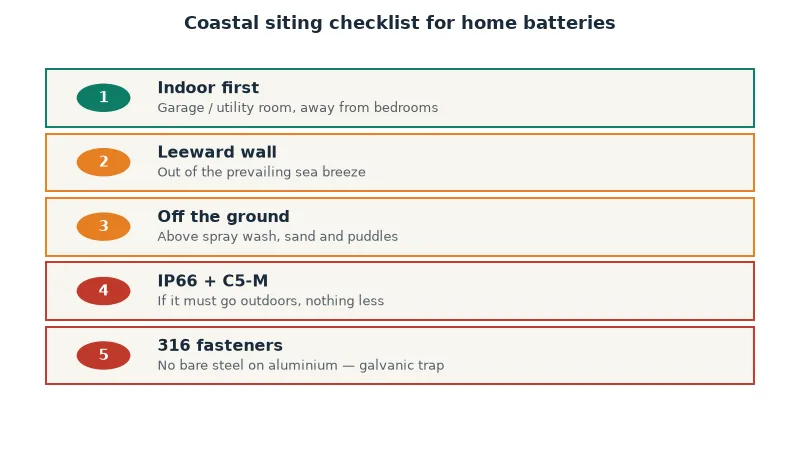
- Indoor first. A garage or utility room removes most of the problem and simplifies the permitting picture — our EU permit guide explains when indoor installs are notification-free.
- Leeward wall, off the ground. If outdoor mounting is unavoidable, put the unit on the side away from the prevailing sea breeze, raised above splash wash and wind-blown sand.
- Mind the galvanic trap. Mixing aluminium enclosures with bare steel fasteners in salt air creates galvanic corrosion at the contact point. A4/316 stainless hardware, sealed cable glands and desiccant breather valves are cheap insurance.
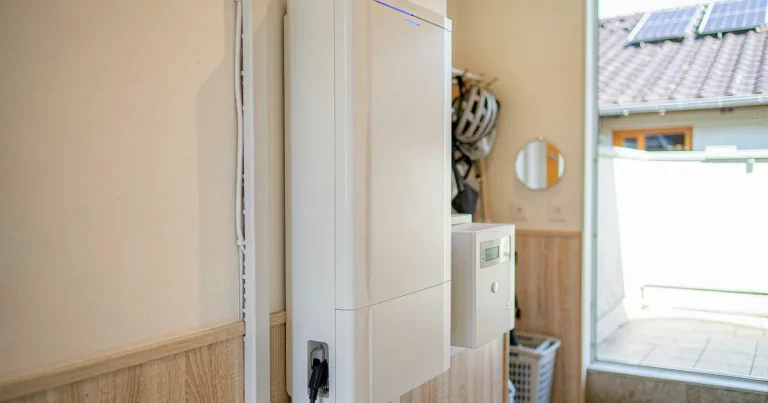
- Give electronics cover. Hybrid inverters are often the most corrosion-sensitive box on the wall; shelter them or specify a conformal-coated, IP66 model.
Whether the resulting system is AC- or DC-coupled matters less for corrosion than for the rest of the design — our AC vs DC-coupled comparison covers that decision separately.
Maintenance on the Coast: A Six-Month Routine
Coastal systems live or die by maintenance inland installs can skip. Twice a year, inspect terminals and connectors for white salt bloom or green deposits, rinse external surfaces with fresh water (never a pressure washer against gaskets), check that drainage holes and breathers are clear, and photograph anything suspicious for the warranty file. Budget for it: our O&M cost breakdown for the EU suggests coastal owners should add roughly 15–20% to the routine service line versus an inland system.
Country Notes: From the Canaries to the North Sea
Corrosion pressure is not evenly distributed across the EU. Spain’s Canary and Balearic islands — where generous regional storage subsidies now apply — combine salt, humidity and year-round warmth, the most aggressive residential climate in the union; our islands subsidy guide covers the funding side. Greek and Croatian island systems face the same profile, which is why the Commission’s June 2026 islands and coastal communities strategies (COM(2026) 520 and COM(2026) 530) put energy-resilience infrastructure on the funding agenda. On the German and Dutch North Sea coasts, storm-driven spray reaches kilometres inland during winter gales; Irish and Portuguese Atlantic coasts sit in between but rarely dry out.
The strategic point: with the right specification, a coastal battery is not a compromised purchase. Self-consumption economics on sunny southern coasts are among Europe’s best, and island homes with weak grids have the most to gain from storage.
What Getting It Wrong Costs
Replace a corroded 10 kWh system in year four and you are out roughly €5,000–8,000 installed, plus lost self-consumption in the gap period. The preventive stack — an indoor or sheltered position, A4 stainless hardware, breather valves, twice-yearly inspections — costs a few hundred euros over the system’s life. Nothing else in a coastal solar project has a comparable return.
Get a Coastal-Spec Quote
Insum Energy supplies LiFePO4 home batteries and hybrid inverters specified for marine-adjacent installations, with C5-rated enclosure options, stainless mounting hardware and documentation that survives warranty scrutiny. Browse the range on our product pages, learn more about us, or contact Insum Energy for a coastal-spec quote with written warranty confirmation for your address — see insumenergy.com.