EU Cyber Resilience Act 2026: Home Battery Security Rules
Your home battery stopped being a passive box of cells years ago. It runs firmware, talks to a cloud platform, receives over-the-air updates and — if you have joined a virtual power plant — accepts dispatch commands from an aggregator. From Brussels’ point of view, that makes it a product with digital elements, and the EU has spent two years writing binding cybersecurity rules for exactly this kind of device. Two regimes already bite, and the largest — the Cyber Resilience Act — starts reporting obligations in September 2026 and full application in December 2027. Here is what the rules say and what to check before your next battery purchase.
Why your home battery is now a regulated connected product
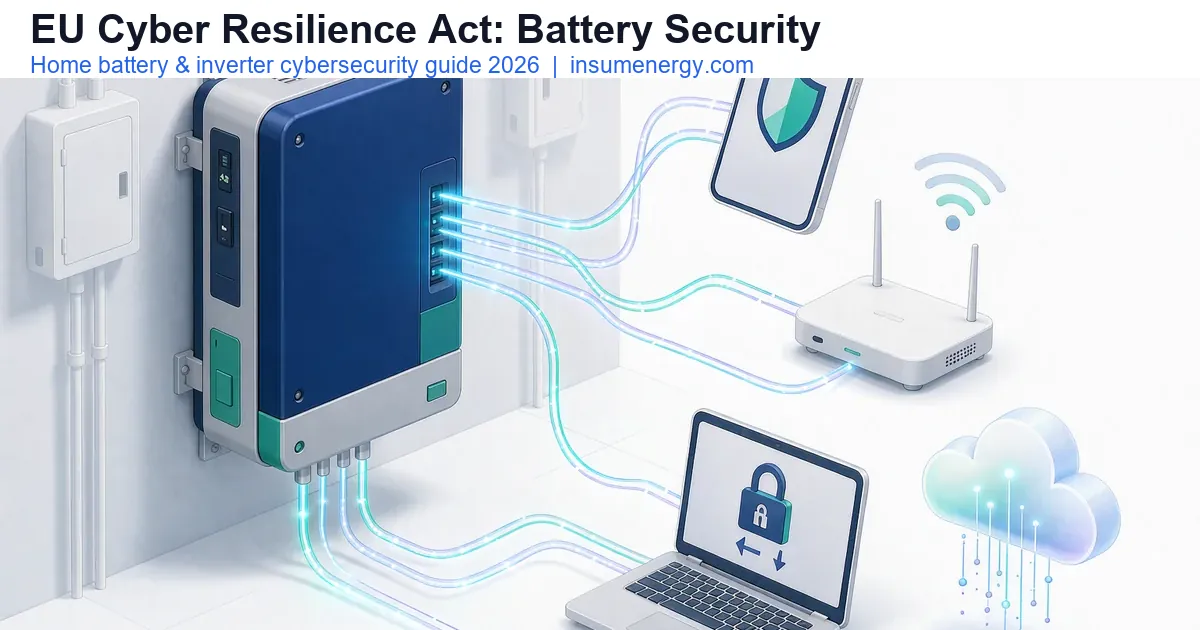
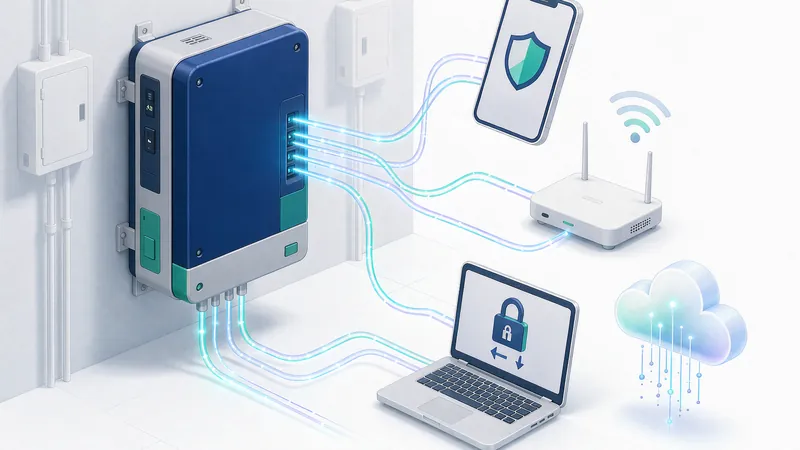
A typical residential battery system sold in the EU in 2026 contains at least five network-facing components: a Wi-Fi or LTE dongle on the inverter, a cloud monitoring portal, a smartphone app, an over-the-air firmware channel, and increasingly an interface for virtual power plant (VPP) programmes. In countries such as Germany, the system may also talk to a certified smart meter gateway; our smart meter rollout guide shows how those deadlines interact with battery integration.
The stakes are concrete. A compromised battery system can falsify the metering data used for feed-in payments, misbehave at the grid-connection point, leak occupancy patterns inferred from load profiles, or be conscripted into a botnet. That is the threat model the EU’s new product-security rules were written for.
The three EU rulebooks now covering your battery
Radio Equipment Directive: already binding since August 2025
The first regime is already in force. Commission Delegated Regulation (EU) 2022/30 activated the cybersecurity essential requirements of Article 3(3)(d), (e) and (f) of the Radio Equipment Directive 2014/53/EU from 1 August 2025. It applies to internet-connected radio equipment — in practice, the Wi-Fi/LTE modules and gateways bundled with inverters and batteries. Such equipment must not harm network functioning, must safeguard personal data, and must support fraud-prevention features.
Compliance is demonstrated against the harmonised standards EN 18031-1, -2 and -3, cited by Commission Implementing Decision (EU) 2025/138. There is a well-known trap: if a product allows the user to skip setting an authentication password entirely, it loses the presumption of conformity and needs a notified body instead. Any battery or inverter placed on the EU market after 1 August 2025 must already meet these requirements, so the Declaration of Conformity in your handover file should reference Regulation (EU) 2022/30. If it does not, ask why.
The Cyber Resilience Act: the big one is coming
The second regime is Regulation (EU) 2024/2847 — the Cyber Resilience Act (CRA) — the first horizontal EU law making cybersecurity a CE-marking requirement for connected products. It entered into force on 10 December 2024 and phases in through three milestones:
- 11 June 2026: the notified-body chapter (Chapter IV) applies, covering the higher-risk product classes.
- 11 September 2026: Article 14 reporting obligations start. Manufacturers must report actively exploited vulnerabilities and severe incidents through the CRA Single Reporting Platform — an early warning within 24 hours, a full notification within 72 hours, and a final report afterwards. This applies to products already on the market.
- 11 December 2027: full application. Every product with digital elements placed on the EU market must meet the Annex I essential requirements, carry CE marking, and be backed by a technical file including a software bill of materials (SBOM).
For manufacturers of home batteries, inverters and energy management systems, the CRA means secure-by-design development, a ban on universal default passwords, coordinated vulnerability handling, and security updates throughout a declared support period — with a statutory floor of five years (Article 13(8)). Penalties are serious: up to €15 million or 2.5% of global annual turnover for breaching the essential requirements, €10 million or 2% for other manufacturer obligations, and €5 million or 1% for misleading information. Most residential energy products fall into the default class and can self-assess, but the documentation burden is real.
NIS2 and the Battery Regulation complete the picture
Two neighbouring laws matter. Directive (EU) 2022/2555 (NIS2) regulates the organisations rather than the devices: electricity undertakings, aggregators and VPP operators are essential or important entities with their own incident-reporting clocks. If you sell flexibility services, your platform operator is regulated even though your battery is not. And under Regulation (EU) 2023/1542 (the EU Battery Regulation), industrial batteries above 2 kWh — which covers stationary storage — must carry a battery passport accessible via QR code from 18 February 2027; our battery passport explainer covers what data it exposes.
| Date | What becomes binding | Who feels it first |
|---|---|---|
| 10 Dec 2024 | CRA (EU) 2024/2847 enters into force | Manufacturers begin compliance planning |
| 1 Aug 2025 | Delegated Regulation (EU) 2022/30 applies; EN 18031 harmonised | Importers, distributors, installers checking CE files |
| 11 Jun 2026 | CRA notified-body chapter applies | Higher-risk product classes |
| 11 Sep 2026 | CRA Article 14 vulnerability/incident reporting | All manufacturers with connected products |
| 18 Feb 2027 | Battery passport via QR code (Reg. (EU) 2023/1542) | Battery manufacturers, LMT/industrial/EV |
| 11 Dec 2027 | Full CRA application, CE marking for cybersecurity | Entire supply chain |
What EU homeowners should ask
You do not need to read the Official Journal to buy safely — ask four questions and get the answers in writing:
- How long will security updates last? The CRA sets a five-year floor, but your battery’s design life is 10–15 years. Ask the manufacturer to commit in writing to a support period that matches the product warranty — our warranty guide shows what those commitments look like.
- Is the app protected properly? Multi-factor authentication and no “continue without a password” option — the exact gap that strips EN 18031 products of their presumption of conformity.
- Does the system still work without the cloud? Local control and a documented local interface protect you from outages.
- Is there a vulnerability disclosure policy? A serious manufacturer publishes one; it is also a hint at CRA readiness.
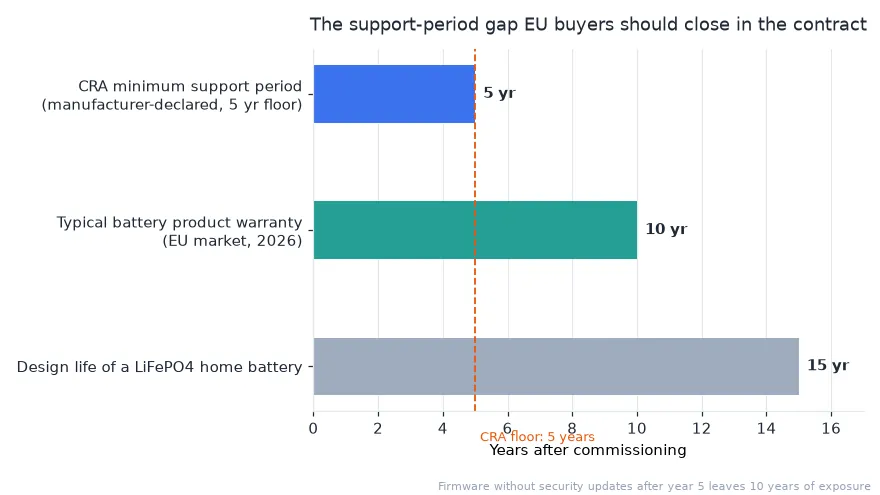
These questions pair naturally with the sustainability and repair rules in our Ecodesign regulation guide: firmware support, spare parts and repairability are part of the same “how long does this product stay maintained” conversation.
What installers must check before commissioning

For installation companies, cybersecurity is becoming part of professional handover practice:
- Verify the EU Declaration of Conformity covers Regulation (EU) 2022/30 and the EN 18031 series for anything with a radio module.
- Update firmware to the current release during commissioning — factory-shipped firmware is often months old.
- Force a unique, strong password on the inverter interface and the customer account, and enable MFA where offered.
- Record the installed firmware version and the manufacturer’s support end-date in the handover documentation.
Importers and distributors: your due-care duty
The CRA does not only target manufacturers. Importers must verify, before placing a product on the market, that it meets the essential requirements and carries correct CE marking and documentation; distributors must verify the same before making it available, and both must keep the technical documentation and declaration of conformity on file for ten years. In practice, procurement teams should add cybersecurity clauses to supply contracts: an SBOM on request, a named contact for vulnerability reports, and a written support period. Our supply chain due diligence guide shows how these clauses fit alongside existing sustainability checks.
What it will cost — and who pays
Compliance is not free. Industry estimates for EN 18031 testing, penetration assessment and CRA documentation for a household-energy product line run from roughly €15,000 for lean self-assessment files to well over €100,000 where notified-body involvement is required — plus recurring costs for vulnerability monitoring and update infrastructure. Some of that lands in product prices, though for a €3,000–4,500 battery system the effect should be modest, because the connected module is a small part of the bill of materials. Be sceptical of the opposite signal: a suspiciously cheap battery from a vendor that cannot name its support period or show a 2025-or-later Declaration of Conformity. From December 2027 such products cannot legally be sold in the EU.
Frequently asked questions
Does the CRA apply to a battery bought in 2024?
Partly. The reporting obligations apply from 11 September 2026 to products already on the market, so your manufacturer must report actively exploited vulnerabilities in your system. Full technical requirements apply to products placed on the market from 11 December 2027, or after a substantial modification. Enforcement sits with national market surveillance authorities, supported by ENISA; non-compliant products can be recalled and fines scale to global turnover.
Buy a battery that is ready for the rules
Insum Energy supplies LiFePO4 home battery systems built for EU compliance: EN 18031-tested connectivity, security updates committed for the full warranty period, no default passwords, and documentation your installer can drop straight into the handover file. Browse our battery product range, learn more about us, and contact Insum Energy for a quote — we will size a system for your tariff, your subsidy scheme and the 2027 rulebook. More guides on the Insum Energy homepage.