EU Electricity Market Reform 2026: Home Battery Impact
On 25 September 2026, the European Commission sent letters of formal notice to 18 Member States — among them Spain, France, the Netherlands, Poland, Romania and Greece — for failing to fully transpose the EU’s electricity market design reform. For anyone selling or installing home battery storage, that bureaucratic-sounding headline is one of the most commercially important events of the year. The reform, delivered by Directive (EU) 2024/1711 and Regulation (EU) 2024/1747, is quietly rewriting who may sell electricity, at what price, and with which enforceable rights. This guide explains what actually changed in 2026 and what it means for storage economics in Germany, Spain and Italy — with systems built to match the new rules.
What the EU Electricity Market Design Reform Changed
After the 2021–2023 energy price crisis, the EU adopted two complementary instruments on 13 June 2024, both in force since 16 July 2024:
- Directive (EU) 2024/1711 amends the Internal Electricity Market Directive (EU) 2019/944 and the Renewable Energy Directive (EU) 2018/2001. Member States had to transpose most provisions by 17 January 2025; the rules on free choice of supplier (amended Article 4) and the new right to energy sharing (new Article 15a) had a deferred deadline of 17 July 2026.
- Regulation (EU) 2024/1747 amends Regulations (EU) 2019/943 and (EU) 2019/942. As a regulation, it applies directly in every Member State without national transposition.
Four changes matter directly for battery owners and installers: dynamic price contracts become an enforceable consumer right, energy sharing becomes a right rather than a pilot project, storage is formally recognised inside the flexibility framework, and a dedicated measurement device can now settle flexibility services from storage. The Commission estimates the integrated internal market already saves Europeans about €34 billion per year, rising to €40–43 billion by 2030.
Dynamic Price Contracts Are Now a Consumer Right
Article 18a of Directive (EU) 2019/944, as amended, obliges every electricity supplier to offer at least one dynamic price contract that passes wholesale prices through to the customer. That legal right meets a market that is already extremely volatile. Average day-ahead prices in September 2026 ranged from roughly €4/MWh in Sweden to €197/MWh in Italy — a spread of nearly 50× inside a single internal market.
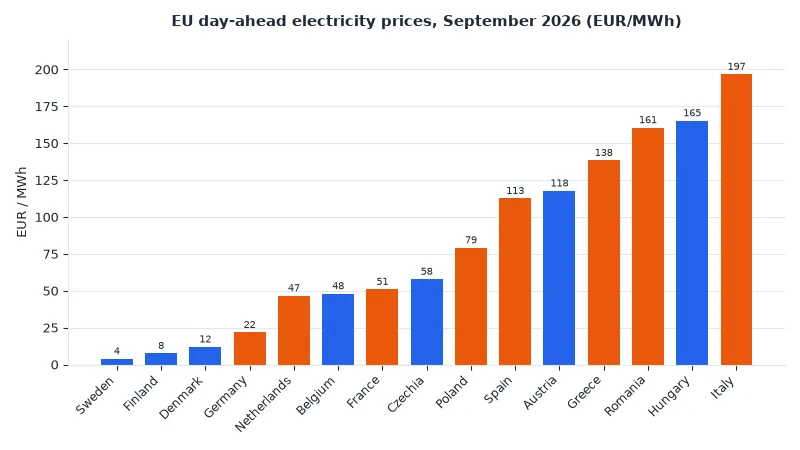
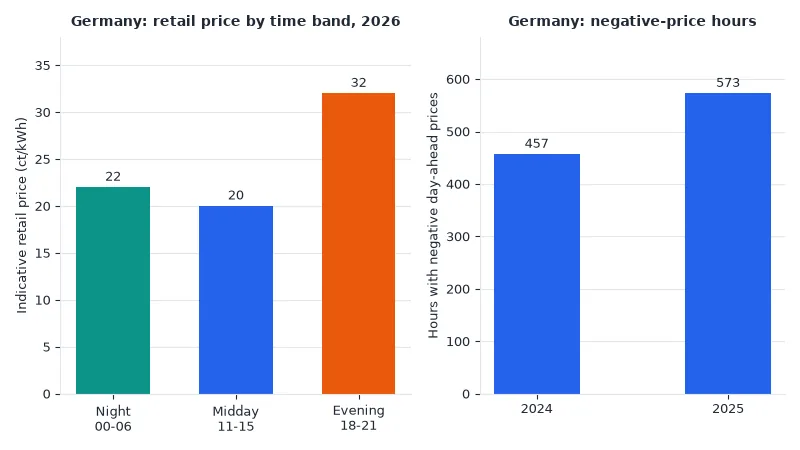
For battery sizing, the intraday shape matters more than the average. In Germany, wholesale power was negative for 573 hours in 2025 (up from 457 in 2024), and indicative 2026 retail prices — taxes and grid fees included — still show a midday band near 20 ct/kWh against an evening peak around 32 ct/kWh. Spanish PVPC customers regularly see midday hours below €0.05/kWh, while Dutch households on hourly EPEX-linked contracts pay a blended retail rate near €0.35/kWh once the ODE energy tax is included.
A 10 kWh LiFePO4 battery cycling daily across that spread typically saves €400–€1,500 per year. Our guides on the EU dynamic electricity tariff structure and advanced tariff-aware charging strategies show how to automate that arbitrage.
Energy Sharing Turns a Battery Into Shared Infrastructure
The reform’s most under-rated provision is Article 15a, inserted into Directive (EU) 2019/944. Households, SMEs and public bodies now have the right to participate in energy sharing — sharing self-generated or stored renewable electricity with other customers on a non-discriminatory basis, within the same bidding zone or a smaller area defined by the Member State.
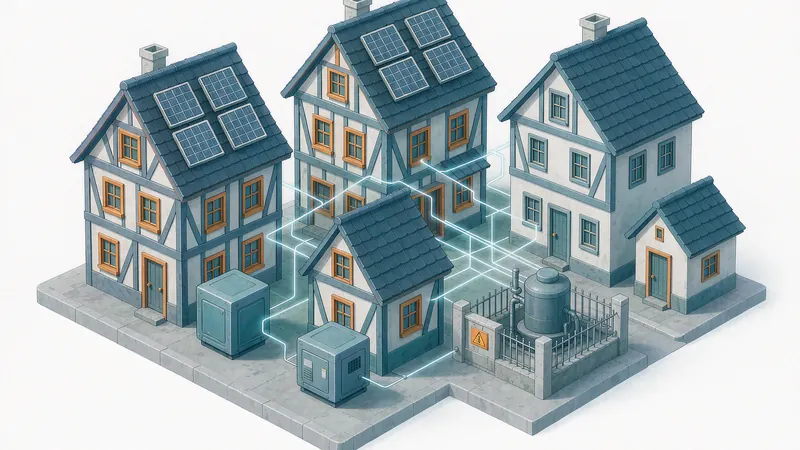
The technically relevant details for storage projects:
- Shared electricity is deducted from each participant’s metered consumption within the imbalance settlement period — quarterly-hourly metering is the practical prerequisite.
- Participants may appoint a third-party energy sharing organiser, which may own or manage a generation or storage facility of up to 6 MW and can operate behind-the-meter flexible loads, distributed renewables and storage assets.
- Households sharing up to 10.8 kW (single family homes) or 50 kW (multi-apartment blocks) are relieved of supplier obligations; Member States may widen these limits to 30 kW and 40–100 kW.
National implementation is uneven, which is exactly why the Commission acted. Germany transposed the right through Section 42c of the Energy Industry Act (EnWG), in force since 23 December 2025, with distribution operators obliged to enable energy sharing from 1 June 2026. Spain extended the maximum distance for collective self-consumption to 5 km in March 2026, and France revised its allocation rules in June 2026. The 18 Member States under formal notice — including the Netherlands, Belgium, Poland and the Nordics — have two months to respond, so expect national frameworks to land quickly and to reinforce citizen energy communities and battery storage.
Flexibility, Peak Shaving and Getting Paid for Your Battery
Regulation (EU) 2024/1747 builds the first EU-wide framework that treats home storage as grid infrastructure:
- New Article 7a (peak-shaving product) — during a declared regional or Union-wide price crisis, system operators may procure peak-shaving products from demand response, paying flexible assets to reduce consumption at peak.
- New Article 7b (dedicated measurement device) — where a smart meter cannot deliver the required data, system operators must accept data from a dedicated measurement device for settling demand response and flexibility services, explicitly including energy storage, without discriminating against that customer.
- Articles 19e–19h (flexibility framework) — every Member State must assess flexibility needs, set an indicative national objective for non-fossil flexibility, and may design support schemes for storage and demand response.
- Two-way contracts for difference (Article 19d) apply to new generation but exclude storage — so battery owners keep full merchant revenue from arbitrage and grid services.
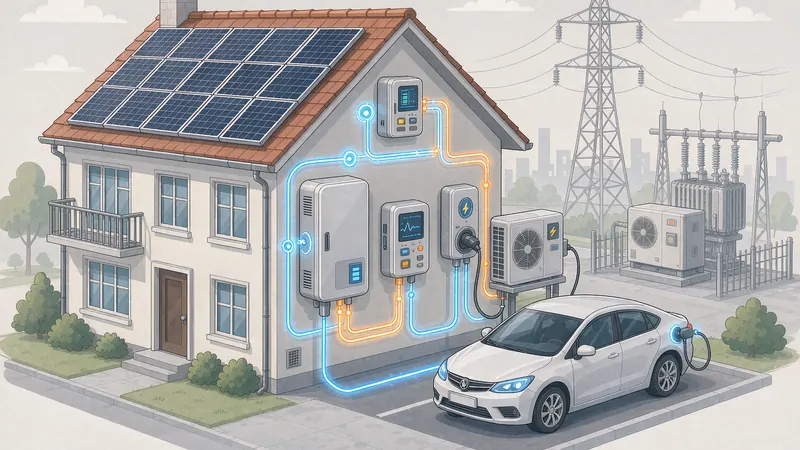
In practice this is the legal backbone of revenue stacking: self-consumption first, tariff arbitrage second, aggregator and flexibility programmes third. Our guide to virtual power plants in Europe details what aggregators currently pay, and the flexibility framework also eases the connection bottleneck described in our article on grid connection capacity limits, since flexible connection agreements are now explicitly encouraged.
How National Subsidies Stack With the New Market Rules in 2026
The market reform defines what your battery can earn; national programmes still decide what it costs. Indicative 2026 support across key markets:
| Country | Programme | Indicative 2026 support |
|---|---|---|
| Germany | 0% VAT (§12(3) UStG) + KfW 270 loan | 19% price cut on PV + storage, plus low-interest financing |
| France | MaPrimeRénov’ 2026 + 5.5% VAT (PV ≤ 9 kWc) | Up to ~€11,000 renovation package; battery value via self-consumption |
| Italy | Conto Termico 2.0 + 50% tax deduction | Up to ~40% for heat-pump + storage; 50% deduction over 10 years |
| Netherlands | ISDE + Salderingsregeling phase-out | ~€1,800–€2,500 for a home battery; net metering ends 2027 |
| Poland | Mój Prąd 2026 | PLN 7,500–15,000 (≈€1,700–€3,500); top tier needs ≥2 kWh battery per kWp |
| Czechia | NZÚ | Up to CZK 150,000 (≈€6,000) for PV + storage up to 50 kWh |
| Romania | Casa Verde Baterii 2026 | Up to RON 15,000 (≈€3,000), 75% of eligible costs, ≥10 kWh, max RON 1,500/kWh |
| Greece | Recovery Fund storage programme | Up to ~€10,000 at roughly 65% aid intensity for PV + storage |
Country specifics are covered in our German KfW application guide, the France & Italy subsidy guide, the Greek €200 million storage programme and the wider Eastern Europe 2026 subsidy playbook. Because net metering is disappearing — see our analysis of the net metering phase-out in Europe — every euro of subsidy now compounds with market-based savings instead of competing with them.
What Installers and Distributors Should Do in Q4 2026
- Track transposition country by country. Eighteen states are under formal notice; national energy-sharing frameworks will be adopted at speed, and eligibility rules will differ.
- Quote energy-sharing-ready systems: a compliant smart meter or dedicated measurement device (Article 7b), a dynamic-tariff-capable inverter, and a battery with documented CAN/RS485 communication for the energy sharing organiser.
- Model revenue properly. Present savings under a dynamic tariff scenario, not a flat-rate assumption; the midday-to-evening spread is the business case.
- Watch subsidy calendars. Mój Prąd, NZÚ and Casa Verde rounds close quickly; sequencing installation against the window protects payback.
- Document compliance. EU Battery Regulation (EU) 2023/1542 conformity, CE marking and grid-operator registration files keep the whole chain — subsidy, grid and insurance — smooth.
Frequently Asked Questions
Does the reform force me onto a dynamic tariff?
No. Suppliers must offer one dynamic contract, but fixed-price contracts remain available. With German evening peaks around 32 ct/kWh against 20 ct/kWh midday — and hundreds of negative-price hours — the dynamic option paired with a battery is now usually the cheaper combination.
Can an apartment share stored solar with neighbours?
Yes. Article 15a applies to households in multi-apartment blocks, with supplier obligations waived for shared capacity up to 50 kW by default, extendable to 100 kW by the Member State.
Will batteries face discriminatory grid fees?
Regulation (EU) 2024/1747 requires tariff methodologies to take storage into account, and the Commission’s July 2025 guidance on future-proof network charges pushes regulators toward cost-reflective, storage-friendly grid tariffs.
Get a Market-Reform-Ready Quote from Insum Energy
The 2026 reform turns home storage from a self-consumption accessory into legally protected market infrastructure. Insum Energy supplies LiFePO4 battery systems engineered for the EU market — certified, communicative and ready for dynamic tariffs, energy sharing and flexibility programmes. Learn who we are, browse the product range, or contact our team for a tailored quote and let us size a system that monetises the new rules in your country.