Greece Battery Storage Subsidy Guide 2026: €200M Program + Standalone Battery Rules Explained
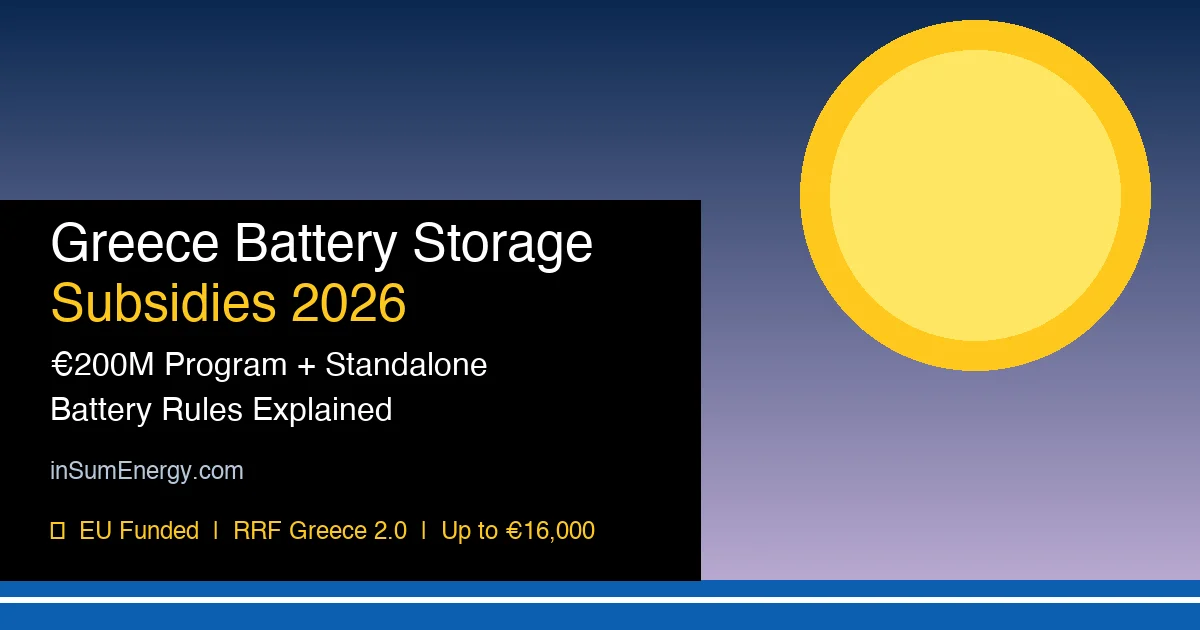
In September 2026, Greece made its most significant move yet in the energy storage market: the Ministry of Environment and Energy unlocked standalone battery storage for households and businesses — without requiring a solar installation. Combined with the ongoing “Photovoltaics on Rooftops” program (part of the €30+ billion Greece 2.0 National Recovery and Resilience Plan) and a newly announced €200 million battery subsidy tranche for 2027–2028, the country is rapidly becoming one of the most attractive markets in the EU for residential and commercial energy storage.
This guide covers every active and upcoming subsidy program, the new standalone battery framework, dynamic electricity tariff strategies that pair with battery storage, and what Greek homeowners and installers need to do before the December 31, 2026 deadline for the rooftop PV+battery program.
Why Greece Is a Hot Market for Battery Storage in 2026
Greece’s electricity market presents a uniquely compelling case for battery storage. The country has among the highest solar irradiation levels in Europe — averaging 4.6–5.5 peak sun hours daily — while simultaneously experiencing some of the continent’s sharpest price volatility. Wholesale day-ahead prices on the Hellenic Energy Exchange ranged from €0.03/kWh to €0.52/kWh within the same month in 2026, creating massive arbitrage potential for battery owners.
Key 2026 market data for Greek households:
- Average retail electricity price: €0.236/kWh (including taxes, Feb 2026) — below the EU average of €0.261/kWh but rising
- Variable “yellow” tariff: avg €49.99/month for 300 kWh/month households (Jan–Jul 2026)
- Fixed “blue” tariff: avg €55.86/month for 300 kWh/month households (Jan–Jul 2026)
- Wholesale market average (2026 YTD): €0.103/kWh — with hours below €0.03/kWh during peak solar and spikes above €0.40/kWh in late afternoon
Meanwhile, Greece’s installed solar capacity has already surpassed its 2030 target — reaching 13.8 GW in July 2026, ahead of the revised National Energy and Climate Plan (NECP) forecast of 13.5 GW. But battery storage lags far behind, with only ~700 MW installed against a target of 3–4 GW by end-2028 (revised upward from the original 4.325 GW NECP goal). This gap represents a massive opportunity for early adopters.
Active Greece Battery Storage Subsidies in 2026
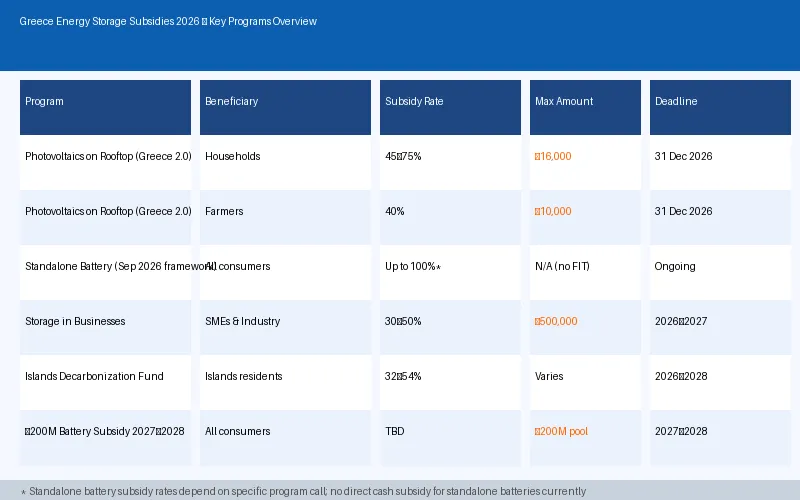
1. “Photovoltaics on Rooftops” — Greece 2.0 (RRF) Programme
Launched under Joint Ministerial Decision No. 47129/720 (May 2, 2023) and updated by No. 114572/877 (November 8, 2023), this flagship program is funded by the EU Recovery and Resilience Facility (RRF) and NextGenerationEU. Applications are submitted through the dedicated portal at pvstegi.gov.gr.
For the PV+battery combination, subsidies scale by beneficiary category:
| Beneficiary | PV Subsidy | Battery Subsidy | Maximum Total | Application Deadline |
|---|---|---|---|---|
| Household (standard) | 20–40% | 60–75% | €16,000 | Until funds exhausted Best apply before Q4 2026 |
| Household (vulnerable) | 50–65% | 90–100% | €16,000 | |
| Farmers | 40% | 40% | €10,000 | |
| Persons with disabilities | +10% bonus on any subsidy | Varies | ||
Key requirements: Applicants must hold a valid Connection Agreement with DEDDIE (Hellenic Electricity Distribution Network Operator) for both the PV station and the battery storage system. Photovoltaic stations must be activated by June 30, 2025 for applications submitted under the original deadline — though remaining funds continue for new applicants through December 31, 2026.
Eligible expenses include PV panels, inverters, mounting systems, PV meters, storage systems (LiFePO4 strongly recommended), and professional installation fees. To understand how battery sizing affects subsidy ROI, see our home battery storage guide covering key sizing factors.
2. “Storage in Businesses” Programme
A dedicated SME and industrial storage scheme, providing 30–50% subsidies for behind-the-meter battery installations. The beneficiary list was expected within days as of September 2026. Installations must be connected to the grid under a self-consumption agreement. Maximum project size: typically up to €500,000 per beneficiary, with a total program budget in the hundreds of millions of euros from RRF funding.
3. Islands Decarbonization Fund — €970 Million
Approved by the European Commission in 2026, this landmark fund allocates €970 million specifically for Greek non-interconnected islands. Of this, €476 million targets 316 MW of photovoltaic capacity combined with 295 MW of battery storage. Beneficiaries include households, businesses, public buildings, water utilities, farmers, and airports on islands. Support rates range from approximately 32% to 54% depending on beneficiary category.
4. New €200 Million Battery Subsidy Programme (2027–2028)
Announced by the Ministry of Development in September 2026, this new tranche will provide direct battery subsidies funded through national resources. The program is designed to accelerate Greece’s battery storage deployment toward the revised targets of 3–4 GW by end-2028 and 5–7 GW by 2030. Detailed eligibility criteria and application procedures are expected before end-2026.
Standalone Battery Storage: Greece’s Game-Changing New Rules
Effective September 14, 2026, Greece’s Ministry of Environment and Energy — under the Agreement for Progress and Prosperity presented at the 90th Thessaloniki International Fair — introduced a revolutionary framework allowing standalone battery installations without solar panels, solely for self-consumption.
Key provisions of the new standalone battery framework:
- No solar required: Households, businesses, and industries can install batteries using only grid power — charging during cheap hours, discharging during expensive hours
- Inverter capacity limit: Battery inverter can be sized up to 100% of contracted power (unlike solar+battery where inverter is typically oversize-limited)
- Anti-backfeed requirement: A dedicated sensor and remote metering system ensures no electricity is fed back to the grid
- Bank guarantee exemption: Consumers connected to low-voltage grid are exempt from the bank guarantee requirement (a major barrier eliminated)
- Grid operator response time cut: Connection agreement response time reduced from 15 days to 5 days
- Balcony solar simplification: Small plug-in PV systems (up to 800W, expandable to 1,000W with storage) now require only a digital notification — no connection agreement, permit, or connection fee needed
The framework is specifically designed for consumers on dynamic (“yellow”) electricity tariffs, who can now exploit intraday price spreads directly. Greece’s wholesale market regularly shows spreads of €0.10–0.30/kWh between off-peak (midday solar hours) and peak (late afternoon) prices — a perfect use case for LiFePO4 battery arbitrage.
For households considering this route, combining a standalone battery with Greece’s new balcony solar rules creates a highly cost-effective entry point. Our EU balcony solar and battery guide covers the simplified installation procedures across member states including Greece.
Dynamic Tariffs: How Greek Households Maximize Battery ROI
Since April 2026, Greece’s state utility PPC (Public Power Corporation) offers DEI myHome Dynamic — a fully hourly dynamic tariff for households with smart meters. This creates the ideal pairing with a LiFePO4 battery. Real 2026 data from the Hellenic Energy Exchange shows:
| Time of Day | Typical Market Price (2026) | Best Strategy for Battery Owners |
|---|---|---|
| 10:00–14:00 | €0.03–0.08/kWh | Charge battery from grid or PV |
| 17:00–21:00 | €0.25–0.45/kWh | Discharge battery to cover peak demand |
| 22:00–07:00 | €0.08–0.15/kWh | Opportunity charge if battery not full |
With a typical 10 kWh LiFePO4 battery, a Greek household can avoid 15–25 kWh of peak-priced electricity daily, saving approximately €3–8/day or €1,100–2,900/year depending on usage patterns. Our article on EU dynamic electricity tariff strategies for LiFePO4 batteries provides detailed optimization algorithms for European prosumers.
Net Billing vs. Net Metering: What Changed in 2024
Since November 2024, Greece transitioned from net metering to net billing under Law 5106/2024. Under net metering, excess solar generation was credited one-for-one against consumed electricity. Under net billing, surplus solar is sold to the grid at market-based compensation rates — typically much lower than retail prices.
This shift makes battery storage critically important for Greek solar owners: instead of exporting excess solar at low feed-in rates (~€0.07/kWh), a battery stores it for self-consumption, effectively worth €0.14–0.25/kWh in avoided retail purchases. This is a decisive argument for combining PV with LiFePO4 storage in all new Greek installations.
Real ROI: Solar + Battery in Greece 2026
A typical Greek household consuming 400 kWh/month currently pays approximately €1,048/year in electricity at the average retail price of €0.236/kWh. Adding a 5 kW rooftop PV system with a 10 kWh LiFePO4 battery changes the math dramatically:
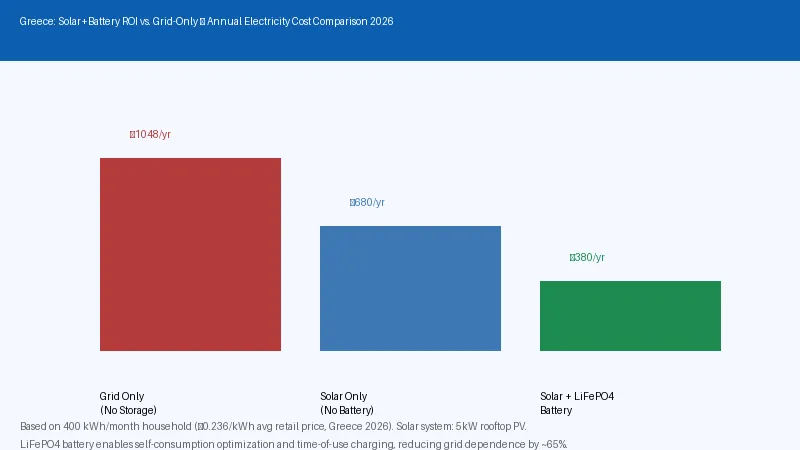
- Annual electricity cost without storage: ~€1,048/year
- Annual electricity cost with solar only: ~€680/year (still buying peak power)
- Annual electricity cost with solar + LiFePO4 battery: ~€380/year (65% reduction)
- Investment with subsidy (45% PV+battery): ~€6,500–8,000
- Payback period with 45% subsidy: 4–6 years
- Payback period without subsidy: 7–9 years
Compare this to other EU markets: Germany offers KfW subsidies up to €21,600 but has higher electricity prices (~€0.295/kWh); the Netherlands provides Salderingsregeling (net metering) benefits but is phasing out by 2027. For a detailed country-by-country comparison, see our solar + battery ROI across 4 EU countries.
What Installers and Distributors Need to Know
For EU installers targeting the Greek market, several technical and regulatory requirements apply:
- Grid connection: All battery installations require a connection agreement with DEDDIE; low-voltage connections (typical residential) are exempt from the bank guarantee requirement under the September 2026 framework
- Smart meter mandate: Standalone battery installations require remote metering infrastructure; DEDDIE will roll out the digital portal for balcony solar + storage notifications by end-2026
- Battery chemistry: LiFePO4 (LFP) is the dominant chemistry for new installations in Greece due to its safety profile, cycle life (4,000–6,000 cycles), and compliance with EU Battery Regulation (EU) 2023/1542
- EU Battery Passport: Under EU Regulation 2023/1542, all battery storage systems sold in the EU must include a digital battery passport with carbon footprint declaration from 2027 — installers should source from compliant manufacturers now
- Installer declaration: Balcony solar and storage installations require a signed declaration from a certified installer confirming compliance with Hellenic Organization for Standardization (ELOT) safety specifications
Looking at subsidy programs across the EU for context, different markets offer varied incentive structures: Germany through KfW 270/270, France via MaPrimeRénov’2026, Italy with Conto Termico 2.0, the Netherlands through Ode/Salderingsregeling, Poland with Mój Prąd 2026, and Romania via Casa Verde 2026. For a comprehensive overview, see our France and Italy home battery subsidy guide.
Key Takeaways for Greek Homeowners
- Act before December 31, 2026 for the highest subsidy rates under the Greece 2.0 RRF program (45–75% for households, up to 100% for vulnerable consumers)
- Standalone batteries are now legal without solar panels — no more mandatory PV installation to qualify for storage
- Dynamic tariff + battery = maximum savings: Exploit Greece’s extreme intraday price spreads with a 10–15 kWh LiFePO4 system
- Islands get extra support: €970 million from the Islands Decarbonization Fund covers 316 MW PV + 295 MW storage with 32–54% subsidies
- 2027–2028 brings more: The €200 million subsidy tranche will expand access further — but early movers lock in lower system costs now
Greece’s energy storage market is at an inflection point. With record solar penetration, severe price volatility, and unprecedented government support, the window for homeowners and businesses to install battery storage at maximum subsidy is open and narrowing.
Ready to Install Battery Storage in Greece?
Whether you are a homeowner in Athens, a farmer in Thessaloniki, or a business on Crete, Insum Energy supplies EU-certified LiFePO4 battery systems suitable for all Greek subsidy programs. Our team can help you:
- Select the right battery capacity for your consumption profile
- Design a solar + storage system that maximizes your subsidy claim
- Ensure compliance with DEDDIE grid connection requirements
- Source CE and EU Battery Regulation-compliant products with full documentation