Alibaba LiFePO4 Battery Guide: How to Avoid Scams in 2026
Alibaba is one of the world’s largest B2B marketplaces, connecting buyers with battery manufacturers and trading companies across China. For European installers, distributors, and large-scale project developers, Alibaba can offer aggressive pricing on LiFePO4 batteries that is difficult to match through local channels.
But the platform also attracts bad actors — and the LiFePO4 battery market has become a prime target. From mislabeled cells to fabricated specifications to outright disappearance after payment, scams are rampant. According to industry estimates, between 15% and 25% of first-time Alibaba battery buyers encounter significant issues ranging from quality problems to outright fraud.
This guide gives you everything you need to source LiFePO4 batteries safely on Alibaba in 2026 — from identifying scam patterns to verifying genuine suppliers.
Why Alibaba Has Become a LiFePO4 Battleground
The global LiFePO4 market has experienced explosive growth, driven by demand for home energy storage systems, commercial installations, and off-grid applications. China’s cell manufacturers — EVE Energy, CATL, REPT, Hithium, and others — supply cells that feed into products sold globally.
Alibaba sits at the intersection of these manufacturers and international buyers. The problem: the platform’s low barrier to entry means that trading companies (which act as intermediaries, not manufacturers) can pose as factories. They can list products using stolen images, inflated specs, and fake certifications.
Meanwhile, genuine manufacturers often sell through established distribution channels and have limited presence on Alibaba’s retail-facing storefronts. This creates a perverse incentive structure where the least trustworthy sellers can appear most competitive.
The Most Common Alibaba LiFePO4 Scams in 2026
Understanding the scam landscape is the first line of defense. Here are the patterns that appear most frequently in the LiFePO4 category:
1. Grade B or Rejected Cells Sold as Grade A
LiFePO4 cells are graded at the factory level. Grade A cells meet full specification; Grade B cells have minor capacity deviations; Grade C or rejected cells are typically sold for recycling. On Alibaba, it’s common to find suppliers advertising brand-name cells (CATL, EVE, REPT) at prices far below market — only to discover the cells are Grade B or even repurposed from EV packs that have reached end-of-life.
The difference in capacity can be 10–20% below rated specs, which materially affects the performance of a battery system over its lifetime.
2. Fabricated BMS Specifications
Battery Management Systems (BMS) are the intelligence of a LiFePO4 battery. Some Alibaba suppliers advertise Bluetooth monitoring, CAN bus communication, or advanced active balancing — then ship units with far simpler BMS hardware that doesn’t support those features.
If you need specific BMS functionality, always request technical documentation and verify it matches what is advertised. For a deeper technical comparison of BMS types, see our guide to JK BMS vs Daly BMS vs JBD BMS.
3. Counterfeit Brand Labels
Suppliers sometimes relabel cells from lesser-known manufacturers with the branding of premium brands like CATL or EVE. This is particularly common with cylindrical cells, where physical appearance is harder to distinguish without specialized equipment.
4. Price Bait and Switch
A supplier quotes $0.08/Wh for a 100kWh system — significantly below market rate. After you place the order, the supplier claims the quoted price was a “promotional error” and demands 30–50% more. Alternatively, they ship fewer units than ordered and keep the balance.
5. Falsified Certifications
CE, UL, and UN38.3 certifications are mandatory for importing LiFePO4 batteries into most markets. Alibaba suppliers frequently display borrowed or Photoshopped certificates that do not correspond to actual tested products. Always verify certifications independently through the issuing body.
For a detailed explanation of what CE and UL markings actually mean for your battery, read our guide: CE & UL Certification Explained: What It Means for Your LiFePO4 Battery Safety.
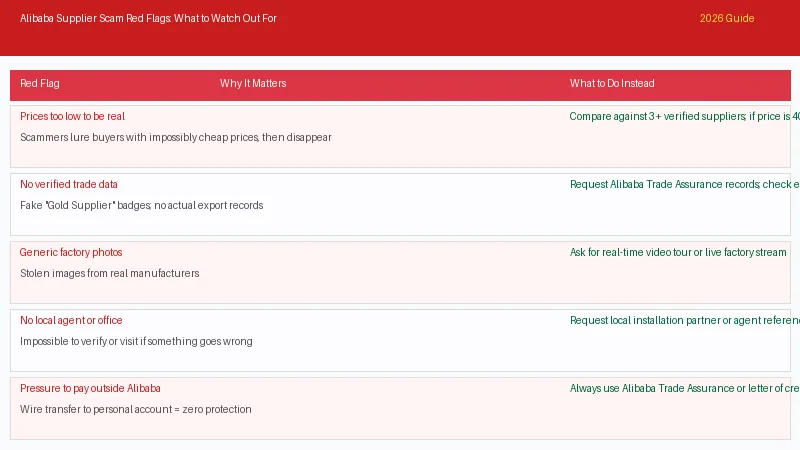
Red Flags Checklist: 8 Signs of a Scam Supplier
Use this checklist when evaluating any Alibaba LiFePO4 supplier. If you check two or more of these boxes, walk away:
- Prices 40%+ below market average — If it sounds too good to be true, it is.
- No verified Trade Assurance transactions — Alibaba Trade Assurance is the platform’s primary buyer protection mechanism. Suppliers without it offer no recourse.
- Factory photos that look like stock images — Use Google Images reverse search to check if photos are stolen from other suppliers or manufacturers.
- Reluctance to provide samples — Legitimate manufacturers always offer sample orders. Refusal to ship samples is a major red flag.
- Requests to pay via Western Union, bank wire to personal accounts, or outside Alibaba — This eliminates all buyer protection.
- No export license or no demonstrated history of international shipments — LiFePO4 batteries are classified as dangerous goods and require proper export documentation.
- Vague or no response to technical questions — A real manufacturer has engineers who can answer detailed questions about cell chemistry, BMS protocols, and testing procedures.
- No physical address or verifiable business registration — Ask for the Chinese business registration number (统一社会信用代码) and verify it through China’s SAMR database.
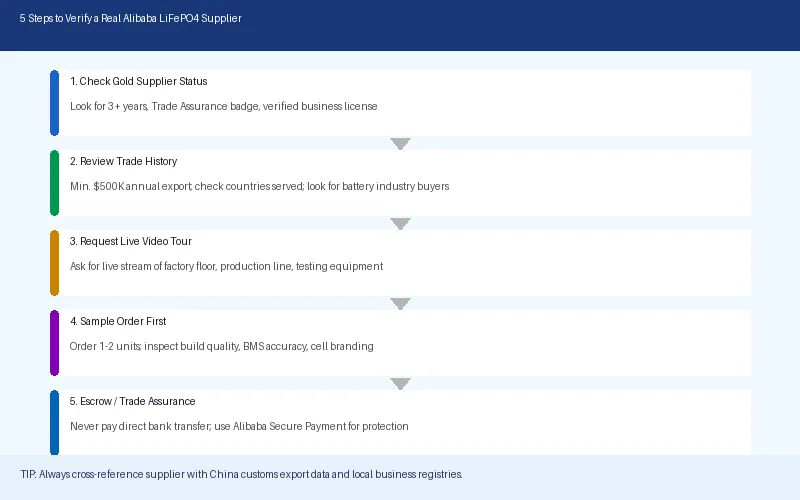
The 5-Step Alibaba Supplier Verification Process
Follow these steps systematically before committing to any order:
Step 1: Verify Gold Supplier Status and Trade History
Look for suppliers with 3+ years of Gold Supplier status and active Trade Assurance transactions. On the product page, click “Contact Supplier” and review their response time and professionalism. A genuine supplier will respond within 24 hours with technically accurate information.
Step 2: Cross-Reference Export Data
Use China customs data platforms (such as ImportYeti or ZoomChina) to verify that the supplier has a documented history of exporting batteries. Look for shipments to your target market and confirm the volume aligns with their claimed production capacity.
Step 3: Request a Live Video Factory Tour
Ask the supplier for a live video walkthrough of their production facility. This single step eliminates most scammers, who cannot provide footage of a facility they don’t actually operate. Request to see: the cell assembly line, welding stations, BMS programming stations, and the testing area where each battery undergoes charge/discharge cycling.
Step 4: Place a Sample Order
Never place a full container order without testing samples first. Order 1–2 units of the battery model you’re considering. Check: actual vs. advertised capacity, BMS accuracy (does it report correct SoC?), build quality, and cell branding. If a supplier refuses samples, do not proceed.
For guidance on what to look for in a battery sample, see our Grade A vs. Grade B LiFePO4 Cells guide.
Step 5: Use Alibaba Trade Assurance
Always pay through Alibaba Trade Assurance. This holds your payment in escrow until the goods are received and verified. If the supplier ships substandard goods or fails to ship, you can file a dispute and recover your payment. Never transfer funds directly to a supplier’s personal bank account.
What to Look For in Genuine LiFePO4 Products
Cell Traceability
Authentic LiFePO4 cells from major manufacturers carry laser-etched codes that can be verified against the manufacturer’s production database. EVE Energy, CATL, and REPT all maintain public or licensed verification systems. Request the cell lot number and verify it independently.
Certification Documentation
For European markets, you need CE marking and, for larger installations, UL certification. Request the original test reports (not just the certificate) and verify: the report number, the testing laboratory accreditation, and whether the report covers the specific product model you’re ordering.
BMS Documentation
A reputable supplier will provide: BMS hardware specifications, firmware version, communication protocol documentation (RS485, CAN, Bluetooth), and a test report showing protection thresholds. If the supplier only provides a product datasheet with no BMS detail, be skeptical.
Building a Long-Term Alibaba Sourcing Strategy
If you’re sourcing LiFePO4 batteries from Alibaba regularly, consider these additional strategies:
- Visit the factory in person — A 2-day trip to Shenzhen or Dongguan to visit a shortlisted manufacturer costs $2,000–$3,000 but eliminates years of potential fraud losses. Most genuine factories welcome international visitors.
- Use a China-based sourcing agent — A reputable sourcing company can perform factory audits, verify certifications, and supervise production on your behalf for a 3–5% commission.
- Establish payment terms — Negotiate 30% deposit, 70% on shipment, or use a letter of credit through your bank for larger orders.
- Contract for third-party inspection — Hire an inspection company (like QIMA, Bureau Veritas, or SGS) to inspect batteries before they leave the factory.
Conclusion: Protect Your Investment, Source with Confidence
Alibaba remains one of the most cost-effective channels for sourcing LiFePO4 batteries in 2026 — but only if you approach it with the right due diligence. The scams are real, the stakes are high, and the difference between a successful project and a costly failure often comes down to the verification steps you take before placing an order.
By following the process outlined in this guide — from checking trade history to verifying certifications to placing sample orders first — you can significantly reduce your risk and access genuine, high-quality LiFePO4 batteries at competitive prices.
Ready to source reliable LiFePO4 batteries from a verified supplier? Insum Energy specializes in high-quality LiFePO4 battery products for residential, commercial, and industrial applications. Contact us today for a custom quotation tailored to your project requirements — no factory tours required.