EU F-Gas Regulation 2026: How Heat Pump Phase-Down Drives Battery Storage Demand
Europe is in the middle of a heating revolution. By 2029, the EU’s F-Gas Regulation (EU) 2024/573 will effectively ban the most common hydrofluorocarbon (HFC) refrigerants used in conventional gas boilers and air conditioners. Heat pumps—far more energy-efficient and climate-friendly—are flooding into homes across Germany, France, Italy, and beyond. But this energy transition creates a new problem: a grid under enormous pressure, and homeowners stuck paying peak-rate electricity bills to run their new heat pumps. The solution is becoming clearer by the month—LiFePO4 home battery storage.
In this article, we break down exactly what the F-Gas phase-down means for EU households, why heat pumps are straining the grid, and how combining a heat pump with a LiFePO4 battery storage system transforms a regulatory burden into a genuine financial opportunity.
What Is the EU F-Gas Regulation?
The F-Gas Regulation (EU) 2024/573 is the EU’s primary tool for cutting greenhouse-gas emissions from fluorinated gases—gases with a global-warming potential (GWP) up to 14,800 times higher than CO₂. It covers HFCs used as refrigerants in air conditioners, heat pumps, and refrigeration units, as well as insulating foams and aerosols.
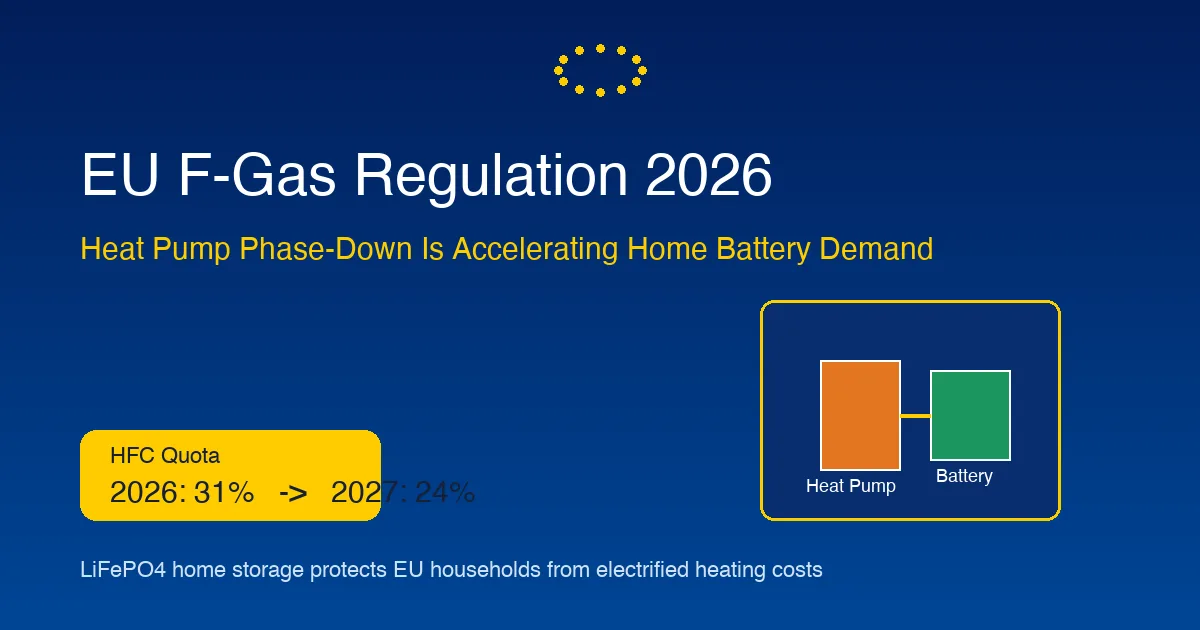
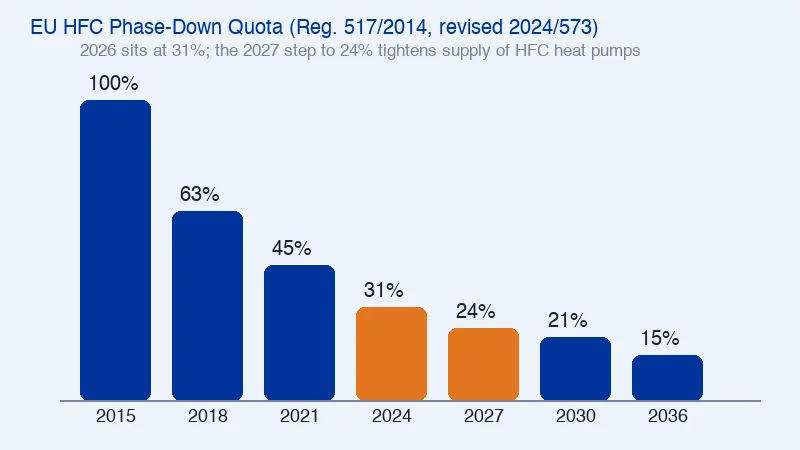
The regulation sets legally binding phase-down schedules for HFC production and import into the EU market, measured in CO₂-equivalent tonnes. The targets grow progressively stricter each year:
| Year | EU HFC Cap (% of 2015 baseline) | Expected Impact |
|---|---|---|
| 2024 | 31% | R-410A shortages begin; installers actively transition to lower-GWP refrigerants |
| 2026 | 24% | R-454B (GWP 466) and R-32 (GWP 675) become the default heat-pump refrigerants |
| 2029 | 13% | Pre-charged residential split systems with HFCs >150 GWP effectively banned |
| 2032 | 5% | Only very low-GWP refrigerants viable for mainstream residential use |
For households, the practical consequence is straightforward: new gas boiler installations are being phased out, and heat pumps are now the default recommendation from [EU Directive 2023/1791 on Energy Efficiency](https://eur-lex.europa.eu/legal-content/EN/TXT/?uri=CELEX:32023L1791). The EU aims for at least 60% of heating in buildings to come from renewable sources by 2030.
Why Heat Pumps Create a Grid Problem
A modern air-source heat pump for a typical European single-family home consumes 3,000–6,000 kWh of electricity per year, depending on climate zone, building insulation, and heating demand. This is a significant additional load on top of a household’s existing electricity consumption (lighting, appliances, EV charging).
Under static electricity tariffs, this additional load simply adds to the household electricity bill. But across the EU, static tariffs are disappearing. As of 2026, dynamic electricity pricing—where the per-kWh price changes every hour or even every 15 minutes—is now available to over 200 million EU households under [EU Directive (EU) 2024/1711](https://eur-lex.europa.eu/legal-content/EN/TXT/?uri=CELEX:32024L1711), which mandates access to dynamic tariff contracts for all EU consumers.
The result: a heat pump running at the wrong time can cost the homeowner €0.35–€0.55/kWh on the German EPEX Spot market during peak demand periods, while the same pump running during sunny midday hours can cost as little as €0.04–€0.08/kWh. Without a battery to shift that demand, homeowners are at the mercy of the spot market.
How LiFePO4 Battery Storage Solves the Heat-Pump Challenge
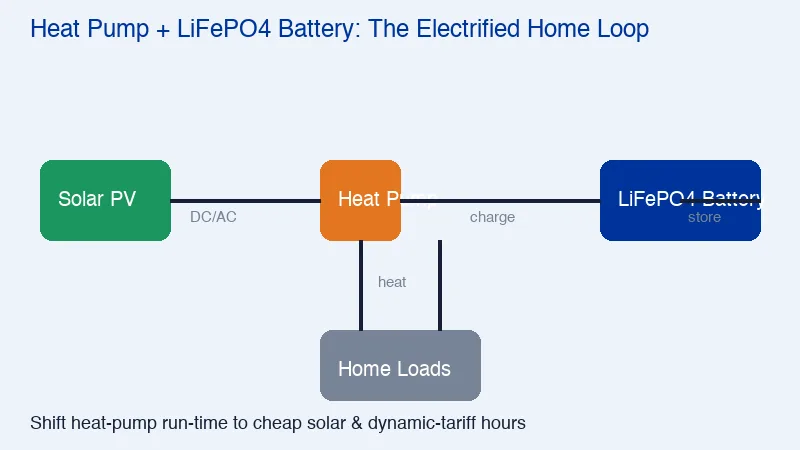
Pairing a LiFePO4 battery storage system with a heat pump turns a grid liability into a financial asset. Here is how it works in practice:
- Solar self-consumption maximisation: During sunny hours, rooftop solar PV produces cheap electricity. A LiFePO4 battery stores this excess rather than exporting it at low feed-in tariffs (now at €0.07–€0.10/kWh in Germany under the reduced KfW-friendly net-metering scheme). The heat pump then draws from the battery instead of the grid during expensive evening peak hours.
- Heat-pump load shifting: The battery can pre-heat the home’s hot-water tank during off-peak hours when electricity prices drop below €0.10/kWh. Modern heat pumps with smart controllers can respond to time-of-use signals automatically, but the battery acts as the critical buffer that makes load shifting possible without comfort loss.
- Emergency resilience: A heat pump without battery backup will fail in a grid outage—leaving a household without heating. A LiFePO4 system with an emergency backup function keeps the heat pump running through power cuts, which are increasingly frequent as grid infrastructure struggles with renewable integration.
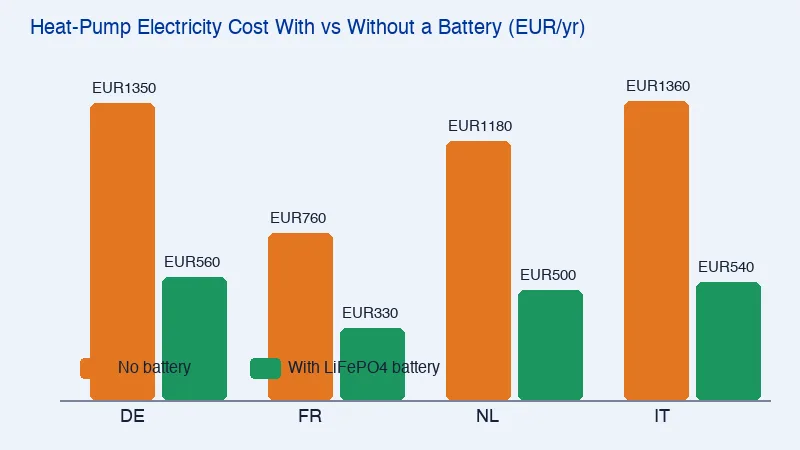
- Arbitrage on dynamic tariffs: On markets like Spain’s PVPC, the Netherlands’ S++ dynamic tariff, or France’s Tempo tariff, the daily price spread between the cheapest and most expensive hours can reach €0.40–€0.60/kWh. A 10 kWh LiFePO4 battery cycling once per day can generate annual savings of €400–€800 on electricity bills, completely offsetting the heat pump’s additional consumption.
Country-by-Country: F-Gas Phase-Down and Battery Storage Incentives
The F-Gas regulation creates a pan-European trend, but national subsidy schemes determine whether heat-pump + battery combos are affordable. Here is the key landscape for 2026:
| Country | Heat Pump Subsidy | Battery Storage Subsidy | Combined Incentive |
|---|---|---|---|
| Germany | KfW 458: up to 70% of HP cost | KfW 458: up to €15,000 for battery | Maximum €25,000 combined per household |
| France | MaPrimeRénov’2026: up to €11,000 | CEE coupons: €2,000–€4,000 | Combined HP + battery up to €15,000 |
| Italy | Conto Termico 2.0: up to 65% of HP cost | Bonus Barriere Architettoniche (partial) | HP incentive covers majority of system cost |
| Netherlands | ISDE: €500–€1,200 per HP | No dedicated battery grant; salderingsregeling still active until 2027 | Saldering makes battery storage financially attractive |
| Spain | Next Generation Funds: up to €8,000 | Plan PREE 2026: up to €5,000 | Combined HP + battery up to €13,000 |
| Poland | Mój Prąd 2026: up to €5,500 for HP | Mój Prąd 2026 battery: up to €2,200 | Combined system up to €7,700 |
These combined incentive packages mean that in Germany and France, a typical 10 kWh LiFePO4 system paired with a heat pump can achieve a payback period of 4–6 years, compared to 8–12 years for a heat pump alone.
Dynamic Tariffs: The Hidden Battery Storage Opportunity
Under [EU Regulation (EU) 2024/1711](https://eur-lex.europa.eu/legal-content/EN/TXT/?uri=CELEX:32024R1711), all EU household electricity suppliers must offer at least one dynamic electricity tariff contract by January 2025. This regulation—part of the EU Electricity Market Reform package—is creating a massive arbitrage opportunity for heat-pump owners with LiFePO4 batteries.
On Germany’s EPEX Spot market, the spread between the cheapest and most expensive trading hours in winter 2025–2026 regularly exceeded €0.45/kWh. On Spain’s PVPC with hourly pricing, the spread in January 2026 hit €0.60/kWh. For a household running a 4 kW (thermal) heat pump for 8 hours per day in winter, a 10 kWh LiFePO4 battery acting as a thermal pre-conditioner can save €500–€900 per heating season.
Smart charging strategies—where the battery charges during the 4 AM–6 AM trough when solar overproduction or wind power floods the grid—are now the professional standard for heat-pump + battery system design. You can learn more about dynamic tariff optimisation strategies in our dedicated guide.
What Size LiFePO4 Battery for a Heat Pump?
Sizing a LiFePO4 battery for a heat-pump household requires a different calculation than sizing for a standard solar-plus-storage system. The key variables are:
- Heat pump daily electricity demand: Typically 8–25 kWh/day in central/northern European climates
- Target self-sufficiency rate: 60–80% for most households; 90%+ for off-grid-capable systems
- Night tariff window: Hours during which you want to pre-charge the battery at low rates (typically 8–10 hours)
- Solar PV overproduction: Excess solar used to charge the battery rather than export
For a typical European single-family home (3–4 occupants, 8–12 kW heat pump), we recommend:
| System Profile | Recommended Battery | Rationale |
|---|---|---|
| Mild climate (Spain, Italy south) | 5–7 kWh | Heat pump demand is lower; 1-night buffer is sufficient |
| Central Europe (Germany, Austria, Belgium) | 10–14 kWh | Higher heating demand; 1–2 night buffer needed |
| Cold climate (Scandinavia, alpine) | 15–20 kWh | Heat pump runs near-continuously in winter; large buffer essential |
For a full sizing guide including EU-specific load profiles and solar-production data, see our article on LiFePO4 battery sizing for different climates.
Regulatory Tailwinds: Why the Timing Is Now
Several EU regulatory developments are converging to make the heat-pump + LiFePO4 battery combination uniquely attractive in 2026:
- EU Renovation Wave 3.0: The revised Energy Performance of Buildings Directive (EPBD) requires all new buildings to be zero-emission from 2028, driving heat-pump installations in new builds—nearly all of which will require battery storage to manage peak electrical demand.
- Carbon Border Adjustment Mechanism (CBAM): While primarily targeting industry, CBAM signals the EU’s long-term commitment to decarbonisation—and indirectly raises the cost of gas, making heat-pump electricity bills a more pressing concern for households.
- EU Smart Meter rollout: Over 70% of EU households now have smart electricity meters (as mandated by [EU Directive 2019/944](https://eur-lex.europa.eu/legal-content/EN/TXT/?uri=CELEX:32019L0944)), enabling the dynamic tariff access that makes battery storage economically viable.
- Grid-forming inverter requirement: Several EU grid operators (Germany, Austria, Netherlands) are beginning to require grid-forming capability for new battery installations—a feature available on modern LiFePO4 systems and discussed in detail in our grid-forming inverter guide.
Conclusion: Turn F-Gas Compliance into Energy Independence
The EU F-Gas Regulation is not just an environmental policy—it is a structural shift in how European households will heat their homes for the next 30 years. Heat pumps are coming, whether homeowners are ready or not. The question is whether they will run on expensive, volatile grid electricity—or on cheap, self-generated solar power buffered by a LiFePO4 battery.
With dynamic electricity tariffs, generous national subsidies, and falling LiFePO4 battery prices, 2026 is the ideal window for EU homeowners, installers, and distributors to adopt the heat-pump + battery combo. The financial case is strong: payback periods of 4–6 years, annual electricity savings of €500–€1,200, and energy independence from both fossil-fuel boilers and volatile grid prices.
At Insum Energy, we supply a full range of LiFePO4 battery storage systems optimised for heat-pump integration, with BMS communication protocols compatible with all major European heat-pump brands including Daikin, Vaillant, Viessmann, Nibe, and Samsung.
Ready to size your heat-pump + LiFePO4 battery system? Contact Insum Energy today for a professional consultation, EU-compliant installation guidance, and a competitive quotation tailored to your specific country, climate zone, and energy tariff.
You can also explore our About Us page to learn more about our European distribution network, or browse our homepage for the full product range.