Agrivoltaics + Battery Storage in the EU 2026: Full Guide
Europe is running out of empty land, but not out of farms. In 2026, agrivoltaics — solar arrays elevated above actively farmed land — has become the fastest politically accepted route to expand EU solar, with roughly 3.5 GW already operating and France, Germany and Italy leading deployment. Yet almost every serious agrivoltaic project now hits the same wall: the grid. Pairing the array with a LiFePO4 battery turns a constrained generator into a self-managed farm power plant that protects crops, cuts electricity bills in euros and stacks several subsidy programmes at once. This guide explains how agrivoltaics and battery storage work together in 2026, what EU markets pay, and how to size a farm system.
What agrivoltaics plus battery storage actually looks like
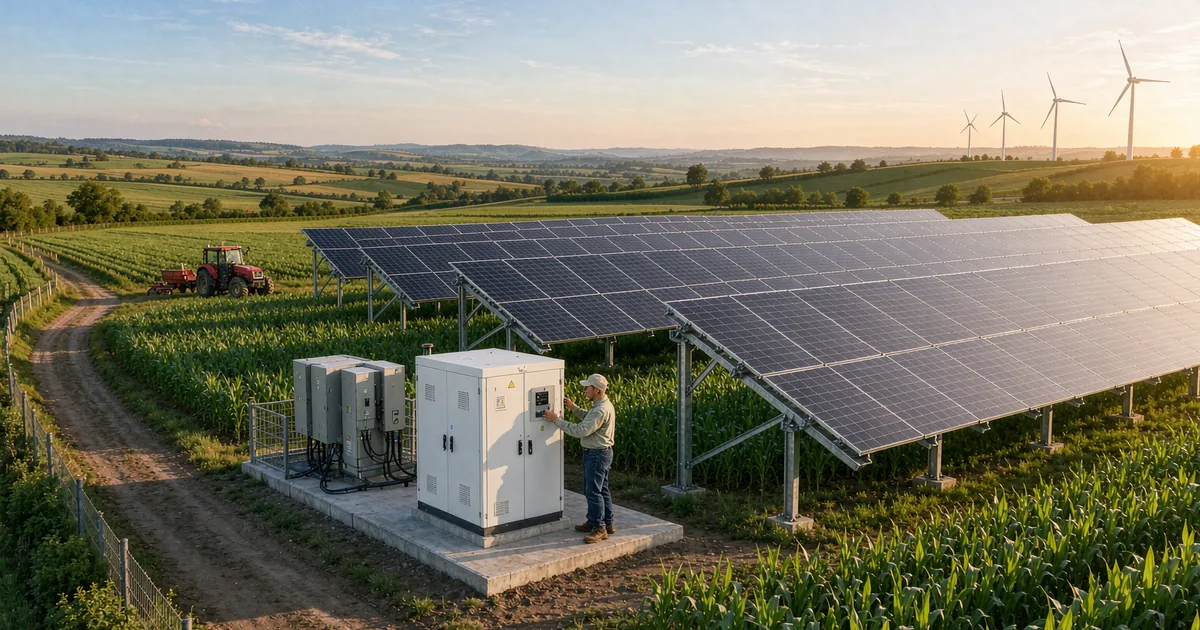
An agrivoltaic (agri-PV) system mounts solar modules at least 2.1 metres above the ground — high enough for tractors and harvesters — or integrates them on greenhouses and vineyard rows. Vertical bifacial “solar fences” let machinery pass between rows, while tracker-mounted elevated structures can deliberately shade crops during midday heat. The battery cabinet, typically a LiFePO4 unit of 30–250 kWh, sits on a concrete pad at the field edge and absorbs the midday surplus the farm cannot use or export.
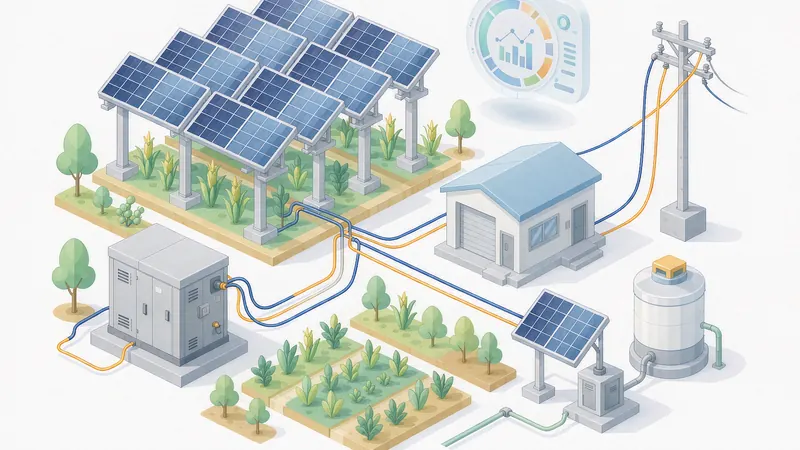
The economics differ fundamentally from a conventional ground-mount plant. Instead of one revenue stream, a dual-use farm stacks four: electricity bill savings, export or feed-in income, reduced irrigation water use (20–30% in shaded configurations) and — crucially — maintained crop income on land that a normal solar farm would have taken out of production entirely. That is why regulators across the EU now write agrivoltaics into law rather than treating it as ordinary ground-mount PV.
Why agri-PV needs a battery in 2026
Grid connection is the bottleneck
Annual solar additions in Europe are forecast to peak in 2026 and then plateau, largely because of connection delays and capacity limits on rural feeders. Distribution system operators increasingly cap injection from new agricultural sites or issue waiting lists measured in years — a problem we break down in our guide to grid connection capacity limits in Europe. A battery changes the negotiating position: the farm can accept a smaller connection, store its own midday surplus and export it in the evening when the feeder has headroom. The EU market reform package — Regulation (EU) 2024/1747 — reinforces this by obliging member states to assess flexibility needs and by encouraging flexible connection agreements that treat storage as a grid asset rather than a nuisance.
The farm load profile does not match the solar curve
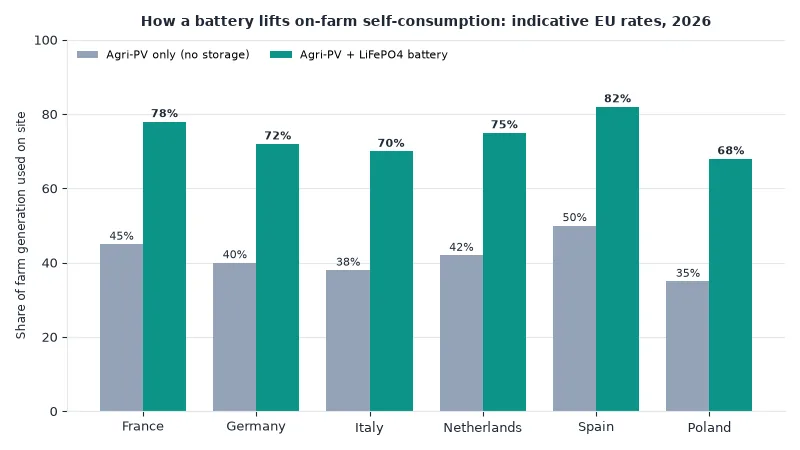
Irrigation peaks in the evening when panels stop producing, milking runs twice daily before dawn and after dusk, and cold stores and ventilation run around the clock. Without storage, a typical EU farm consumes only 35–50% of its on-site generation; with a correctly sized battery that rises to 68–82%, which is exactly the range that matters now that export tariffs and net metering are being cut back across the Union. Our country comparison of self-consumption rates for solar plus battery shows how much each national tariff regime rewards that shift.
The 2026 EU policy and subsidy stack
Only five member states — Croatia, the Czech Republic, France, Germany and Slovenia — currently have a statutory definition of agrivoltaics, but the funding is moving far faster than the legislation. On top of national schemes, the EU Common Agricultural Policy 2023–2027 eco-schemes can add a 5–15% premium on CAP payments for certified agri-PV land in several member states, provided agricultural activity remains genuine and measurable.
| Country | Agri-PV framework in 2026 | Battery / storage support in 2026 |
|---|---|---|
| Germany | Solarpaket I: privileged permitting under §35 BauGB (up to 2.5 ha); 1,200 MW dedicated auction volume; +0.5 ct/kWh bonus for elevated agri-PV (§38b EEG) | KfW 270 loan; 0% VAT on PV + storage; regional CAPEX grants (e.g. NRW 20–25%) |
| France | Loi APER decree: ≥90% of reference yield maintained, 40% ground-coverage cap above 10 MW, dedicated CRE auctions (≈€68–88/MWh) | MaPrimeRénov’ 2026 up to ≈€11,000 for renovation + storage packages; 5.5% VAT on PV ≤9 kWc |
| Italy | PNRR €1.7 bn agrivoltaics fund; first GSE tender awarded 1.5 GW; Law 4/2026 makes agri-PV a legal category with ≥70% of land kept in agriculture | 50% tax deduction on PV + storage over 10 years; Conto Termico 2.0 for thermal + storage combos |
| Netherlands | SDE++ supports agri-PV, including fruit growing under elevated arrays | ≈€1,800–€2,500 home-battery support; Salderingsregeling net metering ends 2027, raising battery value |
| Spain | October 2025 decree: farmland with panels can keep CAP subsidies while farming stays the principal use | Regional self-consumption grants; strong PVPC daytime-to-evening price spread for arbitrage |
| Greece | New 130 MW agri-PV programme from February 2026: €65/MWh tariff, 200 kW per project, 10 MW per region | Storage written into the rules: batteries must deliver ≥1 hour of storage and may only charge from the solar plant — see our Greek battery subsidy guide |
| PL / CZ / RO | Pilot pipelines growing; no agri-PV statute yet | Mój Prąd 2026 (≈€1,700–€3,500), NZÚ (≈€6,000), Casa Verde 2026 for PV + storage |
Sizing the battery to the farm
Farm storage sizing follows different rules from a household system:
- Start from the load, not the array. Evening irrigation and a 24/7 cold chain justify a larger battery; direct daytime pumping needs very little.
- Rule of thumb: 0.8–1.0 kWh of storage per kWp of agri-PV where injection is capped or net billing applies, and 0.4–0.6 kWh/kWp where export at a decent tariff remains possible.
- Check the C-rate. Irrigation pumps draw high inrush currents; size the inverter and battery for 1.5–2× the running load during start-up.
- Choose LiFePO4 for daily cycling. 6,000+ cycles at high depth of discharge and stable thermal behaviour in outdoor cabinets make it the default farm chemistry.
- Respect national control rules. Greece’s programme explicitly forbids charging the battery from the grid, so the energy-management logic must prioritise solar-only charging.
What it costs and how fast it pays back
Agrivoltaics carries a 40–50% structural premium over standard ground-mount solar — roughly €1,000–€1,400 per kWp installed — because of elevated steel, trackers and wider row spacing. The battery adds about €450–€600 per kWh installed. Against that, a well-designed project stacks bill savings, avoided curtailment, reduced water use and preserved crop revenue.
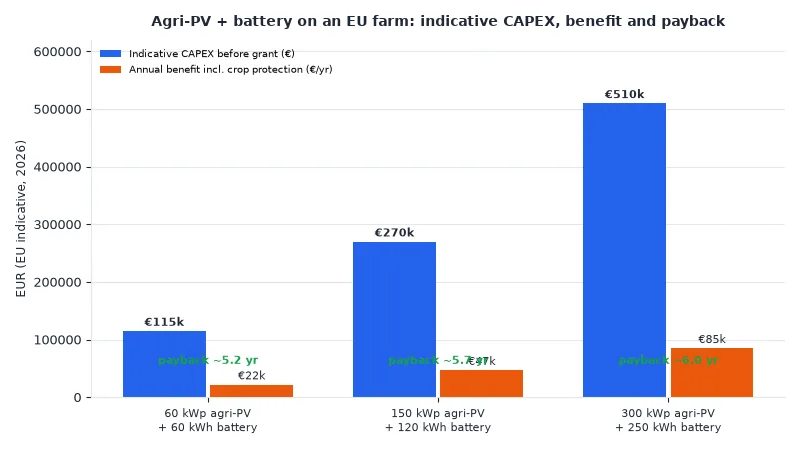
Real examples show the range. A Dutch strawberry grower with a 150 kW elevated agri-PV array spent €210,000, self-consumed 58% of generation and cut €18,000 per year from the electricity bill at €0.243/kWh, plus €4,000 in irrigation savings — an 8.6-year payback before counting preserved berry revenue. A Bavarian mixed farm combining rooftop PV, a LiFePO4 battery and load management cut its energy costs by about 70%, as documented in our Bavarian farm case study. For a 60 kWp array with a 60 kWh battery, indicative 2026 figures land near €115,000 CAPEX, €22,000 annual benefit and a 5.2-year payback before grants; KfW financing, the Italian deduction or CAP eco-scheme premiums typically pull that below 4.5 years. Where upfront capital is tight, third-party ownership is spreading — see our overview of battery storage financing and leasing in the EU.
Quick country notes for installers
- France: agrivoltaic status requires documented agricultural services; model yield maintenance before quoting, and expect CRE auction prices near €68–88/MWh for larger projects.
- Germany: the +0.5 ct/kWh elevated agri-PV bonus applies today while the larger Solarpaket I premium waits on EU state-aid approval; privileged permitting up to 2.5 ha shortens timelines dramatically.
- Italy: GSE tenders funded by the PNRR reward projects that keep ≥70% of land agricultural; pair the array with the 50% personal tax deduction on storage.
- Greece: the February 2026 window is chronological and capped at 10 MW per region — file early and specify the ≥1-hour battery from day one.
- Netherlands: with net metering ending in 2027, every agri-PV quote should assume storage; SDE++ support softens the CAPEX.
The dual-use logic also applies to paved surfaces: our guide to solar carports plus battery storage covers the same “energy above, activity below” model for farmyards and commercial parking.
Compliance checklist before you quote
- Confirm whether the member state has an agrivoltaic definition, and what agricultural-performance evidence the subsidy requires (France ≥90% of reference yield; Italy ≥80% of gross saleable production).
- Verify the DSO injection cap and whether a flexible connection agreement is available in exchange for storage.
- Specify battery capacity ≥1 hour of plant output where mandated (Greece) and configure solar-only charging where grid charging is banned.
- Ensure the battery meets Regulation (EU) 2023/1542 — carbon footprint declaration and, from 2027, the digital battery passport.
- Document crop, water and energy baselines now; post-commissioning audits in France and Italy compare against them.
Get a farm-ready storage quote from Insum Energy
Agrivoltaics rewards suppliers who understand both agriculture and storage: correct chemistry, high cycle life, outdoor-rated enclosures and control logic that respects national grid rules. Insum Energy supplies EU-market LiFePO4 battery systems from 5 kWh cabinets to 250 kWh farm-scale units, with documentation aligned to EU regulations and national subsidy files. Browse our battery storage product range, learn more about Insum Energy, or contact our team for a tailored farm quote — and explore more practical guides on insumenergy.com.