Solar Carport + Battery Storage in the EU 2026: A Guide
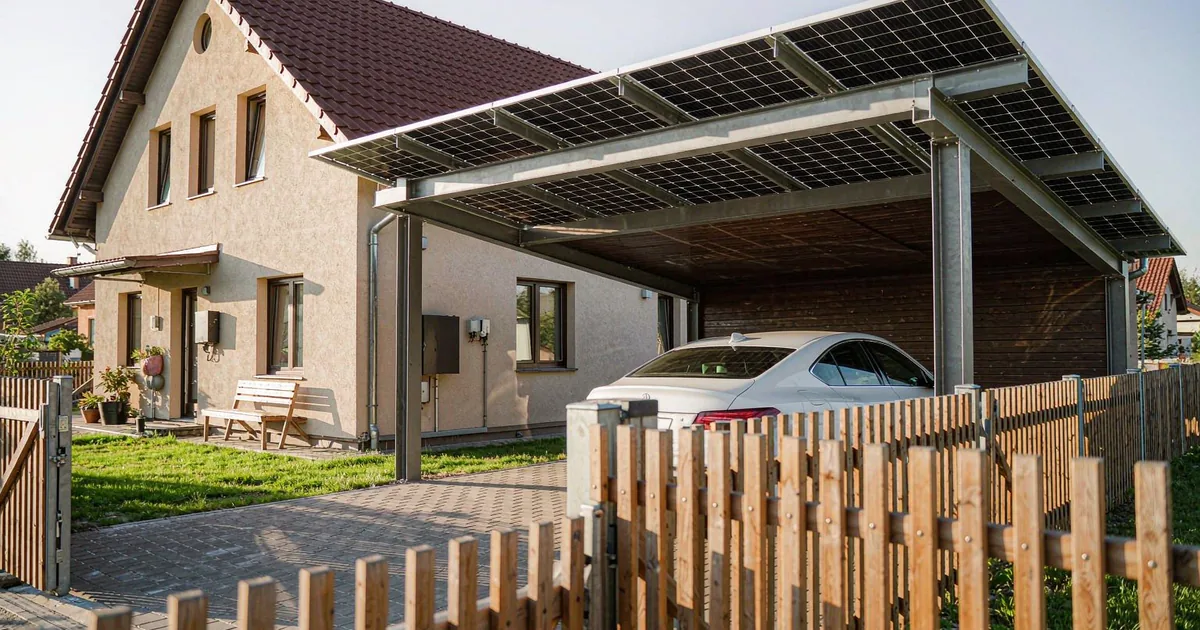
Across the EU, the humble parking space is becoming a power plant. New solar obligations, high electricity prices and maturing battery economics are turning carports into one of the fastest-growing segments of the European PV market — and pairing the canopy with a LiFePO4 battery is what converts a shading structure into a genuine energy asset. Here is the 2026 picture.
Why solar carports are taking off in the EU in 2026
Solar carports were long a niche add-on in Europe. Three forces have changed that:
- The EPBD solar mandate. The recast Energy Performance of Buildings Directive (EU) 2024/1275 requires new non-residential buildings — and their parking areas — to be made solar-ready, with phased application from 30 December 2026.
- France’s parking-lot law. The Loi APER (n° 2023-175) and decree n° 2024-1023 oblige outdoor car parks over 1,500 m² to install solar canopies — lots above 10,000 m² by 30 July 2026, the rest by 30 July 2028.
- German state rules. Baden-Württemberg requires PV on new non-residential car parks above roughly 35 spaces; North Rhine-Westphalia and Hesse have similar rules.
Meanwhile, net-metering is being phased out — most notably the Dutch salderingsregeling — and dynamic tariffs are spreading. A bare carport produces power at midday, when the car is away and nobody is home. The battery captures that solar and delivers it in the evening, at night-time EV charging, or during peak hours.
How a solar carport + battery system works
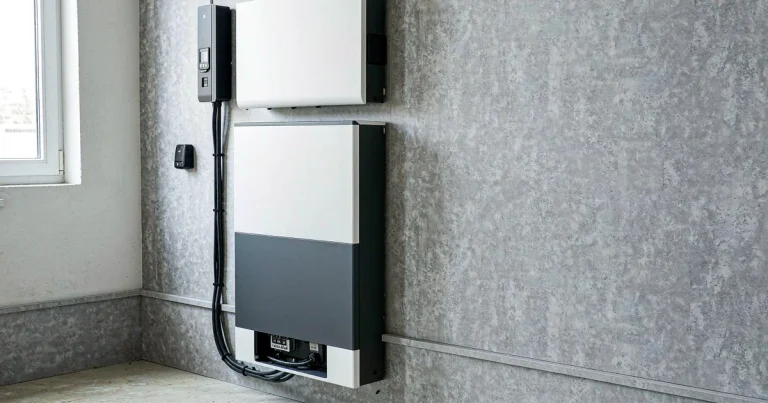
A complete installation combines the carport structure, PV modules, a hybrid inverter, a battery and — optionally — an EV charger. The battery determines most of the economics, which is why we recommend lithium iron phosphate (LiFePO4): the best mix of thermal stability and cycle life for daily cycling in an outdoor cabinet.
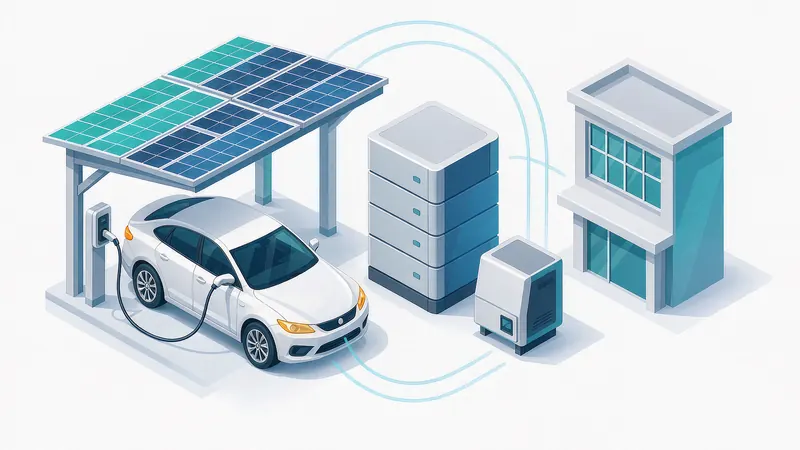
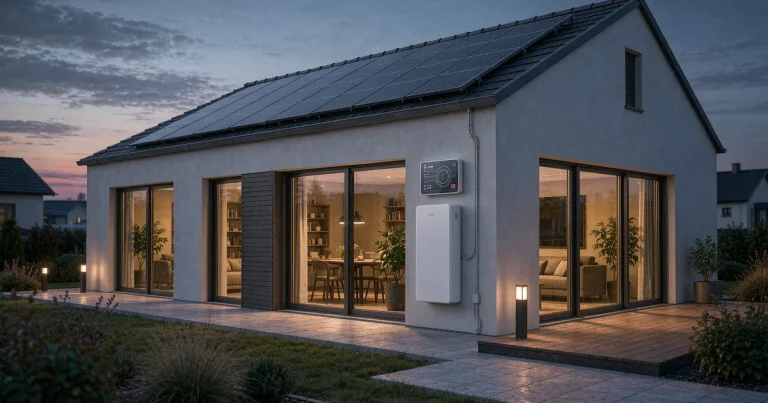
The system behaves like any hybrid PV-plus-storage setup: the array feeds the hybrid inverter, which prioritises household load and EV charging, stores the surplus in the battery, and only exports what is left. Because the carport doubles as weather protection, the land underneath stays usable — an advantage over ground-mounted arrays.
The five components to specify correctly
- Structure: steel or glulam timber, engineered for local wind and snow loads per the Eurocode EN 1991 series.
- PV modules: 400–450 Wp residential modules; one parking space typically fits 3–4 kWp.
- Hybrid inverter: three-phase for larger carports, with dynamic-tariff and smart-meter interfaces.
- Battery: LiFePO4, certified to EN IEC 62619 and IEC 63056 — the safety benchmarks EU insurers and grid operators increasingly ask for.
- EV charger (optional): a 7–22 kW AC wallbox turns the carport into a home charging hub.
Sizing a solar carport + battery in the EU
Sizing follows rooftop logic, with one twist: the carport area is fixed by how many vehicles must be shaded.
- Single parking space: 3–4 kWp — enough to offset a large share of a typical EU household’s consumption.
- Two-car driveway: 5–6 kWp, the sweet spot for a 10 kWh battery.
- Battery capacity: roughly 10 kWh of storage per 4–5 kWp of array maximises self-consumption without stranding PV output.
- Commercial canopies: four spaces ≈ 12–16 kWp; size the battery against the site’s evening load profile, not the array.
Our article on self-consumption rates by EU country shows why the same array delivers 70–80% self-sufficiency with a battery versus 30–40% without one.
Configurations and indicative economics
| Configuration | Installed cost (excl. VAT) | Self-consumption | Annual savings | Payback |
|---|---|---|---|---|
| 6 kWp carport only | ≈ €9,600 | ~35% | €620–€900 | 9–12 years |
| 6 kWp + 5 kWh LiFePO4 | ≈ €11,300 | ~55% | €950–€1,300 | 8–10 years |
| 6 kWp + 10 kWh LiFePO4 | ≈ €13,000 | ~75% | €1,150–€1,600 | 8–11 years |
Exact figures depend on local electricity prices — from roughly €0.256/kWh in the Netherlands to €0.387/kWh in Germany — and on whether you charge an EV from the system, which dramatically shortens payback.
EU subsidies for solar carports + batteries in 2026
Nearly every major EU programme now treats carport-mounted PV like any other solar installation — and most cover the battery as well:
- Germany: the KfW programme Solarstrom für Elektroautos (KfW 442) funds PV, battery and wallbox combinations with grants of up to €7,200, while §7b of the Income Tax Act gives a 30% tax credit on residential PV on roofs and carports, including storage.
- France: the prime à l’autoconsommation pays per installed PV kilowatt, reduced VAT of 5.5–10% applies to residential systems, and the APER law drives commercial canopies. Households can also route works through the MaPrimeRénov’ 2026 framework.
- Italy: the 50% renovation tax deduction covers PV-plus-storage when bundled with eligible building works, and the Conto Termico 2.0 (Ministerial Decree 236/2024) funds building energy upgrades through which businesses finance carport PV + storage.
- Netherlands: the ISDE scheme is expected to subsidise home batteries from 2026 (roughly €100 per kWh), while the salderingsregeling winds down — making storage essential. The ODE levy on small users was abolished in 2025.
- Poland: Mój Prąd 6.0 continues into 2026, paying a battery top-up of up to about €3,700 for storage up to 16 kWh alongside the PV grant.
- Czechia: Nová zelená úsporám (NZÚ) supports PV with storage, with combined support reaching roughly €8,000.
- Romania: Casa Verde 2026 funds residential PV and storage for eligible households, covering a substantial share of a turnkey system.
- Greece: the national €200 million storage programme subsidises batteries by up to €10,000 per household, stackable with PV.
| Country | Programme (2026) | What it funds | Indicative maximum |
|---|---|---|---|
| Germany | KfW 442 + §7b EStG | PV + battery + wallbox | €7,200 grant / 30% tax credit |
| France | Prime à l’autoconsommation | PV, incl. canopies | ≈ €2,200 (3 kWp) + reduced VAT |
| Italy | 50% deduction / Conto Termico 2.0 | PV + storage | 50% of eligible cost |
| Netherlands | ISDE (batteries, from 2026) | Home battery | ≈ €100 per kWh |
| Poland | Mój Prąd 6.0 | PV + battery | ≈ €3,700 (battery top-up) |
| Czechia | Nová zelená úsporám | PV + storage | ≈ €8,000 combined |
| Romania | Casa Verde 2026 | PV + storage | Share of turnkey cost |
| Greece | €200M storage programme | Battery (with PV) | ≈ €10,000 |
What does a solar carport + battery cost in the EU?
As a 2026 EU rule of thumb, expect around €13,000 excluding VAT for a 6 kWp residential carport with a 10 kWh LiFePO4 battery, and roughly €34,000 for a four-space commercial canopy of 14 kWp with a 25 kWh battery and dual EV chargers.
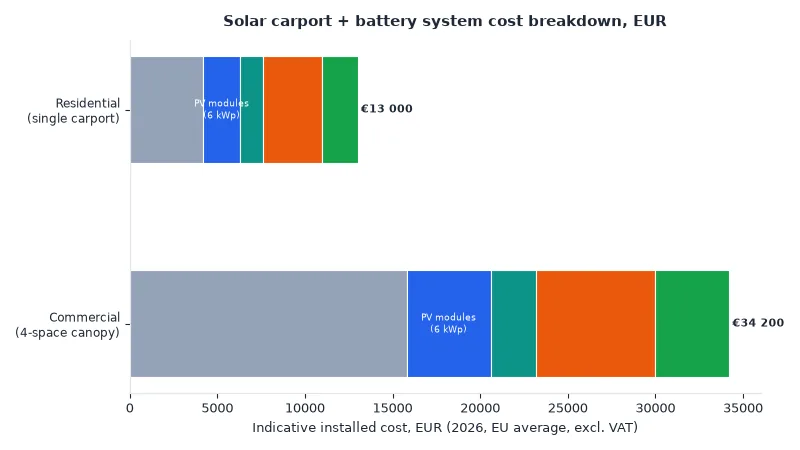
Two details move the total more than buyers expect. Premium timber or galvanised steel engineered for alpine snow loads can add €1,500 versus a basic frame. And a certified LiFePO4 pack with a robust BMS costs more upfront, but protects both your payback and your insurance cover.
Payback across the EU in 2026
Payback is driven by electricity prices and self-consumption. EU household prices remain among the world’s highest — around €0.387/kWh in Germany, €0.297/kWh in Italy, €0.267/kWh on Spain’s regulated PVPC tariff and €0.256/kWh in the Netherlands — while wholesale prices on the German EPEX day-ahead market near €90/MWh keep dynamic-tariff arbitrage attractive. Against those numbers, a well-sized system pays for itself in roughly eight to twelve years across the major EU markets.
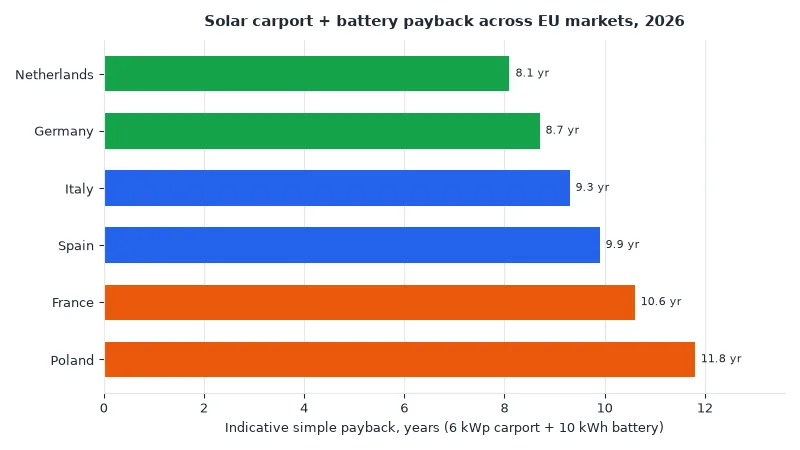
For the underlying maths, see our comparison of solar + battery ROI in Germany, Spain, Italy and the Netherlands.
Choosing EU-compliant equipment
- Battery safety: EN IEC 62619 and IEC 63056 certification, plus VDE 2510-50 recognition in Germany.
- Structure: wind and snow loading calculated to the EN 1991 Eurocodes for your exact location.
- CE marking and Declaration of Conformity for every component, as required under the EU Battery Regulation (EU) 2023/1542 and the Low Voltage and EMC Directives.
- Warranty: at least 10 years or 6,000 cycles to 80% state of health.
- Grid and tariff readiness: a BMS and inverter with open protocols to join the flexibility markets emerging from the EU’s electricity market design reform.
Permits and grid connection
Most member states treat a carport as minor construction works, requiring a simplified building notification rather than full planning permission — France’s APER decree even streamlined canopy permitting. Electrically, systems above a few kilowatts must be registered with the national DSO, and some grids impose connection limits that a battery helps manage by smoothing exports. With the EU smart-meter rollout past 60% penetration, most households can already access the tariffs that make storage pay.
The bottom line
A solar carport + battery system in 2026 is no longer just a shelter with panels on top. With EU policy pushing PV onto parking surfaces, subsidies covering storage, and LiFePO4 batteries safely delivering 6,000+ cycles, the economics now work across most of the union — especially where prices are highest and an EV is charged at home.
Ready to add a solar carport and storage to your property or product portfolio? Contact Insum Energy for a quote — our team supports installers and distributors across the EU with certified LiFePO4 battery systems sized for carport and EV applications. Learn more about us, browse our battery product range, or explore the latest insights on our homepage.