
EU Battery Supply Chain Due Diligence 2026: Buyer’s Guide
EU Battery Supply Chain Due Diligence 2026: Buyer’s Guide
From 18 August 2027, every battery that enters the European Union must be backed by verified evidence that its cobalt, lithium, nickel and natural graphite were sourced responsibly. The obligation comes from Chapter VII (Articles 47–53) of the EU Battery Regulation (EU) 2023/1542, and it was pushed back from August 2025 to August 2027 by the “stop-the-clock” Regulation (EU) 2025/1561. For EU importers, distributors and installers, that two-year reprieve is not a pause — it is the last window to audit your supply chain before non-compliant stock becomes unsellable. Here is what the rules require, who they apply to, and how to prepare in 2026.
What the EU battery due diligence obligation actually requires
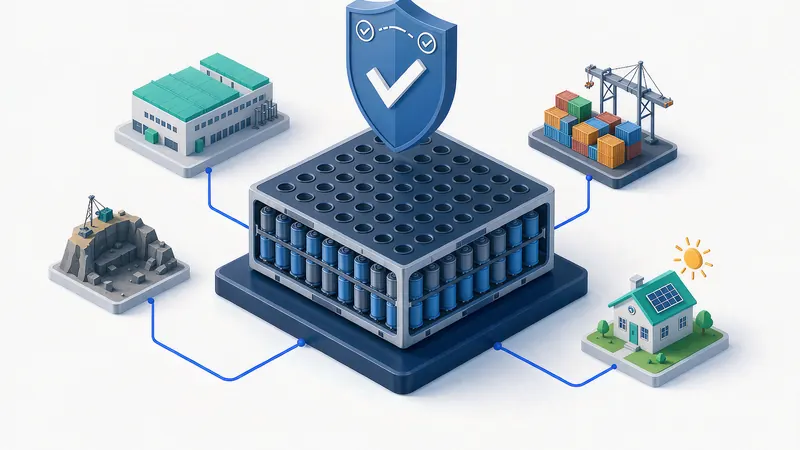
Chapter VII of Regulation (EU) 2023/1542 borrows its logic from the OECD Due Diligence Guidance for Responsible Supply Chains of Minerals. Any operator that places batteries on the EU market with a turnover above the threshold must operate a documented, third-party-verified system covering four pillars:
- A due diligence management system. A board-approved sourcing policy for cobalt, lithium, natural graphite and nickel, integrated into company risk management, with a named senior manager accountable.
- Risk identification and assessment. Mapping the chain of raw-material suppliers — from mine and refiner through cell maker — and screening for human rights abuses (child labour, forced labour) and environmental harm, using on-the-ground assessments rather than questionnaires alone.
- Risk management and response. A documented plan to prevent or mitigate identified risks, monitor progress, and suspend or exit suppliers that refuse to remediate — as a last resort.
- Third-party verification and public reporting. An annual due diligence report, independently audited by a notified body, disclosed alongside company disclosures.
Batteries produced in the EU from recycled materials are treated as low-risk, which is one reason the Regulation simultaneously drives recycling rates and producer-responsibility fees upward.
The 2026–2031 timeline: what changes, and when
The Battery Regulation applies in stages, and several deadlines depend on secondary legislation that is still being adopted. The dates that matter for due diligence and related obligations are:
| Date | Obligation | Legal basis |
|---|---|---|
| 18 Aug 2025 | Producer registration + extended producer responsibility (EPR) in force; Batteries Directive 2006/66/EC repealed | Arts 55–56 |
| 26 Jul 2026 | Commission due diligence guidelines due | Reg. (EU) 2025/1561 |
| 18 Feb 2027 | Digital battery passport for EV, LMT and industrial batteries >2 kWh | Art. 77, Annex XIII |
| 18 Aug 2027 | Supply chain due diligence obligations apply | Chapter VII |
| 18 Aug 2028 | Documentation of recovered cobalt, lithium, nickel and lead content | Art. 8(1) |
| 18 Aug 2031 | Binding recycled-content minimums: 16% cobalt, 85% lead, 6% lithium, 6% nickel | Art. 8(2) |
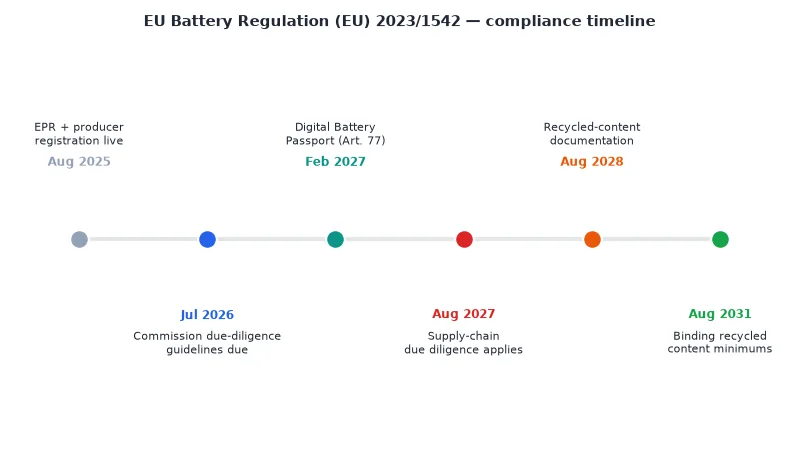
Note that the digital battery passport was not postponed with due diligence — it arrives on 18 February 2027 regardless, and our battery passport 2027 preparation guide explains the QR-code and Annex XIII data requirements in detail. Carbon footprint declarations, meanwhile, remain in limbo until the Commission adopts the methodology acts, so check the latest status in our overview of EU carbon footprint declaration rules.
Who is in scope? The €40 million threshold — and the companies it catches indirectly
Directly, Chapter VII applies to economic operators with a net turnover of at least €40 million that are not controlled by a larger group exceeding that limit (Article 47). A proposal under the Omnibus IV review would raise the medium-sized threshold to €150 million, but it is not yet law, so plan on €40 million.
Indirectly, the reach is far wider — and this is the part most installers and distributors miss. Because large brands must audit their chains, every smaller wholesaler and installer inside those chains receives due diligence data requests: supplier declarations, smelter and refiner lists, audit certificates, EPR registration numbers. If you cannot produce them, you become the weak link in your customer’s audit — and large EU buyers are already de-listing suppliers who cannot answer.
Do not confuse this with the Corporate Sustainability Due Diligence Directive (CSDDD, Directive (EU) 2024/1760). The CSDDD — reshaped by the Omnibus package and delayed by Directive (EU) 2025/794 — now targets only the largest groups (roughly 5,000+ employees and €1.5 billion turnover) with application expected around 2028–2029 and fines capped near 3% of global turnover. The battery Regulation’s Chapter VII is separate, sector-specific, and arrives first.
Why due diligence now decides which batteries you can sell
Market access is the hard consequence. From August 2027, batteries without a compliant, verified due diligence policy face withdrawal from the EU market and border rejections — the same enforcement logic that applies to CBAM carbon border costs on aluminium and steel inputs, which entered their definitive regime on 1 January 2026 under Regulation (EU) 2023/956 and quietly raise the cost of metal-housed enclosures.
Layered on top are obligations that already apply: per-country EPR registration (since 7 October 2025, Germany runs this through the BattDG law via stiftung ear, and non-German producers must appoint an authorised representative), safety and performance requirements under Articles 10 and 12, and the repairability rules described in our EU Ecodesign for batteries guide. Recycling targets ratchet up in parallel: lithium-based batteries must reach 65% recycling efficiency by the end of 2025 (70% by 2030), with 50% of lithium recovered by the end of 2027 rising to 80% by 2031 — thresholds set out in the Regulation and its methodology Implementing Regulation (EU) 2025/606. Together these rules raise the floor on quality, which is exactly why serious buyers now treat certification as a purchase criterion — see our EU battery insurance and certification guide.
What this means for European buyers: compliant storage is bankable storage
For homeowners and SMEs, due diligence sounds abstract — until you claim a subsidy. Every major 2026 support scheme effectively demands CE conformity and a traceable supply chain: Germany’s KfW 270 loans of up to €100,000 (with KfW 442 bonuses of up to €10,200 for solar + battery + EV packages), France’s MaPrimeRénov’ 2026 and the 0% éco-PTZ, Italy’s 50% Irpef deduction plus Conto Termico 2.0, Poland’s Mój Prąd grants of roughly €3,700, Czech NZÚ grants, Romania’s Casa Verde 2026 and Greece’s €200 million storage programme. In the Netherlands, the 0% VAT rule and the end of the salderingsregeling net-metering scheme on 1 January 2027 make a compliant battery the difference between earning €0.05/kWh for exported solar and avoiding €0.30/kWh evening imports.
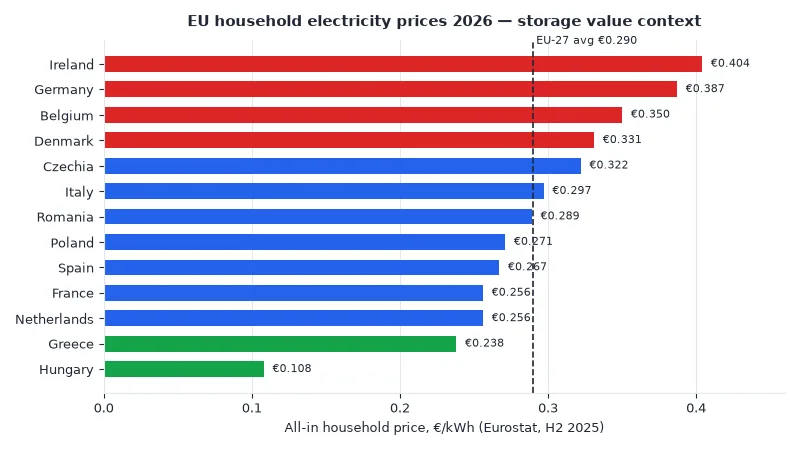
The savings case is real wherever bills are high. Eurostat’s latest figures (H2 2025, published 2026) put the EU-27 average household price at €0.290/kWh including taxes — but €0.387/kWh in Germany, €0.350 in Belgium, €0.297 in Italy, €0.267 in Spain and €0.256 in both France and the Netherlands. A 10 kWh LiFePO4 battery installed at €6,500–€9,500 offsets thousands of euro over a decade at these rates, and the full country-by-country maths is in our EU Battery Regulation overview for owners.
A practical preparation checklist for installers and distributors
- Map your chain to cell level. Know who refines your cobalt, lithium, nickel and graphite — not just who ships the pallets.
- Collect documents now: supplier sourcing policies, OECD-aligned risk assessments, third-party audit reports and smelter/refiner lists.
- Verify producer registrations in every member state you sell into, and confirm your authorised representative where required.
- Test passport readiness: can your supplier generate the Annex XIII dataset and QR code before February 2027?
- Budget for EPR fees and take-back per country, and align your warranty and end-of-life logistics.
- Assign internal ownership — one named person accountable for due diligence files, because auditors ask for a person, not a mailbox.
The bottom line
The 18 August 2027 deadline looks distant from October 2026, but the Commission’s due diligence guidelines land on 26 July 2026, battery passports go live in February 2027, and supply chains take 12–18 months to audit properly. Buyers who lock in verified, fully documented LiFePO4 systems now protect both their market access and their subsidy eligibility; those who wait will face the 2027 cliff with incomplete files.
Need a compliant, fully documented storage supply for your market? Contact Insum Energy for a quote — we supply certified LiFePO4 battery systems from our product range with complete EU conformity documentation, and you can learn more about Insum Energy or explore our full library of European market guides from the homepage.