
LiFePO4 Battery Price Trend 2026: Why Prices Are Changing
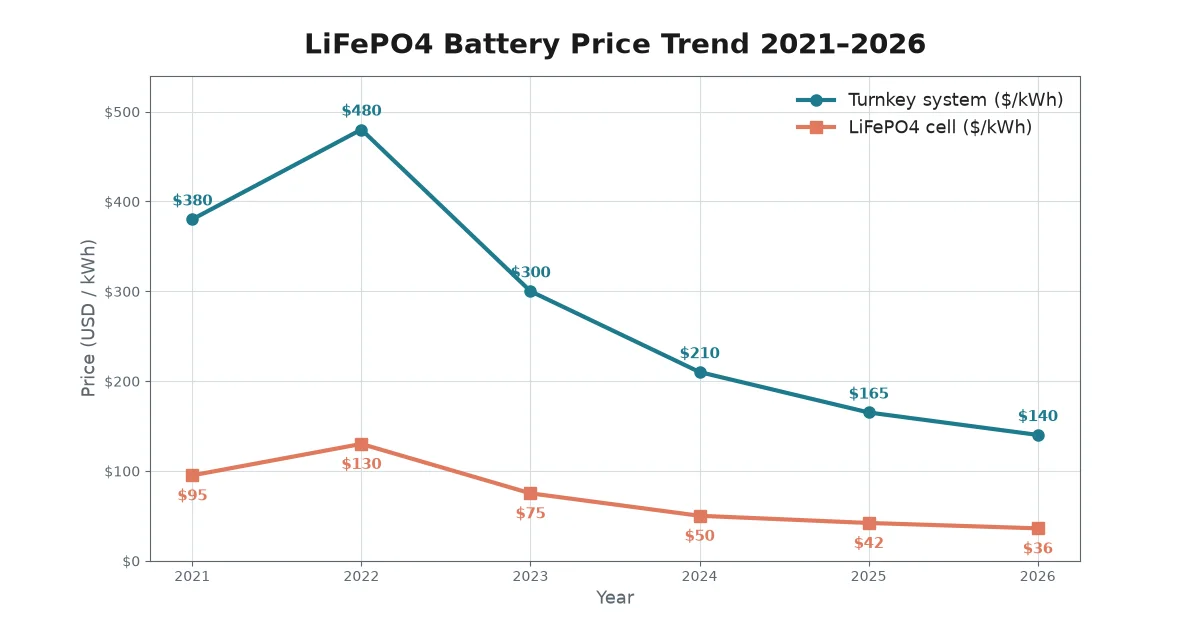
LiFePO4 (Lithium Iron Phosphate) battery prices have been on a remarkable downward trajectory over the past five years, reshaping the energy storage landscape for homeowners, installers, and industrial buyers alike. In 2026, the market is experiencing a new phase of price evolution — one driven by supply chain maturation, chemistry improvements, and shifting geopolitical dynamics rather than pure manufacturing scale. This guide breaks down what’s really happening with LiFePO4 battery prices in 2026 and what it means for your next purchase decision.
Current Price Landscape: Where Are LiFePO4 Batteries Today?
As of mid-2026, LiFePO4 battery cell prices have settled into a more mature pricing band. After the dramatic drops of 2020–2023, the rate of price decline has moderated — but the market remains highly competitive.
Average LiFePO4 Cell Prices (Q2 2026)

| Cell Type | Avg. Price (FOB China) | YoY Change | Trend |
|---|---|---|---|
| 280Ah Prismatic | $65–$80 / kWh | -8% | ↓ Stabilizing |
| 314Ah Prismatic | $70–$85 / kWh | -5% | ↓ Slowing |
| 320Ah Prismatic | $72–$88 / kWh | -4% | ↓ Plateauing |
| 100Ah Cylindrical (32700) | $75–$90 / kWh | -6% | ↓ Competitive |
| Complete 48V 100Ah Pack | $550–$750 | -7% | ↓ Buyer-friendly |
The era of 30–40% annual price drops is over. The LiFePO4 market has entered a phase where 5–10% annual reductions are the norm — similar to how the solar PV industry matured. This is still good news for buyers: batteries are becoming more affordable every year, just at a slower, more sustainable rate.
Why Prices Are Falling (The Structural Drivers)
1. Manufacturing Oversupply in China
China’s LiFePO4 manufacturing capacity expanded at breakneck speed between 2022 and 2025. By 2026, production capacity for LiFePO4 cells exceeds demand by an estimated 35–40%. This oversupply creates intense price pressure on manufacturers, and those savings flow downstream to buyers. Major cell makers including CATL, REPT, EVE Energy, and Hithium are fighting for market share with aggressive pricing strategies.
2. Raw Material Cost Reductions
LiFePO4 batteries use iron phosphate and lithium carbonate — both of which have seen price corrections since the 2022–2023 peak. Lithium carbonate prices, which spiked above $80,000/ton in 2022, have stabilized in the $12,000–$18,000/ton range in 2026. Iron prices remain moderate. These input cost reductions directly translate to lower cell prices.
3. Improved Energy Density
Newer LiFePO4 chemistries — particularly the 314Ah and 320Ah prismatic cells — pack more energy into the same form factor. Manufacturers achieve cost-per-kWh savings by amortizing their fixed production costs across higher-capacity cells. This “cost-per-kWh improvement” drives headline price reductions even when per-cell manufacturing costs remain relatively stable.
4. Automation and Process Improvements
Third-generation LiFePO4 production lines now feature advanced dry-electrode processing, improved thermal management during formation cycling, and tighter quality control. These process improvements reduce scrap rates and increase throughput — key drivers of unit cost reduction.
Why Prices Are Rising in Some Segments
It’s not all downhill. Several countervailing forces are creating upward price pressure in specific areas:
- US tariffs on Chinese batteries: Section 301 tariffs and IRA provisions have added 25% or more to landed costs for Chinese-manufactured cells entering the US market.
- European localized production: European-made LiFePO4 cells command a 30–50% premium over Chinese equivalents, driven by higher labor and compliance costs.
- Battery passport compliance: New EU regulations requiring digital battery passports add ~$5–$10/kWh in compliance costs for batteries sold in Europe from 2027 onward.
- High-capacity cell scarcity: The newest 320Ah cells are still ramping up production, creating temporary supply tightness and a modest price premium for the latest technology.
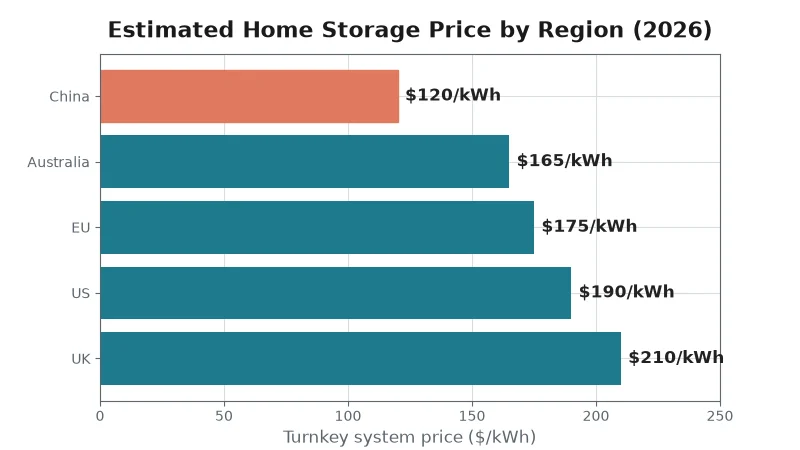
Price Comparison: China vs Europe vs USA

| Region | Cell Cost | Complete Pack Cost | Key Driver |
|---|---|---|---|
| China (FOB) | $65–$80 / kWh | $85–$110 / kWh | Oversupply, domestic competition |
| Europe (local) | $110–$140 / kWh | $150–$200 / kWh | Tarrifs, regulations, labor costs |
| USA (imported) | $90–$115 / kWh | $130–$180 / kWh | Section 301 tariffs, logistics |
When to Buy: Timing Your LiFePO4 Purchase in 2026
If you’re planning a solar + storage installation or upgrading your home battery system, timing matters:
- Q3 2026 (July–September): Typically the best buying window. Manufacturers are clearing inventory ahead of Q4 production cycles and Chinese domestic demand softens during summer months.
- Avoid Q4 (October–December): Year-end demand spikes — particularly in Europe ahead of winter and in the US ahead of tax credit deadlines — can tighten supply and push prices 5–10% higher.
- Watch for “Golden September”: Many Chinese manufacturers run aggressive promotions in September. This is historically the best month for negotiating volume pricing on packs and modules.
What to Expect in 2027 and Beyond
The LiFePO4 price trajectory points firmly downward over the next 3–5 years, but the slope is gentler than what we saw during 2020–2023. Industry analysts project:
- 2027: 4–7% average price reduction globally. 280Ah cells may fall below $60/kWh FOB China.
- 2028: 3–5% reduction. New sodium-ion hybrid chemistries may start competing at the low end.
- 2029+: Market consolidation reduces the number of viable manufacturers from 30+ to perhaps 10–15, stabilizing prices at levels roughly 15–20% below 2026.
How to Get the Best LiFePO4 Price in 2026
Whether you’re buying a single home battery pack or sourcing batteries for a commercial project, these strategies will help you secure the best price:
1. Buy in Volume
Volume pricing is significant in the LiFePO4 market. A single 48V 100Ah pack might cost $700, but buying five units could bring the per-unit price to $580 — a 17% savings. If you have multiple properties or projects, consolidate your purchases.
2. Source Directly from Reputable Manufacturers
Middlemen add 10–20% to battery costs. Working directly with established manufacturers like Insum Energy’s certified supplier network eliminates these markups while ensuring quality and warranty support.
3. Verify Cell Grade Before Purchase
Price differences between Grade A and Grade B cells can be 20–30%, but the performance gap is significant. Always request cycle test data before purchasing at “bargain” prices. A battery that fails prematurely will cost far more than the savings it offered upfront.
4. Consider Pre-Assembled Packs for Simplicity
While DIY battery packs offer maximum flexibility, pre-assembled and certified packs from established suppliers often represent better value when you factor in BMS integration, safety certifications, and installation support. Contact Insum Energy for a customized quote tailored to your project specifications.
Conclusion: The Window of Opportunity Is Open
LiFePO4 battery prices in 2026 represent a compelling opportunity for anyone building or upgrading an energy storage system. The dramatic drops of the past decade have stabilized into a more predictable, sustainable cost reduction curve. While the era of 30% annual price cuts is behind us, batteries are still becoming more affordable — and today’s prices are genuinely competitive compared to lead-acid or NMC alternatives.
The key insight: don’t wait for “the perfect moment” — that moment is now. Prices will be slightly lower in 12 months, but the energy savings you’ll generate from a system installed today more than offset that difference. Whether you’re powering a home, a business, or an off-grid cabin, 2026 is an excellent year to invest in LiFePO4 technology.
Ready to explore your options? Get in touch with Insum Energy for a no-obligation quote on LiFePO4 battery packs, complete storage systems, or custom configurations. Our team of energy storage specialists can help you find the right solution at the right price.


One Comment