LiFePO4 Battery C-Rating Explained: Match Charge & Discharge Rates (2026)
When you’re building a solar storage system, picking the right battery capacity is only half the equation. The other half is understanding how fast your battery can charge and discharge — and that’s exactly what the C-rating tells you. Ignore it, and you risk overheating your cells, reducing cycle life, or simply not having enough power when you need it most.
In this guide, you’ll learn what C-rating really means, how to calculate it for any LiFePO4 battery, and how to match the right C-rate to your specific application — from home solar storage to RVs, marine vessels, and telecom base stations.
What Is Battery C-Rating?
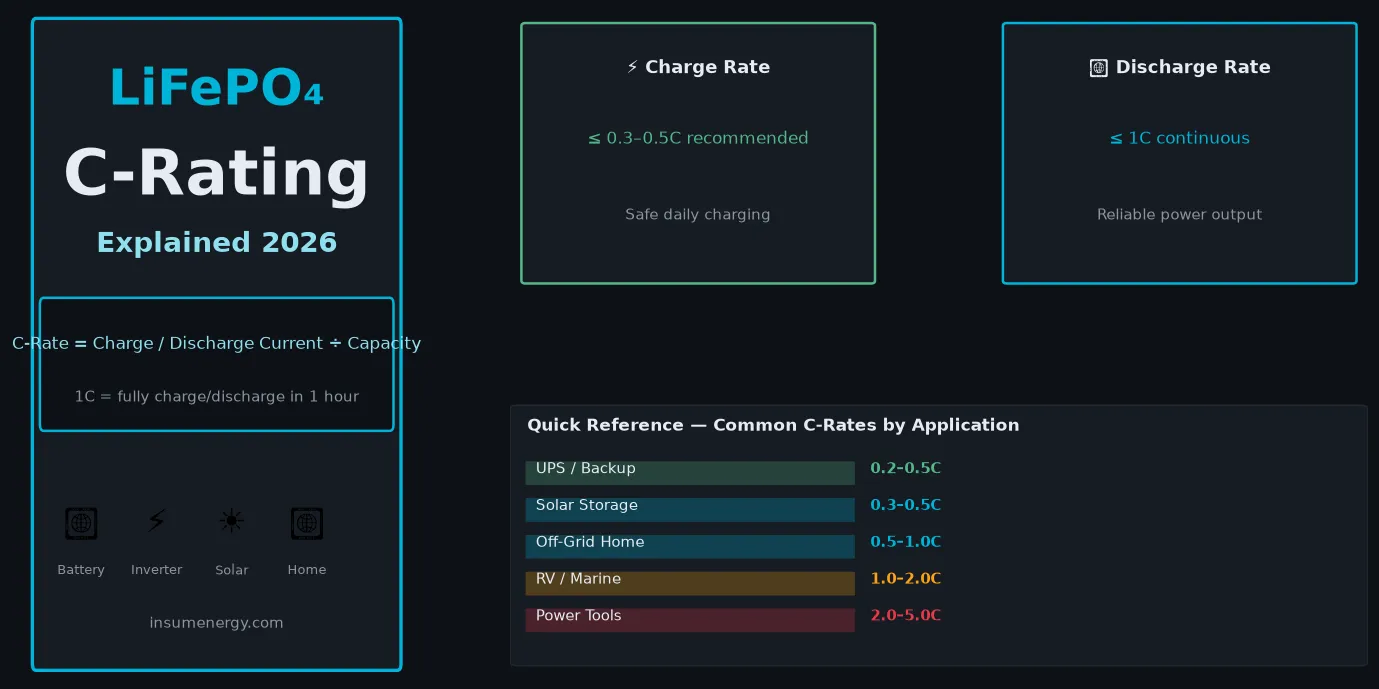
The C-rating (or C-rate) is a measure of the rate at which a battery is charged or discharged relative to its maximum capacity. It expresses the relationship between the current (in Amps) and the capacity (in Amp-hours, Ah).
The formula is straightforward:
C-Rate = Current (A) ÷ Battery Capacity (Ah)
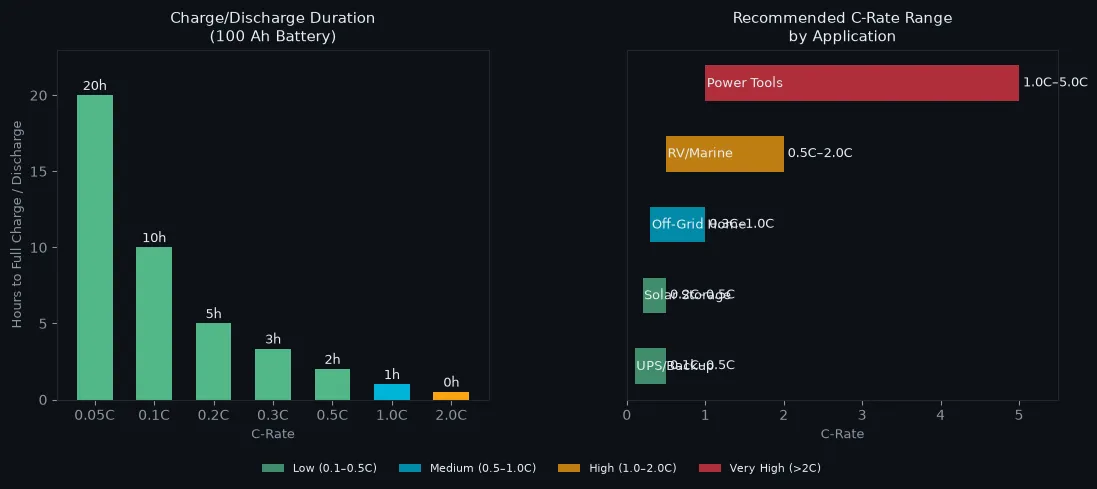
For a 100 Ah LiFePO4 battery: 1C = 100A → full charge/discharge in 1 hour
0.5C = 50A → full charge/discharge in 2 hours
0.2C = 20A → full charge/discharge in 5 hours
The higher the C-rate, the faster the battery delivers or absorbs energy — but high C-rates also generate more heat and cause more wear on the cells. LiFePO4 batteries are well-known for tolerating high discharge rates better than lead-acid, but there are still real limits you need to respect.
Why C-Rating Matters for LiFePO4 Batteries
LiFePO4 (Lithium Iron Phosphate) batteries have become the dominant chemistry for residential energy storage, RVs, marine, and off-grid applications. Compared to lead-acid, they offer:
- ✅ Significantly higher usable capacity (80–100% DoD vs 50% for lead-acid)
- ✅ 4x+ cycle life (3,000–6,000 cycles at 80% DoD)
- ✅ Flat discharge voltage curve maintaining high efficiency
- ✅ Low self-discharge rate (<3% per month)
But LiFePO4’s high C-rate capability doesn’t mean you can push any battery to its limits indefinitely. Here’s what happens when you do:
- 🔴 Excess heat generation — accelerates electrolyte degradation
- 🔴 Reduced cycle life — operating at 2C+ continuously cuts cycle life by 30–50%
- 🔴 Voltage sag — high loads cause voltage drop, reducing usable inverter efficiency
- 🔴 BMS triggering — the battery management system may cut off power to protect cells
Common C-Rates and What They Mean in Practice
Understanding the Numbers
| C-Rate | For 100 Ah Battery | Charge/Discharge Time | Best For |
|---|---|---|---|
| 0.05C | 5 A | ~20 hours | Trickle charge, maintenance |
| 0.2C | 20 A | ~5 hours | Solar trickle, long backup |
| 0.5C | 50 A | ~2 hours | Daily solar cycling, UPS |
| 1.0C | 100 A | ~1 hour | High-demand off-grid, RV |
| 2.0C | 200 A | ~30 minutes | Surge, power tools (short bursts) |
| 3.0C+ | 300 A+ | <20 minutes | Emergency only — not continuous |
The Difference Between Charge and Discharge C-Rates
Notably, LiFePO4 batteries typically have different rated C-rates for charging versus discharging. Most manufacturers specify:
- 🔋 Continuous discharge C-rate: Usually 1C (some premium cells like CATL Eversee support up to 1.5C)
- ⚡ Peak/max discharge C-rate: Typically 2–3C for 5–30 seconds (used for motor startup)
- 🔌 Max charge C-rate: Usually 0.3–0.5C for daily cycling (higher charge rates require better thermal management)
Charging at high C-rates generates more heat than discharging because the electrochemical reactions are less efficient during the absorption phase. Most LiFePO4 manufacturers recommend keeping charge current below 0.3–0.5C for daily cycling to maximize cycle life.
How to Calculate Your System’s C-Rate Requirements
Step 1: Know Your Load
First, determine the maximum continuous power draw of your system in Watts (W) or Amps (A). This information comes from your inverter specifications or a power meter.
Step 2: Know Your Battery Capacity
Check your battery’s nominal capacity in Amp-hours (Ah). For a 48V system, this is typically:
- Small systems: 50–100 Ah (2.4–4.8 kWh)
- Medium systems: 100–200 Ah (4.8–9.6 kWh)
- Large systems: 200–400 Ah (9.6–19.2 kWh)
Step 3: Apply the Formula
Example: You have a 48V 200Ah LiFePO4 battery and a 5,000W inverter.
Maximum discharge current = 5,000W ÷ 48V = 104 A
C-Rate = 104A ÷ 200Ah = 0.52C ✅ (Safe for continuous operation)
Quick C-Rate Calculator Table
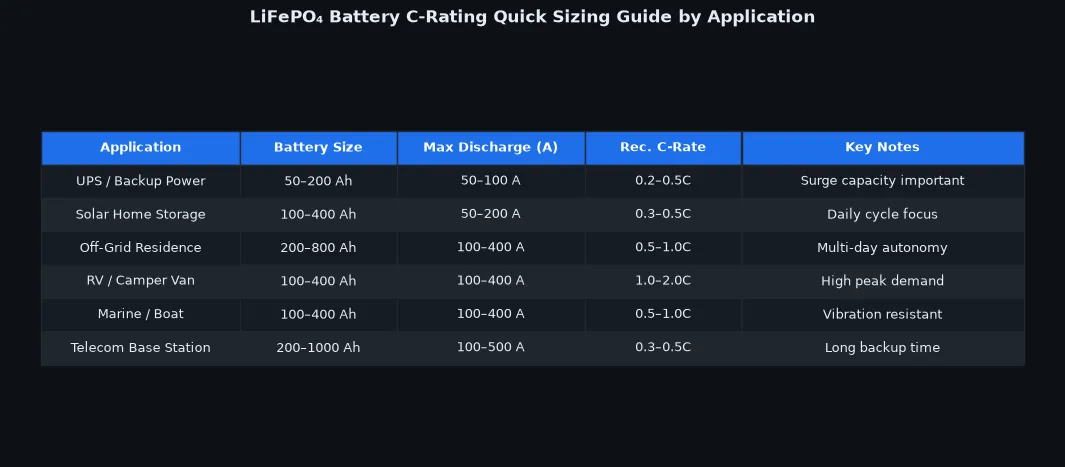
Choosing the Right C-Rate for Your Application
Residential Solar Storage
For daily solar cycling in a home energy storage system, you want a C-rate that allows the battery to charge fully during sunlight hours and discharge overnight without strain.
- Recommended C-rate: 0.3–0.5C continuous discharge, 0.2–0.3C charge
- Why: Maximizes cycle life; most solar systems have 4–6 peak sun hours per day
- Example: A 15 kWh battery (48V 300Ah) → 150A max discharge at 0.5C → supports 7,200W inverter
If you’re looking for help sizing the right battery for your solar setup, check out our guide on how to choose the right LiFePO4 battery for your solar energy system.
Off-Grid Home Systems
Off-grid systems need to handle higher sustained loads and may have fewer charging opportunities. The battery often runs through multiple cycles per day in winter.
- Recommended C-rate: 0.5–1.0C continuous discharge
- Why: Higher peak demands (pumps, HVAC) and longer autonomy requirements
- Key consideration: Add 20–30% capacity buffer to keep the C-rate comfortably low
RV and Camper Van
RVs present unique challenges: high surge loads from air conditioning, microwave ovens, and induction cooktops, combined with limited charging from solar or shore power.
- Recommended C-rate: 1.0–2.0C continuous discharge, 0.5C max charge
- Why: AC units and appliances create peak loads of 1,500–3,000W regularly
- Tip: Choose a battery with ≥1C rated continuous discharge to handle compressor startup currents
For a full breakdown of energy storage options for recreational vehicles, read our RV solar battery systems guide.
Marine Applications (Boats and Yachts)
Marine environments add vibration, humidity, and salt exposure to the mix. Your battery must maintain performance in these harsh conditions while powering trolling motors, winches, and onboard systems.
- Recommended C-rate: 0.5–1.0C continuous, with surge capacity of 2–3C for winch/motor startup
- Why: Trolling motors and electric winches have high startup currents
- Look for: IP-rated enclosures, vibration-resistant cell design
Explore our LiFePO4 marine battery guide for detailed recommendations on boats and yachts.
UPS and Backup Power Systems
UPS systems prioritize reliability and surge capacity over energy throughput. Batteries sit idle most of the time and discharge only during power outages.
- Recommended C-rate: 0.2–0.5C continuous discharge
- Why: UPS loads are typically moderate; extended backup time requires larger capacity rather than higher C-rate
- Key advantage: LiFePO4 batteries can be held at partial SOC indefinitely without damage (unlike lead-acid)
Compare LiFePO4 with traditional UPS solutions in our UPS vs LiFePO4 battery backup comparison.
Telecom Base Stations
Telecom operators are rapidly switching from lead-acid to LiFePO4 for their base station backup systems. The requirements are high: 8–24 hours of backup time, reliable in outdoor environments, with remote monitoring.
- Recommended C-rate: 0.3–0.5C continuous discharge
- Why: Long backup duration; most base stations draw 50–200A continuously
- Battery sizing: Typically 48V 200–1,000Ah systems for 8–48 hour autonomy
Learn why major telecom operators are making the switch in our article on telecom base station LiFePO4 batteries.
How C-Rating Affects Battery Sizing
Here’s the key insight: if your loads require a high C-rate, you need a larger capacity battery — not a “higher C-rate” battery. The C-rate is a ratio, not a fixed performance rating you can “upgrade.”
⚠️ Common Mistake: Buying a 100Ah battery rated at 1C to run a 100A load seems fine mathematically — but in practice, you want headroom. Running continuously at the rated C-rate generates significant heat and accelerates degradation. Always add a 20–50% capacity buffer.
Practical Sizing Rule of Thumb
| Max Load (A) | Target C-Rate | Minimum Battery Size |
|---|---|---|
| 50 A | 0.5C | 100 Ah |
| 100 A | 0.5C | 200 Ah |
| 200 A | 0.5C | 400 Ah |
| 100 A | 1.0C | 100 Ah |
| 200 A | 1.0C | 200 Ah |
C-Rating and Battery Chemistry: LiFePO4 vs NMC vs Lead-Acid
Not all battery chemistries handle high C-rates the same way. Here’s how LiFePO4 compares:
| Parameter | LiFePO4 | NMC (Li-ion) | Lead-Acid |
|---|---|---|---|
| Typical Max Continuous Discharge | 1.0C | 1.0–3.0C | 0.2C |
| Peak Discharge (short burst) | 2–3C | 5–10C | 0.5C |
| Max Charge Rate (daily) | 0.3–0.5C | 0.5–1.0C | 0.1–0.2C |
| Cycle Life at 1C | 3,000–5,000 cycles | 1,000–2,000 cycles | 300–500 cycles |
| Thermal Safety | Excellent | Moderate (thermal runaway risk) | Good |
For a full comparison between battery chemistries, read our guide on LiFePO4 vs NMC lithium batteries.
How C-Rating Interacts with Battery Management System (BMS)
Every quality LiFePO4 battery includes a Battery Management System (BMS) that monitors and controls charge/discharge rates. The BMS provides critical protections:
- 🔒 Over-current protection: Cuts off discharge if current exceeds safe limits (typically 1–3C depending on cell rating)
- ⚡ Voltage protection: Prevents discharge below cell protection voltage (usually 2.5–2.8V per cell)
- 🔋 Capacity balancing: Active or passive balancing ensures all cells stay balanced during charge cycles
The BMS essentially enforces the C-rating limits — but you should still design your system so the BMS rarely has to intervene. If your BMS is frequently triggering over-current protection, your battery is undersized for your load.
C-Rating and Round-Trip Efficiency
Higher C-rates reduce round-trip efficiency. At low C-rates (0.1–0.2C), LiFePO4 batteries achieve 95–98% round-trip efficiency. At high C-rates (1C+), efficiency drops to 90–94% due to internal resistance losses and heat generation.
- 💡 For solar storage: Keep charge rate at 0.2–0.3C during bulk charging to maximize energy capture
- 💡 For fast-response backup: Accept 90–92% efficiency in exchange for rapid power delivery
Signs Your Battery C-Rate Is Too High
Watch for these warning signs that your system is pushing the battery beyond its comfortable C-rate:
- ⚠️ Battery becomes noticeably warm or hot to the touch during discharge
- ⚠️ Voltage drops significantly under load (voltage sag >5% at rated current)
- ⚠️ BMS triggers protection mode or limits output
- ⚠️ Unexpected capacity loss after a few months of use
- ⚠️ Inverter shuts down due to low input voltage from battery sag
If you experience any of these issues, it’s likely time to either upgrade to a higher-capacity battery or reduce your load — or both. Read more about LiFePO4 battery fault diagnosis and solutions.
Frequently Asked Questions
What C-rate can I continuously discharge a LiFePO4 battery at?
Most quality LiFePO4 batteries support 1C continuous discharge (fully discharge in 1 hour). For daily cycling, we recommend staying at or below 0.5C to maximize cycle life. Premium LiFePO4 cells from CATL and EVE can handle up to 1.0–1.5C continuous with proper thermal management.
Can I charge a LiFePO4 battery at 1C?
Technically yes for some high-rate LiFePO4 cells, but we recommend keeping charge current at 0.3–0.5C for daily solar cycling. Charging at 1C generates significant heat and reduces cycle life. If you need faster charging, look for batteries specifically rated for 1C charge and ensure adequate cooling.
What happens if I exceed the battery’s C-rating?
The BMS will typically disconnect the battery to protect the cells. Repeatedly bypassing BMS protection can cause permanent damage: reduced capacity, shortened cycle life, overheating, and in extreme cases, cell venting. Always respect the rated C-limits.
Is a higher C-rating always better?
Not necessarily. Higher C-rating batteries often have lower energy density and may have trade-offs in cycle life at high rates. For most residential solar applications, a 0.5C-rated battery used at 0.2–0.3C is the optimal balance of cost, longevity, and performance.
How does temperature affect C-rating?
Cold temperatures significantly reduce effective C-rating. At below 0°C (32°F), LiFePO4 charge acceptance drops sharply, and attempting high-rate charge can cause lithium plating. At high temperatures (above 45°C / 113°F), the BMS will derate or shut down to protect cells. Optimal operating range is 15–35°C (59–95°F). For extreme climates, see our battery sizing guide for hot and cold climates.
Conclusion: Match Your C-Rate to Your Application
The C-rating is one of the most practical specifications to understand when selecting a LiFePO4 battery — yet it’s often overlooked in favor of capacity alone. The key takeaway is simple:
- 🔋 For solar storage: Prioritize low C-rate (0.3–0.5C), high cycle life, and adequate capacity
- ⚡ For high-demand applications (RV, marine, off-grid with heavy loads): Choose batteries rated for 1.0–2.0C with proper thermal management
- 🔌 For UPS/backup: Focus on reliability and float life; moderate C-rate is fine
Remember: if your load requires a high C-rate, increase your battery capacity rather than pushing the battery harder. A larger, lower-C-rate battery will last significantly longer than a smaller, higher-C-rate battery running at its limits.
At Insum Energy, we supply a full range of LiFePO4 batteries optimized for every application. Whether you need a compact 48V 100Ah system for a cabin or a 1MWh container storage solution, we have the right battery with the right C-rating for your needs.
Need Help Choosing the Right LiFePO4 Battery?
Contact Insum Energy today for a free consultation and competitive quote on solar storage, RV, marine, or backup battery systems.