Baltic States Battery Storage 2026: After Desynchronisation
On 8 February 2025 at 09:09 Tallinn time, the switches opened and Estonia, Latvia and Lithuania stopped sharing a frequency with Moscow. Twenty-four hours later the three grids were synchronised with Continental Europe through Poland, ten months ahead of the original schedule. It was the biggest change to the region’s power system since the 1990s — and it quietly rewrote the case for owning a home battery in the Baltics. Here is what has actually changed for buyers, installers and distributors in 2026.
What Changed on 8 February 2025
For three decades the Baltic power system ran inside the Soviet-era BRELL ring, its frequency dispatched from Russia. On 8 February 2025 the three states disconnected from that system and survived a deliberate island-mode test — absorbing an unexpected outage at Lithuania’s Elektrėnai plant without dropping a single consumer — before synchronising with the Continental European grid via the LitPol Link on 9 February, ten months ahead of schedule (European Commission). Brussels backed the project with more than €1.23 billion in Connecting Europe Facility grants covering 75% of investment costs (EC statement), and ENTSO-E certified the synchronisation permanent on 28 November 2025 (NRB).
Why does a political milestone matter to a homeowner? Because frequency control is now a local responsibility. Every mismatch between generation and consumption in Estonia, Latvia and Lithuania must be balanced by resources inside the region — and that is where batteries, large and small, earn their keep.
Frequency Reserves Are the Region’s New Currency
The three transmission operators — Elering, AST and Litgrid — now buy balancing capacity in a shared Baltic Balancing Capacity Market, live since 4 February 2025 for frequency containment and manual reserves, with automatic reserves added that April as Elering joined the PICASSO platform (Volton). The procurement is big money: from October 2025 to June 2026 the Baltic TSOs spent €108.6 million reserving aFRR and mFRR capacity, with 61% of it attributable to Lithuania (windindustry). Competition is still thin and concentrated in a few large assets — which is precisely why flexibility capacity commands premium prices.
Here is the household angle. The minimum bid is 1 MW, far beyond any home battery, but aggregators pool hundreds of small batteries into virtual units that clear the threshold (Volton balancing market guide). Specialists are scaling fast: Sunly already sells more than 20 MW of qualified frequency reserve in Estonia and was recently prequalified for up to 100 MW in Latvia (Trade with Estonia). A home battery behind an aggregator contract earns capacity payments for standing ready, on top of the energy it shifts — the same stacking logic behind VPP revenue for EU battery owners.
A Record Build-Out You Can Watch Happen
Lithuania is the clearest bellwether. Grid-scale battery capacity jumped from roughly 700 MW at the end of June 2026 to 1,195 MW and 2,261 MWh by early October — a 70% rise in a single quarter — with up to twenty further projects expected before year-end, which would push the fleet past 2 GW and 4 GWh (Litgrid data via windindustry). Latvia switched on CEF-funded batteries at Tume and Rēzekne alongside Ventspils and Līksna synchronous condensers (CINEA), while Estonia installed its own condensers at Pussi and Kiisa (NRB).
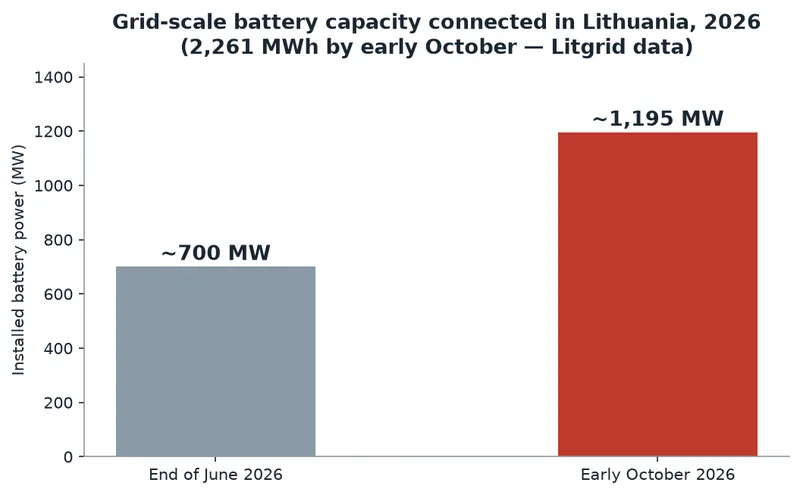
The signal for consumers is simple: regulators now treat storage as core infrastructure. That mindset tends to produce friendlier rules for behind-the-meter batteries too, and Estonia’s 2026 fee reform is the first proof.
What Baltic Households Actually Pay
Storage economics live or die on the spread between cheap and expensive hours, and the Baltics offer unusually wide ones. Household electricity remains below the EU average: Eurostat’s H1 2026 survey puts it at 23.6 ct/kWh in Estonia, 23.9 in Lithuania and 27.3 in Latvia, against an EU average of 28.3, all taxes and levies included (Eurostat, nrg_pc_204).
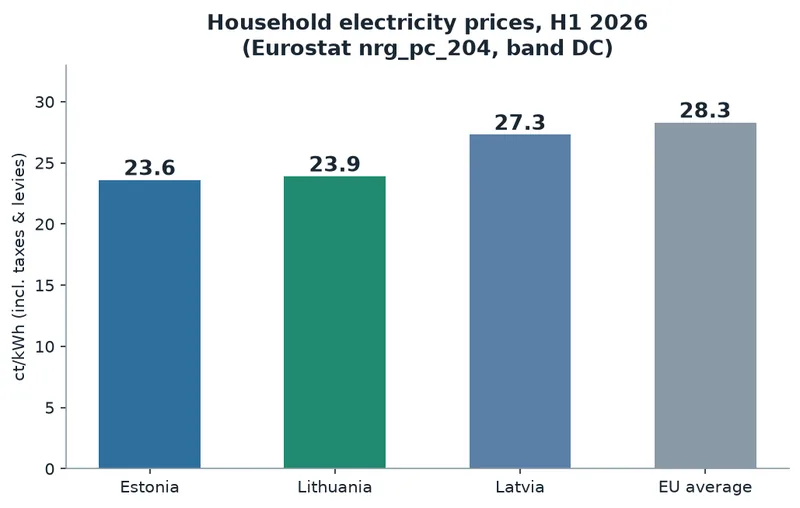
Those averages hide brutal swings. In December 2025 the Estonian wholesale average was a friendly 7.37 ct/kWh excluding VAT; by January 2026, days averaging above 20 ct/kWh became routine and peak-hour prices multiplied (Enefit). In July 2026, Estonian day-ahead power averaged about 4.4 ct/kWh ex-VAT, with daily peaks near 11.2 ct and overnight lows at 1.1 ct (ERR via Talivio). Charging at 1–2 ct and discharging into a 15–25 ct evening is exactly the job a 10 kWh battery does every day — a spread worth roughly €300–500 a year on arbitrage alone, before solar or reserve revenue. The mechanics are identical to what we describe in our guide to dynamic tariffs and battery optimisation.
Subsidies in 2026: Three Different Doors
| Country | 2026 scheme | Key numbers | Status |
|---|---|---|---|
| Estonia | No open residential storage grant (KredEx RRF round closed 1 Mar 2025) | Closed grant: 30%, battery €642/kWh, max €3,852; export premium €0.0537/kWh + market price for up to 12 years | Closed — watch for new rounds |
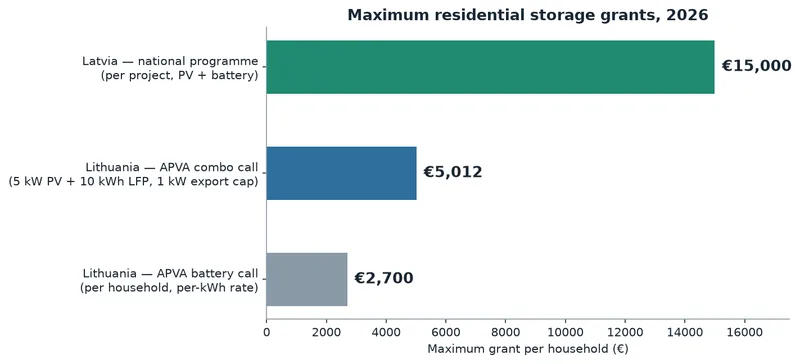
| Latvia | National €85m household programme | Up to €15,000 per project; battery minimum raised 5→10 kWh; ~€20m left; 85% for large families | Open |
| Lithuania | APVA battery call (from 19 May 2026) + combo call for grid-constrained areas | Up to €2,700 per battery; €5,012 for 5 kW PV + 10 kWh LFP at ≤1 kW export; solar call €170/kW | First come, first served — fills fast |
Latvia’s programme is the region’s flagship. The Ministry of Climate and Energy raised the minimum eligible battery from 5 kWh to 10 kWh and lifted support for Goda ģimene families from 70% to 85% of eligible costs; 15,700 projects and €59.75 million had been paid out by May 2026, leaving around €20 million (pv magazine). Mind the conditionality: support applicants must demonstrate at least 80% self-consumption, which in practice pushes larger solar arrays towards adding a battery (Commodus).
Lithuania’s APVA runs short, first-come calls. The standalone battery round opened on 19 May 2026 with €10 million and pays up to €2,700 per household, calculated per installed kWh, for new LFP or lithium-ion equipment (Infoerdve; call conditions on the agency site, APVA). A parallel call for areas with a 1 kW export cap funds a 5 kW solar + 10 kWh LiFePO₄ bundle at €5,012 (Pinus LT). Estonia, meanwhile, has no open grant — but from 1 January 2026, grid fees and the renewable charge on storage are levied on net consumption only, cutting the operating cost of every battery in the country (Volton).
Metering Rules Decide Your Payback
The export side matters as much as the purchase price. Estonia pays microproducers the market price plus a €0.0537/kWh premium for exported power — decent, but self-consumed kilowatt-hours avoid grid fees and taxes entirely, so a battery still wins on most winter evenings (SurgePV). Lithuania is shifting from net metering towards net billing, which lowers the value of every exported kWh and strengthens the storage case (Pinus LT, 2026 plan). Latvia’s 80% self-consumption requirement makes a battery almost a condition of support for larger systems. And across the region, DSO connection caps — like Lithuania’s 1 kW export limits in congested areas — are a growing reason to add storage instead of a bigger inverter, a pattern we track in our guide to grid connection limits in Europe.
Sizing for a Dark Baltic Winter
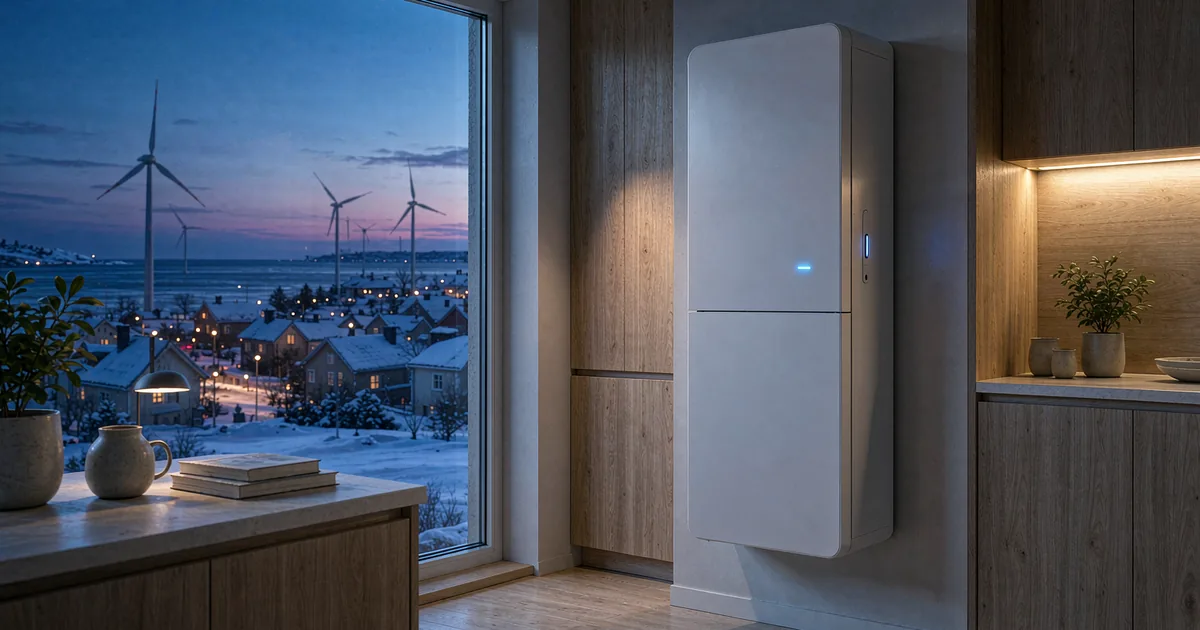
Baltic winters combine the year’s highest prices with the year’s lowest solar yield, so size for the evening, not the day. A 10 kWh battery covers one long dark evening of a typical house; homes with heat pumps should look at 15–20 kWh, the same logic we set out in our Dunkelflaute analysis. If you join an aggregator, expect to reserve roughly half the capacity for your own backup while the pool trades the rest (Volton). How much of your solar output you can shift also depends on your starting self-consumption rate — our country comparison shows typical uplifts from adding storage.
The 2026 Verdict
Desynchronisation turned the Baltics into a flexibility-first market. The honest read for 2026: frequency-reserve revenue flows through aggregator contracts, spot arbitrage rewards dynamic-tariff customers, and grants in Latvia and Lithuania reward whoever moves first. Estonia offers the best regulation but no cheque; Latvian families hold the strongest grant; Lithuanian prosumers live by the APVA calendar.
For installers and distributors, the practical playbook is to quote the APVA call calendar in Lithuania, Latvia’s remaining €20 million, and Estonia’s net-fee advantage side by side. The cheapest system is not the one with the lowest sticker price — it is the one that matches the local rulebook.
Insum Energy supplies stackable LiFePO₄ home batteries and works with installers across Northern and Eastern Europe. Browse the product range, learn more about us, or contact Insum Energy for a tailored quote — and see how our systems fit the new Baltic market at insumenergy.com.