
EU Solar Curtailment 2026: What a Home Battery Captures
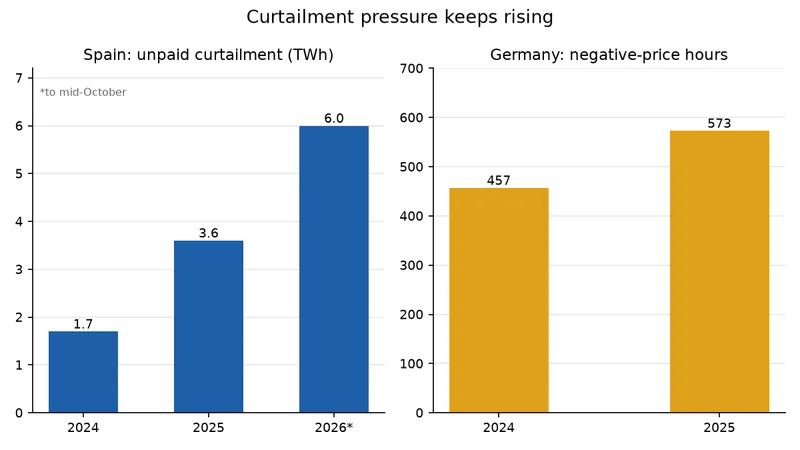
Curtailment used to be a grid-operator footnote. In 2025 Germany could not deliver 9.4 TWh of renewable electricity and paid €433 million in compensation for it. Spain’s uncompensated curtailment passed 6 TWh by mid-October 2026, double a year earlier. Italy’s regulator counted 802 GWh cut in 2025.
None of those terawatt-hours sat on a residential roof. Yet the price and voltage signals behind them now reach household inverters, and they decide what a home battery is worth.
Curtailment in 2026: larger, and increasingly unpaid
Germany publishes both volume and money. The Federal Network Agency’s congestion-management statistics, with market data on SMARD, put 2025 congestion costs at about €3.07 billion, of which curtailment compensation was €433 million — down 22% from €554 million in 2024, per the economy ministry’s reply to a parliamentary question reported by Clean Energy Wire. Wind curtailment fell; PV curtailment rose 94% year on year after record solar additions and a sunny spring (dpa, citing BNetzA).
Spain shows the uncompensated version. Red Eléctrica’s technical-restriction reports separate phase-1 restrictions, which are unpaid, from remunerated redispatch. Those unpaid volumes went from 1.7 TWh in 2024 to 3.6 TWh in 2025, then 2.5 TWh in the first half of 2026 with a record 1.2 TWh in June alone (Aurora Energy Research). By mid-October the cumulative figure had doubled year on year to 6 TWh (Energía Estratégica).
Italy curtails less but more visibly for households: 802 GWh in 2025 on the high-voltage grid, plus 411 GWh in spring 2026 and about 107 GWh on medium voltage, per ARERA data summarised here. On 2 May 2026, Ri.Ge.Di. was activated in 18 regions for plants of 100 kW and above.
| Market | 2024 | 2025 | 2026 to date | Paid? |
|---|---|---|---|---|
| Germany | 9.4 TWh (3.5% of RES) | 9.4 TWh; €433m | Not yet published | Yes, but shrinking |
| Spain | 1.7 TWh | 3.6 TWh | 6 TWh by mid-October | No, phase 1 unpaid |
| Italy | 338 GWh (solar) | 802 GWh, HV grid | ~518 GWh to spring | Partly |
The clause that decides whether a battery helps
EU law sets the hierarchy. Regulation (EU) 2019/943 requires redispatch to rest on objective, transparent and non-discriminatory criteria, open to generation, storage and demand response alike (Article 13(1)), and to be compensated when market-based (Article 13(2)). Article 13(5)(a) caps planned curtailment of directly connected renewables at 5% of annual generation — with an exemption where renewables exceed 50% of gross final electricity consumption.
Two paragraphs matter more for a homeowner. Article 13(6)(a) allows renewable curtailment only where no alternative exists. Article 13(6)(c) goes further: self-generated electricity not fed into the network may not be curtailed unless nothing else resolves a security problem. A kilowatt-hour consumed behind your meter never enters the curtailment queue.
Article 13(7) pays the higher of additional operating cost or lost day-ahead revenue — but exempts producers that accepted a connection agreement without guaranteed firm delivery. That exception is growing. The Commission’s European Grids Package pushes flexible, non-firm connections to clear queues present in at least 16 member states by mid-2026: faster connection, in exchange for being curtailable without payment.
Priority dispatch survives only at the small end — below 400 kW, and below 200 kW for installations commissioned from 1 January 2026 (Article 12). A 10 kWp roof keeps its place in the dispatch order, which protects it from being switched off before a coal plant. It does not protect it from a negative price, a voltage rise, or a congested feeder.
How curtailment actually reaches a household
| Mechanism | Trigger | Paid? | What a battery does |
|---|---|---|---|
| Negative-price hours | Day-ahead price below zero in any 15-minute interval | No — EEG §51 pays zero | Charges instead of exporting |
| DSO feed-in management | Local transformer or feeder overload | Usually, capped at 5% | Reduces the surplus causing it |
| Voltage-driven trip | Voltage above 110% of nominal | No | Absorbs output, holds voltage down |
Germany illustrates the first route. Since the Solar Peak Act of February 2025, §51 EEG cuts feed-in remuneration to zero in every quarter-hour with a negative day-ahead price for new plants from 2 kW; §51a extends the support period to recover some of those hours if a smart meter is installed. Without one, export is capped at 60% of capacity. Germany recorded 573 negative-price hours in 2025, up from 457 in 2024.
Italy illustrates the third. Household inverters must disconnect above 110% of nominal voltage under CEI 0-21, and ARERA opened 15 proceedings between October 2024 and July 2025 over repeated disconnections of systems typically up to 6 kW (ARERA data reported here). No order was issued; the roof stopped producing at the sunniest hour and the house imported power.
What 10 kWh of storage captures
Model a 10 kWp array on a clear June day in central Europe: 45–50 kWh generated, maybe 8 kWh used in the house while the sun is up, the rest exported into a midday market that is flat or negative. A 10 kWh battery with 90% round-trip efficiency absorbs about 9 kWh of that surplus and returns roughly 8.1 kWh after losses.
The value gap is not marginal. An exported midday kWh earns €0.00–0.03 in a negative or near-zero hour; the same kWh consumed in the evening avoids an import at the household rate — €0.2896/kWh on the Eurostat EU average for the second half of 2025, €0.3869 in Germany (Eurostat nrg_pc_204).
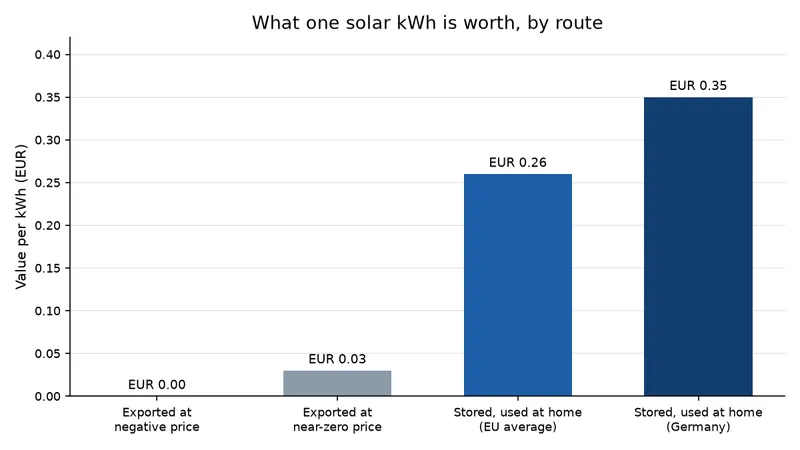
Over a year, 250 equivalent cycles shift about 2,000 kWh, worth €580 at the EU average and €770 in Germany before any dynamic-tariff arbitrage. Against €5,500–8,000 installed for 10 kWh, that is a 7–13 year simple payback — and the reason the end of net metering across Europe changed the sales conversation more than any subsidy did.
Sizing to the surplus, not to the annual bill
Most sizing tools start with annual consumption. Curtailment-aware sizing starts with the shape of the surplus: pull 15-minute data for a sunny week and count the hours when export price was zero or negative, or when the inverter logged a voltage trip. That energy is the battery’s raw material, and it is free.
- Rule of thumb: 0.8–1.2 kWh usable per kWp in central Europe, 1.2–1.5 kWh per kWp in Spain, Italy and Greece, where midday surplus is larger and evening cooling load lasts longer.
- Do not size for a July weekend. Two sunny days exhaust any residential battery by noon on day two; the second day’s surplus is structurally uncapturable without a load.
- Check the DC/AC ratio. A 1.25–1.35 oversizing clips at midday, exactly when the battery wants to charge. DC-coupled systems avoid a second conversion and recover more of the clipped peak.
- Confirm curtailment readiness: the inverter must accept a zero-export setpoint from the DSO and keep charging while export is limited to zero.
What a battery cannot fix
It cannot fix a week of surplus. A 10 kWh pack covers one evening, not a season — the same limit that makes a dark lull a different problem. It cannot monetise energy that never reached your meter, and it should not be sold on curtailment compensation: Germany’s draft network package would remove that payment for new plants in congested areas for ten years.
What it can do is turn an hour of zero-value export into an hour of avoided import, keep the array producing when voltage rises, and give the house a predictable price. Paired with a heat pump or EV charger that flexibility is worth more than arbitrage alone — see our guides to grid-fee avoidance under §14a EnWG and to the rooftop obligations shaping new-build sizing.
Buyer and installer checklist
- Ask the DSO whether the connection is firm; price any flexible agreement into the payback.
- Pull one year of 15-minute export data, not just annual kWh.
- Verify the inverter’s response to a negative price and to a DSO setpoint.
- Size usable kWh to the average daily surplus, then stress-test the worst sunny weekend.
- Log voltage at the inverter terminals during peak production; repeated 110% events are a sizing signal.
Next step
Curtailment is a system-level number that lands on a household as a price, a setpoint or a voltage trip. Sizing against that reality rather than an annual consumption figure is what separates a battery that earns from one that idles. Insum Energy’s storage range is built for this duty cycle, from 5 kWh wall units to stackable 30 kWh cabinets with inverter-level export control. Send a year of interval data through our contact page and we will model the capture for your market; warranty and service details are on the about us page, and the full catalogue starts at insumenergy.com.


One Comment