Three-Phase vs Single-Phase Home Battery: 2026 Guide
If you are installing a home battery storage system in Europe, one of the first technical questions you will face is whether you need a single-phase or three-phase battery setup. It is a decision that affects everything from maximum power output to how fast you can charge an electric vehicle.
Yet most homeowners are never told the difference — until something does not work as expected. This guide explains exactly what each system means, who needs which, and how to choose correctly before you spend a euro.
What Is the Difference Between Single-Phase and Three-Phase Power?
Electricity reaches European homes in one of two configurations:
- Single-phase (L+N): Most residential properties in Europe receive a single live wire and one neutral wire. This delivers up to 230V and is sufficient for most everyday appliances.
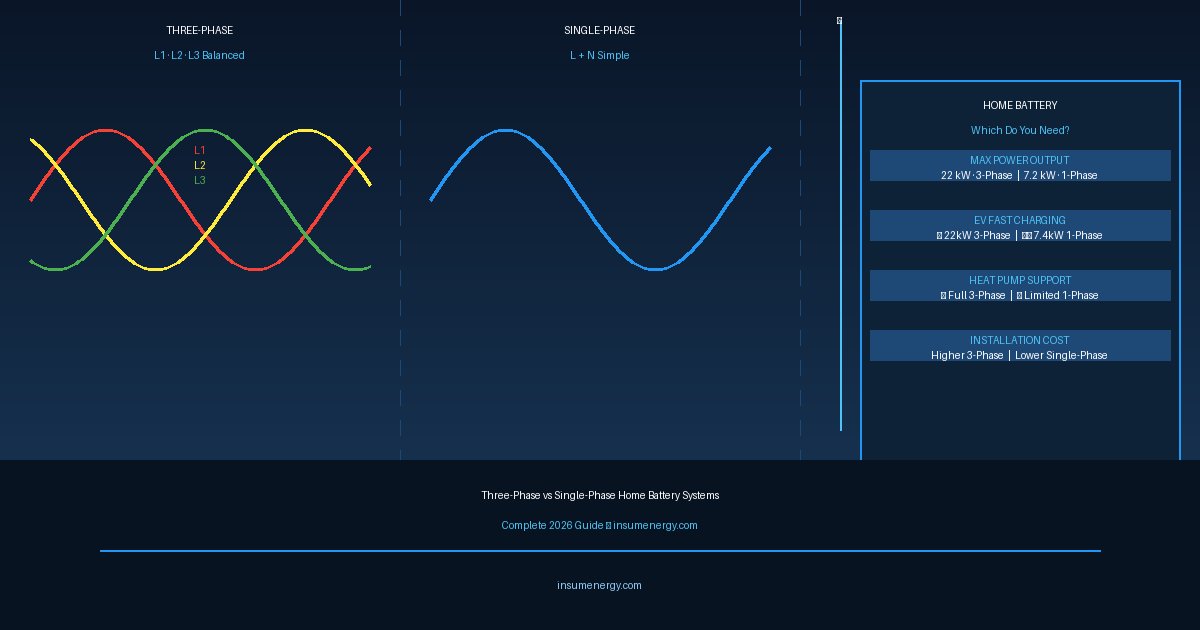
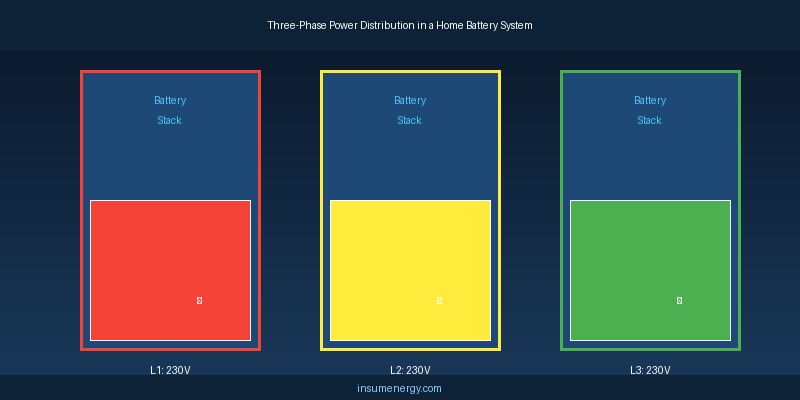
- Three-phase (L1+L2+L3): Larger homes, farms, and commercial buildings may receive three live wires and one neutral, each carrying up to 230V. The phases are spaced 120 degrees apart.
The critical difference is power capacity. A single-phase connection maxes out at around 7.2 kW of continuous power output. A three-phase connection can deliver 17-22 kW — roughly three times more. This matters enormously for a home battery system that needs to power high-demand appliances simultaneously.
Why Your Phase Type Matters for Home Battery Systems
A home battery does not just store energy — it must integrate with your property electrical infrastructure. Here is why the phase type is so consequential:
Maximum Power Output
With a single-phase battery system, you are constrained by the 7.2 kW limit of your connection. If you try to draw more — running a heat pump, an EV charger, and induction cooktop at the same time — the system will either fail to deliver or draw from the grid to compensate.
A three-phase battery can distribute that load across three wires, delivering up to 22 kW of power without issue. For households with high energy demand, this is the difference between a battery that actually works and one that leaves you stranded.
Generator Charging Speed
During a grid outage, many homeowners pair a home battery with a backup generator. The speed at which the battery recharges from the generator depends on input power. Single-phase limits you to roughly 7.2 kW input, while three-phase systems can accept 15-22 kW, cutting generator recharge time by more than half.
EV Fast Charging Compatibility
Single-phase EV chargers max out at 7.4 kW (32A at 230V). Three-phase chargers can deliver 11 kW or even 22 kW, slashing EV charging time from 8 hours to under 2 hours for a typical 60 kWh battery. If you own or plan to own an electric vehicle, your phase configuration will directly determine your home charging speed.
Heat Pump Integration
Modern air-to-water heat pumps often require 6-9 kW of continuous power. Many single-phase households find that running a heat pump and a home battery simultaneously trips the main breaker. Three-phase systems comfortably handle heat pumps alongside battery storage and EV charging without stress.
Single-Phase vs Three-Phase Home Battery: Direct Comparison
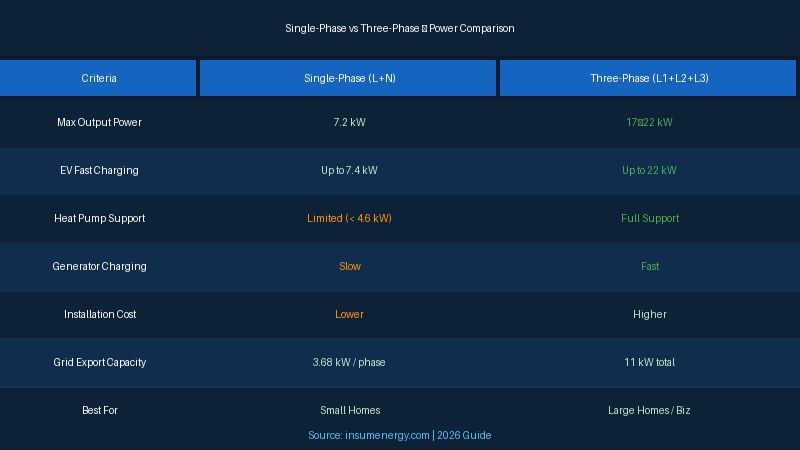
The table above highlights the key differences. Below is a deeper breakdown:
| Criteria | Single-Phase (L+N) | Three-Phase (L1+L2+L3) |
|---|---|---|
| Max Continuous Output | 7.2 kW | 17-22 kW |
| EV Charging Speed | Up to 7.4 kW | Up to 22 kW |
| Heat Pump Support | Limited (under 4.6 kW) | Full support (6-9 kW+) |
| Generator Recharge Rate | ~7.2 kW | ~15-22 kW |
| Grid Export Capacity | 3.68 kW per phase | Up to 11 kW total |
| Installation Cost | Lower | Higher |
| Best Suited For | Apartments, small homes | Large homes, farms, businesses |
Do You Have Three-Phase Power? How to Check
Before choosing a battery system, confirm your property connection type. Here are three ways to check:
- Check your electricity meter: A three-phase meter will have three numbered fuse switches or a 4-pole breaker. A single-phase meter has one or two.
- Look at your main distribution board: Three-phase systems have three live bus bars running through the consumer unit.
- Ask your grid operator: In most European countries, your DNO (Distribution Network Operator) can confirm your connection type. For German homes, check with your local Netzbetreiber. In the Netherlands, contact your netbeheer.
What Size Battery Do You Need by Phase Type?
Single-Phase Properties
For single-phase homes with moderate consumption (under 5,000 kWh per year), a 5-10 kWh LiFePO4 battery is typically sufficient. This covers evening peak hours, backup for outages, and self-consumption of solar generation.
Three-Phase Properties
Three-phase homes with higher demand — heat pumps, EVs, larger families — generally need 10-20 kWh or more. The higher power output means you can actually use the stored energy at a meaningful scale without worrying about overload.
For those considering off-grid setups, three-phase is strongly recommended because it allows you to balance loads across phases and achieve true energy independence without grid reliance.
Three-Phase Battery Installation: What to Know
Installing a three-phase battery system requires careful planning:
- Hybrid inverter sizing: The inverter must handle all three phases. Make sure the inverter can manage asymmetric loads (when different phases carry different amounts of power).
- Grid connection rules: In the UK, you will need G98 or G99 approval from your DNO for systems above 3.68 kW per phase. In Germany, installations above 12 kW require grid operator notification.
- Phase balancing: A good three-phase battery system monitors and balances loads across all three phases automatically. Ask your installer about this feature.
- Certified installer: Always use an MCS-certified installer (UK) or a VDE-certified installer (Germany) to ensure compliance with local grid codes.
How to Choose the Right System for Your Home
Use this quick decision guide to determine which system fits your situation:
- Choose Single-Phase if: You live in a small apartment or standard house, have no EV, and do not run high-power appliances simultaneously. A 5-10 kWh LiFePO4 system will cover your needs.
- Choose Three-Phase if: You have (or plan to get) an EV, own a heat pump, live in a large property, run multiple high-power appliances, or want true backup power capability.
The extra upfront cost of a three-phase system — typically 20-40% more than single-phase — pays for itself in flexibility, backup reliability, and future-proofing as energy demands grow.
FAQ: Three-Phase vs Single-Phase Home Batteries
Can I upgrade from single-phase to three-phase?
Yes, but it requires your distribution network operator to upgrade the grid connection at your property. This can take weeks to months and costs vary by country and utility.
Will a single-phase battery work for backup power?
Yes, but only for single-phase loads. If your property has three-phase circuits (e.g., for heavy machinery or three-phase air conditioning), those loads will not be backed up by a single-phase battery.
Do all LiFePO4 batteries support three-phase?
Most high-quality LiFePO4 battery systems from reputable manufacturers — including Insum Energy LiFePO4 battery products — support three-phase configurations through compatible hybrid inverters.
Is three-phase more expensive to maintain?
The battery hardware itself does not cost more to maintain. However, three-phase installation may involve more complex wiring and higher labour costs from a qualified electrician.
Conclusion
The choice between single-phase and three-phase home battery storage is not a technicality — it is a fundamental decision that affects your system performance, your backup capabilities, and your ability to grow with new technology like EVs and heat pumps.
If your property has three-phase power, it almost always makes sense to use it. The additional cost is modest compared to the long-term flexibility you gain.
Need help selecting the right LiFePO4 battery system for your home? Contact Insum Energy for a tailored quote and professional installation advice. We supply and install commercial and residential LiFePO4 battery storage solutions across Europe.
This article is part of our complete home energy storage guide. For more on LiFePO4 technology, see our about Insum Energy page.