Zero-Export Limits: Home Battery Control in the EU 2026
A zero-export limit is no longer a niche request from off-grid enthusiasts. In 2026 it arrives from the other direction: as the only connection a network operator will offer. The Commission counts connection queues in at least 16 member states, with roughly 120 GW of mature renewable projects and 1.5 million household installations at risk of missing grid access by 2030 (European Commission, European grids, citing EMBER 2026). When a cable cannot take more export, “connect, but do not export” is the offer. It is worth taking — if the system is designed for it.
What a zero-export limit is — and what it is not
A zero-export limit is a contractual ceiling on active power flowing from your installation into the network, measured at the point of connection. It is not curtailment. Curtailment is a temporary instruction from the operator, logged, often compensated, and over when the constraint passes. A zero-export limit is permanent, priced into your connection, and verifiable from the meter.
Nor is it a percentage cap: Germany’s 60% rule limits export as a share of nameplate output, a zero-export condition fixes the absolute figure at the boundary.
The EU law that made this ordinary
Article 6a of Directive (EU) 2024/1711 requires national regulators to build a framework for flexible connection agreements wherever network capacity is limited. It allows them permanently where reinforcement is not the most efficient answer — including for storage — and sets one hard condition: the user “shall be required to install a power control system that is certified by an authorised certifier.” That sentence is the whole compliance story.
The Commission guidance on efficient and timely grid connections (C/2025/6703, published 19 December 2025) tells regulators to enable exactly these non-firm arrangements. ACER Recommendation 01/2026 then asked national regulators to report, by 25 July 2026, on what still blocks distributed flexibility. The direction is unambiguous: fewer firm connections, more conditioned ones.
Three ways the cap reaches your meter
- As a statutory modality. Spain is the cleanest example. Real Decreto 244/2019 defines autoconsumo sin excedentes in Article 4.1.a and requires a mecanismo antivertido that prevents injection at every moment; Article 3.k ties the device to ITC-BT-40. In exchange, Article 7 exempts the generation unit from access and connection permits. That administrative shortcut is the real prize.
- As a connection-level cap. The operator writes a maximum export figure into the agreement — sometimes 0 kW, often 3 or 5 kW. Read the number.
- As a permanent flexible agreement. Firm and flexible capacity in time blocks, with network charges split accordingly, as Article 6a(2) allows. The Netherlands runs several variants, including fully flexible and minimal-availability contracts, per the Commission’s guidelines on future-proof network charges.
What 0 kW does to system sizing
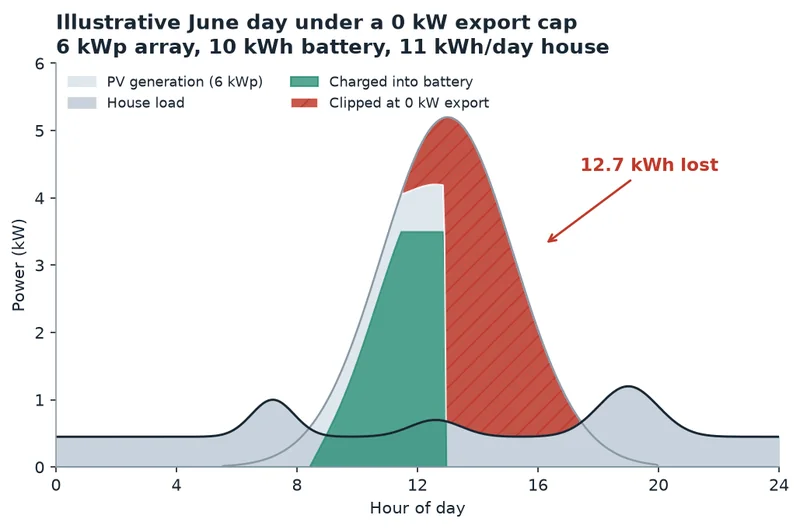
Under a 0 kW cap, output the house cannot absorb at that instant is lost, and two constraints bind at once: daily energy and midday power. Size the array to a clear June day, not to the annual balance.
| Annual consumption | Clear June day | Battery (usable) | PV to avoid clipping | Charge power |
|---|---|---|---|---|
| 4,000 kWh | ~14 kWh | 6–8 kWh | 2.5–3.5 kWp | 2.5–3 kW |
| 6,500 kWh (heat pump) | ~18 kWh | 8–10 kWh | 3.5–4.5 kWp | 3.5–4.5 kW |
| 10,000 kWh (heat pump + EV) | ~24 kWh | 12–15 kWh | 5–6 kWp | 5–6 kW |
These numbers look small beside a normal roof plan: an annual balance would put a 4,000 kWh house at 4 kWp or more. The gap is the energy you cannot export. Ten kWp behind a 5 kWh battery throws away the best hours of a June afternoon; even 6 kWp on an 11 kWh/day house sheds around 13 kWh on a clear day (chart below). If the array already exists, the fix is more storage or a controlled load, not a bigger inverter.
The control loop, and what happens when it fails
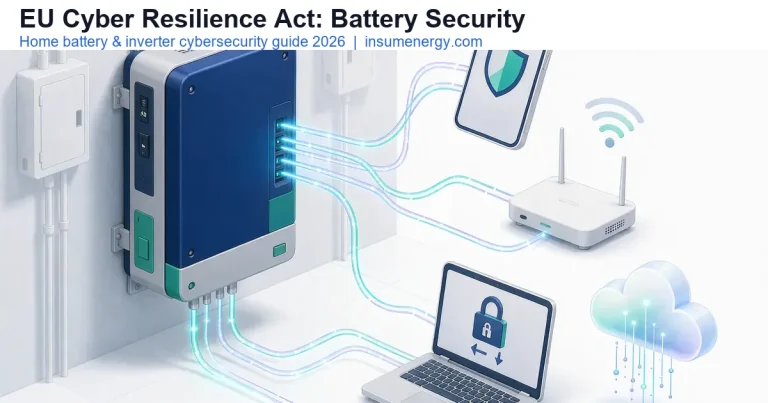
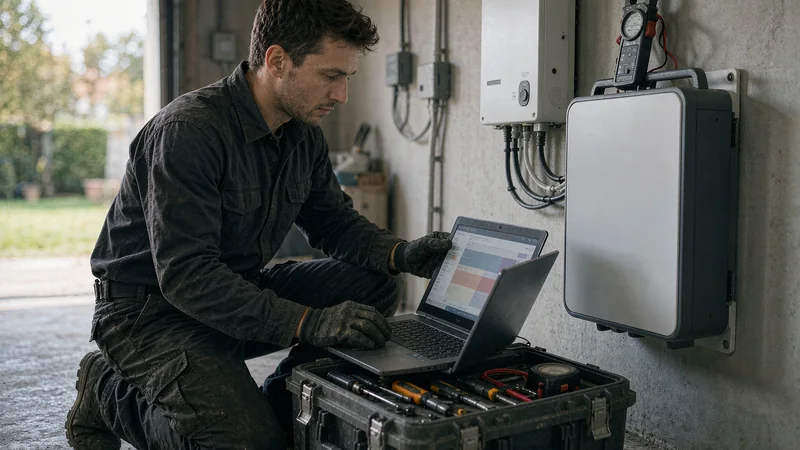
Certification is not paperwork about the inverter; it is a claim about a closed loop: a meter at the connection point measures net export, a controller computes a setpoint, the inverter follows it. Three properties decide whether the loop holds:
- Location. Measurement must sit at the connection point, not the inverter terminals; a second array, a diverter or a legacy string behind the same meter will otherwise export unnoticed.
- Speed and granularity. A 5-minute excursion at 3 kW is 0.25 kWh — and a contractual event. The averaging window decides whether you are compliant or in breach.
- Fail-safe direction. If the controller loses communication, the inverter must fall back to zero export, not full output. Ask for that behaviour in writing.
National interface standards set the frame: EN 50549-1, VDE-AR-N 4105 in Germany, and in Italy CEI 0-21:2026-07, in force since 1 August 2026. Enforcement is measured: Spain lets the distributor disconnect supply where the anti-export device or the meter has been tampered with (Article 5.6, RD 244/2019, applying Article 87 of RD 1955/2000). Two traps follow: undeclared export can be billed as unauthorised injection, and an undisclosed export limit can leave an insurance claim unpaid.
Country rules in 2026
| Market | How the cap arrives | Who verifies |
|---|---|---|
| Spain | Statutory “sin excedentes” modality; anti-export device mandatory (Art. 4.1.a) | Distributor, ITC-BT-40 |
| Germany | 60% feed-in cap until an iMSys is fitted (§9 EEG); 0 kW only by agreement | Metering operator |
| Netherlands | Flexible agreement: fully flexible or minimal availability | DSO |
| Poland | Grid Act in force 30 April 2026 creates flexible agreements; micro-installations often capped | DSO |
| Italy | DSO-approved scheme under CEI 0-21:2026-07 fixes maximum injected power | Commissioning test |
| EU baseline | Art. 6a: certified power control system is a condition of connection | Authorised certifier |
Germany is the instructive case. §9 EEG obliges operators to let the network operator reduce feed-in remotely, and caps feed-in at 60% of installed capacity for systems up to 25 kW on the feed-in tariff until smart metering is fitted. Section 9(1) addresses operators whose systems feed electricity into the grid; a site that never exports sits outside that duty — and outside the tariff with it. That trade is the honest core: give up the tariff, gain simplicity.
What a kWh with nowhere to go is worth
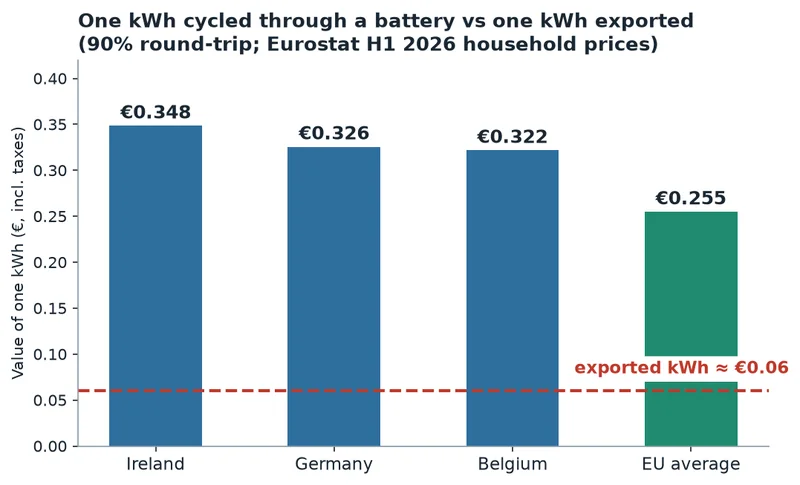
Here zero export becomes an advantage: an exported kWh earns the market price or a feed-in tariff, call it €0.06. A stored kWh avoids a retail kWh. At 90% round-trip efficiency and the EU average household price of €0.2832/kWh in the first half of 2026 (Eurostat, nrg_pc_204), that is €0.255 of avoided import; in Germany, €0.326.
On a 10 kWh battery at 200 full cycles a year, 1,800 kWh delivered is worth €510 at the EU average and €651 in Germany; the same energy pushed to the grid would earn about €108. Under a zero-export cap, storage is worth five to six times what export is worth — the highest value per stored kWh in the European residential market. It is also why the rooftop obligation and the connection queue push the same way.
The caveat is unchanged: a €6,500–€8,500 installed 10 kWh system still pays back over eight to eleven years. What zero export changes is the comparison set: without a battery the alternative is not “export and earn”, it is “do not connect”.
Which subsidy programmes still pay
Support rules rarely mention export limits, but two conditions recur: the battery must be new and grid-connected, and the installation declared. Both hold at 0 kW.
| Market | Programme | What it pays | Watch out |
|---|---|---|---|
| Germany | KfW 270 / 442 | Low-interest loan; 442 grant closed | Apply before ordering |
| France | MaPrimeRénov’ 2026 | Heat-pump tiers €5,000 / 4,000 / 3,000 | Battery on a separate invoice |
| Italy | Conto Termico 2.0 | Up to 65% of eligible cost | Storage needs a renewable source |
| Netherlands | Salderingsregeling | Netting ends 1 January 2027 | Export value collapses |
| Poland | Mój Pr&ad;d / PME 2 | 30% of cost, PLN 800/kWh, cap PLN 16,000 | Short call windows |
| Czechia | NZÚ | CZK 75,000 for PV + storage | Paused between rounds |
| Romania | Casa Verde 2026 | RON 20,000 for storage | Local registration queue |
| Greece | HDB retrofit programme | 45–75% grant by income band | Zero export preferred on saturated islands |
Installer checklist before you sign the connection
- Get the export figure in kW, in writing, with its averaging window.
- Confirm the metering point and the control-load arrangement.
- Specify fail-safe-to-zero behaviour and prove it at commissioning.
- Keep the certified control documentation in the handover pack; auditors ask for it.
- Check the permit position separately; a zero-export modality can remove one filing and add another.
Zero export is not a downgrade. It is a different specification: storage-first, control-certified, and sized to the load rather than the array. If you are working through a capped connection in Germany, Spain, the Netherlands, Poland or Italy, talk to our team about a system built for it, and see the battery range we supply across the EU. The German §14a regime is covered in our guide to grid-fee avoidance; more about Insum Energy is here, and our full catalogue sits on insumenergy.com.