Flood-Zone Battery Installation in the EU: 2026 Siting Rules
Water is the one hazard a lithium battery never forgives. Across the EU, floods are already the most common and most expensive natural disaster, and 2024’s events in Valencia and southern Germany pushed the question onto every installer’s desk: can a home battery legally and safely sit in a mapped flood zone? The answer in 2026 is a firm yes, but only above the water line. This guide sets out the law, the IP-rating reality, the insurer’s view and a siting checklist that keeps a 10 kWh LiFePO4 pack out of trouble.
Floods Are Europe’s Costliest Climate Hazard
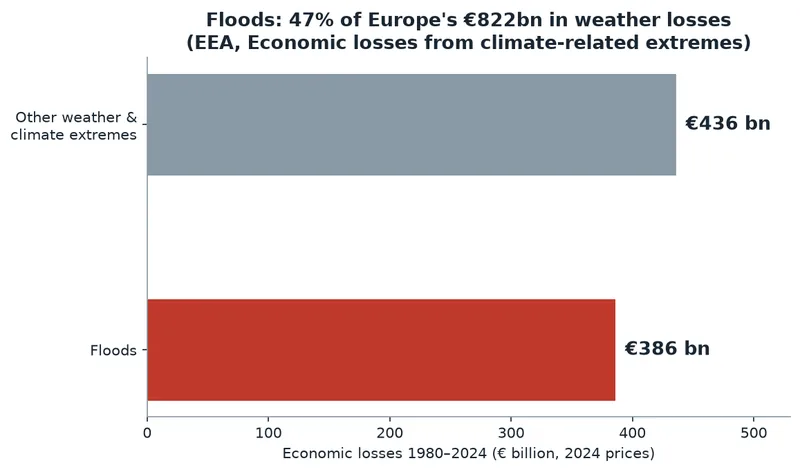
The European Environment Agency puts weather- and climate-related economic losses in Europe at roughly €822 billion between 1980 and 2024, with floods responsible for the largest single share — around 47 percent (EEA, Economic losses from climate-related extremes). Floods are, by the Agency’s own description, the most common and most costly natural disasters on the continent. Between 1980 and 2023, extreme weather caused around 240,000 fatalities in Europe and about €738 billion in losses — and less than a third of non-human losses were insured (EEA, Climate change impacts). The Commission adds that only one euro in five of climate-related losses is insured today (European Commission, 27 October 2026). That same day the Commission tabled a European climate resilience law, signalling tighter mapping and risk disclosure ahead (European Commission, Climate Resilience Framework).
The legal foundation is unchanged: Directive 2007/60/EC (the Floods Directive) obliges every member state to map flood hazard and risk for 14,000 identified areas of potentially significant flood risk, and to run six-year Flood Risk Management Plan cycles — the third runs 2022–2027 (European Commission, Floods). If your home appears on those maps, your battery’s mounting height is no longer a styling choice.
What National Law Actually Requires
No EU directive tells a homeowner how high to mount a battery. The binding rules arrive through national flood-zone regulations, building codes and insurers’ conditions. Four markets show how differently they land on a residential battery:
- Germany. Section 78 of the Federal Water Act (WHG) bans structural installations in designated flood zones, and §78b requires flood-adapted construction in extreme-flood-risk areas — which in practice means raising electrical equipment above the design water level (WHG §78, gesetze-im-internet.de).
- France. Flood Prevention Plans (PPRI) commonly require electricity metering cabinets and all water-sensitive equipment to sit at least 0.50 m above the highest known flood level, with vulnerability-reduction works mandatory up to 10 percent of property value within five years. Plans are searchable by address on georisques.gouv.fr.
- Spain. Royal Decree 903/2010 transposed the Floods Directive, and the SNCZI national map viewer publishes T10/T100/T500 flood envelopes (MITECO, SNCZI). Inside the zona de flujo preferente, new vulnerable installations are heavily restricted after the Valencia DANA of October 2024.
- Netherlands. PGS 37 is the national guideline for lithium storage; PGS37-1 covers home systems up to 20 kWh, and insurers routinely refuse cover for installations that ignore it (Publicatiereeks Gevaarlijke Stoffen 37). Dutch installers also avoid basements precisely because of water.
IP Ratings Will Not Save a Drowned Battery
Here is the most common marketing trap. An IEC 60529 IP65 rating — the outdoor standard on most modern batteries — certifies resistance to water jets, not standing water. IP67 means temporary immersion at one metre for thirty minutes under laboratory conditions; no residential battery is certified for repeated flood submersion in silt-laden, contaminated water. Silt, sewage and dissolved salts attack terminals and cable glands long before cells fail, and repeated wet–dry cycles corrode aluminium busbars from the outside in. Manufacturer manuals are explicit: SMA’s installation manual requires that on flood plains the battery site be elevated and permanently protected from water contact (SMA Home Storage manual).
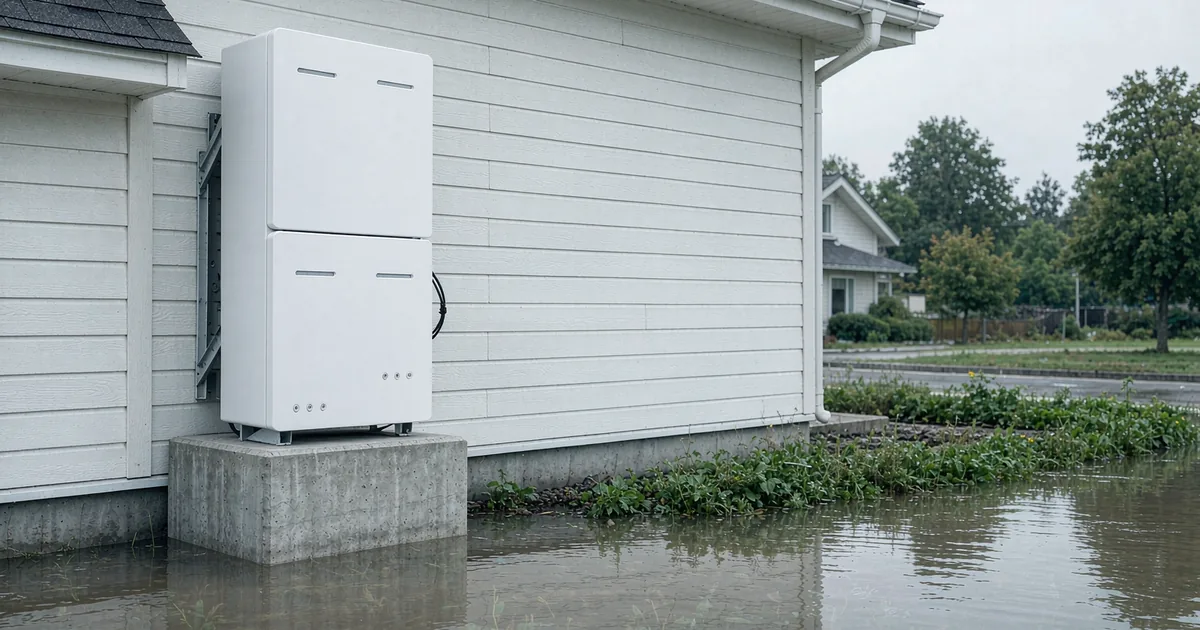
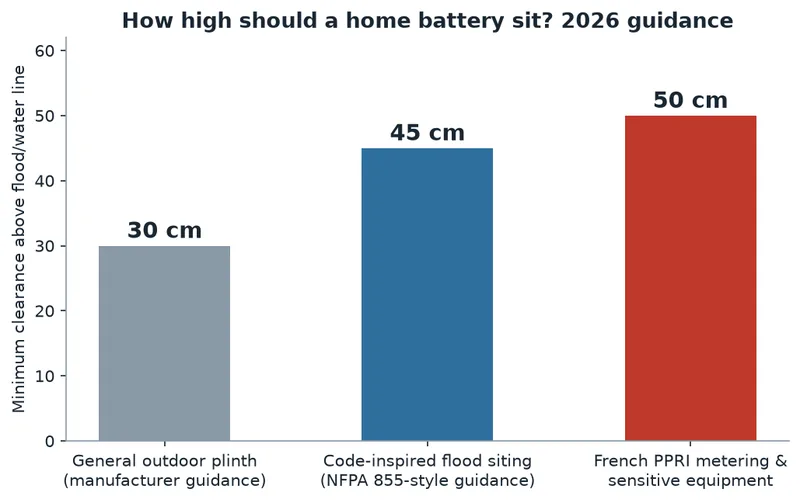
Practically, three mounting heights recur in 2026 guidance: a minimum 30 cm plinth for general outdoor clearance, 45 cm above finished floor or flood level in code-inspired North American guidance, and 50 cm above the reference flood line in French PPRI regulations. In a real mapped flood zone, take the highest applicable figure — and add freeboard for climate-driven record events.
A Siting Checklist for Installers
- Check the map first. Pull the address from the national flood viewer (SNCZI in Spain, georisques in France, state flood portals in Germany) before quoting.
- Mount above the reference flood level plus 0.5 m. Wall brackets, not floor stands, in ground-floor and basement-adjacent rooms.
- Avoid basements and ground-floor utility niches in T100 or T500 zones entirely — upper floors or garages on raised slabs are the safe default.
- Seal cable entries with compression glands so water cannot wick along conduits, and keep DC isolators and AC disconnects above the flood line too.
- Fit a water-leak sensor wired to open the DC contactor at first contact — it converts a total loss into a damp afternoon.
- Anchor outdoor cabinets against buoyancy and debris, and document the mounting height in the handover file.
This checklist complements the general permit and placement rules covered in our EU battery permit guide, and pairs naturally with the corrosion logic in our coastal salt-air guide.
Insurance: The Part Most Owners Skip
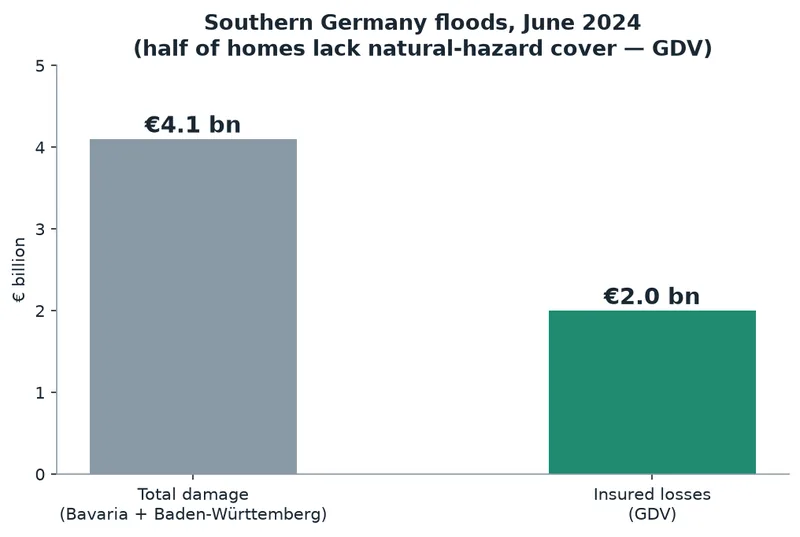
Insurers are the quiet enforcers of flood-zone siting. In Germany, only about half of residential buildings carry natural-hazard cover, and the June 2024 southern Germany floods generated roughly €2 billion in insured losses out of €4.1 billion in total damage (GDV, 2024). German insurers use flood-risk databases such as ZÜRS Geo to price or decline cover, and a battery bolted into a mapped cellar will not help a claim. In Spain, the Consorcio de Compensación de Seguros paid out over €4 billion on more than 210,000 claims from the 2024 DANA (Consorcio, SNCZI analysis). France’s Cat-Nat scheme and Spain’s Consorcio pay where private policies do not, but both ask the same question after an event: was the equipment installed above the flood line, per code? Dutch insurers condition cover on PGS 37 compliance, and German insurers price water risk through databases such as ZÜRS Geo — a battery bolted into a mapped cellar will not help a claim.
After a Flood: Never Reconnect a Wet Battery
If a battery has been submerged — even partially — the rule is absolute: do not attempt to charge, restart or bypass it. Damaged lithium packs can ignite hours, days or even weeks after water exposure, and a water-damaged residential energy storage system must not be re-energised until a qualified technician has inspected and cleared it (US Fire Administration flood guidance; Country Fire Service, SA). Flood-exposed batteries should be disconnected from chargers, removed from buildings, isolated from combustibles on non-combustible surfaces, and disposed of as hazardous waste — never in household bins or storm debris (US Fire Administration flood guidance; Country Fire Service, SA). Our LiFePO4 fire safety guide covers the emergency response in detail. For grid-dependent homes, this is also the honest argument for keeping backup expectations realistic: a 10 kWh pack buys hours, not days (Dunkelflaute explainer).
What Subsidies Still Fund in 2026
Batteries themselves are rarely grant-aided directly, but the 2026 national schemes below still apply to PV-plus-storage packages — and flood-adapted mounting (brackets, raised plinths, relocation work) is normally invoiced as part of the qualifying installation.
| Country | Scheme (2026 status) | What you can claim |
|---|---|---|
| Germany | KfW 442 closed; KfW 270 open | Low-interest loans for PV + storage |
| France | MaPrimeRénov’ 2026 | Heat-pump tiers €5,000/€4,000/€3,000; flood-vulnerability works via risk-prevention funds |
| Italy | Conto Termico 2.0 | Up to 65% deduction, €900m/year envelope |
| Netherlands | Salderingsregeling ends 31 Dec 2026 | Final full net-metering year — storage gains value in 2027 |
| Poland | Mój Prąd (PME 2) | 30% of storage cost, up to PLN 16,000 (~€3,700) |
| Czechia | NZÚ storage call | Up to CZK 75,000 (~€3,000) — call currently paused |
| Romania | Casa Verde 2026 | Up to RON 20,000 (~€4,000) for PV + storage |
| Greece | National PV + storage programme | 45–75% subsidy by region |
Sources: KfW, ANAH, GSE, Rijksoverheid, przydomowemagazyny.gov.pl, zelenausporam.cz, AFM, HDB.
The Bottom Line
In a mapped EU flood zone, the deciding factors are unglamorous: the reference flood level, a bracket at +0.5 m, sealed glands, a leak sensor and a paper trail your insurer accepts. The economics still work — with EU household electricity averaging €0.2896/kWh in the second half of 2025 (Eurostat nrg_pc_204), a well-placed battery earns its keep by evening shifting in any market, and routine servicing costs stay modest (O&M budget guide). Expect the new climate resilience law to make flood-zone disclosure stricter still when homes change hands. The siting, however, must be decided before the first flood, not after it.
Planning a battery in a flood-prone area? Contact Insum Energy for a site-specific quotation — our LiFePO4 storage range is specified for outdoor and elevated installations across the EU. Learn more about us or browse the product range and homepage.