LiFePO4 Fire Safety: Prevention, Detection & Emergency Response
Why LiFePO4 Fire Safety Matters in 2026
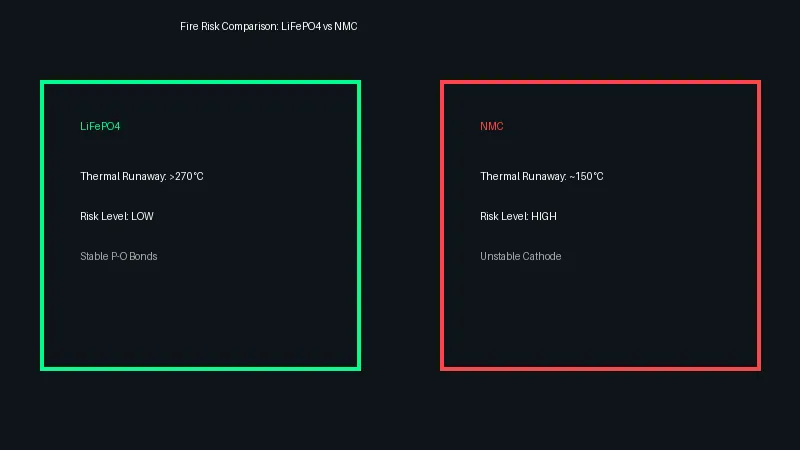
LiFePO4 (lithium iron phosphate) batteries are widely considered the safest lithium chemistry on the market. With a stable olivine crystal structure and thermal runaway temperature above 270°C (520°F), they are far less prone to fire than NMC or LCO lithium batteries. However, “safer” does not mean “safe.” Under abuse conditions — overcharge, physical damage, manufacturing defects, or BMS failure — LiFePO4 cells can still fail and ignite.
As home energy storage systems scale up in 2026, with 280Ah and 314Ah cells becoming standard in residential installations, understanding fire safety is no longer optional. This guide covers three pillars: prevention, detection, and emergency response.

Understanding LiFePO4 Fire Risks
What Causes LiFePO4 Thermal Runaway?
Thermal runaway is a self-reinforcing chain reaction where rising cell temperature causes internal exothermic reactions, which generate more heat, further raising temperature. For LiFePO4, this typically requires:
- Overcharge: Charging beyond 3.65V per cell breaks down the electrolyte and triggers oxygen release from the cathode.
- External short circuit: High-current fault that overheats internal components.
- Physical damage: Punctured or crushed cells can develop internal shorts.
- Manufacturing defects: Contaminated electrodes or poor welding create latent failure points.
- Poor thermal management: Sustained high temperatures (>45°C) accelerate cell degradation and increase failure risk.
LiFePO4 vs NMC: Fire Risk Comparison
| Parameter | LiFePO4 | NMC (Lithium Nickel Manganese Cobalt) |
|---|---|---|
| Thermal runaway temperature | >270°C (520°F) | ~150–200°C (300–390°F) |
| Oxygen release from cathode | Very low (stable P-O bonds) | High |
| Fire propagation risk | Low (typically single-cell failure) | High (rapid pack-wide propagation) |
| Required abuse to ignite | Severe overcharge or extreme heat | Moderate overcharge or puncture |
| Post-fire toxicity | Lower (mainly phosphorus/iron compounds) | Higher (HF gas, toxic cobalt/nickel compounds) |
Prevention: How to Minimize Fire Risk
1. Choose a Quality BMS with Multi-Layer Protection
The Battery Management System is your first line of defense. A capable BMS for home energy storage should include:
- Overvoltage protection: Cuts off charge at 3.65V/cell (adjustable).
- Undervoltage protection: Disconnects load at 2.5–2.8V/cell to prevent deep discharge damage.
- Overcurrent protection: Hardware-level current sensing with <10ms response.
- Temperature cutoff: Charge cutoff at >55°C, discharge cutoff at >65°C.
- Cell balancing: Active balancing above 2A is recommended for large-capacity packs (280Ah+).
- Pre-charge circuit: Limits inrush current that can damage contactors or create sparks.
For home installations, Insum Energy’s integrated BMS solutions provide multi-layer protection specifically designed for residential LiFePO4 systems.
2. Proper Thermal Management Design
Heat is the enemy of battery safety. Every 10°C increase in operating temperature roughly doubles the rate of cell degradation — and increases fire risk.
- Passive cooling: Install batteries in a well-ventilated enclosure with natural convection. Maintain at least 5cm clearance on all sides.
- Active cooling: For high-current applications (>100A continuous), install temperature-controlled fans that activate at 35°C.
- Avoid direct sunlight: Battery enclosures should never be placed in direct solar exposure.
- Climate considerations: In hot climates (ambient >35°C), consider an air-conditioned battery room or active liquid cooling.
3. Correct Installation Practices
- Use appropriately sized copper cables — undersized wiring creates resistance heating.
- Torque terminal connections to manufacturer specs (typically 10–12 Nm for M8 studs). Loose connections cause arcing.
- Install a DC-rated fuse or circuit breaker within 18 inches of the battery positive terminal.
- Never install LiFePO4 batteries in habitable spaces (bedrooms, living rooms) — use a dedicated battery room or outdoor-rated enclosure.
- Ensure the battery enclosure has a fire rating of at least 30 minutes (EN 13501-1 or equivalent).
4. Use Certified Grade A Cells
Counterfeit or Grade B LiFePO4 cells are a leading cause of battery fires in DIY installations. Always verify:
- QR code on the cell body matches the manufacturer’s database (EVE, CATL, REPT all provide online verification).
- Supplier provides a valid UN38.3 test report.
- Cells have recognizable laser-etched markings (not printed/sticker labels).
Detection: Early Warning Systems
Prevention reduces risk, but detection ensures that if something goes wrong, you have time to respond before a small incident becomes a major fire.
Temperature Monitoring
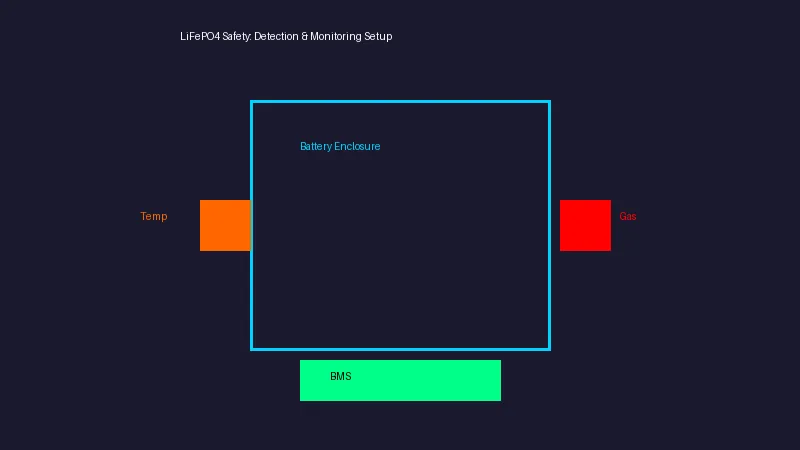
Your BMS should log cell temperatures, but a separate temperature monitoring system adds redundancy. Install NTC thermistors on the battery terminals and log data to a cloud dashboard. Set alerts for:
- Any cell temperature >50°C
- Temperature delta between cells >10°C (indicates poor balancing or internal fault)
Smoke and Gas Detection
Standard smoke detectors are not enough. LiFePO4 off-gassing before thermal runaway includes:
- Carbon monoxide (CO): Detectable with standard CO alarms.
- Hydrogen fluoride (HF) precursor gases: Specialized electrochemical gas sensors can detect electrolyte breakdown before fire starts.
- VOCs (volatile organic compounds): Indicate electrolyte leakage.
Install a multi-gas detector in the battery enclosure, with the alarm connected to both a local siren and a remote notification (SMS/app alert).
Battery Enclosure Design for Safety
A well-designed enclosure contains small failures and prevents them from spreading:
- Fire-resistant materials: Use steel or aluminum enclosures, not plastic. Steel with high-temperature powder coating is ideal.
- Ventilation with backdraft damper: Allows off-gassing to escape without letting outside air feed a fire.
- Compartmentalization: For multi-pack systems, physically separate packs into fire-resistant compartments.
- Aerosol fire extinguisher: Install an automatic aerosol suppression canister inside the enclosure (triggers at 70°C). These are compact, maintenance-free, and specifically effective for lithium battery fires.
Emergency Response: What to Do If It Happens
If You Smell Something or See Smoke
- Do NOT open the battery enclosure. Oxygen will feed the fire.
- Cut the main isolation switch (DC disconnect) if safe to access.
- Evacuate the area — LiFePO4 fires can produce toxic gases including hydrogen fluoride.
- Call emergency services — tell them it is a “lithium battery fire” so they bring appropriate extinguishing agents.
Extinguishing a LiFePO4 Battery Fire
Conventional water extinguishers are not recommended for lithium battery fires — although they can cool the cells, they risk electrical shock and do not prevent re-ignition.
- Class D fire extinguishers: Designed for metal fires, effective on lithium.
- Aerosol suppression: Condensed aerosol generators (e.g., FirePro, Stat-X) are highly effective in enclosed battery spaces.
- Copious amounts of water: Only for large-scale outdoor installations where electrical isolation is confirmed. Flooding the battery with water cools it and prevents re-ignition, but requires thousands of liters.
- DO NOT use CO₂ or standard dry chemical extinguishers — they will not cool the cells and thermal runaway will continue.
After the Incident
Even after the visible fire is out, LiFePO4 cells can re-ignite hours later as remaining energy in neighboring cells triggers new thermal runaway. Keep the area evacuated and monitored for at least 24 hours. Damaged cells must be disposed of as hazardous waste — do not reuse or attempt to recharge them.
Regulatory Standards and Certifications to Look For
When purchasing LiFePO4 batteries or components in 2026, verify these certifications:
| Certification | What It Covers | Why It Matters for Fire Safety |
|---|---|---|
| UL 1973 | Battery safety for stationary storage | Tests thermal, electrical, and mechanical abuse scenarios |
| UL 9540 | Energy storage system safety | Full system integration test (battery + inverter + BMS) |
| IEC 62619 | Secondary Li batteries for industrial applications | International standard for safety requirements |
| UN 38.3 | Transport safety of lithium batteries | Altitude, vibration, shock, and thermal testing |
| CE (EN 62109) | EU safety compliance for power converters | Required for legal installation in EU countries |
Conclusion
LiFePO4 batteries are the safest choice for home energy storage, but safety is not automatic — it is engineered. A proper BMS, thermal management, quality cells, and early detection systems work together to reduce fire risk to near zero. For homeowners and installers alike, the cost of these safety measures is a fraction of the cost of a single battery fire.
Learn more about Insum Energy’s safety-first design philosophy, or contact our team for a customized, code-compliant LiFePO4 storage solution tailored to your home or business.
Ready to build a safe, reliable energy storage system?
Contact Insum Energy today for a free consultation and quote. Our LiFePO4 battery solutions are engineered for safety, certified to international standards, and backed by expert support.