
JK BMS vs Daly BMS vs JBD BMS: Complete 2026 Comparison Guide
If you’re building a LiFePO4 battery system in 2026, one of the most critical decisions you’ll make is choosing the right Battery Management System (BMS). The BMS acts as the brain of your battery pack, protecting cells from overcharge, over-discharge, short circuits, and temperature extremes. Three brands dominate the market: JK BMS, Daly BMS, and JBD BMS (also called Overkill Solar). In this comprehensive guide, we’ll break down each brand’s features, performance, pricing, and ideal use cases to help you make an informed decision.
What Does a BMS Do?
Before diving into brand comparisons, let’s understand why a BMS matters. A quality Battery Management System performs several essential functions:
- Cell Balancing: Ensures all cells in a battery pack charge and discharge evenly, maximizing capacity and lifespan
- Overcharge/Over-discharge Protection: Prevents cells from reaching dangerous voltage levels that could cause permanent damage or safety hazards
- Temperature Monitoring: Protects cells from thermal runaway by cutting off charging or discharging when temperatures exceed safe limits
- Current Limiting: Prevents damage from short circuits or excessive current draw
- Communication: Many modern BMS units communicate with inverters and monitoring systems via CAN bus, RS485, or Bluetooth

JK BMS: The Premium Professional Choice
JK BMS has established itself as the premium option in the home energy storage market. Known for exceptional build quality and advanced features, JK BMS units are favored by professional installers and high-end residential systems.
Key Features of JK BMS
- Intelligent Active Balancing: JK BMS uses active balancing technology that can transfer up to 5A between cells, significantly faster than passive balancing
- High Accuracy Sensing: Voltage measurement accuracy within ±10mV ensures precise monitoring
- Robust Communication: Supports RS485, CAN bus, and Bluetooth connectivity with dedicated apps
- Wide Temperature Range: Operating range from -20°C to 60°C makes them suitable for various climates
- High Current Ratings: Models available up to 200A continuous discharge current
Pros of JK BMS
- Superior build quality and reliability
- Advanced active balancing extends battery life
- Comprehensive protection features
- Excellent customer support
- Compatible with major inverter brands (Victron, SMA, Growatt)
Cons of JK BMS
- Higher price point (30-50% more than competitors)
- Configuration can be complex for beginners
- Limited availability in some regions
Daly BMS: The Budget-Friendly Workhorse
Daly BMS has become the go-to choice for budget-conscious builders and DIY enthusiasts. While not as feature-rich as JK, Daly offers reliable basic protection at a fraction of the price.
Key Features of Daly BMS
- Passive Balancing: Standard passive balancing with 30-100mA balancing current
- Basic Protection Functions: Over-charge, over-discharge, over-current, and short circuit protection
- Simple Bluetooth App: User-friendly smartphone app for basic monitoring
- Wide Cell Support: Compatible with LiFePO4, NCM, and other lithium chemistries
- Affordable Pricing: Entry-level models starting under $30
Pros of Daly BMS
- Excellent value for money
- Easy to install and configure
- Widely available worldwide
- Large community support and documentation
- Good for 12V and 24V DIY battery projects
Cons of Daly BMS
- Passive balancing is slower and less efficient
- Lower current ratings on budget models
- Less accurate voltage sensing (±20-30mV)
- Limited inverter compatibility
- Quality control inconsistencies between batches
JBD BMS (Overkill Solar): The Smart Integrator’s Choice
JBD BMS, distributed through Overkill Solar, bridges the gap between budget and professional options. Known for excellent firmware and smart features, JBD has carved out a loyal following among system integrators.
Key Features of JBD BMS
- Smart Protection IC: Integrated protection with configurable parameters
- Bluetooth Connectivity: Dedicated app with detailed monitoring and logging
- Multiple Communication Protocols: UART, RS485, and CAN bus options
- Configurable Thresholds: User-adjustable voltage, current, and temperature limits
- LED Status Indicators: Visual feedback for system status
Pros of JBD BMS
- Excellent firmware with regular updates
- Good balance of features and price
- Strong community support
- Overkill Solar provides quality packaging and documentation
- Good for 4S to 16S configurations
Cons of JBD BMS
- Limited high-current models
- Active balancing only on premium models
- Some compatibility issues with certain inverter brands
- Documentation can be sparse
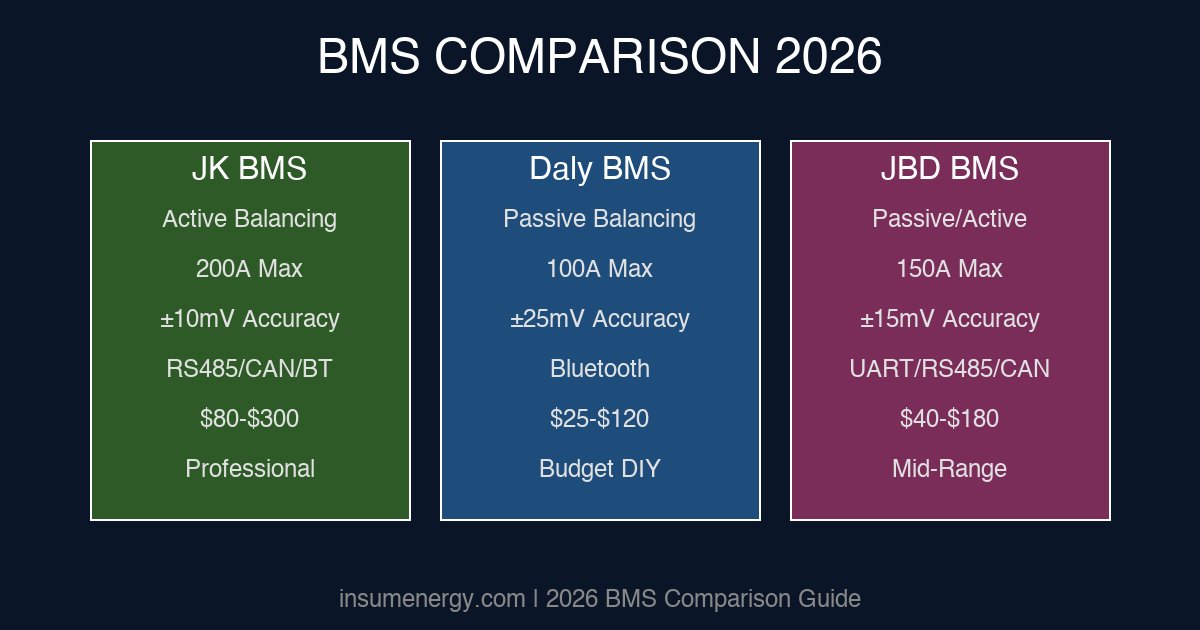
Head-to-Head Comparison Table
| Feature | JK BMS | Daly BMS | JBD BMS |
|---|---|---|---|
| Balancing Type | Active (up to 5A) | Passive (30-100mA) | Passive/Active (select models) |
| Voltage Accuracy | ±10mV | ±20-30mV | ±15mV |
| Max Current | 200A | 100A | 150A |
| Communication | RS485, CAN, Bluetooth | Bluetooth only | UART, RS485, CAN |
| Temperature Range | -20°C to 60°C | -10°C to 50°C | -10°C to 55°C |
| Price Range | $80-$300 | $25-$120 | $40-$180 |
| Best For | Professional installations | DIY projects | System integrators |
| Inverter Compatibility | Excellent | Limited | Good |
Which BMS Should You Choose?
The right BMS depends on your specific requirements, budget, and technical expertise. Here’s our recommendation breakdown:
Choose JK BMS If:
- You’re building a professional-grade home energy storage system
- You need high current handling (100A+ continuous)
- You want the longest battery lifespan through active balancing
- You’re installing in extreme temperature environments
- Budget is not your primary concern
Choose Daly BMS If:
- You’re building a small DIY system (12V or 24V)
- Budget is your primary constraint
- You’re new to battery systems and want easy setup
- You need basic protection without advanced features
- You’re building a portable power station or camping battery
Choose JBD BMS If:
- You want good features at a mid-range price
- You’re comfortable with configuration and troubleshooting
- You need UART or RS485 communication for your inverter
- You want regular firmware updates and community support
- You’re building a 48V system for medium-scale storage

Installation Tips for All BMS Brands
Regardless of which BMS you choose, follow these best practices for optimal performance and safety:
- Proper Wiring: Use appropriately sized cables for your current requirements. Undersized wiring causes voltage drops and overheating.
- Secure Connections: Use quality terminal blocks and ensure all connections are tight. Loose connections cause resistance and heat buildup.
- Temperature Sensing: Place temperature sensors directly on the battery cells, not just on the BMS board.
- Initial Configuration: Set your BMS parameters to match your specific cell manufacturer’s specifications.
- Regular Monitoring: Check your BMS app regularly to monitor cell voltages and identify any imbalances early.
- Firmware Updates: Keep your BMS firmware updated for the latest features and bug fixes.
Conclusion
Choosing the right BMS is crucial for the performance, safety, and longevity of your LiFePO4 battery system. JK BMS offers the best protection and features for professional installations, while Daly BMS provides excellent value for DIY projects. JBD BMS strikes a balance between the two, making it ideal for intermediate users and system integrators.
At Insum Energy, we recommend matching your BMS choice to your project requirements. If you’re unsure which BMS is right for your system, our technical team can help you select the optimal solution for your specific needs.
Need help choosing the right BMS for your project? Contact Insum Energy today for expert consultation and competitive pricing on quality BMS units and complete battery solutions.
Have questions about BMS selection or need a custom battery system design? Reach out to our team – we’re here to help you build reliable, efficient energy storage solutions.