EU Ecodesign Regulation for Batteries 2026: Design & Repairability Rules
The EU is rewriting the rules for how batteries are designed, manufactured, and retired. Two landmark regulations — the Batteries Regulation (EU) 2023/1542 and the Ecodesign for Sustainable Products Regulation (ESPR, EU) 2024/1781 — are now phasing in obligations that will fundamentally reshape the home and commercial battery storage market across Europe. For EU installers, distributors, and homeowners, understanding these ecodesign requirements is no longer optional — it is a purchasing criterion that affects compliance, resale value, and total cost of ownership.
What the EU Ecodesign Framework Means for Battery Storage
The ESPR, in force since 18 July 2024, replaces the old Ecodesign Directive 2009/125/EC and dramatically expands its scope. Where the directive covered only energy-related products, the ESPR empowers the European Commission to set ecodesign requirements — durability, repairability, recyclability, recycled content, carbon footprint — for almost any physical product placed on the EU market. Battery storage systems are squarely in scope.
The ESPR works through delegated acts: sector-specific regulations that define exact data fields, performance thresholds, and compliance dates for each product category. The first working plan (COM(2025) 187) was adopted in April 2025 and covers the period through 2030. While batteries fall primarily under the separate Batteries Regulation, the ESPR framework adds overlapping obligations — particularly the Digital Product Passport (DPP) registry, which went live on 20 July 2026.
For stationary battery energy storage systems (BESS), the practical implications are immediate: products that cannot demonstrate ecodesign compliance will face market access restrictions, customs barriers, and exclusion from public procurement. The EU DPP registry now requires every covered product to carry a unique registration identifier verified at the border.
Five Core Ecodesign Requirements for Batteries in 2026–2027
1. Carbon Footprint Declaration (Already Live)
Since 18 February 2026, all rechargeable industrial batteries above 2 kWh — which includes most home and commercial storage systems — must carry a carbon footprint declaration per model and manufacturing plant. The declaration must be calculated according to the European Commission’s prescribed methodology and expressed in kg CO₂e per kWh of total energy delivered over the battery’s expected lifetime.
This is not a future deadline. Batteries entering the EU market after February 2026 without a valid carbon footprint declaration are, in principle, non-compliant. For standard industrial batteries, performance class requirements follow in August 2026, and maximum lifecycle carbon footprint thresholds arrive in February 2028. Note that batteries with exclusively external storage (typical containerised BESS) have deferred timelines — performance classes in August 2030 and maximum thresholds in February 2032 — but the direction is identical.
2. Digital Battery Passport (18 February 2027)
From 18 February 2027, every EV battery, LMT battery, and industrial battery above 2 kWh placed on the EU market must carry a Digital Battery Passport accessible via a QR code. The passport contains roughly one hundred data fields per Annex XIII of the Batteries Regulation, including:
- Manufacturer identity and model specifications
- Carbon footprint declaration and performance class
- Material composition and recycled content percentages
- Supply chain due diligence information
- State of health (SoH) data updated via the BMS
- Repair, disassembly, and end-of-life instructions

Three details demand preparation now. First, the passport is per individual battery, not per model — the BMS is the primary data source, so BMS data fields must be aligned today. Second, access is tiered: the public, repair operators, and market surveillance authorities see different content layers. Third, batteries with replaced cells or modules count as a new placing on the market and trigger fresh conformity assessment — repair records must become updatable passport content.
3. Recycled Content Minimums (2028–2031)
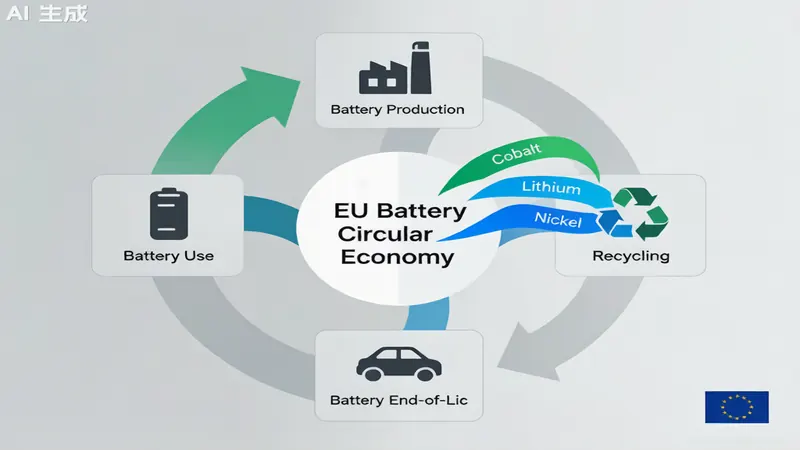
The regulation sets mandatory minimum recycled content for cobalt, lead, lithium, and nickel in new batteries. Documentation obligations begin on 18 August 2028. Mandatory minimum thresholds take effect from 18 August 2031:
| Material | 2028 Declaration | 2031 Minimum | 2036 Target |
|---|---|---|---|
| Cobalt | Documented | 16% | 26% |
| Lead | Documented | 85% | 85% |
| Lithium | Documented | 6% | 12% |
| Nickel | Documented | 6% | 15% |
For LiFePO4 battery buyers, this is largely favourable: LFP chemistry contains no cobalt or nickel, simplifying compliance. Lithium recovery requirements still apply, but the overall regulatory burden is lighter than for NMC alternatives. This aligns with the broader EU push toward carbon-conscious battery sourcing.
4. Repairability and Modularity Requirements
The Batteries Regulation requires that stationary and industrial batteries be designed so that spare parts are available and repair information is provided for a defined period. This pushes manufacturers toward modular packs with replaceable cells and serviceable BMS modules rather than glued, unserviceable blocks. The Right to Repair Directive (EU) 2024/1799, which Member States must transpose by 31 July 2026, strengthens this further by giving consumers a right to affordable out-of-warranty repair.
For EU buyers, the practical test is concrete: can individual cells or modules be replaced without destroying the enclosure? Is the BMS a €80–€250 replaceable part rather than a reason to scrap a €6,000 pack? Are wiring diagrams and error codes published? These are now purchasing criteria, not nice-to-haves.
5. Performance, Durability, and Safety Standards
Since 18 August 2024, rechargeable industrial batteries above 2 kWh must be accompanied by performance and durability documentation (Annex IV). Stationary BESS must be safe in normal use and documented against Annex V safety parameters. The BMS must maintain up-to-date state-of-health data — remaining capacity, remaining power capability, round-trip efficiency, self-discharge rates, and ohmic resistance where technically feasible — with read-only access for the battery owner, independent operators, and waste operators.
How Ecodesign Affects the Economics of Battery Storage in the EU
The ecodesign requirements are not just compliance paperwork — they directly affect the financial equation for EU homeowners and businesses investing in battery storage. Here is how:
Resale and second-life value. A battery with a valid Digital Passport and documented SoH history is a tradeable asset. A battery without one is a liability. European commercial banks and insurers are already adjusting risk assessment models: energy storage assets lacking full lifecycle traceability face valuation discounts or financing difficulties. This is especially relevant for warranty and insurance claims.
Longer service life through repairability. A modular, repairable LiFePO4 pack with 6,000+ cycles should deliver 10–15 years of service. With German household electricity prices at approximately €0.32–€0.35/kWh in 2026, Dutch dynamic contracts around €0.28/kWh, and Spanish PVPC tariffs ranging €0.10–€0.25/kWh, every additional year of service is significant. Avoiding a premature €4,500–€9,000 replacement keeps self-consumption savings flowing.
Compliance costs and supply chain readiness. Manufacturers must invest in lifecycle assessment infrastructure, BMS data systems, and supply chain traceability. These costs will be reflected in pricing — but non-compliant products will simply not reach the EU market. Buyers should verify that their supplier has a documented compliance roadmap before purchasing.
Timeline: Key Ecodesign Deadlines for Battery Storage
| Date | Obligation | Scope |
|---|---|---|
| 18 Feb 2026 | Carbon footprint declaration | Rechargeable industrial batteries >2 kWh (standard) |
| 18 Aug 2026 | Carbon footprint performance classes | Standard industrial batteries |
| 19 Jul 2026 | EU DPP registry live | All products requiring digital passports |
| 31 Jul 2026 | Right to Repair Directive transposition | All EU Member States |
| 18 Feb 2027 | Digital Battery Passport mandatory | EV, LMT, industrial batteries >2 kWh |
| 18 Feb 2027 | QR code and removability rules | Portable batteries in products |
| 18 Aug 2027 | Supply chain due diligence | Operators with turnover >€40M |
| 18 Aug 2028 | Recycled content documentation | EV, SLI, industrial >2 kWh |
| 18 Aug 2030 | Carbon footprint performance classes | Batteries with external storage (typical BESS) |
| 18 Aug 2031 | Mandatory minimum recycled content | EV, SLI, industrial >2 kWh |
What EU Buyers, Installers, and Distributors Should Do Now
Whether you are a homeowner evaluating a battery storage system or a distributor sourcing products for the European market, the ecodesign transition requires action before the 2027 deadlines:
- Verify carbon footprint compliance. Ask your supplier for the carbon footprint declaration required since February 2026. If they cannot provide it, the product may not be legally placeable on the EU market.
- Check Digital Battery Passport readiness. Confirm that the manufacturer has a documented plan for passport data fields, QR code integration, and BMS data alignment. Passport-ready has little contractual value unless the digital deliverable can be verified.
- Prioritise modular, repairable designs. Choose systems with swappable cells, replaceable BMS, and published repair documentation. This protects your investment and aligns with the Right to Repair Directive. For more on this topic, see our EU Right to Repair guide for home batteries.
- Plan for end-of-life obligations. Extended Producer Responsibility (EPR) registration is already mandatory. Producers must register in each EU Member state where they place batteries on the market. Understand the EPR fees and recycling rates by country before you commit to a supplier.
- Assess second-life pathways. The regulation encourages reuse before recycling. A battery with documented SoH history and a valid passport can enter second-life applications — stationary storage from retired EV packs — creating residual value. Our guide to EU battery recycling and second life covers this in depth.
The Bottom Line
The EU ecodesign framework is transforming battery storage from a commodity purchase into a regulated lifecycle asset. Products that meet the new standards — modular design, carbon transparency, digital traceability, repairability — will hold their value longer, face fewer market access barriers, and deliver better total cost of ownership. Products that do not will be progressively shut out of the European market.
For EU households and businesses, the message is clear: buy compliant, buy modular, buy repairable. The regulations are not a barrier — they are a quality filter that rewards better-engineered products and protects your investment over a 10–15 year service life.
Ready to choose a compliant, future-proof battery storage system? Contact Insum Energy for expert guidance and a tailored quote, or explore our battery storage product range to find the right system for your needs.