
Battery Recycling Rates & EPR Fees by EU Country 2026
The EU Battery Regulation (EU) 2023/1542 has entered a critical implementation phase in 2026, placing binding collection targets and Extended Producer Responsibility (EPR) obligations on every company placing batteries on the European market. For battery manufacturers, importers, distributors, and installers, understanding the recycling landscape is no longer optional — it directly affects product pricing, compliance costs, and market access.
This guide breaks down the current battery recycling rates across EU member states, explains how EPR fees vary by country and battery chemistry, and outlines what stakeholders must do to stay compliant. Whether you supply LiFePO4 battery systems to European customers or manage end-of-life logistics, this information is essential for your 2026 planning.
EU Battery Collection Targets Under Regulation 2023/1542
The revised EU Battery Regulation sets escalating collection targets for portable batteries that began in 2022 and run through 2031:
- 2022: 45% collection rate (already in force)
- 2027: 63% collection rate
- 2031: 73% collection rate
For LMT (light means of transport) batteries and SLI (starting, lighting, ignition) batteries, specific Producer Responsibility Organization (PRO) registration is mandatory. Industrial batteries — including most LiFePO4 home storage systems above 2 kWh — fall under separate EPR schemes requiring documented end-of-life management pathways.
Member states must report collection rates annually to the European Commission. Countries falling behind targets face infringement proceedings, which has pushed several governments to tighten enforcement in 2026.
Current Battery Recycling Rates by EU Country (2025-2026 Data)
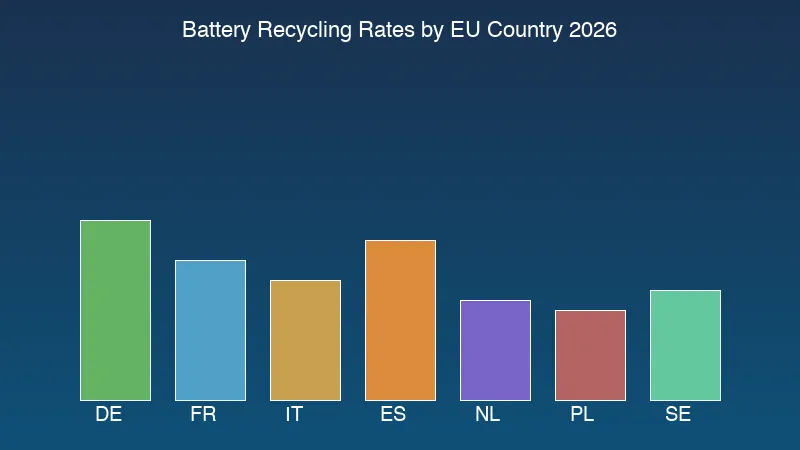
Collection rates vary dramatically across the EU, reflecting differences in infrastructure, enforcement, and consumer awareness. Based on the latest Eurostat figures and national regulatory reports:
| Country | Collection Rate (2024-2025) | 2027 Target Gap | EPR Fee Range (per kg) |
|---|---|---|---|
| Germany | 51% | -12 pts | €3.80 – €4.50 |
| France | 73% | +10 pts (on track) | €3.20 – €4.00 |
| Italy | 40% | -23 pts | €2.80 – €3.50 |
| Spain | 38% | -25 pts | €3.00 – €3.80 |
| Netherlands | 68% | +5 pts (on track) | €2.50 – €3.20 |
| Poland | 35% | -28 pts | €2.00 – €2.80 |
| Sweden | 70% | +7 pts (on track) | €3.50 – €4.20 |
| Czech Republic | 36% | -27 pts | €2.20 – €2.90 |
France, Sweden, and the Netherlands are already meeting or exceeding the 2027 target of 63%. Meanwhile, Southern and Eastern European countries — including Italy, Spain, Poland, and Czech Republic — face significant gaps that will require substantial investment in collection infrastructure and consumer education campaigns before 2027.
How EPR Fees Work for Batteries in the EU
Extended Producer Responsibility (EPR) shifts the financial burden of battery collection, transport, and recycling from municipalities to producers. Under Article 61 of EU Regulation 2023/1542, every producer must either:
- Join an authorized Producer Responsibility Organization (PRO) that manages collection and recycling on their behalf, or
- Oper an individual compliance scheme approved by the national authority
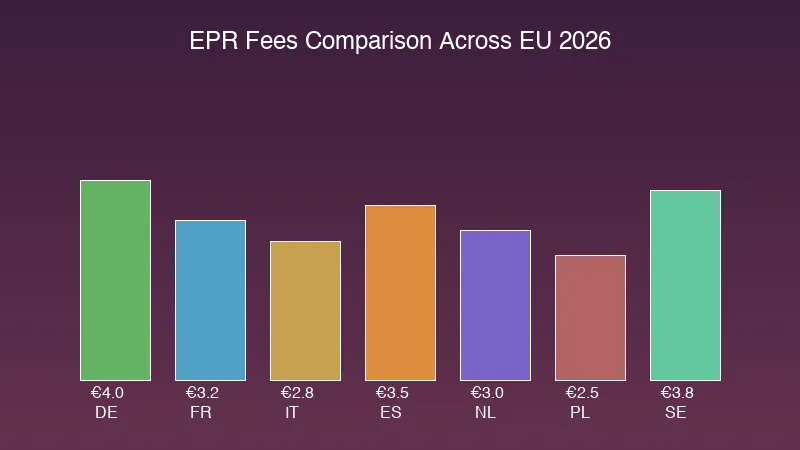
EPR fees are typically calculated per kilogram of batteries placed on the market, with rates varying by:
- Chemistry (LiFePO4, NMC, lead-acid, etc.)
- Battery category (portable, industrial, automotive, LMT)
- Recyclability of the battery design
- Country of placement
For LiFePO4 batteries, EPR fees are generally 10-15% lower than NMC due to the absence of cobalt and nickel recovery costs, and the simpler hydrometallurgical recycling process.
EPR Fee Breakdown: What Producers Actually Pay
The total EPR cost per kilogram of LiFePO4 battery placed on the EU market includes several components:
- Collection fee: €0.80 – €1.50/kg (funds public collection points and retail take-back)
- Transport fee: €0.40 – €0.80/kg (logistics to recycling facility)
- Processing fee: €0.60 – €1.20/kg (mechanical and hydrometallurgical processing)
- Administrative fee: €0.20 – €0.50/kg (PRO management, reporting, auditing)
- Eco-design modulation: -€0.20 to +€0.30/kg (fee reductions for recyclable design, penalties for hard-to-recycle designs)
Country-by-Country EPR Compliance Guide
Germany: Stiftung EAR & GRS Batterien
Germany operates a dual system: the Stiftung EAR (Stiftung Elektro-Altgeräte-Register) manages producer registration, while GRS Batterien (Gemeinsames Rücknahmesystem Batterien) is the largest PRO. Producers pay €3.80–€4.50/kg for LiFePO4 batteries. The BattG (Batteriegesetz) was updated in 2024 to align with the EU Regulation, introducing stricter reporting deadlines and increasing penalties for non-compliance to €100,000 per violation.
For German homeowners and installers, this means battery pricing already includes EPR costs. The KfW solar battery subsidy does not exempt producers from EPR obligations.
France: Corepile & Screlec
France has two main PROs: Corepile and Screlec. EPR fees range from €3.20–€4.00/kg for LiFePO4. France already achieves a 73% collection rate thanks to its well-established network of 50,000+ collection points and mandatory in-store take-back. The AGEC Law (Loi anti-gaspillage) adds a reparability index requirement for batteries above 2 kWh.
Italy: Remondis & Ecolight
Italy’s collection rate of 40% is among the lowest in Western Europe. PROs include Ecolight and Remondis Italia. EPR fees are €2.80–€3.50/kg. The Italian government announced a €180 million investment in collection infrastructure under Piano Nazionale di Ripresa e Resilienza (PNRR) funding to close the gap before 2027. This aligns with broader EU goals discussed in our EU Battery Regulations 2026 guide.
Spain: Ecopilas & Envalia
Spain’s 38% collection rate is the second-lowest in Western Europe. Ecopilas and Envalia are the primary PROs. EPR fees are €3.00–€3.80/kg. Spain’s Real Decreto 710/2024 updated the national framework to align with EU Regulation 2023/1542. The government plans 15,000 new collection points by end of 2026 to address the shortfall.
Netherlands: Stibat
The Netherlands has Stibat as its single PRO, offering the lowest EPR fees in the EU at €2.50–€3.20/kg thanks to high collection volumes and efficient processing. The 68% collection rate is supported by a deposit-return-style system for industrial batteries and mandatory retailer take-back.
Poland: REBA & Europmetro
Poland’s EPR landscape is fragmented, with REBA Organizacja Odzysku and Euroometro as key PROs. EPR fees are €2.00–€2.80/kg. The 35% collection rate reflects limited infrastructure in rural areas. Poland received €220 million in EU recovery funds specifically for battery collection infrastructure through 2026.
Sweden & Nordic Region
Sweden’s El-Kretsen operates one of Europe’s most efficient PROs, with EPR fees of €3.50–€4.20/kg but a 70% collection rate. Sweden’s success stems from municipal-level mandates and a well-funded consumer education program. This Nordic model is being studied by other member states. Learn more in our Nordic Battery Storage Guide 2026.
The Economics of LiFePO4 Battery Recycling in 2026
LiFePO4 battery recycling has reached economic break-even in 2026 — a milestone driven by three factors:
- Lithium carbonate prices stabilized at €18,000–€22,000/tonne, making recovery economically viable
- Hydrometallurgical process improvements now achieve 95%+ lithium recovery from LFP cathodes
- EPR fee revenue funds the gap between processing costs and material recovery value
For a typical 10 kWh LiFePO4 home battery (approximately 65 kg), the embedded EPR cost is €195–€280, representing 3-5% of the total battery system price. As recycling technology matures and economies of scale improve, these costs are projected to decline by 15-20% by 2030.
What Battery Importers and Distributors Must Do
If you place LiFePO4 batteries on the EU market — whether as a manufacturer, importer, or distance seller — your compliance checklist for 2026 includes:
- National registration: Register as a battery producer in every EU country where you sell. Each country has its own registry (e.g., Stiftung EAR in Germany, ADEME portal in France).
- PRO membership: Join a PRO in each country or establish an individual compliance scheme. Most importers choose PRO membership for simplicity.
- CE marking & labelling: Batteries must carry the CE mark, separate collection symbol (crossed-out wheeled bin), and chemical symbols (Li for lithium). From 2027, the battery passport QR code becomes mandatory.
- Reporting: Submit quarterly or annual reports on volumes placed on the market by chemistry and category. Penalties for non-reporting start at €10,000 in most countries.
- Financing: Pay EPR fees to your PRO. Some countries require a financial guarantee deposit for future recycling costs, typically €2–€5/kg depending on battery type.
- Design for recycling: Article 12 of the EU Battery Regulation requires batteries to be designed for reuse and recycling. Removable Design requirements apply from 2027. Our Right to Repair guide covers these design rules.
Recycling Infrastructure Investment Across the EU
The EU has allocated over €2 billion in funding for battery recycling infrastructure through IPCEI Batteries and the Innovation Fund. Key projects operational in 2026 include:
- Hydrovolt (Norway): 12,000 tonnes/year LFP recycling capacity
- Cylib (Germany): 30,000 tonnes/year integrated lithium and black mass recovery
- EcoLiB (France): 15,000 tonnes/year hydrometallurgical plant in Dunkirk
- Lithore (Italy): 8,000 tonnes/year pilot facility near Turin
- Batteryloop (Sweden): 10,000 tonnes/year focusing on industrial batteries
These facilities collectively provide approximately 75,000 tonnes of annual LiFePO4 recycling capacity, which the EU estimates will cover projected end-of-life volumes through 2028. For more on the end-of-life process, see our LiFePO4 End-of-Life Guide.
How EPR Fees Affect Battery Pricing for EU Buyers
For end consumers and installers purchasing LiFePO4 battery systems, EPR compliance costs are embedded in the retail price. Here is how EPR fees translate to per-kWh cost for a typical 10 kWh system:
| Country | EPR Fee per kWh (est.) | % of Battery System Price |
|---|---|---|
| Germany | €240–€290 | 3.8 – 4.6% |
| France | €200–€260 | 3.2 – 4.1% |
| Italy | €180–€225 | 2.9 – 3.6% |
| Spain | €190–€245 | 3.0 – 3.9% |
| Netherlands | €160–€205 | 2.5 – 3.2% |
| Poland | €130–€180 | 2.1 – 2.9% |
| Sweden | €225–€270 | 3.6 – 4.3% |
Second-Life Applications: Before Recycling Begins
Before batteries reach the recycling facility, many undergo a second-life phase. LiFePO4 batteries retired from home storage at 70-80% SoH can serve 5-8 additional years in less demanding applications:
- UPS and backup power for small businesses
- Off-grid cabin and holiday home systems
- EV charging buffer storage at workplaces
- Grid-support services in energy communities
The EU Battery Regulation explicitly encourages second-life use through Article 74, which requires a state-of-health assessment before a battery is classified as waste. This extends the useful life of LiFePO4 batteries from 10-15 years to 15-23 years before final recycling.
Conclusion: Plan Now for 2027 Deadlines
With the 63% collection target taking effect in 2027, 2026 is the critical preparation year. Battery producers should audit their compliance status in every EU market, verify PRO memberships are current, and ensure reporting systems can handle the stricter requirements arriving next year.
For buyers and installers, understanding EPR costs helps explain price differences between countries and informs purchasing decisions. Choosing batteries designed for recyclability — with modular construction, documented cell chemistry, and clear disassembly instructions — will increasingly reduce total cost of ownership as eco-design fee modulations take effect.
Looking for compliant, recyclable LiFePO4 battery systems for the EU market? Contact Insum Energy today for a quote. Our batteries are CE-certified, fully EPR-compliant, and designed for easy end-of-life recycling across all EU member states. Visit our homepage to explore our full product range.



2 Comments