
Home Battery Sizing: How Much Capacity (kWh) Do You Really Need for Energy Independence?
As solar technology matures, the conversation has shifted from “How many panels do I need?” to “How much storage do I need?” Selecting the right battery capacity is a balance between your energy goals, your budget, and your solar production. At **Insum Energy**, we see many homeowners struggle with over-sized systems that are too expensive or under-sized systems that leave them in the dark during outages.
This guide provides a practical framework to calculate the exact kilowatt-hour (kWh) capacity required for your household.
Step 1: Analyze Your Daily Consumption
The foundation of battery sizing is your average daily energy usage. Look at your utility bill for the “Average Daily kWh.”
- Average Home: A typical 2,000 sq. ft. home in the US uses approximately 25–30 kWh per day.
- Energy-Efficient Home: A highly efficient or smaller home may use 10–15 kWh per day.
Step 2: Define Your Backup Goals
How do you plan to use your battery?
- Essential Load Backup: Only powering lights, refrigerators, and Wi-Fi during an outage. This typically requires 10–15kWh of storage.
- Whole-Home Backup: Powering everything, including HVAC systems and electric stoves. This often requires 30 kWh or more.
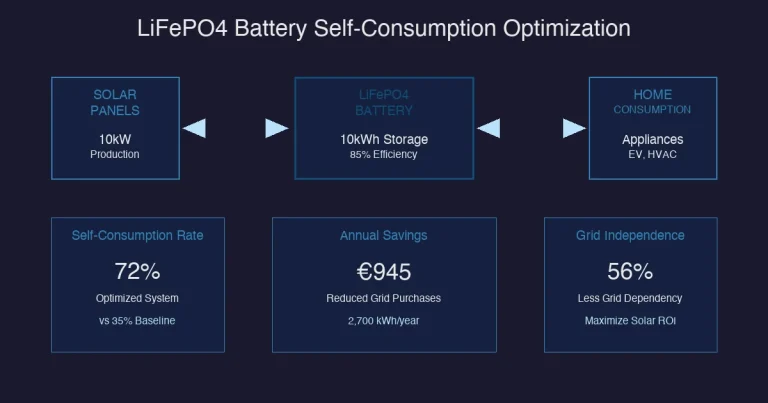
- Self-Consumption / Bill Offset: Storing solar energy during the day to avoid high peak-time utility rates at night. A general rule of thumb is to size the battery to 50%–70% of your daily usage.
Step 3: Align with Solar Production
A battery is only as good as its ability to recharge. If you have a 5kW solar array, it will produce roughly 20–25 kWh on a sunny day (depending on “peak sun hours”).
- Formula: Battery Capacity (kWh) ≤ Daily Solar Production (kWh) . If your battery is significantly larger than your daily solar production, you will struggle to fully recharge it during the winter or on cloudy days.
The Modern Benchmark: Why 14.3kWh is the "Sweet Spot"
For many of our customers at Insum Energy, the 14.3kWh configuration (created by 16S 280Ah LiFePO4 cells) has become the industry benchmark.
- Versatility: It covers essential loads for 24 hours or whole-home loads for 4–6 hours.
- Scalability: Because it uses standard 48V/51.2V architecture, you can easily parallel two units to reach 28.6kWh as your needs grow.
- Cost-to-Value: Utilizing Grade A 280Ah or the newer 314Ah cells provides maximum density at a competitive price point for DIY and B2B projects.
Conclusion: Future-Proofing Your System
Don’t feel pressured to buy everything at once. The beauty of modern LiFePO4 systems is modularity. Start with a capacity that covers your essential needs—typically around 14kWh—and monitor your performance. If you find yourself frequently hitting the low-voltage cutoff, adding a second rack is a straightforward expansion.
Ready to calculate your specific needs? Explore our Grade A LiFePO4 DIY kits and 14.3kWh-16kWh solutions at insumenergy.com.



One Comment
Comments are closed.