EU CBAM 2026: Carbon Border Tax Impact on Battery Buyers
What Is the EU CBAM and Why Should Battery Professionals Care?
The Carbon Border Adjustment Mechanism (CBAM) entered its definitive phase on 1 January 2026 under Regulation (EU) 2023/956, amended by the “Omnibus” simplification Regulation (EU) 2025/2083. It is not a tariff — it is a certificate obligation that makes imported carbon-intensive goods bear the same carbon cost as EU producers under the EU Emissions Trading System (EU ETS).
The six sectors directly in scope are cement, iron and steel, aluminium, fertilisers, hydrogen, and electricity. Batteries themselves are not on that list — but that is exactly where many importers relax too soon. A typical imported LiFePO4 cabinet or rack system is built around aluminium enclosures, steel frames, busbars and cooling plates, all of which are CBAM-covered goods. If you import complete storage systems or components from outside the EU, the embedded emissions of those metals now carry a financial liability. For the parallel battery-specific carbon rule, see our guide to the EU Battery Carbon Footprint Declaration 2026.
CBAM at a Glance: The 2026 Numbers
The European Commission publishes the CBAM certificate price as the weighted average of EU ETS allowance auction prices. In 2026 it is calculated quarterly; from 2027 it moves to a weekly basis, with certificate sales opening on 1 February 2027 through the common central platform.
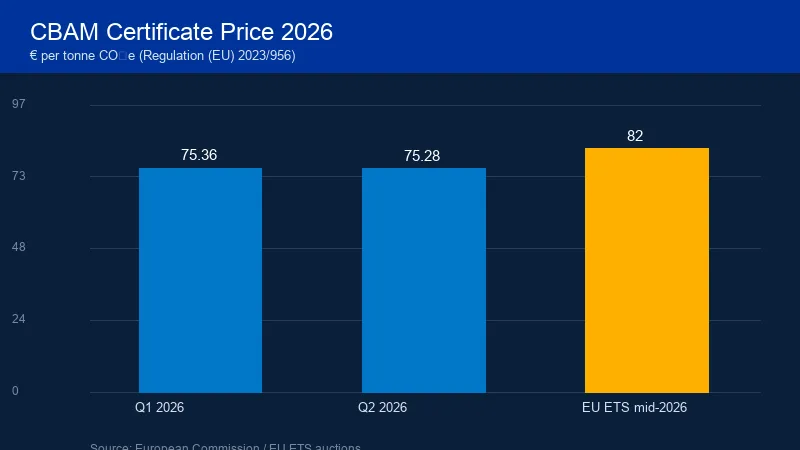
- Q1 2026 certificate price: €75.36 per tonne CO₂e (published 7 April 2026)
- Q2 2026 certificate price: €75.28 per tonne CO₂e (published 6 July 2026)
- Underlying EU ETS price: roughly €80–€85/tCO₂ through mid-2026
- First declaration & surrender: 30 September 2027, covering 2026 imports
- De minimis threshold: 50 tonnes/year combined (does not apply to electricity or hydrogen)
The Phase-In Schedule That Softens 2026 But Bites Later
Because EU ETS free allocation is being withdrawn in parallel, the CBAM “factor” starts small and grows to full coverage by 2034:
| Year | CBAM factor (% of embedded emissions) |
|---|---|
| 2026 | 2.5% |
| 2027 | 5% |
| 2028 | 10% |
| 2029 | 22.5% |
| 2030 | 48.5% |
| 2031 | 61% |
| 2032 | 73.5% |
| 2033 | 86% |
| 2034 | 100% |
In 2026, only 2.5% of embedded emissions require certificates — so the immediate cash impact on a battery importer is modest. But the trajectory is steep: by 2030 the obligation jumps to 48.5%, and by 2034 it is 100%. Planning that starts in 2026 is what protects margin in 2030.
Where Battery Importers Actually Feel CBAM
Consider an imported wall-mounted cabinet weighing 40 kg, of which roughly 12 kg is aluminium and 8 kg is steel. Primary aluminium carries one of the highest embedded-emission factors of any CBAM good (often 1.5–2.0 tCO₂ per tonne of metal). At €75/tCO₂ and the 2026 2.5% factor, the certificate cost is small today — but multiply that by thousands of units and the 2034 100% factor, and the same cabinet adds a meaningful per-unit cost that must be priced into EU quotes.
This is exactly why our analysis of European battery manufacturing in 2026 matters: locally produced, low-carbon-aluminium cabinets avoid CBAM exposure entirely and gain a widening cost advantage as the factor rises.
The EU Battery Regulation (EU) 2023/1542: The Direct Carbon Rule
While CBAM touches batteries indirectly through metals, the EU Battery Regulation (EU) 2023/1542 regulates batteries directly. It requires a carbon footprint declaration for EV batteries and industrial batteries above 2 kWh from 18 February 2025, and for light means of transport (LMT) batteries from 18 August 2025. Due-diligence obligations for raw-material sourcing apply from 2025, and a digital battery passport plus a central register arrive in 2027.
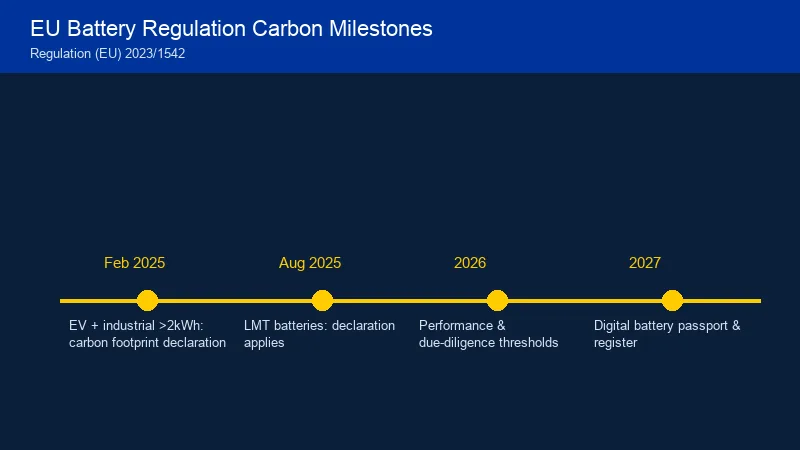
For EU buyers, this means two carbon compliance layers: CBAM on the metals you import, and a carbon-footprint declaration on the battery itself. Together they reward suppliers who can show verified, installation-level emissions data — and penalise those relying on EU default values, which are deliberately conservative and expensive.
2026 EU Electricity Prices: The Wider Cost Context
CBAM and the Battery Regulation sit on top of an already elevated EU energy-cost environment. Indicative 2026 household retail rates (including taxes and network charges) show why energy-intensive manufacturing — and the batteries built from it — carry structural cost pressure:
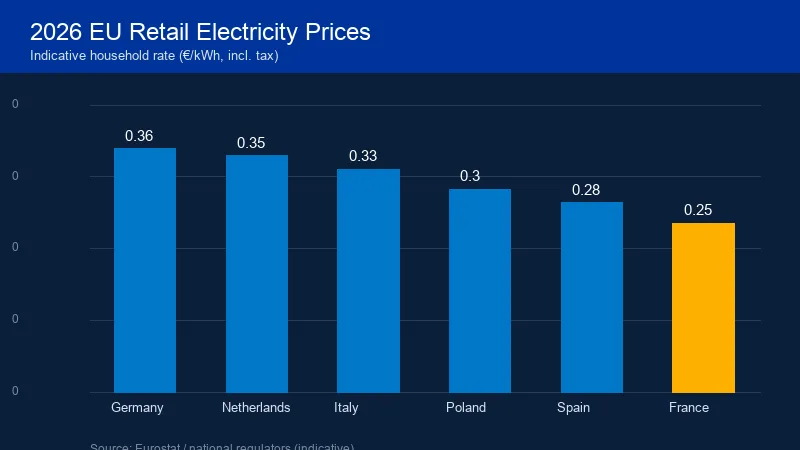
| Country | Reference market | Indicative 2026 retail (€/kWh) |
|---|---|---|
| Germany | EPEX SPOT + high grid fees/tax | ~€0.36 |
| Netherlands | APX + energy tax (ODE) | ~€0.35 |
| Italy | ARERA regulated | ~€0.33 |
| Poland | TGE (Polish Power Exchange) | ~€0.30 |
| Spain | PVPC / OMIE | ~€0.28 |
| France | Regulated TRV | ~€0.25 |
These figures are indicative 2026 ranges compiled from EPEX SPOT, OMIE/PVPC, APX, ARERA and Eurostat. They explain why a solar + battery ROI comparison across EU countries is essential before specifying a system — and why low-carbon, locally assembled storage wins on total cost of ownership.
EU Subsidy Landscape: Offsetting the Cost Pressure
High energy and carbon costs are partly offset by national subsidy programmes that favour compliant, storage-enabled installations. Indicative 2026 figures:
| Country | Programme | Indicative 2026 support |
|---|---|---|
| Germany | KfW (KfW 458 / 270) | Up to ~30% grant; ~€15,000–€17,500 for PV + storage |
| France | MaPrimeRénov’ 2026 | Up to ~€11,000 for renovation + storage / heat pump |
| Italy | Conto Termico 2.0 | Up to ~40% grant for heat-pump + storage systems |
| Netherlands | ISDE home-battery + Salderingsregeling phase-out | ~€1,800–€2,500 thuisbatterij; net metering ending |
| Poland | Mój Prąd 2026 | Up to ~PLN 7,500–15,000 (≈€1,700–€3,500) PV+battery+heat pump |
| Czechia | NZÚ | Up to ~CZK 150,000 (≈€6,000) for PV + battery |
| Romania | Casa Verde 2026 | Up to ~€7,000–€10,000 for PV + storage |
| Greece | Storage programme (Recovery Fund) | Up to ~€10,000 for PV + storage |
With net metering being phased out across Europe, batteries are no longer optional add-ons — they are the mechanism that makes these subsidies pay back. Our home battery insurance & certification guide covers the compliance side installers must satisfy to qualify.
What Battery Importers and EU Buyers Should Do in 2026
- Map your metals. Identify the aluminium and steel content in every imported enclosure, rack and component, and confirm whether you cross the 50-tonne CBAM threshold.
- Collect verified emissions data now. Request installation-level data from suppliers; default EU values will inflate your certificate cost.
- Register as an Authorised CBAM Declarant before your next covered shipment if you are above the threshold.
- Prefer low-carbon and EU-assembled systems to avoid CBAM exposure and meet Battery Regulation carbon-footprint thresholds.
- Stack national subsidies with storage to protect payback against high retail electricity prices.
Get a CBAM-Ready Quote from Insum Energy
Navigating CBAM, the EU Battery Regulation and divergent national subsidies is complex — but it is also where the biggest savings hide. Insum Energy supplies EU-market storage systems engineered for carbon compliance, certification and fast payback. Contact our team for a tailored quote, or explore our product range. Learn more about Insum Energy and start your home energy project today.