
SoH (State of Health) Estimation for LiFePO4 Batteries: A Complete Technical Guide
Introduction
Every LiFePO4 battery ages. Whether it is powering a family home, a commercial solar installation, or an off-grid cabin, capacity fade is inevitable. But how do you know exactly when your battery has lost 20% of its original capacity? How can installers and homeowners track battery health without specialized lab equipment?
State of Health (SoH) estimation is the answer.
SoH is a metric that expresses a battery’s current condition relative to its original factory specifications. Where State of Charge (SoC) tells you how full the battery is right now, SoH tells you how much life the battery has left. For home energy storage systems, accurate SoH tracking is essential for warranty claims, system planning, resale value, and safety.
This guide explains how SoH estimation works for LiFePO4 batteries, the most reliable methods available in 2026, and how to interpret the numbers your BMS reports.
What Is State of Health (SoH)?
SoH is defined as the ratio of a battery’s maximum usable capacity to its original rated capacity, expressed as a percentage.
- A brand-new 100Ah LiFePO4 battery = 100% SoH
- After 5 years of use, if it only holds 80Ah = 80% SoH
- Most manufacturers consider a battery end of life at 70–80% SoH
SoH is not a direct measurement. It is an estimate, calculated using algorithms that process voltage, current, temperature, and time-series data.
Why SoH Matters for Home Battery Owners
| Application | Why SoH Tracking Matters |
|---|---|
| Solar + Storage | Ensures the system still meets household energy needs as the battery ages |
| Warranty Claims | Most manufacturers require documented SoH decline for capacity warranty claims |
| Home Resale | Buyers want to know remaining battery life before purchasing |
| Off-Grid Systems | Accurate SoH prevents unexpected power loss in remote locations |
| Commercial Installations | SoH data drives maintenance schedules and replacement planning |
How LiFePO4 Batteries Age: The Science Behind SoH
Before diving into estimation methods, it helps to understand what physically changes inside a LiFePO4 cell over time.
Primary Aging Mechanisms
1. Solid Electrolyte Interphase (SEI) Layer Growth
The SEI layer forms on the graphite anode during initial charging and stabilizes. Over thousands of cycles, it continues to grow, consuming lithium ions and reducing the cell’s active lithium inventory. This is the dominant aging mechanism in LiFePO4 cells.
2. Lithium Plating
Charging at high rates or in cold temperatures can cause lithium ions to deposit as metallic lithium on the anode surface instead of intercalating into the graphite. Plated lithium is electrochemically inactive and cannot contribute to capacity.
3. Active Material Degradation
The cathode material (LiFePO4) can undergo structural changes, particularly when operated at high temperatures (above 45°C) or high states of charge (above 90% SoC).
4. Electrolyte Decomposition
The electrolyte gradually breaks down, increasing internal resistance and reducing both capacity and power capability.
5. Mechanical Degradation
Repeated expansion and contraction of electrode materials during charge/discharge cycles causes micro-cracks, degrading electrical connectivity within the cell.
SoH vs. SoC: A Key Distinction
Many homeowners confuse SoH with State of Charge (SoC). Here is the difference:
| Metric | What It Measures | Changes With |
|---|---|---|
| SoC (State of Charge) | Current energy level (% full right now) | Immediate charge/discharge |
| SoH (State of Health) | Overall battery condition vs. new state | Long-term aging, cycle count |
A 70% SoH battery might show 100% SoC when fully charged. But that 100% SoC only represents 70% of the battery’s original rated capacity.
SoH Estimation Methods: From Lab to BMS
Method 1: Coulomb Counting (Current Integration)
Principle: Track total charge (Ah) that has flowed in and out of the battery over its entire lifetime, then compare against the theoretical maximum.
Formula:
SoH (%) = (Current Maximum Capacity / Rated Nominal Capacity) × 100where: Current Maximum Capacity = Total Charge Through Battery Since New − Observed Fade
Pros:
- Simple to implement
- Works with standard BMS hardware
- Good accuracy with proper calibration
Cons:
- Requires initial full characterization
- Measurement errors accumulate over time (current sensor drift)
- Cannot distinguish between capacity loss and temporary performance issues
Accuracy: ±5–10% without periodic full charge/discharge cycles
Most home battery BMS units (Daly, JBD, JK) use some form of coulomb counting. However, they often lack a true SoH percentage display. They typically show this data as cycle count and cell voltage snapshots.
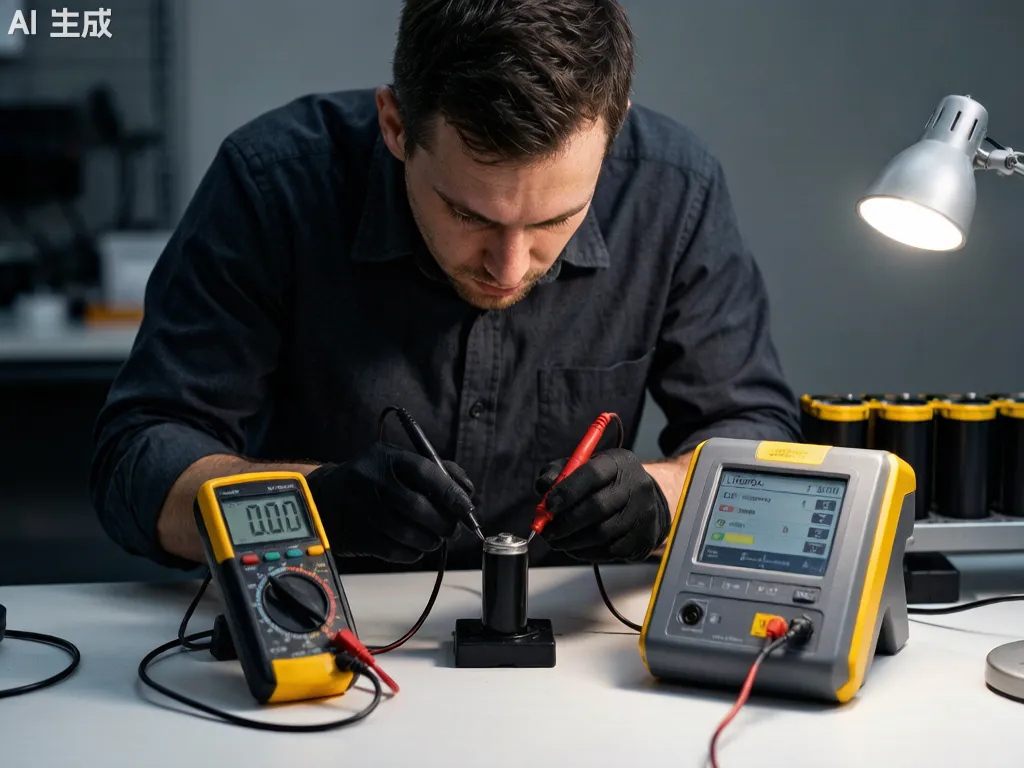
Method 2: Voltage Curve Analysis (Open Circuit Voltage Method)
Principle: Every LiFePO4 cell has a predictable voltage-to-capacity relationship when at rest. By comparing the current rest voltage curve against the factory reference curve, you can estimate remaining capacity.
How It Works:
- The battery is allowed to rest (no current flow) for 2–8 hours
- The open circuit voltage (OCV) is measured
- The OCV is mapped to SoC using the cell’s OCV-SoC curve
- By tracking how the full charge voltage curve shifts over time, SoH can be estimated
Accuracy: ±8–15% depending on rest duration and temperature stability
Method 3: Internal Resistance Measurement (Electrochemical Impedance Spectroscopy)
Principle: Battery aging increases internal resistance. By measuring the battery’s impedance at different frequencies, you can correlate resistance values with SoH.
Pros:
- Fast measurement (seconds to minutes)
- Sensitive to multiple aging mechanisms
- Can detect early-stage degradation before capacity loss is significant
Cons:
- Requires specialized equipment
- Temperature sensitivity (resistance varies with temperature)
- Most home BMS units do not include EIS functionality
Accuracy: ±3–5% with high-quality EIS equipment
Method 4: Kalman Filtering
Principle: A mathematical algorithm that fuses multiple sensor inputs (current, voltage, temperature, aging models) to estimate both SoC and SoH with minimal drift.
How It Works:
- A dynamic battery model predicts voltage based on current input
- The actual measured voltage is compared with the prediction
- The model corrects itself using a Kalman gain matrix
- Over time, the model adapts to battery aging, and the SoH parameter is estimated
Accuracy: ±2–5% in well-tuned systems
Many commercial and industrial LiFePO4 systems use Kalman filtering for SoH estimation. Some advanced home battery inverters (Victron, SMA, Solax) include basic Kalman-based SoH estimation.
Method 5: Machine Learning Approaches
Principle: Neural networks and other ML models learn to predict SoH from large datasets of voltage, current, temperature, and cycle history — without explicit physical models.
Current Status: Primarily used in electric vehicle battery management systems and grid-scale storage. Adoption in home energy storage is growing but not yet mainstream in 2026.
Comparing SoH Estimation Methods
| Method | Accuracy | Equipment Needed | Real-Time | Best For |
|---|---|---|---|---|
| Coulomb Counting | ±5–10% | Basic BMS | Yes | Homeowners, basic monitoring |
| Voltage Curve Analysis | ±8–15% | Multimeter | No | Manual spot checks |
| EIS / Resistance | ±3–5% | EIS analyzer | Yes | Professional diagnostics |
| Kalman Filtering | ±2–5% | Advanced BMS | Yes | Commercial systems |
| Machine Learning | ±3–8% | Data + compute | Yes | EV / grid storage |
How to Check Your LiFePO4 Battery SoH (Practical Steps)
Step 1: Check Your BMS Display or App
Most battery-integrated systems display key health metrics:
- Cycle count — Total charge/discharge cycles since installation (most important single indicator)
- Cell voltages — Real-time voltage of every cell in the pack (balanced cells = healthy)
- Maximum charge voltage — Voltage sag during discharge indicates aging
A LiFePO4 cell typically maintains flat voltage curves between 20–90% SoC, making it harder to read SoH from voltage alone compared to lead-acid.
Step 2: Perform a Full Capacity Test
This is the most accurate method available to homeowners:
- Fully charge the battery at a low rate (0.1C or lower)
- Allow a 2-hour rest period
- Discharge at 0.2C rate while measuring Ah drawn
- Compare measured Ah to rated capacity
Formula:
SoH = (Measured Discharge Capacity / Rated Capacity) × 100
Example: A 100Ah battery delivers 82Ah in a full discharge test:
SoH = (82 / 100) × 100 = 82%
Step 3: Monitor Cell Balance
Use a Bluetooth BMS app (JK BMS, Daly BMS, JBD BMS) to check individual cell voltages after a full charge cycle. If any cell is consistently more than 50mV lower than the others, the battery pack has developed an imbalance that may be masking true capacity.
Step 4: Track Over Time
Record your capacity test results every 6 months. A LiFePO4 battery should lose approximately 2–3% of its rated capacity per year under normal use. If the fade rate is significantly higher, investigate operating conditions (temperature, charge/discharge rates, depth of discharge).
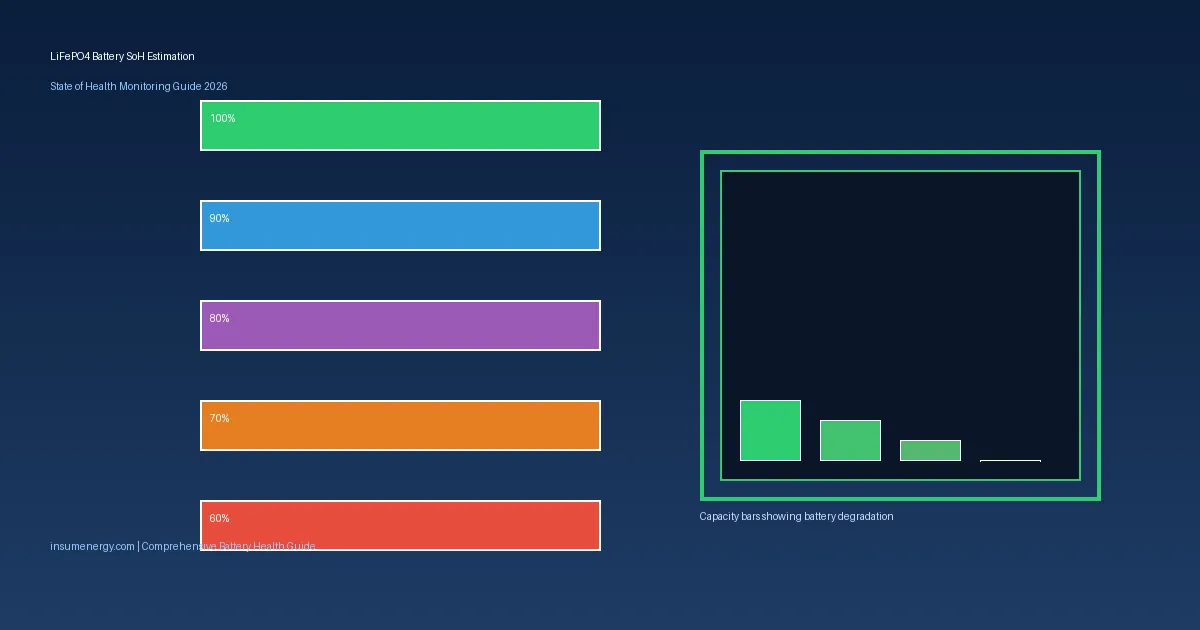
SoH Thresholds and What They Mean
| SoH Range | Battery Condition | Recommended Action |
|---|---|---|
| 100–90% | Excellent — factory fresh | No action needed |
| 90–80% | Good — normal aging | Continue normal monitoring |
| 80–70% | Fair — reduced capacity | Plan for replacement within 2–3 years |
| 70–60% | Poor — significant capacity loss | Consider replacement; check warranty eligibility |
| Below 60% | End of Life | Replace; most manufacturers deny capacity warranties below this |
Note: Most LiFePO4 manufacturers warranty their batteries to 60% SoH after 10 years at 0.5C discharge and 25°C average temperature.
Factors That Accelerate LiFePO4 Aging
Understanding what speeds up degradation helps you protect your battery investment:
High Temperature (above 40°C): Every 10°C increase above 25°C approximately doubles the rate of SEI layer growth. Install batteries in climate-controlled spaces.
High State of Charge Storage: Storing a LiFePO4 battery at 100% SoC for extended periods accelerates aging. Ideally, store at 40–60% SoC if the battery will sit unused for more than 1 month.
High Discharge Rates: Continuous discharge above 1C rating accelerates mechanical degradation of electrode structures.
Deep Discharge Cycles: While LiFePO4 tolerates 80–100% DoD better than lead-acid, keeping cycles in the 60–80% DoD range extends overall lifespan.
Cold Charging: Charging below 0°C causes lithium plating. Most quality LiFePO4 batteries have low-temperature charging protection in the BMS.
How Insum Energy Monitors and Reports Battery SoH
At Insum Energy, all residential and commercial LiFePO4 battery products include integrated BMS monitoring with real-time data accessible via smartphone app or web portal. Key health metrics tracked include:
- Cell voltage monitoring — Real-time voltage of every cell in the pack
- Cycle count tracking — Total charge/discharge cycles since installation
- Temperature logging — Operating temperature history for all cells
- Alarm history — Record of any over-voltage, under-voltage, over-temperature, or short-circuit events
For installers and commercial customers, Insum Energy provides BMS data export tools that enable professional SoH estimation using coulomb counting and voltage curve analysis methods.
Explore Insum Energy LiFePO4 Battery Products
Conclusion: Proactive SoH Monitoring Extends Battery Life
State of Health estimation transforms battery management from reactive to proactive. Rather than discovering a degraded battery only when it fails to meet your energy needs, regular SoH monitoring lets you plan replacements, protect warranty claims, and optimize operating conditions.
For home energy storage owners, the most practical approach in 2026 is a combination of:
- Coulomb counting via your BMS app for continuous tracking
- Periodic full capacity tests every 6–12 months for calibration
- Cell voltage monitoring to catch imbalance early
LiFePO4 technology remains the most durable chemistry available for home energy storage, with typical lifespan exceeding 6,000 cycles at 80% DoD. Understanding SoH helps you capture that full lifespan — and know exactly when it is time to plan your next battery investment.
Need help sizing a battery system or understanding the health of your current installation? Contact the Insum Energy team for expert guidance on LiFePO4 battery selection, installation, and long-term maintenance.



2 Comments