Second-Hand EV Battery Packs: 5 Hidden Risks Before You Buy
A second-hand EV battery pack looks like the cheapest path to home energy storage. Salvage yards, online marketplaces and even fleet auctions now list NMC and NCA modules pulled from electric vehicles at a fraction of the cost of a new LiFePO4 home battery. The problem is that a used pack is a black box until you actually test it — and the wrong pack can burn out your inverter, fail insurance, or worse.
This 2026 buyer’s guide walks you through the 5 hidden risks every DIY installer, off-grid hobbyist and budget-conscious homeowner should know before wiring a salvaged pack into a home battery system. We’ll show you where sellers cut corners, what an honest SoH capacity test actually reveals, and how a quality BMS changes the math.
Why buyers look at second-hand EV packs
Between 2018 and 2024, more than 15 million EVs hit the road worldwide. A meaningful share of those vehicles are now being scrapped after collisions, flood damage or end-of-lease returns — long before the cells inside are actually dead. To resellers, those packs look like cheap energy density. To homeowners, they look like a budget entry point.
The appeal is real on paper:
- 30–60% lower upfront cost per kWh than new LiFePO4
- High energy density (often 180–250 Wh/kg) in a compact enclosure
- Modules already assembled with busbars, BMS and thermal management
What most marketplace listings don’t tell you is that price reflects risk, not just capacity. The five risks below are the ones that consistently turn a “bargain” into a money pit.
Risk 1 — Cell degradation you can’t see
An EV battery’s State of Health (SoH) drops every time it is fast-charged, exposed to high temperatures, or stored fully charged. A pack from a 2019 EV that ran in a hot climate for 80,000 km can show a headline voltage that looks healthy while individual cells have lost 25–40% of their original capacity.
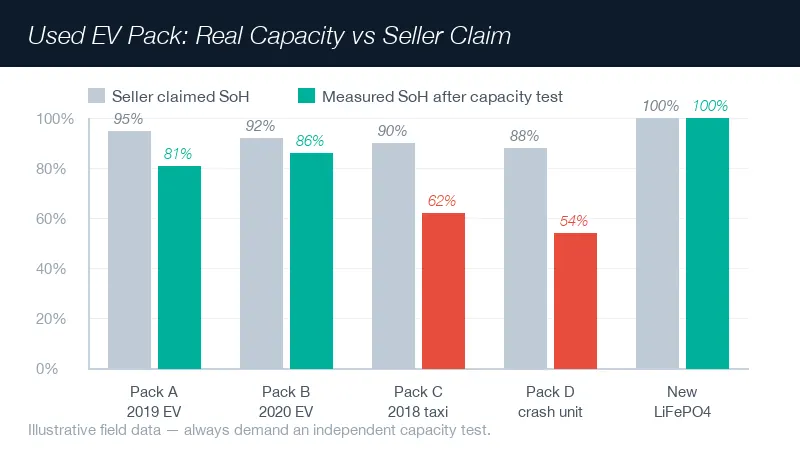
The chart above shows what an independent SoH capacity test typically reveals on used packs:
- Light-duty private EVs: 8–15% SoH loss after 5 years (acceptable)
- High-mileage or taxi-fleet EVs: 30–45% SoH loss (poor value)
- Salvage / crash units: often <60% SoH even when “tested OK”
Rule of thumb: anything below 70% SoH is not economically viable for stationary storage. Always ask for a written 0.2C full-cycle test report, not a screenshot of the dashboard.
Risk 2 — OEM BMS lock-out and proprietary CAN bus
This is the single most underestimated risk. Modern EV packs don’t just contain cells — they contain a BMS that refuses to discharge outside the original vehicle. Tesla, BMW, Hyundai and most Chinese OEMs code their packs with VIN-locking, isolation monitoring and proprietary charge curves. Plug the pack into your inverter and the BMS either:
- Refuses to close the contactor (silent “dead pack”)
- Throttles output to a useless few hundred watts
- Triggers a permanent fault code you cannot clear
Even packs that do wake up usually need a compatible gateway or aftermarket BMS. Our complete guide to BMS in LiFePO4 systems explains what you actually need to monitor cells safely — and why an EV OEM board is rarely the right tool for a home-storage job.
Risk 3 — Zero warranty, zero recourse
A new LiFePO4 pack from an established manufacturer comes with a 5–10 year warranty covering cell defects and premature capacity loss. A second-hand EV pack from a marketplace seller comes with — at best — a 30-day return window, and often with a disclaimer that puts all responsibility on the buyer.
The realistic math (EU/US, 2026):
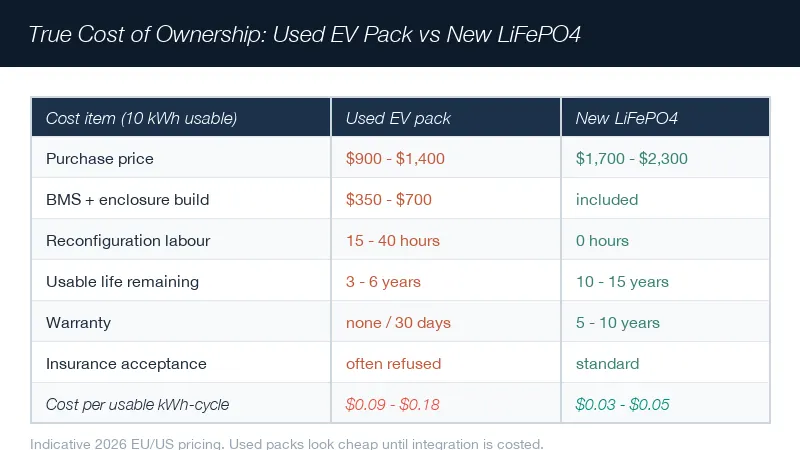
When you fold in BMS, enclosure rework, labour, lost warranty, and a much shorter usable life, the cost per usable kWh-cycle on a second-hand pack is roughly 3–4× higher than a new LiFePO4 unit. The “savings” disappear the moment you add up real engineering hours.
Risk 4 — Hidden thermal and mechanical damage
EV packs live under the floor of a vehicle. They see potholes, water, road salt, vibration, and in accident cases, impact loading and potential coolant-line rupture. Damage isn’t always visible:
- Hairline cracks in cell tabs from impact (latent failure weeks later)
- Coolant ingress that corrodes busbars from the inside
- Swollen cells from prior thermal-runaway near-misses
- Damaged cooling plates that no longer mate properly with a new enclosure
Insist on a teardown inspection with photos of every module before you pay. If the seller refuses to open the pack, walk away — they know what’s inside.
Risk 5 — Certification, transport and insurance headaches
A LiFePO4 pack sold by a reputable manufacturer carries UN38.3, IEC62619, CE and often UL1973 documentation. A second-hand EV pack carries the paperwork from its vehicle — not from a stationary-storage use case. That gap creates three real-world problems:
- Transport: moving a damaged or undeclared pack across borders can violate ADR/IATA dangerous-goods rules
- Installation permits: many EU member states require CE-marked stationary storage for grid-tied installation
- Insurance: home insurers increasingly refuse to cover non-certified battery systems, especially after 2024 residential fire reports
How to buy safely (if you still want to)
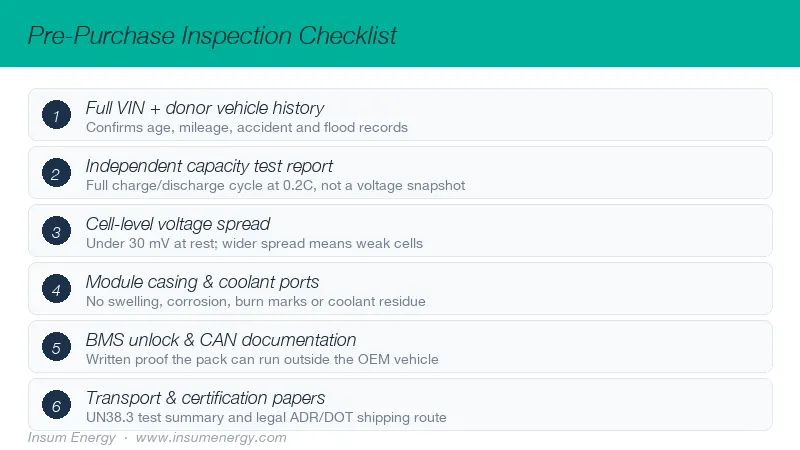
We won’t pretend there’s never a smart way to reuse EV cells — there is, when the source is clean and the engineering is done properly. If you do proceed, run through this checklist before any money changes hands.
Pre-purchase inspection checklist
- Donor history: VIN, mileage, accident and flood records — confirm pack is from a non-salvage vehicle
- Capacity test: full 0.2C charge/discharge cycle, not a voltage snapshot; require SoH > 70%
- Cell spread: voltage difference at rest under 30 mV across the module; wider means weak cells
- Mechanical condition: no swelling, corrosion, burn marks, or coolant residue inside the enclosure
- BMS access: written proof the pack can run outside the OEM vehicle — or budget for an aftermarket BMS
- Paperwork: UN38.3 test summary, transport route, and confirmation it is legal in your jurisdiction
When a new LiFePO4 pack is the smarter buy
If you’re building a primary home battery system, not a hobby project, the safer long-term choice is a new LiFePO4 pack from an established manufacturer. You’ll get:
- Genuine Grade-A prismatic cells with documented cycle life
- A purpose-built BMS sized for stationary storage, not traction
- Full CE / UL / UN38.3 documentation and a real warranty
- Drop-in compatibility with mainstream hybrid inverters
Compare Insum Energy’s home battery and LiFePO4 product line against any second-hand offer and the math almost always favours new. We design our packs for exactly the use case you have in mind — daily cycling, grid-tie backup, and a decade of safe operation.
Key takeaways
- A second-hand EV battery can be a bargain — or a 25 kWh write-off — depending on SoH, BMS, and history
- Always demand an independent capacity test before paying; never trust a dashboard screenshot
- Factor in BMS unlock, enclosure rework, labour and insurance before comparing price
- For grid-tied home storage, a new LiFePO4 pack with proper certification is almost always cheaper per usable kWh-cycle
Frequently asked questions
Are second-hand EV battery packs legal to use in home storage?
It depends on your country and the certification you hold. In the EU, a grid-tied home battery must carry CE marking and typically UN38.3 transport documentation. A bare EV pack on its own usually does not, which is why a CE-certified new LiFePO4 pack is the simpler route.
How do I test the SoH of a used EV pack before buying?
Ask the seller for a full 0.2C charge–discharge cycle report. Compare the measured Ah against the original nameplate value. SoH = measured capacity / original capacity. Anything under 70% is generally not worth buying for stationary storage. See our detailed SoH estimation guide for the math behind the test.
Can I reuse a Tesla, BMW or Hyundai EV pack at home?
Technically yes, but only with the right aftermarket BMS, a cleared OEM fault code, and an enclosure that meets stationary-storage safety standards. It is rarely cost-effective. For most homeowners a new LiFePO4 home battery delivers better economics with far less engineering work.
Talk to Insum Energy about your battery project
Whether you’re weighing a second-hand EV pack, comparing LiFePO4 brands, or sizing a brand-new home battery storage system, the Insum Energy engineering team can help you spec it properly. We supply Grade-A LiFePO4 modules, integrated BMS, and pre-assembled cabinets ready for grid-tie or off-grid installation.
👉 Contact Insum Energy for a tailored quote, or learn more about who we are and the standards we work to. If you’re sourcing cells, also read our Alibaba LiFePO4 buying guide to avoid the most common scams in 2026.