Alpine Battery Storage: Snow Load & Altitude Rules 2026
A home battery that works perfectly in Munich or Milan can fail quietly at 1,400 metres. The three failure modes are not exotic: snow crushing an outdoor cabinet, electronics derating in thin air, and a LiFePO4 pack that refuses a charge at −10 °C. All three are avoidable with the right specification. This guide covers the physics, the standards and the economics of alpine battery storage in 2026 — for homeowners in Austria, Italy, France, Germany and Slovenia, and the installers who specify for them.
The Alps Are a Bigger Market Than You Think
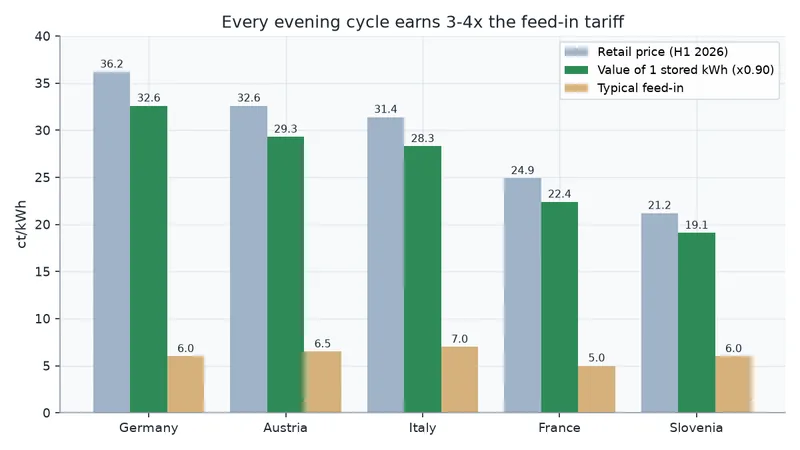
The EU Strategy for the Alpine Region (EUSALP) covers seven countries and 48 regions with more than 80 million inhabitants — roughly 15% of the EU population — across Austria, France, Germany, Italy and Slovenia plus Switzerland and Liechtenstein. Mountain homes are often holiday properties or off-valley plots: long grid feeders, winter peaks from electric heating and heat pumps, and some of Europe’s highest retail tariffs. Household electricity in the first half of 2026 averaged 32.6 ct/kWh in Austria, 31.4 ct in Italy and 24.9 ct in France, against an EU average of 28.3 ct (Eurostat nrg_pc_204, H1 2026; country list via EU EnergyPrices). Every self-consumed kilowatt-hour at altitude earns more than in most of the Union — if the hardware survives the winter.
Snow Load: The Weight Your Cabinet Must Survive
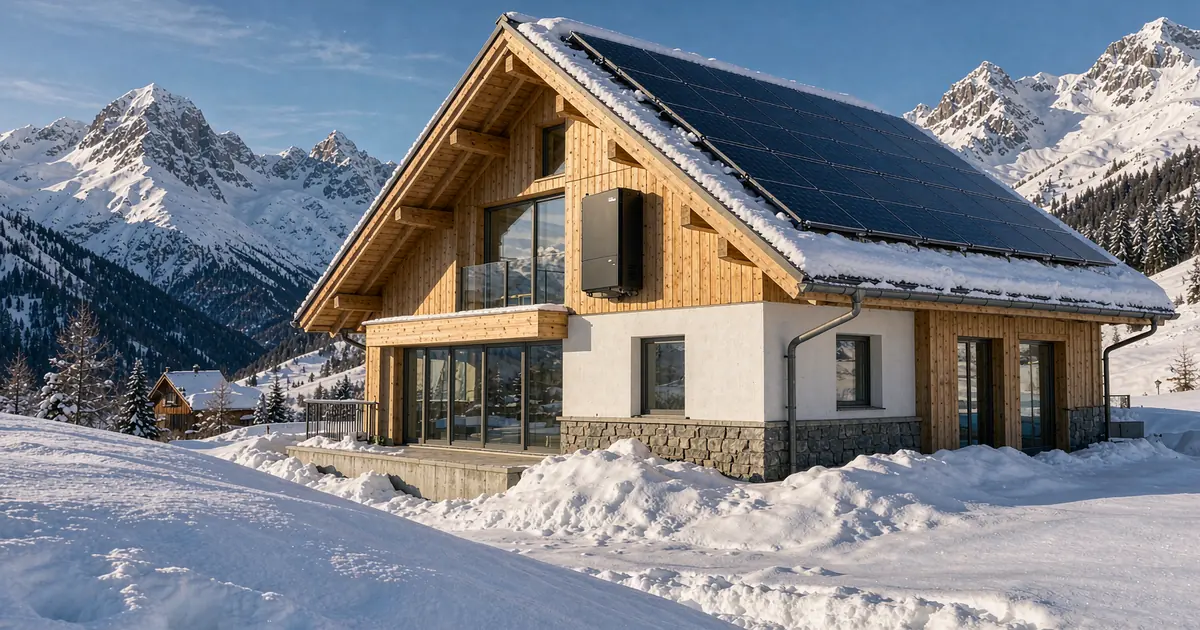
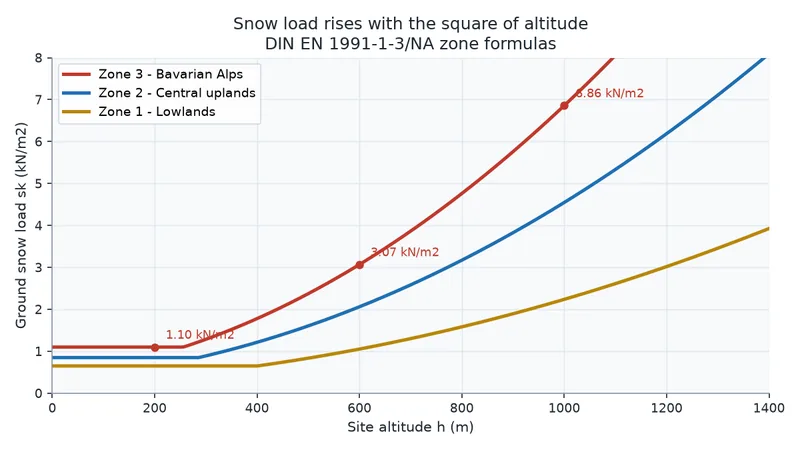
Snow load is the most mis-specified parameter on alpine projects. The governing standard is Eurocode 1, part EN 1991-1-3, and the critical detail is that ground snow load sk grows with the square of altitude. Under the German national annex (DIN EN 1991-1-3/NA), Zone 3 — the Bavarian Alps — follows sk = 0.31 + 2.91 × ((h + 140)/760)² kN/m² (snow-load zones and official formulas). At 200 m that is 1.10 kN/m²; at 600 m it is 3.66 kN/m²; at 1,000 m it reaches 6.86 kN/m² — a six-fold jump without changing zones. Italy applies its own table under the structural code NTC 2018 (Ministerial Decree 17 January 2018); Austria and France keep their own annexes. Alpine sites are typically designed for 2.5–5.0 kN/m² and up — 250 to over 500 kg of snow per square metre.
A wall-mounted enclosure presents only about one square metre of roof — manageable. The killers are secondary: drift snow banking against the uphill wall, roof snow sliding onto ground-mounted hardware, and freeze–thaw heaving the plinth. Three rules cover most of it:
- Mount above the snow line, not the frost line. Keep the enclosure base at least 60 cm above grade where drifted snow accumulates, and never under the eave where roof snow slides off.
- Shed the roof before it sheds on you. A canopy above an outdoor cabinet must itself be engineered to the local sk value — a flat roof rated 100 kg/m² fails in Zone 3 at altitude.
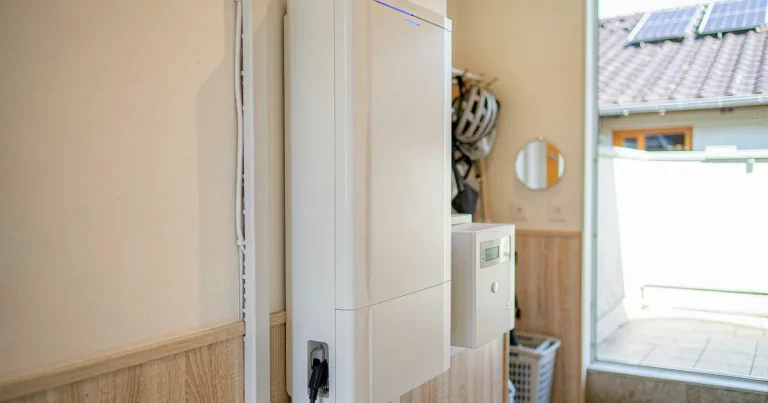
- Indoor beats outdoor. A mountain home almost always has a boiler room or cellar; indoors eliminates snow load, most of the cold problem and the corrosion exposure covered in our coastal siting guide.
Altitude: The 2,000-Metre Ceiling on Electronics
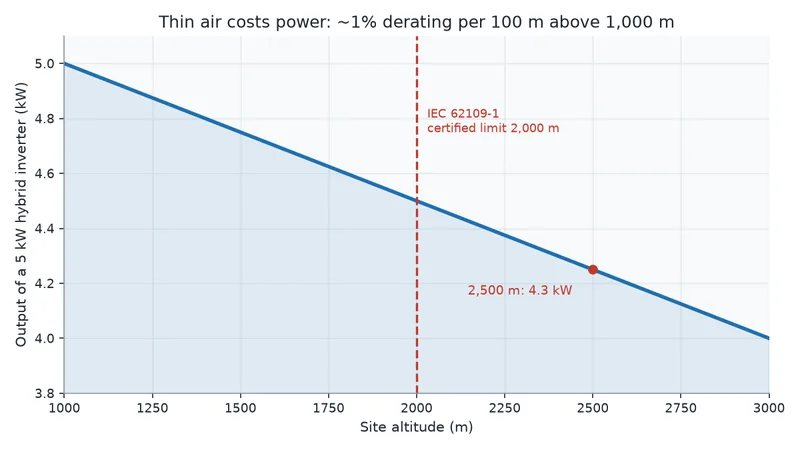
Inverter safety standard IEC 62109-1 certifies power converters up to 2,000 m. Above that, insulation and cooling both degrade in thinner air — manufacturers must reduce DC voltage and AC output. SMA’s technical information for above-2,000 m sites quantifies it: maximum permissible DC voltage falls from 1,000 V to 964 V between 2,501 m and 3,000 m, and maximum AC power derates with altitude (SMA high-altitude installation TI). Residential vendors typically publish roughly 1% output loss per 100 m above 1,000 m — at 2,500 m a 5 kW unit delivers about 4.3 kW. Alpine villages commonly sit above 1,500 m; refuges reach 2,300–2,600 m.
On the PV side there is a second, less-known effect: snow reflection plus thin atmosphere pushes module-level irradiance far beyond the 1,000 W/m² test condition. Measurements at the Schattenhalb test field (2,049 m) recorded 2,411 W/m² on a bifacial rear face, so short-circuit currents reach 2.4 times the datasheet STC value (Alpine PV competence centre, Switzerland). An inverter tested only to a 1.25 × Isc margin can be pushed outside its certified envelope — check maximum input current against the cold-weather, snow-reflected Isc, not the STC value.
The 0 °C Charging Wall
LiFePO4 discharges happily to about −20 °C, but charging below 0 °C causes lithium plating — metallic lithium depositing on the anode instead of intercalating — permanently removing capacity and, over repeated cycles, risking dendrites that pierce the separator (peer-reviewed review of low-temperature lithium-ion behaviour). That is why a compliant BMS blocks charge below the cutoff: a battery can run the house all night at −15 °C and then refuse the first solar amps at 9 a.m. because its cells are still frozen. Cells lag the room by hours, so a garage reaching +2 °C by noon does not guarantee charged cells.
Three remedies:
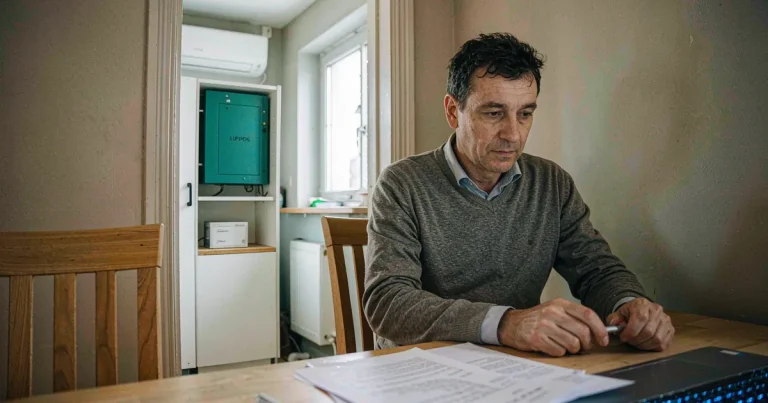
- Install in heated space. A cellar or utility room held above 5 °C makes the problem disappear.
- Self-heating packs. Integrated heaters lift cells above 0 °C before accepting charge — essential for unheated garages and huts.
- Slow cold-charge profiles. Some brands permit reduced current near 0 °C; treat it as brand-specific engineering and verify the charge-temperature window on the datasheet.
Winter Yield: The Snow Is Also a Bonus
High-altitude PV is not a sacrifice; done right it is a winter product. A PNAS study of snow-covered mountain PV showed that steep tilt angles plus snow albedo shift production toward winter, covering up to 50% of the winter electricity deficit without reducing annual output. For a battery owner, a valley array leaves the pack cycling on tariff spreads, while an alpine array at 55–65° tilt keeps a 10 kWh battery cycling usefully through December and January — exactly when heat-pump and lighting loads peak, and when that harvest matters most.
The Economics at Altitude
A stored kilowatt-hour is worth roughly retail × 0.90 at 90% round-trip efficiency: about 29.3 ct in Austria and 28.3 ct in Italy on the H1 2026 figures above, versus feed-in tariffs of 5–8 ct/kWh — a 3–4× gap on every evening cycle. It widens further if the mountain home hosts an EV or heat pump; our EU power price outlook 2027–2030 explains why evening spreads hold up through the decade. Sizing has one alpine twist: winter PV peaks midday, so size the pack for the evening load, not the annual balance, and add capacity if the cellar drops below 10 °C.
For remote huts and chalets with weak grid service, storage is even more central — our generator + battery hybrid sizing guide covers systems where the battery is the primary supply, and the ground-mount solar guide covers timber-clad or heritage-protected roofs. Permits are answered in our EU battery permit guide, indoor noise limits in the noise and siting guide.
What the Subsidy Map Looks Like in the Mountains
Alpine-adjacent markets split into two camps. Germany, Italy and Poland still route money toward battery storage through residential schemes; France, the Netherlands, Czechia, Romania and Greece pay for solar and heat-pump measures while the battery rides along only inside a subsidised package. Austria and Slovenia have no national battery grant — provincial and utility programmes come and go.
| Country | Scheme | What it pays in 2026 | Alpine note |
|---|---|---|---|
| Germany | KfW 270 (BEG) | Low-interest loan, currently open | Bavarian and Black Forest sites; no direct grant |
| France | MaPrimeRénov’ | Heat-pump and envelope works | Battery not a standalone item |
| Italy | Conto Termico 2.0 (GSE) | Up to 65% for building works | Storage via Bonus Casa routes instead |
| Netherlands | Rijksoverheid energy page | Net metering ends 31 Dec 2026 | Low altitude — included for completeness |
| Poland | PME 2 storage programme | 30% grant, capped per kWh | Tatra and Beskid sites eligible |
| Czechia | NZÚ (Zelená úsporám) | Battery subsidy, pauses between calls | Mountain chalets eligible |
| Romania | Casa Verde (AFM) | RON 20,000 cap per household | Carpathian sites included |
| Greece | Greece 2.0 rooftop + storage | 45–75% support | Pindus and Rhodope mountain homes |
A Pre-Winter Checklist
- Confirm your snow-load zone and altitude against the national annex, and get the enclosure engineered — not guessed.
- Verify the inverter’s altitude rating and, on high-albedo sites, its maximum input current against snow-reflected irradiance.
- Specify self-heating batteries for unheated spaces; check the datasheet charge-temperature window, not just discharge.
- Plan the service route: a site that needs a snowcat in January needs remote diagnostics and staged spares.
Get an Alpine-Specific Specification
Insum Energy supplies LiFePO4 home battery systems engineered for cold-charge performance and harsh-environment siting, working with installers across the Alpine arc from Slovenia to the French Alps. If your project sits above 1,000 m — or anywhere snow drifts past the door — browse our battery range and contact Insum Energy for a site-specific quote, including self-heating and altitude-rated options. Learn more about Insum Energy or start from our home page.