
Battery Storage Tax Deduction: EU Country Guide 2026
Across the European Union, the same 10 kWh home battery can cost a household from roughly €4,400 to nearly €9,700 once tax rules are applied. The hardware is identical; the invoice is not. In 2026, tax treatment — not subsidies — is the single biggest price differentiator for battery storage in the EU.
This guide maps the 2026 tax landscape for residential and small-commercial LiFePO4 storage: what you pay in VAT, what you can deduct from income tax, and how businesses should depreciate a battery. Rules summarised here reflect national statutes in force for 2026; confirm project-specific details with a local tax adviser.
One invoice, three tax layers
A battery installation touches three separate areas of tax law:
- VAT is charged on the invoice itself. The EU VAT Directive (2006/112/EC), as amended by Directive (EU) 2022/542, lets member states apply reduced or zero rates to solar supply and installation — and most states that use this option include storage. The spread between 0% and 25% is the largest single line-item difference in Europe.
- Income tax determines whether part of the investment comes back as a deduction or credit, and how fast.
- Depreciation matters for anyone installing a battery on a business, farm or rental property, because it sets how quickly the cost reduces taxable profit.
Tax rules are slower and more predictable than grant cycles, and in several countries now worth more than any subsidy. Before comparing payback figures, check that your quotes even use the same VAT rate.
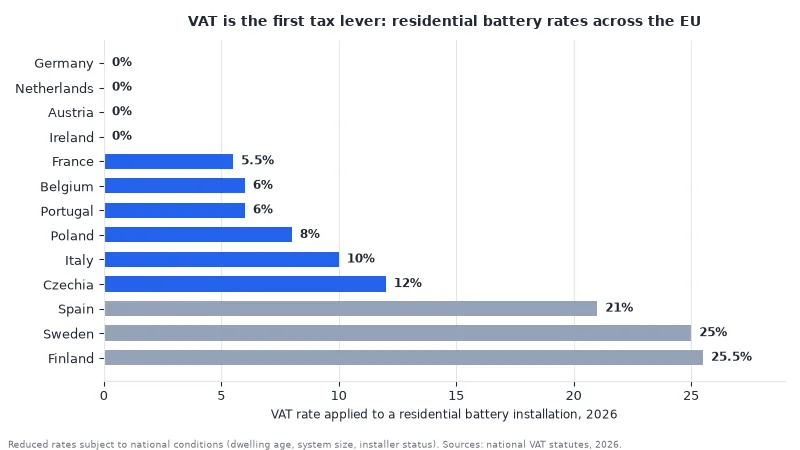
VAT on residential battery installations in 2026
Four EU countries tax residential solar-plus-storage at 0%, and several others apply steeply reduced rates. Conditions differ — dwelling age, system size, installer status — so read the fine print before promising a rate.
| Country | Standard VAT | Battery installation rate (2026) | Key condition |
|---|---|---|---|
| Germany | 19% | 0% (§12(3) UStG) | ≤30 kWp on/near a dwelling; storage included |
| Netherlands | 21% | 0% | On or adjacent to a home |
| Austria | 20% | 0% | Up to 35 kWp, since 2024 |
| Ireland | 23% | 0% | Residential rooftop supply and installation |
| France | 20% | 5.5% | PV ≤9 kWc, homes over 2 years; see warning |
| Belgium | 21% | 6% | Homes over 10 years old |
| Poland | 23% | 8% | Residential works, homes ≤150 m² |
| Italy | 22% | 10% | Domestic purchases |
| Czechia | 21% | 12% | Residential construction works |
| Spain | 21% | 21% (10% on renovation labour) | 10% applies to works on dwellings over 2 years |
| Sweden / Finland | 25% / 25.5% | Full standard rate | Relief via income-tax credits |
The French invoice trap. France is the cautionary tale. The reduced 5.5% TVA applies to a qualified PV system up to 9 kWc — but if the battery is invoiced as part of the same job as the panels, the entire invoice, panels included, can be pushed back up to 20%. The fix is procedural: have the battery quoted and billed as a separate lot, or the installer silently adds roughly €1,100 to a typical €8,000 project.
Belgium’s ten-year rule. The 6% rate applies to homes at least ten years old; new construction pays the standard rate. In Flanders, the renovation premium no longer covers stand-alone PV, so the VAT break is the main fiscal benefit left.
Income-tax deductions homeowners can still claim in 2026
VAT lowers the bill on day one. Income-tax relief determines the real net cost. Here the leaders are Italy, Sweden and Poland, each with a distinctly different mechanism.
| Country | Scheme | Benefit on a battery | Key conditions |
|---|---|---|---|
| Italy | Bonus Casa (art. 16-bis TUIR, Law no. 199/2025) | 50% (main residence) / 36% (other), €96,000 cap, over 10 years | Battery linked to the PV system; bank transfer; last year at 50% |
| Sweden | Grön teknik (Skatteverket) | 50% of material + labour, SEK 50,000 cap/person/year | Grid-connected; F-skatt installer; deducted on the invoice |
| Poland | Ulga termomodernizacyjna | Up to PLN 53,000 deducted from taxable income (~19% value) | Battery part of a broader thermo-modernisation project |
| Spain | Regional IRPF deductions + IBI rebates | IRPF 20–50% by region; IBI rebates up to 50% | Varies by region and municipality |
| Finland | Kotitalousvähennys household credit | Labour-only deduction, claimed on the tax return | Installer reports work in the tax authority system |
Italy deserves a flag: the 50% rate for main residences was confirmed for 2026 by the Budget Law, but falls to 36% from 2027, and the deduction must now be claimed through the tax return. For a homeowner with sufficient IRPEF capacity, a €8,800 battery invoice (10% VAT included) ultimately costs €4,400 in cash terms.
Sweden is the mirror image: full 25% VAT on the invoice, then a 50% credit on the battery line via grön teknik, capped at SEK 50,000 per person. From 1 January 2026 the micro-production credit (the “60-öringen”) for exported solar was abolished, while the storage credit survived — Swedish policy now rewards storing electricity over selling it.
What changed for 2026 — and what it means for batteries
Several 2026 reforms quietly improved the battery’s position in the household budget:
- Netherlands: net metering (salderingsregeling) runs at 100% through 2026 and ends on 1 January 2027; exports then earn at least 50% of the basic delivery rate until 2030. Run Dutch payback calculations twice — with and without saldering.
- Germany: the 0% VAT rate (§12(3) UStG) and the income-tax exemption up to 30 kWp (§3 no. 72 EStG) continue unchanged, while the EEG reform approved in July 2026 plans to move new small systems to direct marketing from 2027 — strengthening the case for storage over export.
- France: the prime à l’autoconsommation was repealed in June 2026 and surplus power earns roughly 1.1 cent per kWh. With export nearly worthless, the battery is what makes French self-consumption add up.
- Italy: 2026 is the final year of the 50% detrazione for main residences; contracts signed in 2027 lock in 30–36% instead.
The pattern is consistent: export revenue is being trimmed while self-consumption and storage keep their fiscal advantages. If you are still modelling a battery project on 2023-era feed-in assumptions, the numbers are wrong.
Businesses, farms and C&I buyers: depreciation is the lever
For a sole trader, farm or SME installing behind the meter, the question shifts from credits to depreciation and input VAT:
- Germany: declining-balance depreciation of 20% per year on movable assets acquired 2025–2028, alongside the linear option; smaller businesses can reserve up to 50% of the cost via the investment deduction (IAB).
- Italy: hyper-depreciation (iper-ammortamento) from the 2025 Budget Law gives 140% — 200% for green-transition assets — on qualifying investments made through 2026.
- Belgium: the standard corporate investment deduction, with enhanced thematic rates for energy-saving assets.
- Netherlands: 21% input VAT recoverable through the VAT return; energy-investment allowances (EIA) may apply to qualified storage equipment.
Combined with tariff arbitrage, these tools are why small-commercial paybacks in Germany and Italy often beat residential ones. Revenue-side detail is in our guide to battery storage grid-fee avoidance in Germany and the EU.
The net-cost spread, visualised
Put the layers together and the same battery produces strikingly different household bills. The chart shows the indicative net cash cost of an €8,000 (ex-VAT) 10 kWh installation under 2026 rules:
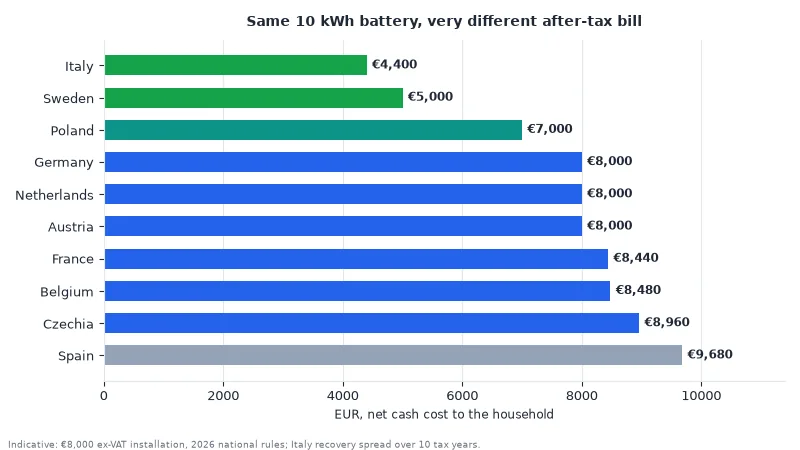
The spread from €4,400 in Italy to €9,680 in Spain is more than a factor of two. Cross-border payback discussions are meaningless until the tax layer is normalised: a Spanish quote that looks 10% cheaper than an Italian one can be 40% more expensive after tax.
Documentation: what the invoice must show
Every scheme above lives or dies on paperwork. Before sign-off, the installation invoice should separately identify:
- the battery (model, kWh) as a distinct line item;
- the VAT rate applied and its legal basis;
- the labour share, where the deduction covers work rather than equipment (Sweden, Finland);
- the installer’s registration status (F-skatt, RGE QualiPV, Italian installer registers);
- the functional battery–PV link where required (Italy, Poland).
Keep contracts, receipts and grid-connection confirmations for the full claim period — ten years in Italy’s case; several tax authorities now scrutinise storage claims closely.
Three mistakes that cost real money
- Bundling the battery into one French invoice with the panels — losing the 5.5% rate on the whole job.
- Assuming the Italian 50% rate continues into 2027 — signing in January instead of December cuts the deduction by 14 percentage points.
- Ignoring the per-person cap. Sweden’s SEK 50,000 ceiling applies per individual, so a two-owner household can plan the invoice split in advance to use both allowances.
Tax relief reduces the price once; Insum Energy supplies certified LiFePO4 battery systems with the datasheets, test reports and compliance files installers need for subsidy applications and tax files across EU markets — browse the range on our product pages, see how financing interacts with tax timing in our guide to battery storage financing and leasing options in the EU, read our article on Netherlands and Belgium VAT for home batteries for the Benelux detail, and learn more about us.
Planning a 2026 installation and want the tax-optimal configuration? Contact Insum Energy for a quote — we will match certified LiFePO4 storage to the deduction rules, VAT conditions and documentation requirements of your market.