Home Battery Noise in the EU 2026: dB Levels & Siting Rules
Almost every home battery sold in Europe now advertises silence: “quiet operation”, “fanless”, “no moving parts”. The claim is half true, and the half that is not is the half that generates complaints. A wall-mounted pack that is inaudible in a showroom can still be heard through a bedroom wall at 02:00 — and its datasheet quotes one number without saying whether it is sound power or sound pressure, typical or worst case, or at what distance.
The Short Answer: Quiet, Not Silent
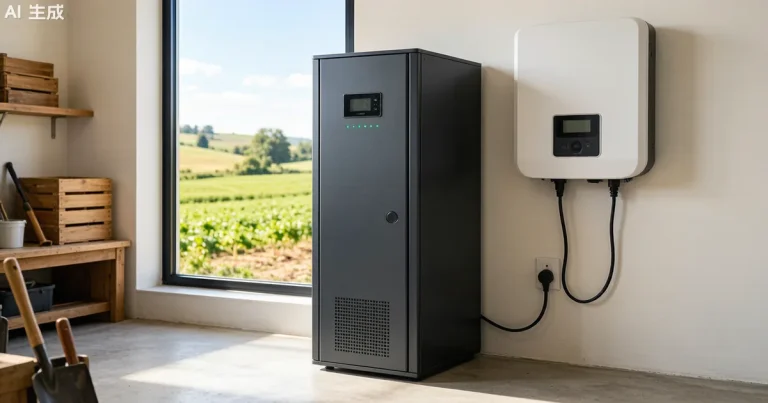
A lithium pack has no compressor, but a battery system has three audible parts. Cooling fans, which run during high-rate charge and discharge, meaning sunny afternoons and backup evenings. The inverter’s transformer and inductors, which hum at twice the grid frequency, 100 Hz in Europe, plus harmonics at 200 Hz. And DC contactors, which clunk when the pack connects or disconnects.
The fan is what neighbours hear; the hum is what wakes light sleepers, because a steady 100 Hz tone is more intrusive than broadband noise at the same level and A-weighting under-reports it. Published figures show the spread: fanless units sit under 30 dB(A), fan-cooled hybrids declare up to 45 dB(A), and the few manufacturers who publish a maximum quote 45 to 62 dB(A). Since 10 dB reads as twice as loud, that spread decides who gets a complaint.
Sound Power vs Sound Pressure: Why Two Datasheets Cannot Be Compared
Sound power (LWA) describes the acoustic energy a machine emits, wherever it stands. Sound pressure (LpA) describes what a microphone hears at a given point, and it falls about 6 dB every time the distance doubles: a unit declared at 55 dB(A) sound power measures roughly 44 dB(A) at one metre, 38 at two and 32 at four.
Most battery datasheets print one figure and no method, so a “40 dB” battery might be typical at one metre with a 55 dB worst case. Treat an unlabelled number as marketing until the supplier confirms the metric, the distance, and whether it is typical or maximum.
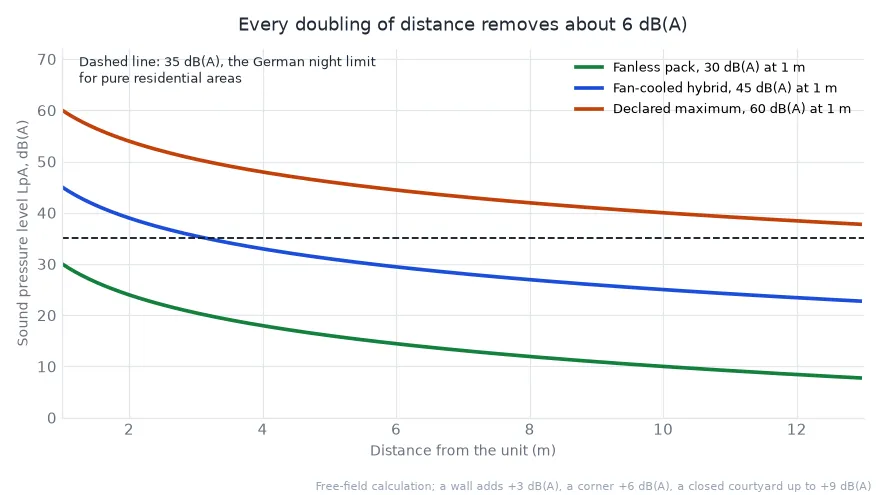
Geometry adds to the arithmetic. A unit against a flat wall gains about 3 dB from reflection, in a corner about 6 dB, in a courtyard enclosed on three sides up to 9 dB. On a shared wall, vibration reaches the neighbour’s room as structure-borne sound, which no window filters.
What EU Law Actually Limits
There is no EU-wide decibel limit for a home battery. The Environmental Noise Directive 2002/49/EC governs strategic mapping, not appliances; the Battery Regulation (EU) 2023/1542 covers chemistry and labelling. IEC 62109-1/-2 covers converter safety and EN 50549-1/-2 grid connection, and neither contains a noise requirement.
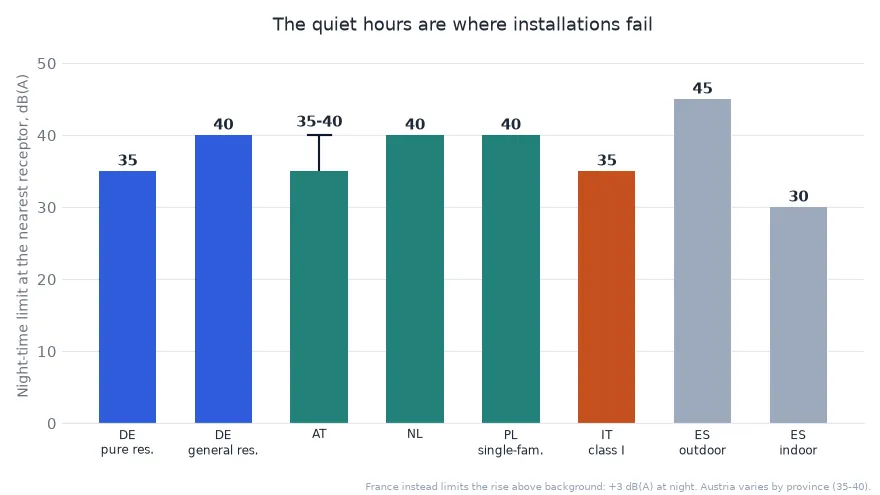
The binding numbers are national or municipal, and apply at the nearest protected room of a neighbour. Germany’s TA Lärm is the strictest common benchmark: 35 dB(A) at night in purely residential areas, 40 dB(A) in general residential areas, plus a 3 or 6 dB(A) surcharge for audible tonal content, which is exactly what a 100 Hz hum is. Low-frequency noise is assessed separately under DIN 45680.
| Country | Instrument | Night limit, residential | Basis |
|---|---|---|---|
| Germany | TA Lärm, No. 6.1 | 35 dB(A) pure / 40 dB(A) general | Immission at nearest protected room, tonal surcharge |
| Austria | Provincial codes, ÖNORM B 8115 | 35-40 dB(A) | Immission, varies by province |
| France | Code de la santé publique, R.1336-5 to 8 | +3 dB(A) above background | Emergence, not an absolute level |
| Italy | DPCM 14/11/1997 | 35-40 dB(A) | Absolute emission, class I-II zones |
| Netherlands | Besluit bouwwerken leefomgeving | 40 dB(A) | At the property boundary, tonality correction |
| Spain | Ley 37/2003, RD 1367/2007, local ordinances | 45 dB(A) outdoor, 25-30 dB(A) indoor | Municipal ordinance sets the number |
| Poland | Environment ministry regulation, 2007 | 40 dB(A) | Single-family housing zones |
France is the outlier that catches installers out. The rule is not a ceiling but an increase: 5 dB(A) above ambient from 07:00 to 22:00, 3 dB(A) from 22:00 to 07:00, at the complainant’s property. Where residual night noise is 28 dB(A), that caps the unit at 31 dB(A) at the neighbour’s window. Long-running noise gets no duration allowance.
Where Installations Actually Fail
A battery rarely breaches an outdoor limit by itself. German courts have dismissed nuisance claims where a correctly decoupled unit measured 27 dB(A) at full load in front of it and added 1 dB(A) at the complainant’s window. What fails is the siting:
- Party walls. A pack on the shared wall of a semi-detached house sits 20 cm from a neighbour’s bed — the commonest failure, and the constraint our apartment and rental storage guide treats as default.
- Re-entrant corners. Two adjoining walls reflect sound from both surfaces, adding 5-6 dB over a free-standing position.
- Garages under bedrooms. The ceiling muffles airborne noise but not vibration; a unit bolted to the wall beneath a bed is worse than one on a rubber-mounted frame.
- Stacked equipment. A battery fan and an outdoor heat pump in one corner add logarithmically: two equal sources give +3 dB, pushing a pair across a 35 dB(A) limit that either would pass alone. Our heat pump and battery guide covers the electrical side; acoustics is the other half.
- Outdoor cabinets on terraces, judged as outdoor sources with no building fabric in the way.
Siting Rules That Survive a Night-Time Check
Design for the strictest case, then measure: take the declared maximum, subtract 6 dB per doubling of distance, add 3 dB for a wall and 6 dB for a corner, and compare with the national night limit at the nearest bedroom window. Under 5 dB of margin, change the position rather than the product.
- Prefer a utility room or ground-floor garage to a hallway wall, and never a wall shared with a neighbour or bedroom.
- Mount on anti-vibration feet or a decoupled frame. Rubber pads cost under €100 and solve most structure-borne cases.
- Keep 2-3 m from a neighbour’s opening outdoors, and avoid corners and courtyards that trap sound.
- Do not box an outdoor unit in a sealed enclosure: trapped heat makes the fan run longer and louder, and can void the thermal warranty. Use a lined, ventilated screen.
- Cap the charge rate at night. Most hybrids allow a scheduled power limit; halving it usually removes the fan ramp, at the cost of a slightly longer absorption window.
- Log a measurement at handover, idle and at full load, with the date — two dated readings are the cheapest defence against a complaint filed a season later.
Maintenance matters: dust on a fan grille raises temperature and run time, both covered in our O&M budget guide. A fan duty cycle above roughly 15% in mild weather signals an oversized charge rate or a badly ventilated room, and BMS and app monitoring shows the trend before anyone hears anything.
Architecture Decides Where the Noise Sits
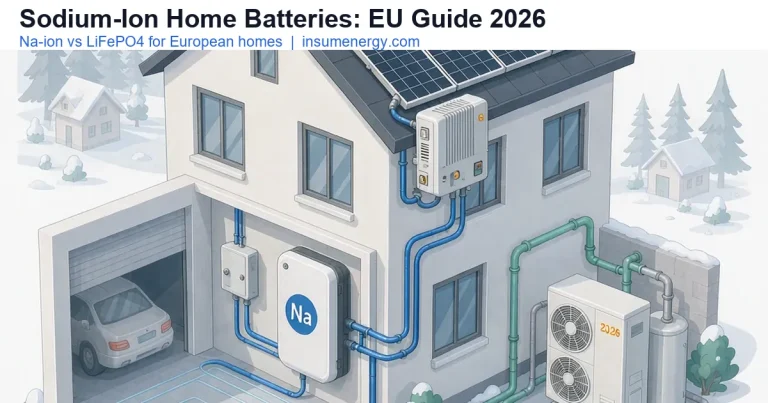
A DC-coupled hybrid runs one converter harder, usually beside the pack; an AC-coupled retrofit adds a second converter, often near the consumer unit in a hallway, exactly where a hum is least welcome. The trade-offs are in our AC versus DC comparison. Passively cooled packs are silent because heat leaves through the casing, which is why thermal management and acoustics are one decision.
What to Ask Before You Sign
- Sound power or sound pressure, at what distance, typical or maximum?
- Which cooling method, and what fan duty cycle at rated charge power?
- Is a night mode or charge-rate limit available, and does it affect the warranty?
- Does the warranty exclude outdoor or unheated installation, and which IP and corrosion class applies?
- Which national limit will the design be checked against, and who signs the acoustic note?
In tenders, put the acoustic figure beside round-trip efficiency and cycle life: 5 dB between two equal products is worth more at the boundary than a 1% efficiency gain. Buyers who need the certification side will find it in our product range and in the permit guide, since several member states attach noise conditions to the building notification.
The Cost of Getting It Wrong
Anti-vibration mounts run €60-150, a lined outdoor enclosure €400-1,200, and relocating a wall-mounted unit, including making good and re-running DC cable, €300-900 in labour. A complaint adds a measurement, a planning condition and, at worst, an order to stop charging at night. On commercial sites the acoustic study belongs in the planning application.
Conclusion
Home batteries are quiet products with unhelpful datasheets. Read the metric, do the distance arithmetic, keep the unit off shared walls, decouple it from the structure, measure at handover. Done that way it is inaudible from a neighbour’s bedroom; done the other way it becomes the reason a household stops charging overnight, which defeats the point of buying it.
If you are specifying storage for one home or a portfolio, contact Insum Energy for a quote that includes the acoustic figures, a siting plan and the certification package. You can also read more about how we test and document our LiFePO4 systems, or start from the Insum Energy homepage.