Do Home Batteries Need a Permit in the EU? 2026 Guide
One of the first questions European homeowners ask before buying a home battery is whether the installation needs a permit. The good news: in most EU countries, a typical 5–15 kWh wall-mounted battery installed indoors does not require a building permit. The bad news: “no permit” does not mean “no paperwork”. Between grid registration, electrical conformity certificates and fire-safety notifications, almost every member state attaches at least one legal obligation to a home battery installation — and skipping it can cost you feed-in revenue, insurance coverage or even a fine.
This guide explains the 2026 rules country by country, based on national building codes and energy regulations. For the EU-wide product rules that apply regardless of where you install, see our overview of EU battery regulations for 2026.
Permit, Registration or Certificate? Three Different Questions
Much of the confusion around battery paperwork comes from mixing up three legally distinct obligations:
- Building permit — permission from the municipality to construct or alter a structure. For an indoor battery on a wall or floor stand, this is rarely required anywhere in the EU.
- Grid and energy registration — telling the grid operator or a national register that a storage unit is now connected to the network. This is mandatory in most countries and is what unlocks feed-in tariffs or surplus compensation.
- Electrical conformity — a certificate or declaration from a licensed installer confirming the wiring meets national electrical codes.
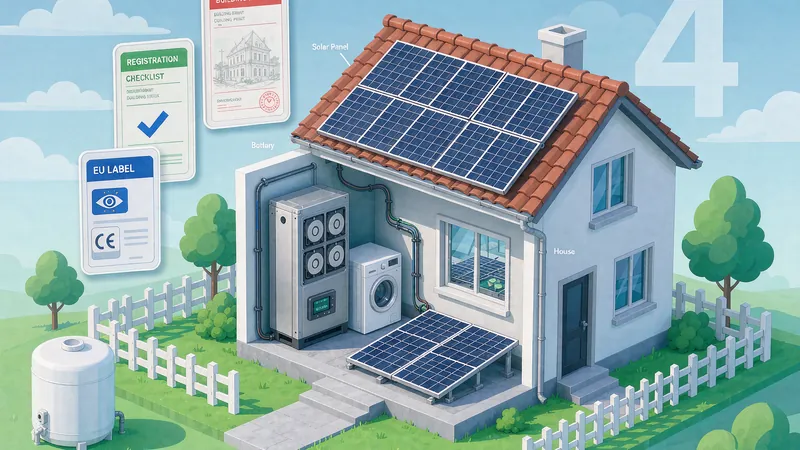
A second distinction matters just as much: indoor vs outdoor. A battery inside an existing utility room is treated as household equipment in most jurisdictions. A cabinet in the garden, a dedicated battery shed or a large commercial unit can cross thresholds that trigger building codes, fire-safety review or even a full permit.
Country-by-Country Rules for 2026
Germany: No Permit, But MaStR Registration Within One Month
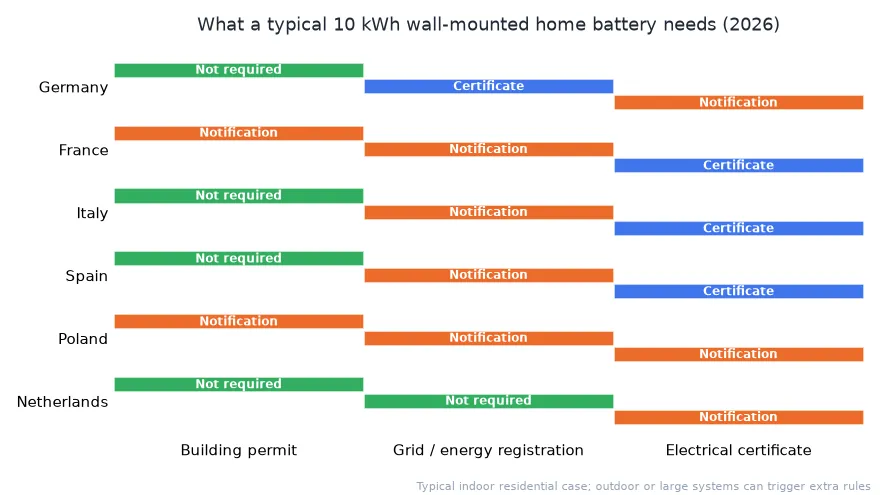
A typical indoor residential battery does not need a building permit under German building law. What it does need is entry in the Marktstammdatenregister (MaStR), the Federal Network Agency’s register of all generation and storage units. Registration must be completed within one month of commissioning at marktstammdatenregister.de — since Solarpaket I, the register informs the grid operator automatically, and a separate DSO notification is no longer required for small plug-in systems. Failing to register is an administrative offence under §95 EnWG, with fines theoretically up to €50,000. Technically, the installation must satisfy the grid connection requirements of VDE-AR-N 4105, and an outdoor battery cabinet or a system above typical household scale can trigger state building regulations (Landesbauordnung) and fire-protection review.
France: The Purple Consuel Is the Real Hurdle
French planning law requires a déclaration préalable at the town hall for rooftop solar visible from a public road — but the battery itself, installed indoors, needs no planning authorisation. The binding step is electrical: any grid-connected PV system with storage requires the Consuel “violet” certificate (€201.17 including VAT in electronic form at the 2025–2026 scale) before Enedis will accept the connection, alongside the CACSI agreement. The inverter must be certified to EN 50549, and the installation must comply with standard NF C 15-100. Note that since 5 June 2026, surplus electricity is bought at a single low tariff of €0.011/kWh, which is one more reason French households are prioritising storage over export.
Italy: Retrofit Batteries Often Fall Under “Edilizia Libera”
Adding a battery to an existing photovoltaic system is frequently classed as edilizia libera (free building activity) — no building title required. Larger PV works need a CILA (comunicazione di inizio lavori asseverata) signed by a licensed technician, typically costing €200–400 in fees. On the energy side, storage units are registered in Terna’s GAUDÌ portal, and retrofit batteries on plants with GSE conventions must follow the GSE’s technical rules for storage integration. The installer also issues a declaration of conformity under DM 37/2008. Combine the paperwork with the incentives: the 2026 Ecobonus (36%, or 50% for a main residence under Law 199/2025) applies to storage as well.
Spain: The Battery Rides on the PV Paperwork
Under Royal Decree 244/2019 (article 5.7), storage is expressly permitted within a self-consumption installation, and the battery itself does not receive its own administrative registration — the CAU file and registration attach to the generation installation. What triggers paperwork is a change in inverter capacity: if you add or upgrade an inverter, article 8.1 obliges you to notify the distributor. The installation must be carried out by a licensed installer who issues a certificate filed with the regional (comunidad autónoma) authorities, complying with the low-voltage electrotechnical regulation (REBT, RD 842/2002).
Poland: Europe’s Clearest Capacity Tiers
Poland’s Building Act amendment created the most explicit capacity tiers in the EU. For storage installed in or on buildings: up to 30 kWh — no construction notification and no permit at all; 30–300 kWh — a construction notification (zgłoszenie) with technical documentation coordinated with a fire-safety expert; above 300 kWh — a full construction permit. Outdoor standalone units face the same first tier, but from 300 kWh upward must also notify the State Fire Service (PSP), and above 2,000 kWh a permit is required. On the grid side, a storage system whose capacity does not exceed the building’s connection capacity only needs a notification, with the distribution operator connecting it within 30 days.
Netherlands: The Lightest Regime for Homes
A behind-the-meter residential battery in the Netherlands generally needs no permit, and no dedicated energy registration applies to small household systems. Large grid-connected storage is a different story: those projects typically need an omgevingsvergunning (environmental permit) and early consultation with the municipality and safety region. For homeowners, the practical deadline is fiscal, not administrative — net metering (salderingsregeling) ends on 1 January 2027, strengthening the case for storage.
Fire Safety and Placement Rules That Come With the Paperwork
Even where no permit applies, placement rules are tightening. Keep batteries out of escape routes and stairwells, respect the manufacturer’s clearance distances, and install on non-combustible surfaces where the manual requires it. Poland’s PSP notification tiers are the most formalised example of fire authorities wanting to know where larger units sit, but insurers across the EU increasingly ask similar questions. Our guide to LiFePO4 fire safety covers the technical side, and our article on battery insurance and certification in the EU explains how to keep your cover valid. 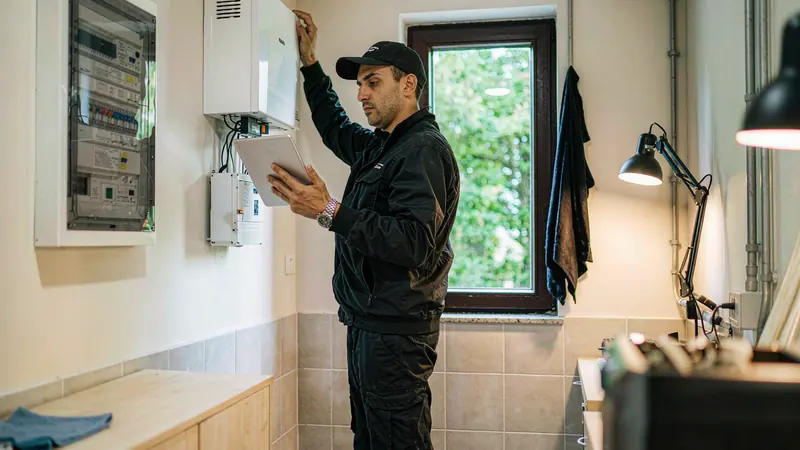
Renters, Apartments and Homeowners’ Associations
In Germany, a tenant needs the landlord’s written consent for a battery — the plug-in solar itself enjoys legal protection, but storage strengthens the landlord’s argument that the installation is a structural change. In condominiums (WEG), mounting on shared property typically requires a majority vote of the owners’ association. Similar dynamics apply in France (syndic approval for common areas) and Spain (comunidad de propietarios consent). Our guide to apartment and rental battery solutions explores the workarounds, including balcony solar with storage.
What Happens if You Skip Registration
The consequences are rarely dramatic on day one — which is exactly why so many owners forget. But an unregistered battery can quietly cost you: loss of feed-in tariff or surplus compensation entitlements, rejected insurance claims after a fire, warranty disputes, and problems when selling the property. In Germany, operating an unregistered unit is an administrative offence under the Energy Industry Act. Registration is free or nearly free everywhere and usually takes well under an hour — the risk-reward calculus is not close.
Pre-Installation Compliance Checklist
- Confirm with your municipality whether any local statute, heritage zone or outdoor-cabinet rule applies to your installation.
- Check the capacity thresholds that apply in your country (30 kWh matters in Poland; scale and location matter in Germany).
- Book a licensed installer who will issue the electrical conformity document — Consuel violet in France, DM 37/2008 declaration in Italy, REBT certificate in Spain.
- File the energy registration: MaStR within one month in Germany, GAUDÌ in Italy, distributor notification in Spain when inverter capacity changes.
- Notify your building insurer with the certificates and installation report.
- Keep every document — you will need them for incentives, warranty claims and any future house sale. Our step-by-step installation guide walks through the physical side.
Get the Paperwork Right the First Time
Battery rules in the EU are converging on a simple pattern: no building permit for indoor residential systems, but always a registration and almost always a certificate. An experienced installer handles nearly all of it — the smartest move is choosing one who will. Insum Energy supplies certified LiFePO4 home batteries with the documentation European installers need, from conformity files to grid-compliance datasheets. Contact us today for a tailored quote and make your 2026 battery installation compliant from day one.