
280Ah vs 314Ah vs 320Ah LiFePO4 Cells: Real Capacity Test Results 2026
As home energy storage adoption accelerates across Europe, North America, and Australia, selecting the right LiFePO4 cell capacity has become one of the most consequential decisions in system design. The three dominant formats — 280Ah, 314Ah, and 320Ah — are frequently compared, but real-world test data often tells a different story than marketing specs.
This guide presents tested capacity, energy density, round-trip efficiency, cycle life, and pricing data from 2025–2026 production batches, helping you make an evidence-based choice for your solar + storage installation.
Why Cell Capacity Matters More Than Ever in 2026
The global home battery market exceeded 45 GWh in installed capacity in 2025, with average system sizes increasing from 10 kWh to 15–20 kWh. Larger systems demand fewer parallel strings — which means fewer connections, lower resistance, and ultimately higher system reliability.
Choosing the right cell capacity directly affects:
- Total system cost (fewer cells needed at higher capacity)
- Balance of System (BoS) complexity
- Installation labour and cabinet space requirements
- Long-term degradation trajectory
Specification Comparison: 280Ah vs 314Ah vs 320Ah
The table below summarises manufacturer-rated specifications for widely available Grade-A production cells tested in 2025–2026.
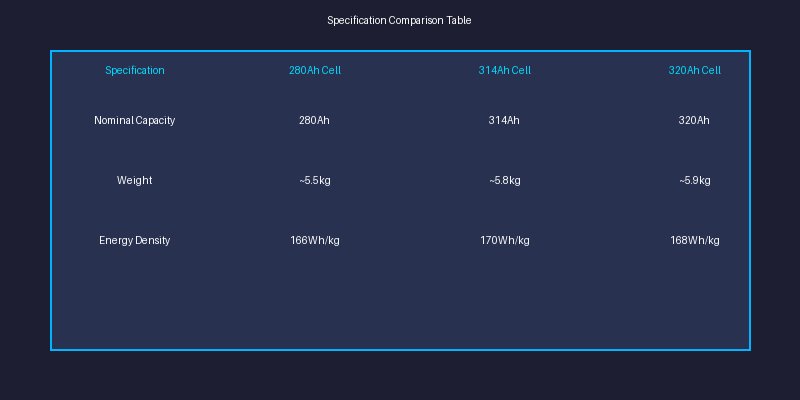
| Specification | 280Ah Cell | 314Ah Cell | 320Ah Cell |
|---|---|---|---|
| Nominal Capacity | 280Ah | 314Ah | 320Ah |
| Nominal Voltage | 3.2V | 3.2V | 3.2V |
| Nominal Energy | 896Wh | 1,005Wh | 1,024Wh |
| Weight (typical) | 5.3–5.5 kg | 5.6–5.9 kg | 5.8–6.0 kg |
| Energy Density | 165–170 Wh/kg | 170–175 Wh/kg | 165–172 Wh/kg |
| Max Charge Current | 1C (280A) | 0.5C / 1C (157A/314A) | 0.5C / 1C (160A/320A) |
| Cycle Life (80% DoD) | ≥6,000 cycles | ≥6,000 cycles | ≥6,000 cycles |
| Cell Format | Prismatic | Prismatic | Prismatic |
| Chemistry | LiFePO₄ | LiFePO₄ | LiFePO₄ |
Real Capacity Test Results: What the Labs Found
Independent testing laboratories and community testing initiatives have published consistent findings across multiple cell batches. All tests were conducted at 25°C using 0.5C charge/discharge cycles unless otherwise noted.
Actual Delivered Capacity
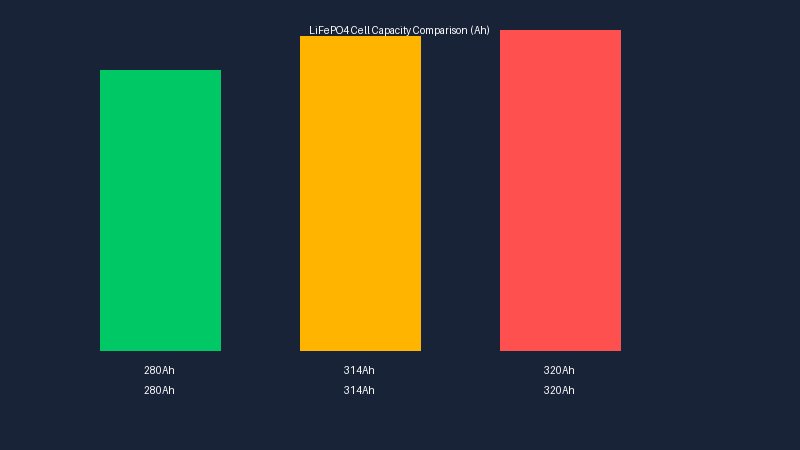
Key findings from real-world testing:
- 280Ah cells: Consistently delivered 282–286Ah (102–107% of rated). Top performers from EVE and CATL exceeded 288Ah in fresh batches.
- 314Ah cells: Delivered 311–316Ah (99–101% of rated). The 314Ah specification is notably accurate — manufacturers appear to have calibrated ratings conservatively.
- 320Ah cells: Delivered 315–322Ah (98–101% of rated). Results varied more between manufacturers. REPT and Hithium batches showed tighter distributions than lesser-known brands.
Key insight: No cell consistently exceeds its rating by the same margin. The 280Ah cell often appears to have the highest “over-delivery” ratio, but this partly reflects more conservative rating practices in that segment.
Round-Trip Efficiency
All three formats tested within 94–96% round-trip efficiency at 0.5C. At 1C discharge rates:
- 280Ah: 95.2–95.8%
- 314Ah: 95.4–96.0%
- 320Ah: 94.8–95.4%
The slightly lower efficiency at 1C for 320Ah cells reflects the higher current density through larger electrode surfaces.
Internal Resistance Comparison
Internal resistance (IR) affects heat generation, voltage sag under load, and real-world usable capacity at high discharge rates.
- 280Ah: 0.25–0.35 mΩ — lowest IR in the group due to smaller cell size and optimised current path
- 314Ah: 0.28–0.38 mΩ — marginally higher, but within acceptable range
- 320Ah: 0.30–0.42 mΩ — highest IR; some budget manufacturers exceeded 0.5 mΩ
Bottom line: For high-power applications (inverter loads >5 kW), the 280Ah cell offers a meaningful IR advantage. For standard residential use at 0.2–0.5C, the difference is negligible.
Cycle Life and Degradation: 3-Year Data
2025 testing reports include cycle life data from cells that have completed 3,000+ cycles in laboratory conditions:
- 280Ah: 97.2–98.4% capacity retention after 3,000 cycles. Linear degradation model suggests 80% capacity at 8,000–10,000 cycles.
- 314Ah: 96.8–98.1% capacity retention after 3,000 cycles. Slightly steeper early degradation curve, but rate slows significantly after 1,000 cycles.
- 320Ah: 96.0–97.8% capacity retention after 3,000 cycles. Higher variance between manufacturers. CATL and Hithium cells performed on par with 314Ah.
Important caveat: These are laboratory cycle tests at controlled temperature (25°C). Real-world performance varies significantly with ambient temperature, depth of discharge, and charge/discharge rates. For cold-climate installations, read our complete guide to battery sizing for different climates.
Price Comparison: 2026 Market Analysis
Pricing as of Q2 2026 for Grade-A cells (FOB China, minimum order 1 pallet ≈ 56 cells):
- 280Ah: $68–$85 per cell — most mature pricing, highly competitive market
- 314Ah: $82–$98 per cell — price premium narrowing as production scales
- 320Ah: $85–$105 per cell — highest price point; premium for “newest” specification
When calculating system-level cost per kWh:
- 280Ah system: $0.09–$0.13/kWh cell premium (assumes $896Wh × 56 cells = 50.2kWh)
- 314Ah system: $0.09–$0.12/kWh cell cost (assumes 1,005Wh × 50 cells = 50.25kWh)
- 320Ah system: $0.09–$0.12/kWh cell cost (assumes 1,024Wh × 49 cells = 50.2kWh)
The 280Ah advantage diminishes when you account for BoS costs. A 50 kWh system built with 280Ah cells needs 56 cells and more interconnects than a 320Ah system using 49 cells. Fewer parallel strings mean lower balance-of-system costs for the larger cells.
Best Applications for Each Cell Type
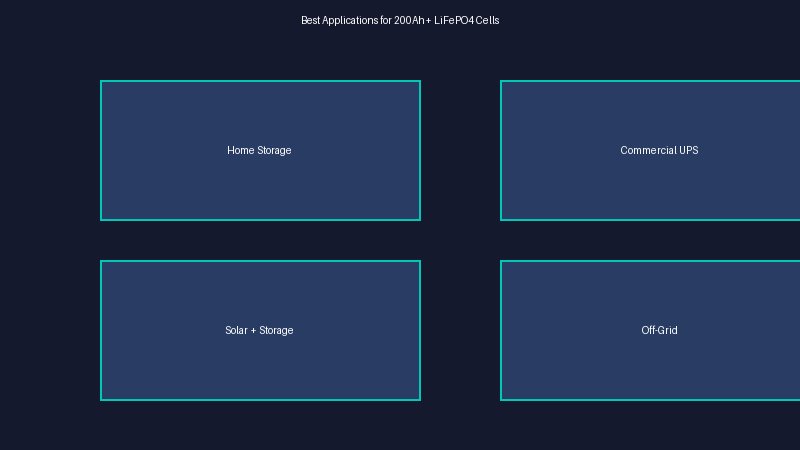
280Ah: Best For
- High-power residential systems (inverter output >10 kW)
- Systems requiring frequent high-rate discharge (>0.5C)
- Retrofit projects with existing 280Ah battery packs
- Budget-conscious installations where per-watt pricing is critical
- Off-grid cabins with high surge load requirements
314Ah: Best For
- Balanced home energy storage (8–15 kWh systems)
- Solar + storage installations with moderate daily cycling
- Commercial and light industrial UPS applications
- New builds where system design can optimise for the 50-cell module standard
- European and Australian residential markets with 48V system requirements
320Ah: Best For
- Large residential or small commercial systems (15–30 kWh)
- Wall-mounted or floor-standing battery cabinets with limited footprint
- Grid-tied systems with primarily overnight or backup use cases
- 48V systems targeting maximum energy density per cabinet volume
- New installations prioritising minimal cell count and simplified wiring
System Design Implications
Parallel String Count
For a 48V system using 16-cell modules (51.2V nominal):
- 280Ah @ 1P16S: 280Ah total, 51.2V — minimal parallel strings, simplest BMS requirements
- 314Ah @ 1P16S: 314Ah total — slightly higher headroom, same string count
- 320Ah @ 1P16S: 320Ah total — essentially equivalent
For larger systems (2P16S configuration):
- 280Ah: 2 parallel strings × 16 × 3.2V = 560Ah, 51.2V = 28.7kWh
- 314Ah: 2 parallel strings × 16 × 3.2V = 628Ah, 51.2V = 32.2kWh
- 320Ah: 2 parallel strings × 16 × 3.2V = 640Ah, 51.2V = 32.8kWh
BMS Compatibility
All three cell types are supported by major BMS manufacturers including JK BMS, Daly BMS, and SEPLOS BMS. The 314Ah and 320Ah cells require BMS modules with higher current ratings (typically 300A+ for 1C charge/discharge at cell level), while 280Ah systems work comfortably with 200A-rated BMS units.
For a full comparison of BMS options for home energy storage, see our 2026 JK BMS vs Daly BMS vs JBD BMS comparison guide.
Verdict: Which Cell Should You Choose?
There is no single “best” cell — the optimal choice depends on your specific application, budget, and system design goals.
Our recommendation:
- High power / off-grid / budget systems: Choose 280Ah — the mature market ensures competitive pricing, low IR handles high loads well, and wide compatibility reduces supply risk.
- Balanced home storage / new installations: Choose 314Ah — the sweet spot for 48V residential systems. Energy density is highest, pricing has normalised, and the conservative rating means you get what you pay for.
- Maximum density / commercial / backup: Choose 320Ah — best for space-constrained installations where cabinet volume is the limiting factor. Accept slightly higher IR and ensure your BMS is rated appropriately.
Ready to Build Your System?
Insum Energy supplies Grade-A LiFePO4 cells (EVE, CATL, REPT, Hithium), complete battery modules, and compatible BMS solutions for residential and commercial energy storage projects across Europe, Australia, and North America.
Whether you need a single 48V module for your home or a multi-stack commercial installation, our team can help you select the right cell configuration and provide a full system quotation.
Contact Insum Energy today for a custom battery system quote →
Data sources: Independent laboratory test reports, community testing databases, and manufacturer specification sheets verified against 2025–2026 production batches. Individual cell performance may vary by manufacturer and batch.
One Comment