

EU Rooftop Solar Mandate 2026: What It Means for Storage
On 31 December 2026 the first hard deadline of the EU solar rooftop standard arrives. From that date, Article 10 of Directive (EU) 2024/1275 — the recast Energy Performance of Buildings Directive, or EPBD — requires suitable solar installations on every new public and non-residential building with a useful floor area above 250 m². By 2030 the obligation reaches new homes, roofed car parks and the whole public building stock. The directive mandates panels, not batteries. But read together with the zero-emission building standard, it quietly sets the framework in which storage will be specified, financed and sold across the EU for the rest of the decade. Here is what owners, installers and distributors actually need to plan for.
What Article 10 Requires, and When
Article 10(3) sets a staircase of obligations that tightens every year (European Commission, solar energy in buildings):
| Deadline | Buildings covered | Threshold |
|---|---|---|
| 31 Dec 2026 | All new public and non-residential buildings | > 250 m² floor area |
| 31 Dec 2027 | Existing public buildings; existing non-residential buildings undergoing major renovation, roof works or permitted technical-system works | > 2,000 m² / > 500 m² |
| 31 Dec 2028 | Existing public buildings | > 750 m² |
| 31 Dec 2029 | All new residential buildings; all new roofed car parks adjacent to buildings | all |
| 31 Dec 2030 | Existing public buildings | > 250 m² |
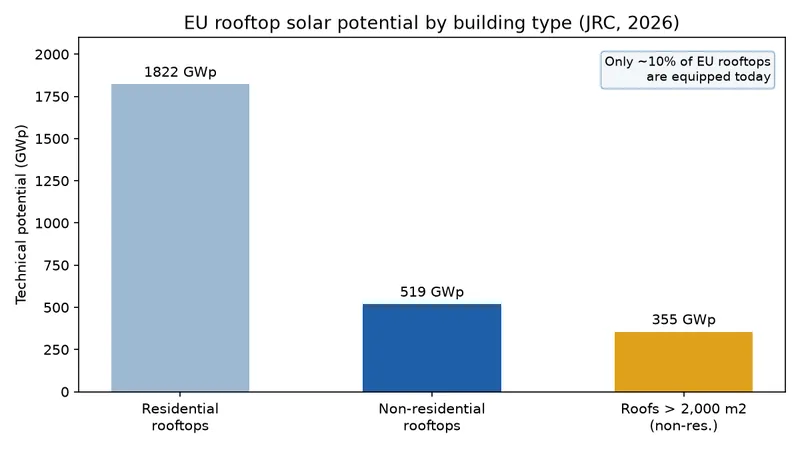
Member states had to transpose the directive by 29 May 2026, so national rules — including the exemption criteria for heritage buildings, green roofs and structurally weak roofs that Article 10(4) allows — are being written into building codes right now. The scale behind the mandate is enormous: a 2026 Joint Research Centre study covering all 271 million EU buildings puts non-residential rooftop potential at about 519 GWp, with large roofs above 2,000 m² alone able to host roughly 355 GWp — and only around 10% of European rooftops equipped so far.
How the 2026 Deadline Bites in Practice
The legal trigger is the completion date, but the Commission’s guidance is more useful for planning: for a new commercial building, the requirement applies where the building permit is submitted from 1 January 2027. In other words, projects entering permitting now must carry solar in their drawings — and the inverter, metering and switchboard design should assume storage from day one, because retrofitting an AC-coupled battery later costs more than specifying it now, as we explain in our guide to AC versus DC-coupled storage.
For existing non-residential buildings above 500 m², the obligation attaches to major renovations or works that need a permit — roof works and technical building system replacements included. Since a mandated roof is by definition a construction site, the marginal cost of adding a battery-ready switchboard, conduit and wall space is trivial at that moment and expensive at any other.
Panels Are Mandatory. Batteries Are Not — Yet
Nothing in Article 10 obliges storage. The storage signal sits in Article 11: a zero-emission building “shall, where economically and technically feasible, offer the capacity to react to external signals and adapt its energy use, generation or storage” (Directive (EU) 2024/1275, Article 11(1)). All new buildings must meet the zero-emission standard from 1 January 2030, and public buildings from 1 January 2028. A building that must react to price and grid signals, on a roof full of midday solar, is functionally a building that wants a battery.
The economics are already pushing the same way. The 2022 EU Solar Energy Strategy noted that rooftop PV could cover almost a quarter of EU electricity consumption, and explicitly asked member states to build support frameworks that combine solar “with energy storage and heat pumps” (COM(2022) 221 final).
The Commercial Battery Economics Are Different
Most storage payback analysis assumes household prices — and that flatters the business case on a commercial roof. Eurostat puts the EU household average at €0.2896/kWh for the second half of 2025, against just €0.1837/kWh for medium-sized non-household consumers (Eurostat, non-household electricity prices H2 2025; household series in the Eurostat nrg_pc_204 databrowser). In Germany the gap is wider still: BDEW’s autumn 2026 analysis shows households paying 37.0 ct/kWh while small and mid-sized industrial users pay 17.2 ct/kWh (BDEW Strompreisanalyse Herbst 2026).
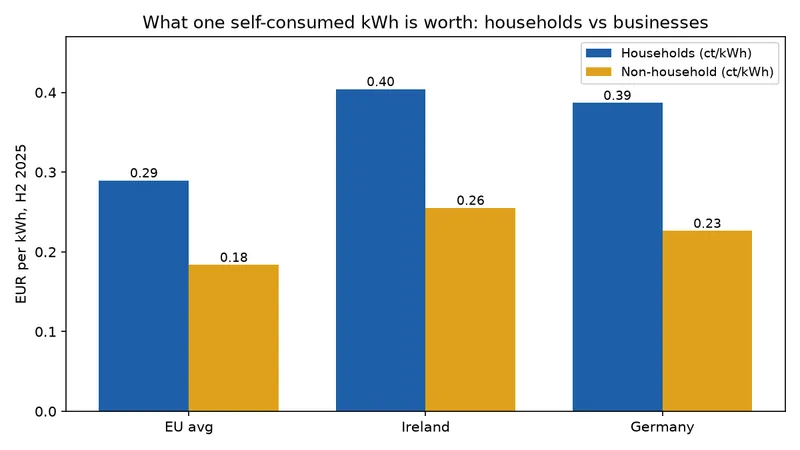
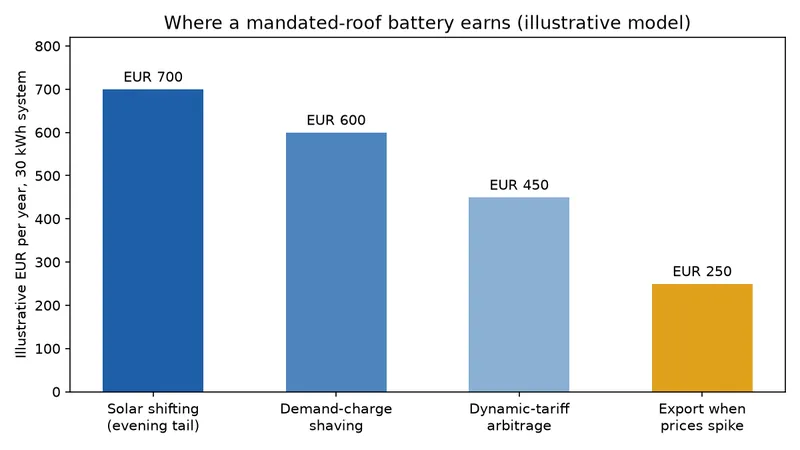
Every self-consumed kWh on a mandated commercial roof is therefore worth roughly half of what it is worth in a home. A office or school also consumes most of its power during daylight, so PV alone already self-consumes 60–80% of generation; the battery’s marginal job is narrower — shaving the evening tail, avoiding demand peaks, and capturing cheap midday surplus that would otherwise be exported. That does not kill the business case, but it changes what the battery must earn: peak-demand charges, grid-fee optimisation and dynamic tariffs, not just solar shifting. Our article on grid-fee avoidance in Germany shows how large that lever is.
Sizing Storage for a Mandated Roof
Three rules cover most projects. First, size PV to the roof and the connection, not to the bill — the mandate rewards capacity. Second, size the battery to the load after sunset and the site’s peak half-hours, not to the PV array. Third, decide early whether the system will be allowed to export at all, because zero-export settings change both sizing and inverter choice. Typical starting points for the buildings the mandate hits first:
| Building type | Typical roof PV | Sensible battery | Why |
|---|---|---|---|
| Office, 500–1,000 m² | 30–60 kWp | 10–20 kWh | Flat daytime load; evening tail is small |
| Retail / supermarket | 50–150 kWp | 30–80 kWh | Refrigeration peaks and weekend demand charges |
| School or town hall | 30–100 kWp | 20–50 kWh | Summer idle weeks; PV output exceeds load |
| Warehouse | 200–500 kWp | case-by-case | Low load density; battery needs a market revenue |
For the 2029 wave, the same logic applies to homes and to the roofed car parks that Article 10 couples with them — a combination our solar carport and storage guide covers in detail. Anyone unsure about capacity can start from our general battery sizing method and adjust for the commercial price gap above.
Grid Connection Is the Real Bottleneck
Article 10(2) routes solar on buildings through the fast-track permit procedure of the recast Renewable Energy Directive and the simple notification route for grid connection — administrative speed is largely solved. Physical capacity is not. A 100 kWp roof on a rural workshop can exceed the site’s connection limit, and several distribution operators now impose dynamic or zero-export caps. Budget for a smart meter, an export-limitation relay and an inverter that supports it; our overview of permit and notification rules lists what each country expects before commissioning.
Who Pays for the Battery: Subsidies in 2026
Support programmes mostly target homes, so the table below flags what each scheme actually covers as the mandate rolls out:
| Country | Programme 2026 | Storage support | Applies to mandated roofs? |
|---|---|---|---|
| Germany | KfW 270 | Low-interest loan, up to 100% of PV + storage cost | Yes — companies and farms |
| France | MaPrimeRénov’ | Renovation grants, residential only | No — businesses use CEE certificates |
| Italy | Conto Termico 2.0 | Up to 65% for small systems, incl. public administration | Yes — public buildings benefit |
| Netherlands | Salderingsregeling | Net metering ends 31 Dec 2026; storage gains value | Partial — commercial never had net metering |
| Poland | PME 2 (Mój Prąd successor) | 30% of storage cost, ≤ PLN 16,000; min 10 kWh | No — households only |
| Czechia | NZÚ | Interest-free loans: CZK 25,000/kWp + CZK 15,000/kWh | Homes; firms use OP-TAK calls |
| Romania | Casa Verde | Voucher grants incl. battery, administered by AFM | Homes only |
| Greece | PV on the Roof rounds | PV 45–75% by income; battery 90–100%, cap €16,000 | Homes and farmers only |
The pattern is blunt: the buildings Article 10 targets first — commercial and public — are precisely those with the thinnest direct grant support. Financing structure, not subsidy, closes the gap, which is why leasing and PPA-style models are moving upmarket; see our guide to storage financing and leasing.
A 90-Day Checklist for Owners and Installers
- Check whether your pipeline includes permits lodged from 1 January 2027 on buildings above 250 m² — those drawings need solar now.
- For existing non-residential stock above 500 m², tag every planned roof or HVAC project before the 2027 trigger catches it.
- Specify battery-ready infrastructure — switchboard space, conduit, wall footing — even when the battery is phase two.
- Ask the DSO early about export limits and connection headroom; it takes longer than the paperwork.
- Model the battery against demand charges and dynamic tariffs, not household prices, before promising payback.
The mandate makes solar a compliance item. Storage is what turns that compliance cost into a controllable energy position — and from 2028, the zero-emission building standard will expect exactly that flexibility. If you are planning a project under the new rules, contact Insum Energy for a tailored quote — our team works with LiFePO4 battery systems sized for commercial and public buildings across the EU, and you can learn more about our work with European installers or start from our homepage.


One Comment