Pool Heat Pump + Home Battery in Southern Europe 2026
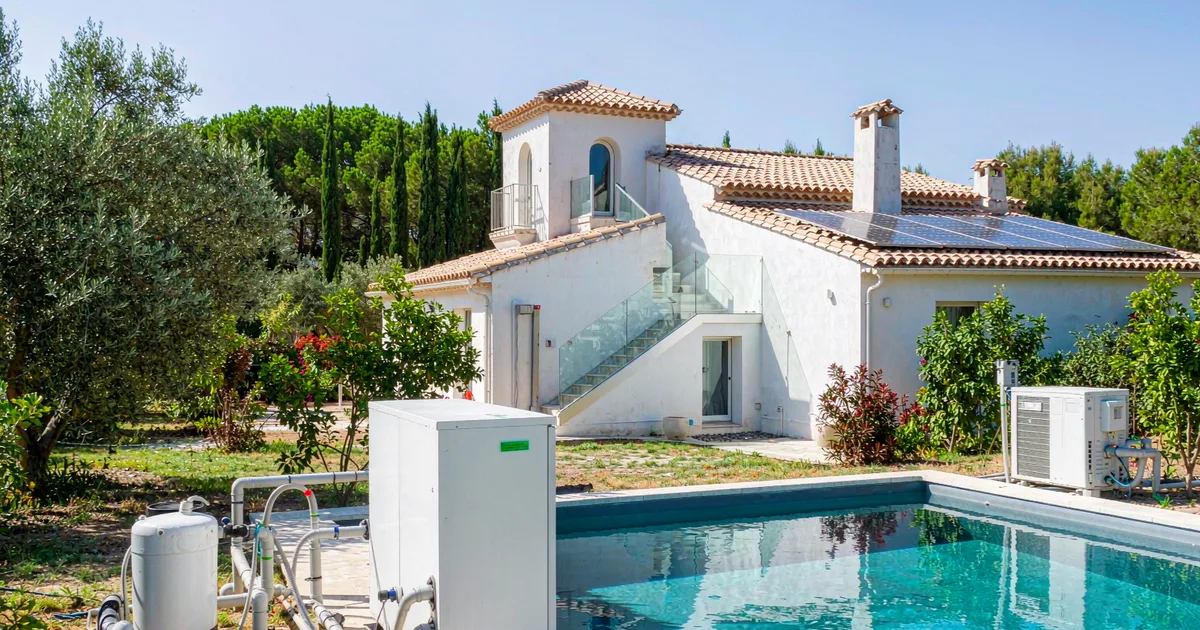
Ask a pool service company in Valencia, Athens or Bari what drives a summer electricity bill and the answer is rarely air conditioning — it is the pool. A filtration pump running six to ten hours a day plus an inverter heat pump holding 27–28 °C from May to October can add 3,500–6,000 kWh a year to a southern-European home. With household electricity in 2026 priced between €0.24 and €0.31 per kWh across Spain, Italy, Greece and Portugal (Eurostat nrg_pc_204, H1 2026), that load quietly costs €800–1,500 a season. Here is what a home battery actually adds to a pool-heated villa in southern Europe in 2026 — and where it does not.
What a pool heat pump really draws
A pool heat pump is not a space-heating unit. Because the temperature lift is small in summer, its coefficient of performance (COP) is high: manufacturers rate inverter pool heat pumps at COP 4–6 — 1 kWh of electricity delivers 4–6 kWh of heat. Industry sizing data puts the seasonal electricity use of a 40–50 m³ outdoor pool kept at 27–28 °C at roughly 2,500–4,000 kWh with an inverter model, 4–5 times more with a direct electric heater. Add the filtration pump — typically 0.5–0.75 kW for 6–10 hours a day — and the pool becomes the largest controllable load on the property. Two cheap fixes matter more than any hardware: a bubble cover cuts evaporation losses by roughly half, and a variable-speed pump cuts filtration energy by 50–70% versus a single-speed unit.
Why solar and pool heating are natural partners
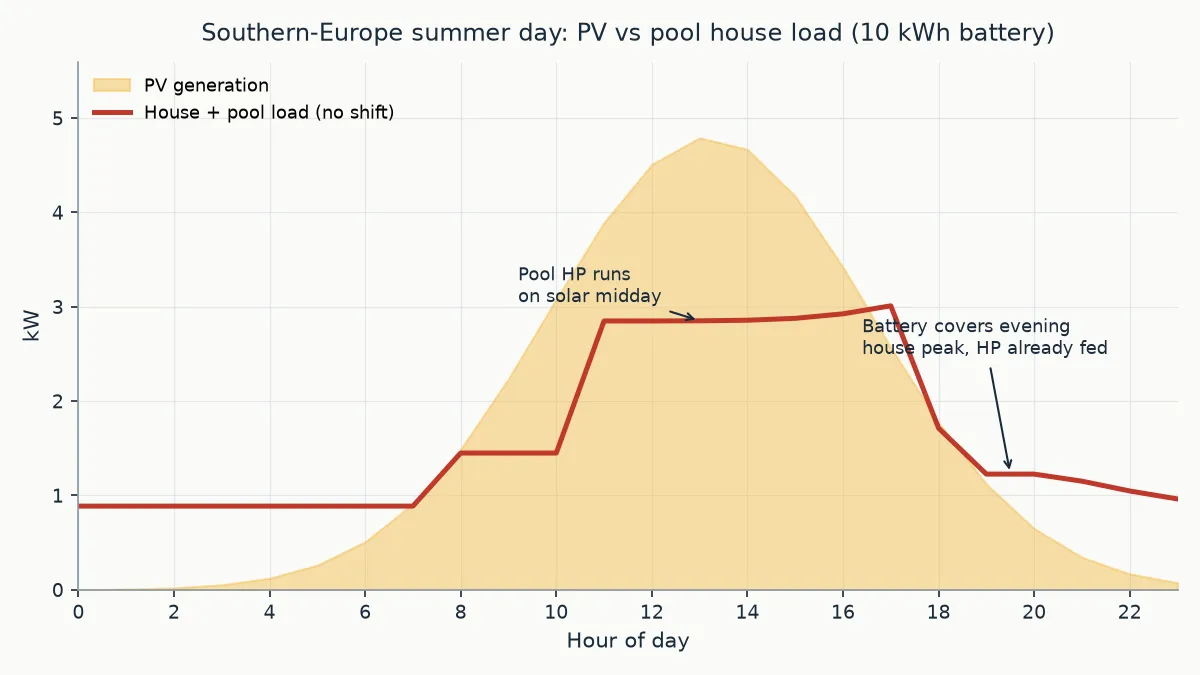
Pool heating is one of the few domestic loads that happily follows the sun. Water stores heat well, so run the heat pump at 13:00, not 20:00 — heat added at midday is still in the pool at dusk. Filtration is the same, which is why self-consumption rates rise sharply when big thermal loads shift into midday (see our self-consumption rates by EU country). A typical southern-European summer day: PV peaks 11:00–16:00, filtration runs 08:00–18:00, the heat pump tops up 11:00–17:00, and the house peak (cooking, cooling, guests) arrives after 18:00. Direct midday consumption alone can cover most of the pool’s electricity in July and August — no battery involved.
What the battery adds — and what it does not
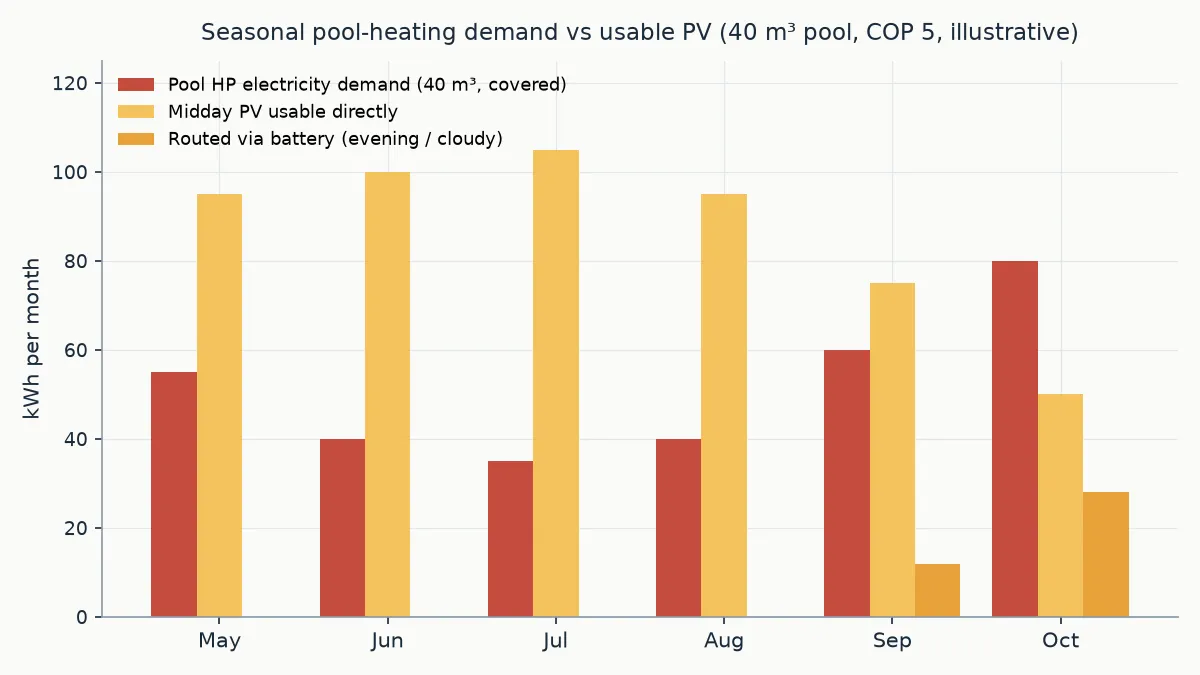
The honest part: in peak summer a well-sized PV array covers the pool heat pump alone, and a battery would simply add cost. It earns its keep at the edges of the season:
- Evening comfort. Guests swim when the sun is gone. If the heat pump must run at 19:00–21:00 in Spain, that is exactly when PVPC hourly prices are highest (published daily by Red Eléctrica’s ESIOS platform); a battery charged from midday surplus supplies those hours.
- September–October. Temperatures fall, COP drops, and heating demand rises just as daily PV output shrinks — the window where stored energy carries the pool.
- Cloudy shoulder days. Spring opening and autumn closing weeks often produce more pool demand than same-day solar.
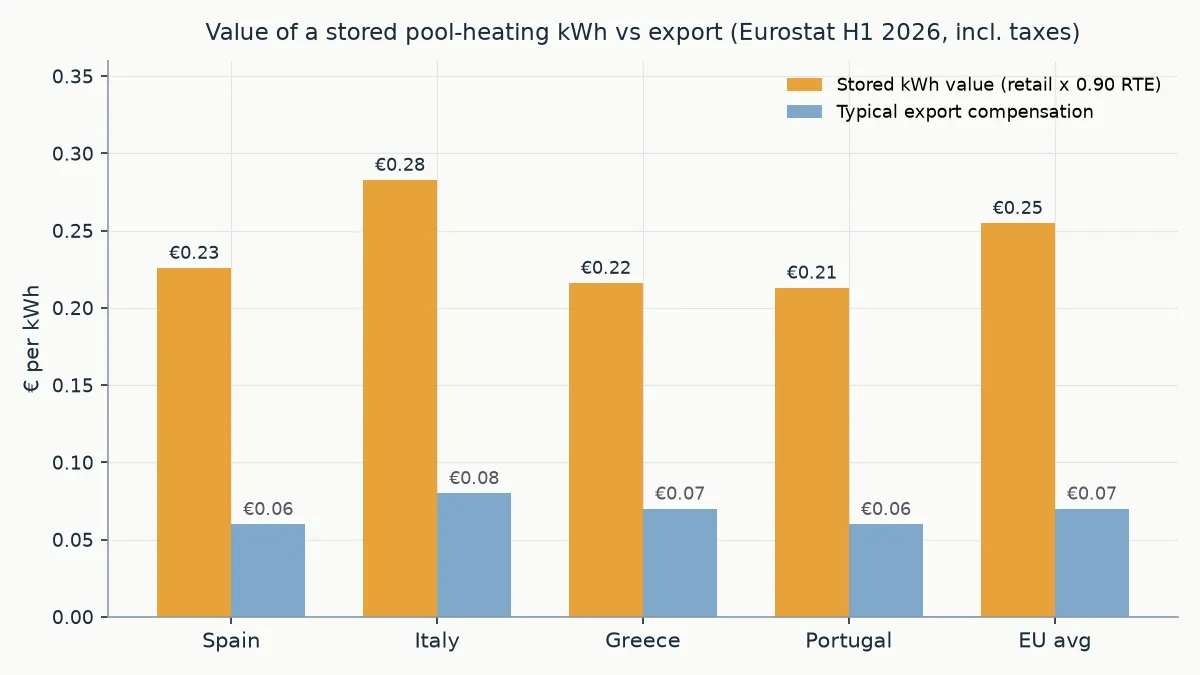
The economics hinge on the gap between the value of a stored kWh and an exported one. Taking household retail prices including taxes for H1 2026 (Eurostat nrg_pc_204) and assuming 90% round-trip efficiency, a stored kWh is worth about €0.23 in Spain (retail €0.2509), €0.28 in Italy (€0.3142), €0.22 in Greece (€0.2401) and €0.21 in Portugal (€0.2367), against an EU average of €0.2832. Export compensation in Spain’s simplified regime typically lands between €0.05 and €0.09 per kWh, tracking hourly market prices. Every pool-heating kWh stored rather than exported is therefore worth three to four times more. Batteries are explicitly permitted in simplified self-consumption installations under Royal Decree 244/2019.
The evening-season arithmetic
Take a 45 m³ pool with a 1.5 kW electrical heat pump running 5 evening hours in September and October: about 220 kWh a month, roughly €55 of grid electricity in Spain at €0.25/kWh. Supplied from a battery charged by midday surplus, that energy is essentially free after the storage investment. Over 10–12 shoulder-season weeks the battery displaces €150–250 of evening heating, stacking on its year-round job of shifting household consumption out of the evening peak.
Sizing the system around the pool
| Pool volume | HP electrical input | Season electricity* | Recommended PV | Battery |
|---|---|---|---|---|
| 30 m³ | 1.0–1.2 kW | 2,000–2,500 kWh | 4 kWp | 5 kWh |
| 45 m³ | 1.4–1.6 kW | 2,800–3,800 kWh | 5 kWp | 8–10 kWh |
| 60 m³ | 2.0–2.4 kW | 4,000–5,000 kWh | 6–8 kWp | 10–15 kWh |
*Covered pool, inverter heat pump, COP ≈ 5; uncovered pools need roughly twice the energy.
The sequence matters: reduce demand first (cover, variable-speed pump, midday scheduling), then size PV for the summer balance, then the battery for the evening and shoulder-season residual. A 10 kWh LiFePO4 system like ours covers a full evening of house load plus 3–4 hours of heat-pump runtime — see our product range for modular options.
Tariffs and rules in the four markets
Spain. The 2.0TD regulated tariff keeps its cheap valley period (00:00–08:00 and weekends), but in summer midday hours are often the cheapest as solar floods the market. For PVPC customers the hourly prices published by REE ESIOS make the evening peak explicit — typically the day’s most expensive hours. Batteries and surplus compensation are fully covered by RD 244/2019, and regional battery subsidies have concentrated on the islands (our Canary and Balearic Islands guide covers those schemes).
Italy. Household prices are the highest of the four (€0.3142/kWh, Eurostat), which strengthens the stored-kWh case, and residential self-consumption rules accommodate storage without extra registration. Note that the GSE’s Conto Termico 2.0 funds space-heating and hot-water heat pumps, not pool heaters.
Greece. Strong irradiance makes midday self-consumption easy, and the national rooftop programme still pays 45–75% of PV-plus-battery costs for households (HDB / programme documentation); our Greece subsidy guide details eligibility.
Portugal. Storage is legal for self-consumers under Decreto-Lei 162/2019, and surplus can be sold to the supplier, but there is no national household battery grant in 2026; Portuguese buyers should treat the battery as a tariff-arbitrage asset, sized conservatively.
Subsidy reality check for 2026
Few schemes were written with pools in mind, and most battery programmes do not care what load you shift. Where each country stands for a pool-heated villa:
| Country | Scheme | What it covers | Status for pool systems |
|---|---|---|---|
| Germany | KfW 270 (442 closed) | Loans for solar + storage | Indoor pools only; no pool HP support |
| France | MaPrimeRénov’ | Space-heating heat pumps | Pool HP excluded; second homes ineligible |
| Italy | Conto Termico 2.0 | Heating/DHW heat pumps, 65% | Pool HP excluded; battery rides on PV rules |
| Netherlands | ODE / salderingsregeling | Net metering ends 31 Dec 2026 | Storage increasingly necessary; few pools |
| Poland | Mój Prąd / PME 2 | 30% battery cost, capped | Open to homes incl. seasonal pools |
| Czechia | NZÚ | Battery up to CZK 75,000 | Intake paused — check reopening |
| Romania | Casa Verde | RON 20,000 max | PV+battery eligible for homes |
| Greece | Rooftop PV + battery | 45–75% of cost | Strongest fit for pool villas |
The pattern is consistent: subsidies reward the house system, not the pool. Do not count pool-specific savings in an application — count the battery’s whole-home duty, which for most southern-European buyers is the evening peak, island grid constraints and dynamic tariffs (see our holiday-let ROI guide and hotel and B&B guide for the tourism-property variants).
Control setup: the order of operations
A pool-plus-battery system only performs if the controls respect a simple hierarchy:
- Run filtration and heat pump between 10:00 and 16:00 whenever PV is available — automate it with the inverter’s load-management or a smart relay.
- Set a battery reserve of 30–40% for evening household demand; only surplus above that should feed the pool in the morning.
- In shoulder season, allow the battery to finish overnight top-ups from the grid only in the cheapest tariff hours.
- Verify your DSO’s export conditions before commissioning: some networks now impose feed-in caps or zero-export conditions that change how the inverter must behave (our zero-export guide explains the control logic).
- Keep the heat pump’s own timer as the safety layer; the battery controller should never be the only thing between the compressor and 28 °C.
When the battery is not worth it
Finally, the honest caveat. If the pool is used June–August only, the heat pump is already scheduled midday, the tariff is flat and there is no evening demand beyond a two-person household, PV alone will decarbonise the pool cheaper than PV plus storage. The battery case strengthens with every evening hour the heat pump runs, every shoulder-season week the pool stays warm, and every tariff that charges more after sunset. For pool villas and holiday homes across southern Europe, that describes most of the market. If you want a system sized around your pool volume, tariff and swimming season, contact Insum Energy for a tailored quote — our engineers size the PV, battery and heat-pump schedule as one system; read more on the About Us page or start from the Insum Energy homepage.