

Holiday-Let Battery Storage in the EU: 2026 ROI Guide
Why Holiday Lets Are a Different Storage Case
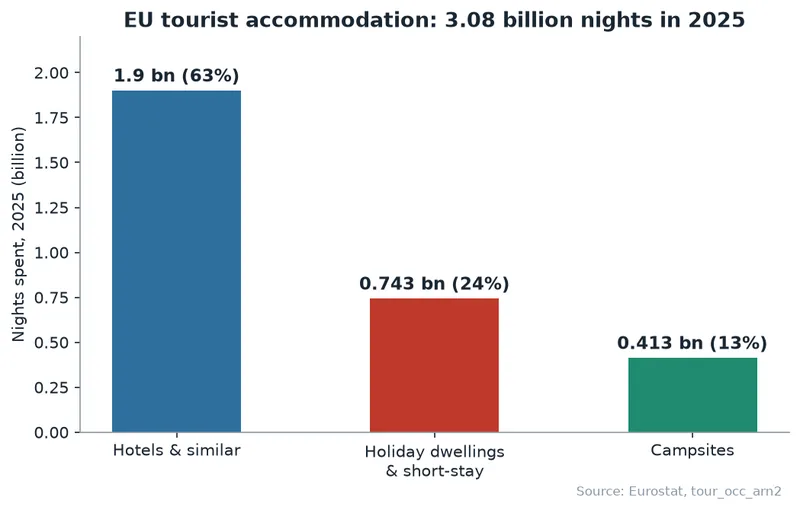
A holiday let is not a smaller version of a family home. It sits empty for weeks, then absorbs eight guests, three loads of laundry and a cleaning crew on a single Saturday afternoon. The bills are yours, not the guests’, which means every kilowatt-hour wasted during a booking comes straight off your rental margin. That combination — violent peaks, long troughs and someone else’s consumption habits — changes both what a home battery is worth and how it should be sized. The 3.08 billion nights spent in EU tourist accommodation in 2025 included 743 million nights (24%) in holiday dwellings and other short-stay accommodation (Eurostat, tour_occ_arn2), so this is a large, largely overlooked segment for storage.
The 2026 Compliance Baseline: Registration Numbers Are EU Law
Before the economics, one regulatory fact every holiday-let owner now lives with. Regulation (EU) 2024/1028 on data collection for short-term accommodation rental services has applied since 20 May 2026 (EUR-Lex). Hosts on platforms must hold a valid registration number where a registration procedure exists, and platforms must verify and display it before a listing goes live. What does this have to do with batteries? Legitimacy. A professionally metered, safely installed PV-plus-storage system supports the compliance file many municipalities and regional tourism authorities now expect, and it matters if you ever need to prove the property is a properly run accommodation business rather than an informal let.
What the Occupancy Data Really Shows
The seasonality numbers explain the load profile better than any sales brochure. Roughly 31% of all EU tourism nights in 2025 fell in July and August alone, with Croatia, Bulgaria and Greece the most extreme cases (European Commission, Transition Pathway for Tourism). A typical coastal or rural let therefore runs at or near full occupancy for 8 to 12 weeks, sees shoulder-season weekend traffic, and stands empty — or is occupied only by its owner — for the rest of the year. Household electricity averaged €0.2832/kWh across the EU in the first half of 2026, with Germany at €0.3618, Ireland at €0.3871 and Belgium at €0.3575 (Eurostat, nrg_pc_204). At those retail levels, guest consumption is one of the quietest profit leaks in the business. Four markets host most of this demand: Spain recorded around 505 million nights, Italy 466 million, France 457 million and Germany 439 million in the 2024 reference year (Eurostat, tour_occ_arn2). If your let sits in one of them, the storage maths below applies almost unchanged.
The Holiday-Let Load Profile: Spikes, Turnovers, Empty Weeks
Three load patterns dominate, and each has a storage answer:
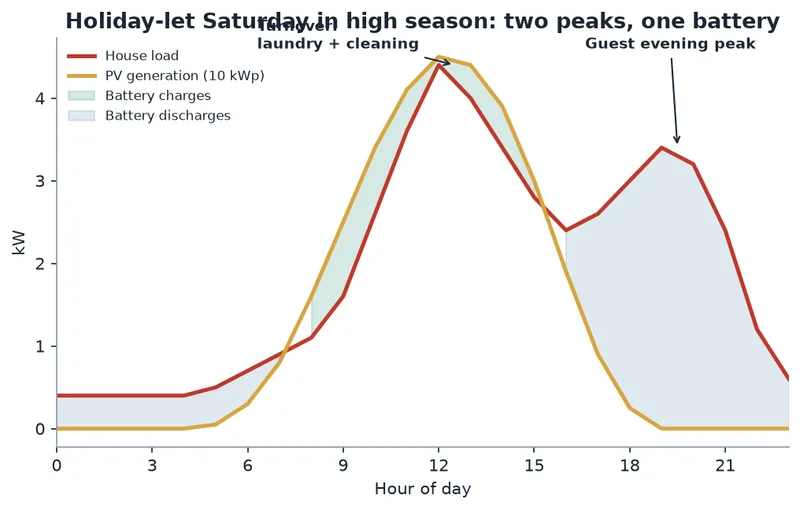
- Turnover afternoons. Check-out at 10:00, cleaning at 11:00, new guests at 16:00. Washing machines, dryers, dishwashers and vacuum cleaners stack onto the same midday hours — which, in summer, is exactly when the PV array peaks. A battery captures the surplus instead of exporting it at feed-in prices, then covers the evening guest peak.
- Guest evenings. Air conditioning, induction hobs, saunas and hot tubs run simultaneously because no guest pays attention to the meter. A 10 kWh battery flattens the evening spike and prevents the expensive mistake of a second connection upgrade in weak rural grids.
- Empty weeks. Nobody is home, but the battery is not unemployed. Against a dynamic tariff it still buys cheap night power and discharges into the evening spread — a smaller, but year-round, income stream that an owner-occupied model actually achieves less cleanly.
ROI Math: Guest Nights vs Cycle Economics
Run the honest numbers for a 10 kWh LFP battery (about 9 kWh usable, 90% round-trip efficiency) at the EU-average retail price:
- One cycle per day over roughly 320 effective days shifts about 2,600 kWh of retail-priced energy — worth around €730 per year at €0.2832/kWh (Eurostat, nrg_pc_204).
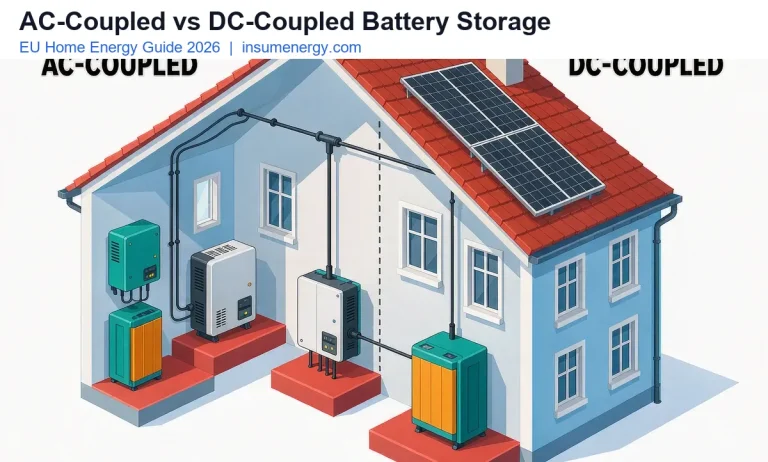
- In Germany at €0.3618/kWh the same behaviour is worth about €930 per year; installed cost for a 10 kWh AC-coupled system runs roughly €4,800–8,300, so the payback without subsidy is 7–10 years.
- A grant in the 30–45% range (Poland, Greece, Romania — see table below) compresses that to about 5–7 years, in line with what we model in our broader solar and battery ROI comparison.
The holiday-let twist cuts both ways. Occupied nights generate more captured kWh than an owner-occupied home because guests simply consume more — but the seasonal concentration means summer surpluses dominate the annual yield. Under a net-metering regime that is fine; where it is ending, it is not. Empty weeks deserve their own line in the model: on a dynamic tariff, buying at €0.06–0.08/kWh overnight and discharging into a €0.20–0.28/kWh evening peak yields roughly €200–300 per year for the same 10 kWh battery — modest, but earned while the property earns nothing else.
| Factor | Owner-occupied home | Holiday let |
|---|---|---|
| Effective cycling days | ~350/year | ~365/year (empty weeks still trade on dynamic tariffs) |
| Peak capture window | Evening 17:00–21:00 | Midday turnover + evening guest spike |
| Summer surplus | Partly exported | Consumed by guests at full retail value |
| Subsidy access | Broad | Narrower — several schemes exclude second homes |
| Monitoring needs | Owner nearby | Remote app access and alerts are essential |
Where a Battery Actually Earns: Tariffs, Caps and Islands
Three market details decide whether the holiday-let business case holds in 2026. First, the Netherlands: the salderingsregeling ends on 31 December 2026 (Rijksoverheid), which hits summer-heavy holiday lets hardest — a property that exports its June surplus for near-zero value now has a structural reason to store instead. Second, export caps: many coastal and rural lets sit on weak distribution grids where the DSO limits feed-in, and a battery turns a capped array from a liability into a self-consumption machine, as we detail in our zero-export limits guide. Third, islands: Mediterranean and Atlantic island properties combine high retail prices, fragile grids and diesel backup, and our island storage guide and the Canary and Balearic subsidy overview cover that economics in depth. For genuinely remote lets, a small generator plus battery hybrid is often cheaper than a grid upgrade — see our generator hybrid sizing guide.
Which Subsidies Pay a Holiday Let? The Primary-Residence Trap
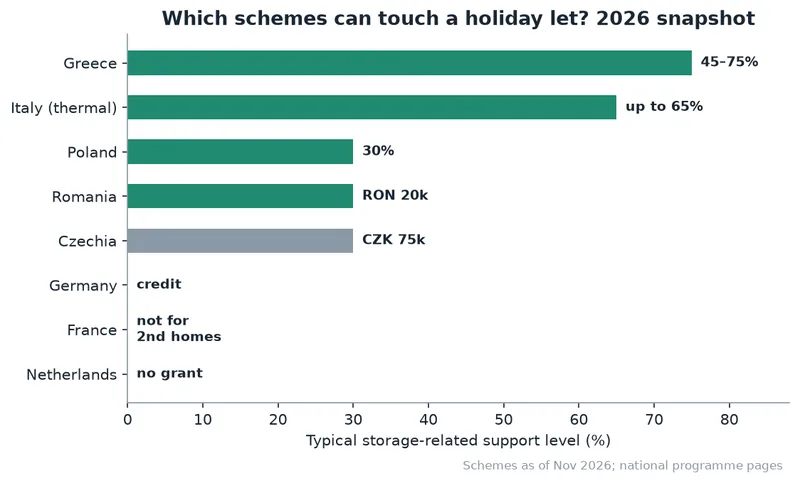
This is where holiday-let owners most often get burned: several flagship EU subsidy schemes require the property to be the applicant’s primary residence. France is the clearest case — MaPrimeRénov’ is closed to second homes entirely (France Rénov’), so a gîte owner must look instead to CEE energy-saving certificates and regional tourism-support schemes. Elsewhere the door is wider, but always check the occupancy clause in writing before quoting a client. The summary below reflects the schemes as of November 2026.
| Country | Scheme (2026 status) | Second home eligible? |
|---|---|---|
| Germany | KfW 270 efficiency credit open; KfW 442 solar-plus-storage grant closed (KfW) | Yes, if a German residential building |
| France | MaPrimeRénov’ 2026 restricted to primary residences (France Rénov’) | No — use CEE / regional schemes |
| Italy | Conto Termico 2.0 thermal credits up to 65% (GSE) | Yes, for existing buildings |
| Netherlands | No national battery grant; saldering ends 31.12.2026 (Rijksoverheid) | Business case, not subsidy, drives ROI |
| Poland | PME 2 storage window open since 20 Oct 2026: 30%, PLN 800/kWh, PLN 16,000 cap (przydomowemagazyny.gov.pl) | Check prosumer registration per property |
| Czechia | NZÚ battery grant CZK 75,000, currently paused for new applications (zelenausporam.cz) | Historically yes, for family homes |
| Romania | Casa Verde Photovoltaics: RON 20,000 for PV plus storage (AFM) | Owner-occupied homes; verify with AFM |
| Greece | Rooftop PV plus battery grants of 45–75% (HDB) | Residential properties incl. holiday homes |
Sizing and Siting Rules for Rentals
Size for the shoulder season, not the August peak. A 6–10 kWh battery covers midday turnover loads and evening spikes; beyond that you are paying for capacity that sits idle in October. Because neither you nor your cleaning crew is on site, insist on remote monitoring with automatic alerts, guest-safe flush mounting out of corridors, and clear labelling. Check your insurance schedule: our insurance and certification guide explains which certificates insurers expect, and rental properties are exactly where insurers look hardest. Finally, if the property faces price scenarios we map in our 2027–2030 power price outlook, a battery bought today is partly a hedge on tomorrow’s tariffs.
Bottom Line and Next Step
A holiday let rewards storage differently than a family home: fewer steady evenings, more violent midday turnovers, a summer-weighted yield and a subsidy map with traps in it. Get the sizing right for the shoulder season, put the battery where the turnover loads are, and confirm eligibility in writing before you commit. For a system sized to your occupancy calendar, contact Insum Energy for a quote, browse our LiFePO4 product range, or learn more about us — and start from our home page if you are new to the site.
One Comment