Hotel & B&B Battery Storage in the EU: 2026 Owner Guide
Ask a Hotelier About Electricity, and You Will Hear About the Kitchen
Yet accommodation is one of the most battery-friendly business profiles in the EU. Energy use concentrates exactly where rooftop solar does, commercial tariffs reward anyone who can flatten a demand peak, and falling unit prices no longer mean falling bills. This guide covers what a 10-to-40-room property can earn, how to size it, which rules bite, and which subsidies apply to a hotel rather than a house.
Why a Hotel Is Not Just a Big House
The scale is easy to underestimate. Accommodation activities alone consumed 253 petajoules of final energy in 2023 — roughly 70 terawatt-hours — and accommodation and food services together accounted for 450 petajoules, about 10.6% of all final energy consumed by the EU services sector, per Eurostat’s detailed services statistics. Most of that is heat and hot water, but the electricity component is what a battery works with — and a hotel’s electricity load is structurally different from a household’s.
Three differences matter. First, the base load is relentless: fridges, ventilation, hot-water circulation and corridor lighting run around the clock, even at 40% occupancy. Second, the peaks are commercial in size — an industrial dishwasher, a laundry line and a heat-pump hot-water plant together can add 20 to 60 kilowatts on top of room load. Third, the midday hours, which a house barely uses, are the hotel’s second-busiest period: check-outs mean laundry, kitchen prep means dishwashing, and pools or saunas run best when the sun does. European Commission best-practice guidance for tourist accommodation notes that structured energy monitoring alone typically yields savings around 10%, and that a best-practice 100-room hotel can cut consumption by 742 MWh per year — monitoring is exactly what a battery system does for free.
Where the Money Actually Comes From
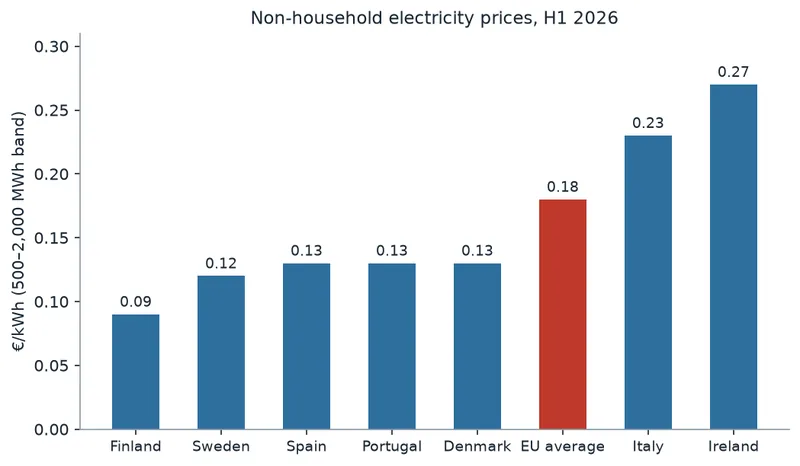
Non-household electricity prices in the EU averaged €0.18 per kWh in the first half of 2026 for consumers in the 500–2,000 MWh annual band — where many small hotels sit — down 5.4% year-on-year, with Ireland at €0.27 and Italy at €0.23 at the top and Finland (€0.09), Sweden (€0.12) and Spain, Denmark and Portugal (€0.13) at the bottom, per Eurostat’s nrg_pc_205 release. The household average was €0.2832 per kWh (Eurostat). A lower unit price means a hotel battery cannot live on arbitrage alone — it earns from four streams:
- Self-consumption: midday solar shifted into the evening guest peak. At 90% round-trip efficiency, a stored unit is worth about €0.16 at the EU-average commercial price, against roughly €0.06–0.08 for exporting the same unit.
- Peak shaving: business connections in several markets carry capacity-linked network charges or demand-weighted contracts; cutting the month’s highest 15-minute peak can save more than shifting a hundred units.
- Volatility: on dynamic commercial contracts, ACER’s market monitoring has documented daily price swings several times wider than in 2020 — a charged battery is a standing option on those hours.
- Continuity: one failed dinner service during an outage costs more than a year of arbitrage.
How these streams develop against wholesale prices is analysed in our EU power price outlook 2027–2030.
Sizing: From a Five-Room B&B to a 40-Room Hotel
Size from two measurements, not the annual energy total: the evening peak and the midday solar surplus. Rule-of-thumb starting points:
| Property | Typical evening peak | Solar range | Battery range |
|---|---|---|---|
| B&B / guesthouse, 5–10 rooms | 10–15 kW | 6–10 kWp | 10–15 kWh |
| Small hotel, 10–20 rooms | 20–40 kW | 15–30 kWp | 15–25 kWh |
| Hotel, 20–40 rooms | 40–80 kW | 30–60 kWp | 25–40 kWh |
The kitchen and laundry decide, not the room count: a property with a pool, spa or electric hot-water plant behaves one size class up. Inverter power matters more than in a house too — a 10 kW hybrid inverter can only shave a 40 kW peak if the battery sits behind a managed load group. Hardware ranges suitable for these loads are listed on our product page, and the logic for the holiday-home sibling of this segment is covered in our holiday-let ROI guide. Two traps recur: never size on the annual balance, and check whether the grid contract caps feed-in — a property on a zero-export condition must size the battery to absorb every midday surplus, because the network will not take it.
The Load Profile Is the Business Case
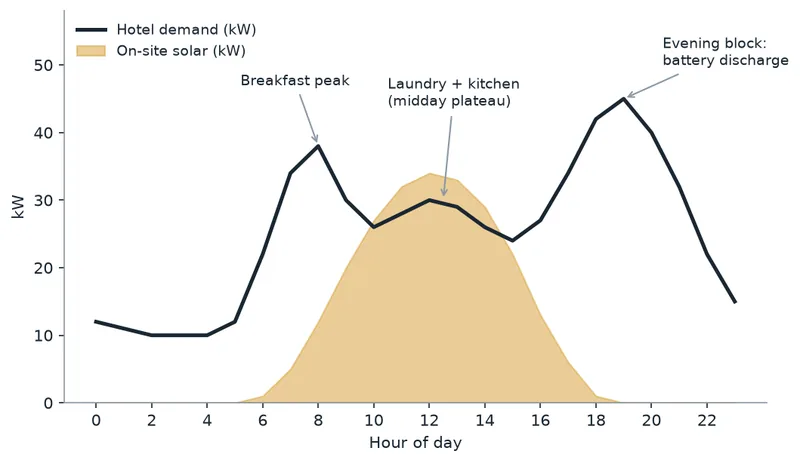
The typical small-hotel day runs in three waves: a breakfast spike around 07:00–10:00, a laundry-and-kitchen plateau through midday, and an evening block from 17:00 to 22:00 when rooms, restaurant and lighting stack up. Solar forms a bell over the middle wave — so the battery earns best by charging from the midday surplus and discharging across the evening block, rather than chasing every price signal.
What the Rules Let a Hotel Do
Most EU markets never offered net metering on business meters, so a hotel already lives in the post-subsidy world households are entering: the Netherlands ended its saldering scheme on 31 December 2026 (Rijksoverheid), and time-of-use contracts are the norm for commercial supply everywhere. That is an advantage — hotel batteries are not built on a subsidy assumption that may expire. What still needs checking before ordering: how the connection agreement treats storage (registration duties differ by market), whether a second meter would unlock anything for a commercial tariff — rarely the case, as our storage metering guide explains — and whether the local DSO requires export limitation or power-control capability as a connection condition, which EU market rules now explicitly accommodate for systems with certified power control under Article 6a of Directive (EU) 2024/1711.
The Funding Reality Check
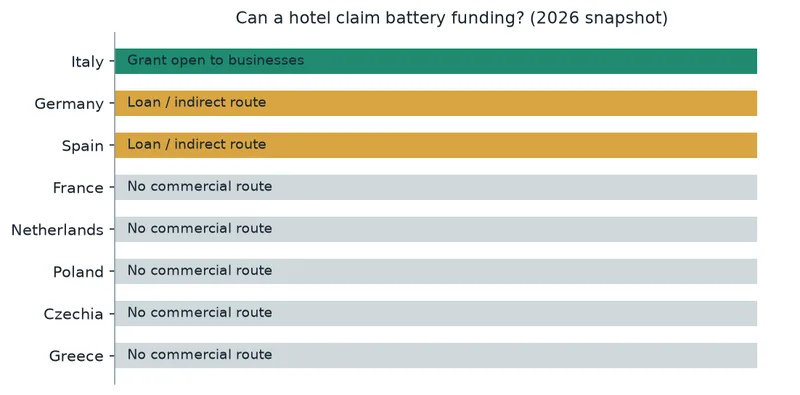
Here is the honest part: most headline battery subsidies in the EU are residential programmes, and a hotel owned by the same person cannot claim them. What commercial properties can access varies sharply:
| Market | Household schemes (hotels excluded) | Business route for a hotel |
|---|---|---|
| Germany | KfW 442/270 residential BEG | KfW BEG for non-residential buildings: refurbishment loans and, since the 21 July 2026 conditions, heat-pump grants up to €28,000 for smaller buildings |
| France | MaPrimeRénov’ — residential only | No direct battery grant; compliance driver instead (Éco Énergie Tertiaire) |
| Italy | Conto Termico 2.0 grant share | Conto Termico 2.0 also admits businesses — refunds on heat-pump and system costs via the GSE |
| Spain | — | IDAE RENOINN windows for commercial and non-residential refurbishment (2026 rounds closed; watch new calls) |
| Netherlands | Saldering ended 31.12.2026 | Business meters never had it — value via time-of-use contracts |
| Poland | Mój Prąd / PME 2 (przydomowemagazyny.gov.pl) | Not eligible — SME energy-efficiency loan calls only |
| Czechia / Romania | NZÚ / Casa Verde — households | Not eligible |
| Greece | Rooftop PV + storage, 45–75% (hdb.gr) | Not eligible — households only |
The takeaway: expect hotel payback from the tariff structure, not a grant. Where a market does fund commercial storage (Italy today, Germany within system refurbishment), the paperwork requires an energy expert or pre-application — budget the lead time.
Compliance: The Obligation You Cannot Shop Around
Two regulatory tracks now push hotels toward exactly the flexibility a battery provides. In France, the décret tertiaire obliges tertiary buildings of 1,000 m² or more — including hotels — to cut final energy consumption 40% by 2030 against a reference year, 50% by 2040 and 60% by 2050, with an annual declaration on ADEME’s OPERAT platform. At EU level, Article 9 of the Energy Performance of Buildings Directive (EU) 2024/1275 requires Member States to renovate the worst-performing non-residential building stock — 26% of it by 2030 and 31% by 2033 — and a hotel is non-residential floor area. Self-consumption plus storage is one of the few measures that cuts metered consumption and peak demand at once, scoring on both tracks.
Installation: Where Hotels Differ From Homes
Commercial installations inherit commercial rules: fire-compartment separation for battery rooms, three-phase distribution, and emergency-power logic that decides which circuits ride through an outage — the kitchen cold room and reception come before the sauna. Where an existing standby generator serves the property, battery and genset must be coordinated rather than paralleled naively; our generator-hybrid sizing guide covers the changeover architectures.
Bottom Line for Owners
A hotel battery is a load-management asset with an insurance rider, not a household arbitrage toy. In the €0.13–0.27 per kWh markets of 2026, a correctly sized system typically pays back through evening shifting and peak shaving within roughly five to eight years, faster where commercial volatility is highest. Get the load profile first — twelve months of half-hourly meter data — and size to it.
Get a Hotel-Sized Quote
Insum Energy supplies 10–40 kWh-class LiFePO4 systems rated for 8,000 cycles at 80% depth of discharge to installers and hospitality operators across 27 EU markets. Send us your half-hourly load data through our contact page or browse the range at insumenergy.com, and we will return a sizing proposal with a tariff-specific payback estimate for your property.