

Battery Storage Financing & Leasing Options in the EU 2026
Battery Storage Financing & Leasing Options in the EU 2026
A quality 10 kWh LiFePO4 home battery installed now costs roughly €7,000–€10,000 in most EU markets. Even with cell prices at historic lows, that upfront cheque remains the single biggest reason households give for not buying storage. In 2026 the answer for millions of European homes is no longer saving up first — it is financing. From Germany’s KfW loans to French zero-interest credit and Dutch monthly subscriptions, the EU home battery market has matured into a genuine finance market.
Why financing is reshaping the EU battery market
Three forces converged to make 2026 the year financing went mainstream:
- Cheaper money. After the European Central Bank’s easing cycle, retail green loans for home energy projects now typically carry 3.5%–5% APR in the euro area, compared with 6%–8% at the 2023 peak.
- Policy support. The revised Electricity Market Design Directive (Directive (EU) 2024/1711) obliges member states to open balancing and flexibility markets to household-scale assets. That means a financed battery can earn revenue from a virtual power plant, not just save on bills.
- Third-party ownership. Subscription providers such as Enpal, 1KOMMA5°, Otovo and Zonneplan have normalised €80–€150 per month all-inclusive battery packages, with no capital tied up.
For consumers signing credit agreements, the new Consumer Credit Directive (EU) 2023/2225 (CCD2) also matters: it standardises APR disclosure and early-repayment rights across the EU, making lease and loan offers easier to compare apples to apples.
The four ways to pay for a home battery in 2026
1. Cash purchase — lowest lifetime cost
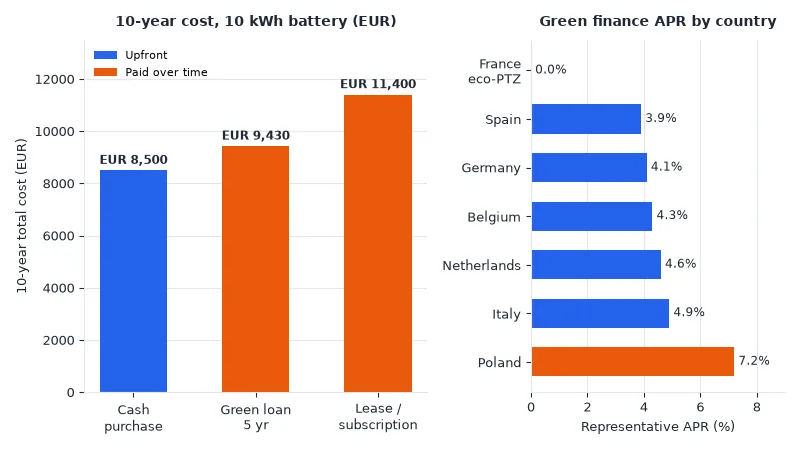
Paying outright still wins on pure economics. A €8,500 cash purchase of a 10 kWh system avoids interest entirely and typically pays back in 7–11 years depending on country and tariff structure, as we detailed in our Solar + Battery ROI comparison across four EU countries. Small businesses and farms can additionally depreciate the asset, and cash buyers can freely assign their battery to a VPP contract for extra revenue.
2. Green loans — the 2026 sweet spot
Bank “green” energy loans are the most flexible route. Expect 3.9%–4.9% APR in Germany, Spain, Italy and the Netherlands, with Poland higher at around 7%. Two public schemes stand out:
- Germany — KfW 270 (“Erneuerbare Energien – Standard”): a low-interest loan covering photovoltaics plus battery storage, often with a repayment bonus. Our KfW solar battery subsidy application guide walks through the process step by step.
- France — éco-PTZ (prêt à taux zéro): an interest-free state-backed loan of up to €50,000 for qualifying renovation packages. Batteries qualify indirectly when bundled with a heat pump or insulation works under the MaPrimeRénov’ framework.
On a typical €8,500 system, a 5-year green loan at 4.2% APR costs about €157 per month — roughly what a European household already saves on electricity each month with a well-sized battery.
3. Leases and subscriptions — zero upfront, zero hassle
Subscription models bundle hardware, installation, monitoring and maintenance into one monthly fee, typically €80–€150 per month over 7–10 years. The provider owns (or reserves) the asset and usually handles warranty claims and firmware updates. The trade-offs: a slightly higher 10-year total, annual indexation clauses, and a buyout payment if you want ownership at the end.
4. Battery-as-a-service and PPAs
The newest model: you pay per delivered kWh or a fixed availability fee while the provider — often a VPP operator such as sonnen, 1KOMMA5° or Tibber — earns trading revenue on your battery and shares part of it back. This works best where virtual power plants let home battery owners earn real revenue, which is now the case in Germany, the Netherlands, Belgium and the Nordic countries.
Financing models compared
| Model | Upfront | 10-year cost | You own it? | Maintenance | Best for |
|---|---|---|---|---|---|
| Cash purchase | €8,500 | €8,500 | Yes | You | Maximum ROI |
| Green loan (5 yr) | €0 | ≈ €9,430 | Yes | You | Spreading cost, keeping subsidies |
| Lease / subscription | €0 | ≈ €11,400 (€95/mo) | Buyout | Provider | Zero-upfront households |
| Battery-as-a-service | €0 | Usage-based | No | Provider | Renters, new builds, hands-off owners |
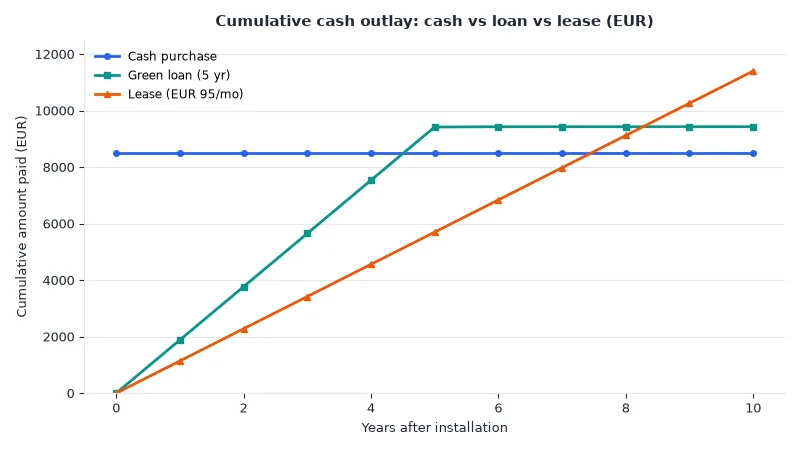
Note that leases can still make sense: at €95/month the crossover with a green loan arrives around year 8, and a lease that includes monitoring and replacement cover de-risks a home battery warranty you would otherwise administer yourself.
Country snapshot: how EU households finance storage in 2026
- Germany: KfW 270 loans plus subscriptions from €79/month. With EPEX day-ahead prices swinging between negative overnight hours and €150+/MWh peaks, financed batteries that arbitrage hourly price spreads shorten payback noticeably.
- France: 0% éco-PTZ and 3%–4% bank green loans; MaPrimeRénov’ 2026 supports heat-pump + battery renovation packages — see our France & Italy home battery subsidy guide.
- Italy: the 50% Irpef renovation deduction, spread over 10 years, effectively halves the net cost when the battery is installed with eligible works; Conto Termico 2.0 adds support on the heating side.
- Netherlands: with the salderingsregeling net-metering scheme phasing out, storage is becoming essential, and 0% VAT on residential solar-plus-battery installations cuts every financing quote — details in our Netherlands & Belgium VAT guide.
- Poland: Mój Prąd grants of up to roughly €3,700 for storage reduce the loan principal directly, offsetting the country’s higher ~7% retail rates.
- Central & Southern Europe: Czech NZÚ grants, Romania’s Casa Verde programme and Greece’s €200 million storage subsidy programme can cover 40%–70% of system cost, making even modest bank loans highly effective.
Stacking subsidies with finance: a worked example
Consider a German household installing an 8 kWh LiFePO4 battery with a hybrid inverter for €9,500 in 2026. Financed through KfW 270 at ~3.5% over 7 years, the cost is about €126 per month. Add dynamic-tariff arbitrage plus €400–€600 per year of VPP flexibility revenue and the net monthly burden drops below €60 — less than one evening of grid electricity during a winter price spike. In France, the same system on a 0% éco-PTZ carries no interest at all; in Poland, a Mój Prąd grant of €3,700 shrinks the financed amount to a fraction of the sticker price.
What to check before you sign
- APR and total cost of credit — CCD2 requires one comparable figure; use it across every quote.
- Indexation clauses — many leases raise fees annually with inflation; cap or avoid them.
- Buyout and end-of-term ownership — know the residual value before committing to 10 years.
- Warranty transferability — if you sell the house, does coverage follow the battery? Our battery insurance and certification guide explains what insurers expect.
- Early repayment rights — EU consumer credit law lets you settle early; confirm any compensation is capped.
The bottom line
In 2026, lacking €9,000 in savings is no longer a barrier to home energy storage in Europe — but the wrong contract can quietly add 20%–30% to lifetime cost. Cash buyers maximise returns, green loans are the balanced default, and subscriptions trade a little value for zero hassle and zero capital. Whichever route you choose, compare at least three offers and stack every national subsidy before you sign.
Ready to finance your home battery on the best terms? Contact Insum Energy for a tailored quote — our team will match certified LiFePO4 storage systems from our product range to the financing and subsidy schemes available in your country. Learn more about Insum Energy or start at our homepage.

One Comment