

EU Power Price Outlook 2027-2030: Sizing Home Storage
European power futures point one way and household bills point another. Traders are pricing 2028 baseload electricity well below 2027 delivery, and the European Environment Agency’s 2030 scenarios see average wholesale prices falling to roughly €71/MWh if gas markets calm down. Meanwhile the average EU household still pays €0.28 per kWh, barely moved. The question this winter is simple: if power gets cheaper by 2030, should the battery get smaller? The honest answer is no — because the average price was never the number a battery earns from. This guide walks through the 2027-2030 outlook and turns it into sizing rules that survive every price scenario.
What the 2027-2030 price outlook actually says
Three independent views describe the next four years, and they do not fully agree. The futures curve is backwardated: in late October 2026 the German Cal-27 baseload contract traded near €150/MWh, with Cal-28 roughly €40/MWh lower as the market prices out this year’s gas risk (market data, October 2026; contracts settle on EEX European Power Futures).
The European Environment Agency models the structural view. In the first sixteen weeks of 2026 the EU average wholesale price was €98/MWh; under a stable-gas-price scenario it falls to about €71/MWh by 2030 as renewables reach 68% of EU generation, while a counterfactual in which renewable build-out stops at 2010 levels would push prices to €160/MWh — 125% higher. Across member states, the renewable share correlates with wholesale prices at r = −0.77, and renewables deployment has saved consumers an estimated €29 billion since 2010 (EEA, Renewable electricity: best buffer against gas price volatility, 2026).
The same report shows how unevenly this lands: Spanish wholesale averaged €43/MWh in early 2026 with gas setting prices in only 9% of hours, against €127/MWh in Italy at 66%.
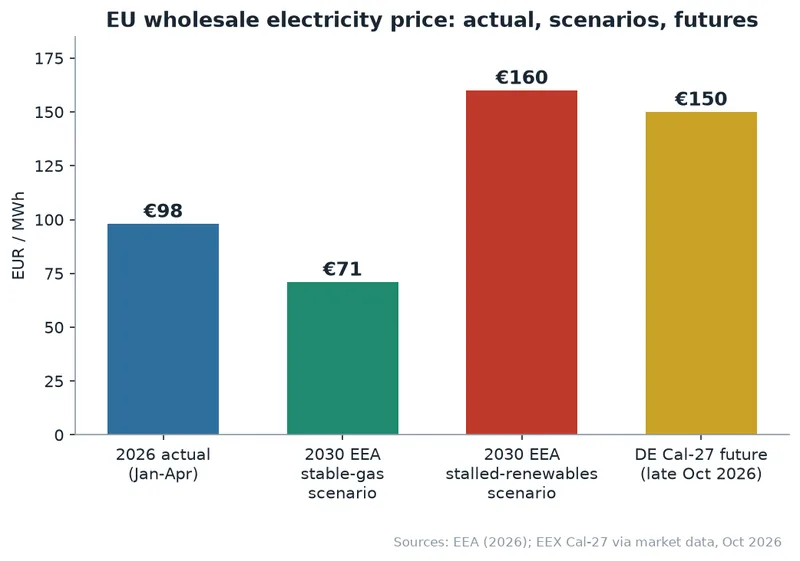
Table 1 — Three views of the EU power price (late 2026)
| View | Level | What it prices |
|---|---|---|
| German Cal-27 baseload future | ≈ €150/MWh | Next year’s gas and fuel risk |
| German Cal-28 baseload future | ≈ €110/MWh | Medium-term normalisation |
| 2026 wholesale actual (Jan-Apr) | €98/MWh | Current generation mix |
| 2030 EEA stable-gas scenario | €71/MWh | Renewables at 68% of generation |
| 2030 EEA stalled-renewables scenario | €160/MWh | Policy and deployment failure |
Read together: the average is set to fall by a quarter to a third by 2030 — unless it doesn’t. Planning storage around either outcome alone is the first mistake.
Why the average price is the wrong target
A household does not buy the wholesale average. ACER’s breakdown of the EU household bill puts energy and supply at about 49%, network costs at 27% and taxes at 24% (ACER Monitoring Report on key developments in EU electricity and gas markets, 2026). If wholesale falls 20%, only the supply component follows, so the bill moves by roughly a tenth — and recent data confirm the lag: EU household prices eased just 2.2% to €0.28/kWh in the first half of 2026, with Ireland at €0.39 and Germany and Belgium at €0.36, while taxes still make up 28.4% of the final bill (Eurostat, first half 2026).
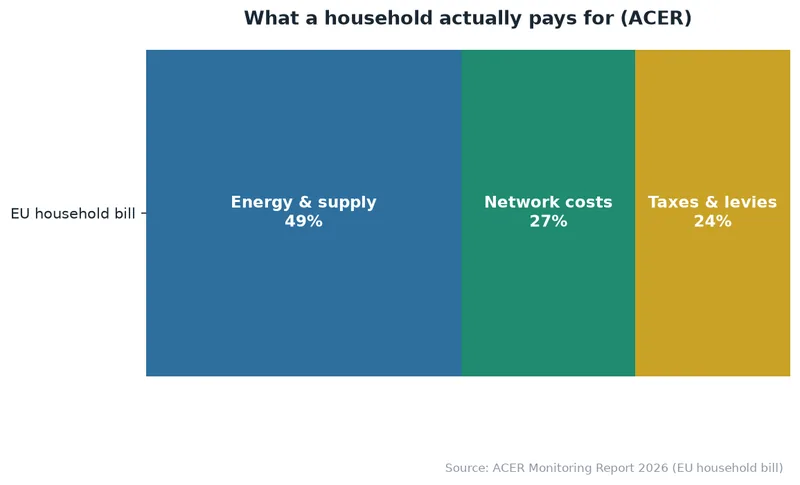
Meanwhile the component a battery cannot avoid — the grid — is heading up, not down. Germany’s four transmission operators have set provisional 2027 national transmission fees at an average 3.54 ct/kWh, up from 2.86 ct/kWh in 2026, and 6.52 ct/kWh without the planned €5.525 billion federal subsidy (Amprion/TSO joint release, October 2026). Across the EU, the Commission’s Electrification Action Plan pushes network charges to reward flexibility and sets a 2030 benchmark that household electricity prices should be no more than 2.5 times gas prices, alongside a legislative proposal on network charges (COM(2026) 595). That time-variable share of the bill is precisely the share a battery controls, and it is growing — see our guide to battery storage and grid-fee avoidance in Germany and the EU.
The number that matters: the evening spread
Volatility, not the average, is where storage lives. ACER found daily wholesale price swings around five times higher than in 2020, with solar lowering midday prices and gas-fired plants pushing evenings up; renewables already supply 50% of EU generation. Its earlier monitoring noted that on 70% of days, day-ahead prices move by €50/MWh or more within the day (Agence Europe summary of ACER’s monitoring report). October 2026 offered a sample: German day-ahead daily averages swung from €51.08 to €201.70/MWh in five days, one evening quarter-hour at €406 (market data).
For a home battery the arithmetic is blunt. A self-consumed kilowatt-hour displaces the full retail price — €0.28 on the EU average, €0.36 in Germany — while a midday kilowatt-hour exported to the grid is worth a fraction of that as solar floods the market, a dynamic our EU solar curtailment guide examines. Even after round-trip losses, stored evening energy is worth several times the export price. A widening spread is therefore good news for battery owners, not bad: cheap midday charging is the raw material, expensive evenings are the product.
Sizing rules for the 2027-2030 window
Four rules translate the outlook into hardware.
1. Size to the evening, not the annual balance
The profitable hours are the four to six between sunset and bedtime. A 10 kWh battery typically covers one full evening of a family home year-round; sizing beyond that buys winter depth, which is a different product.
2. Design for one cycle a day
Bank on roughly 230-280 full-cycle-equivalents a year, not 365. Capacity that only empties during a cold snap earns nothing for eleven months.
3. Leave headroom for electrification
The Commission aims to raise electricity’s share of final energy consumption to 32% by 2030, with heat pumps, EVs and smart meters in at least half of households (COM(2026) 595). Every appliance that goes electric adds load to exactly those expensive evening hours — a heat pump alone can add 3,000 kWh a year. A battery sized for today’s bills will be undersized for 2028’s.
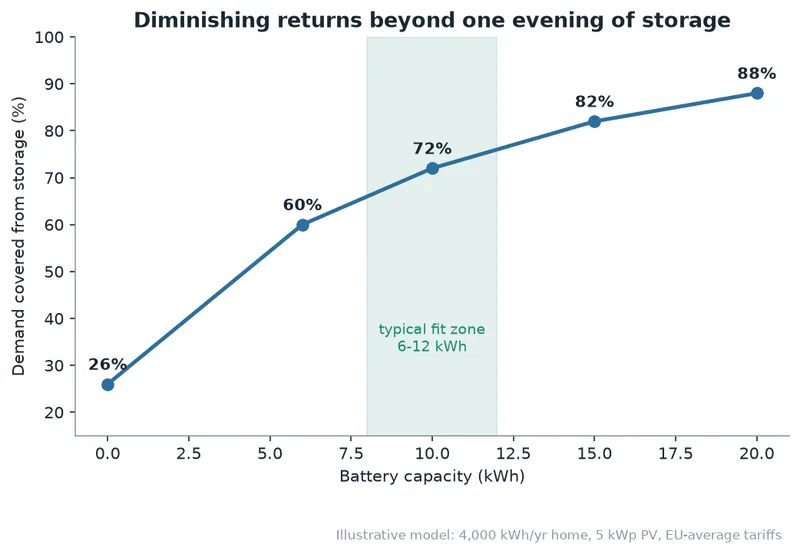
Table 2 — Indicative sizing for a 4,000 kWh/year home with a 5 kWp array, EU-average tariffs (illustrative model; value assumes 250 cycle-equivalents/year, 90% round-trip efficiency and a €0.23/kWh retail-minus-export margin)
| Battery | Demand covered from storage | Best fit | Indicative value/yr |
|---|---|---|---|
| 6 kWh | ≈ 60% | Gas-heated home, flat tariff | ≈ €310 |
| 10 kWh | ≈ 72% | Heat pump, dynamic tariff | ≈ €520 |
| 15 kWh | ≈ 82% | Heat pump plus EV | ≈ €700 |
| 20 kWh | ≈ 88% | All-electric home, VPP participation | ≈ €830 |
One caution: don’t oversize for January. A battery buys hours, not days — our Dunkelflaute analysis shows even 20 kWh covers little of a multi-day windless cold spell. Capacity bought for a week that happens twice a year earns nothing the other fifty.
Policy cliffs that change the maths before 2030
The outlook is not only about prices; several national support schemes expire on a schedule, and the return case for batteries shifts with them.
Table 3 — Dates that move battery economics, 2026-2030
| Date | Change | What to do |
|---|---|---|
| 31 Dec 2026 | Netherlands’ salderingsregeling net-metering ends (Rijksoverheid) | NL households: storage becomes near-essential |
| 31 Dec 2026 | Final RRF payments close; most national grants switch funds (Regulation (EU) 2021/241) | Check our RRF and REPowerEU deadline guide |
| 1 Jan 2027 | Italy’s Bonus Casa drops from 50% to 36% on main homes (Agenzia delle Entrate) | IT buyers: 2026 is the last full-rate year |
| During 2027 | ETS2 allowance auctions begin for buildings fuels (Directive (EU) 2023/959) | Gas-heated homes: see our ETS2 economics guide |
| 2027 | German transmission fees rise to 3.54 ct/kWh (TSO release) | DE: time-variable charges grow |
| 2030 | EU storage target: 200 GW installed, up from around 55 GW in 2026 (COM(2026) 595) | Expect tighter installer capacity — book early |
Should you wait for cheaper batteries?
Battery hardware keeps drifting down in price, but two forces move faster. First, incentive cliffs: an Italian homeowner waiting for cheaper hardware into 2027 loses fourteen percentage points of tax credit on a €96,000-capped project — far more than the likely price drift. Second, the export value of untapped solar erodes every year as negative midday hours spread across the EU. Meanwhile the EU’s own 200 GW storage target implies a squeeze on installer availability. In most markets, waiting costs more than it saves.
The bottom line
The 2027-2030 outlook says the EU average power price will likely fall; it says nothing reassuring about your evening, your grid fee or the value of your midday solar. Size the battery for the spread, one cycle a day, with headroom for the heat pump and the EV — and let the average take care of itself.
Planning a 2027-2028 installation? Browse Insum Energy’s LiFePO4 home battery range, learn who we are and contact Insum Energy for a sizing quote matched to your tariff, your roof and your country’s incentive calendar — or start from our EU storage knowledge base.


One Comment