RRF & REPowerEU Storage Funding: The 2026 Deadlines
The largest subsidy pot in EU history is closing this year. The Recovery and Resilience Facility (RRF) — roughly €650 billion in grants and loans that financed everything from rooftop solar aid in Greece to grid-scale projects in Spain — must pay out its final euro by 31 December 2026. If you are a homeowner eyeing a battery discount, an installer quoting a subsidized system, or a distributor planning 2027 stock, the practical question is no longer “how much is available?” but “whose money is still behind this window?” Because after this year, very little of it will be RRF money.
The RRF, in brief — and why 2026 is the cliff
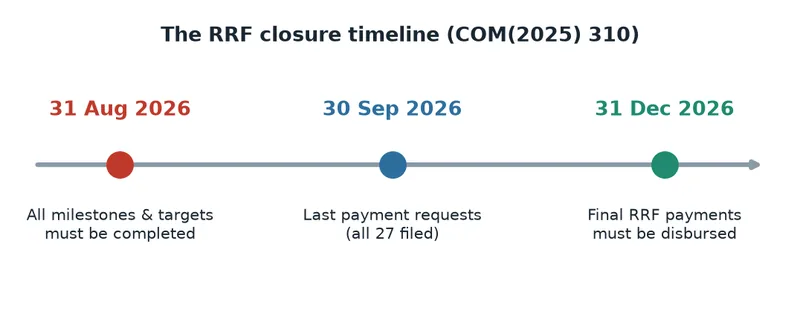
The RRF is the financial engine of NextGenerationEU, created by Regulation (EU) 2021/241 to rebuild economies after COVID-19. Unlike most EU funds, it pays on results: a member state only receives money after proving it has completed agreed milestones and targets. The Commission’s closure guidance, COM(2025) 310, fixed the endpoint: every milestone must be completed by 31 August 2026, the last payment requests were due by 30 September 2026, and the Commission must disburse the final payments by 31 December 2026.
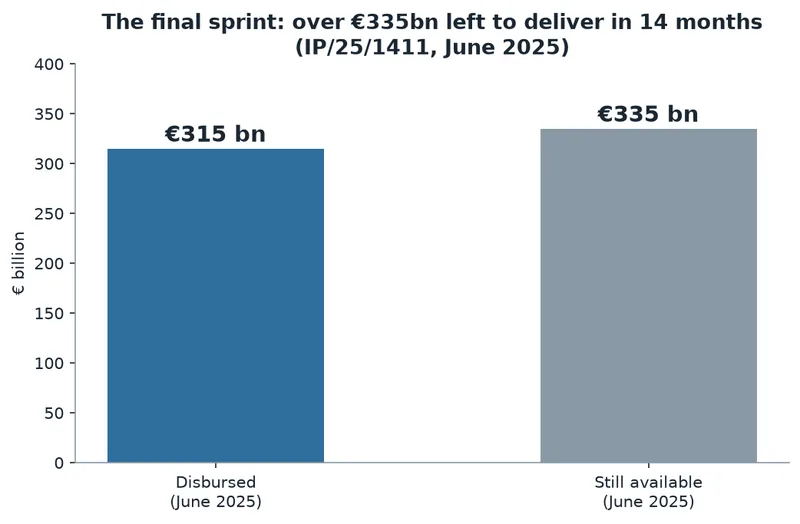
When that guidance was published in June 2025, more than €335 billion was still available and over €315 billion had been disbursed against more than 2,000 delivered milestones (IP/25/1411). By 30 September 2026, all 27 member states had filed their final payment requests; 21 of them arrived in September alone, worth a reported €105.4 billion and covering 1,539 milestones and targets (informat.ro). The RRF supported 110,655 MW of additional renewable capacity — close to 20% of the EU’s 2024 wind and solar fleet — plus 33.4 million MWh of annual primary energy savings.
What REPowerEU added to the pot
In May 2022, the REPowerEU Plan bolted an energy-independence chapter onto every national recovery plan, financed through amended rules in Regulation (EU) 2023/435. That amendment is the reason many 2023–2026 storage schemes exist at all: accelerated permits, collective self-consumption support and battery-linked solar calls were folded into recovery plans as REPowerEU measures.
The Commission’s companion policy, Recommendation (EU) 2023/1762 on energy storage, told member states to treat storage as a strategic asset and to use RRF money to build it. Crucially, REPowerEU chapters obey the same cliff as everything else in the facility: their milestones also expire on 31 August 2026. A REPowerEU label is not an extension.
Which storage windows were still open in 2026
Two national examples show what RRF-era household and community storage support looked like at the finish line.
Spain: innovation calls running right up to August
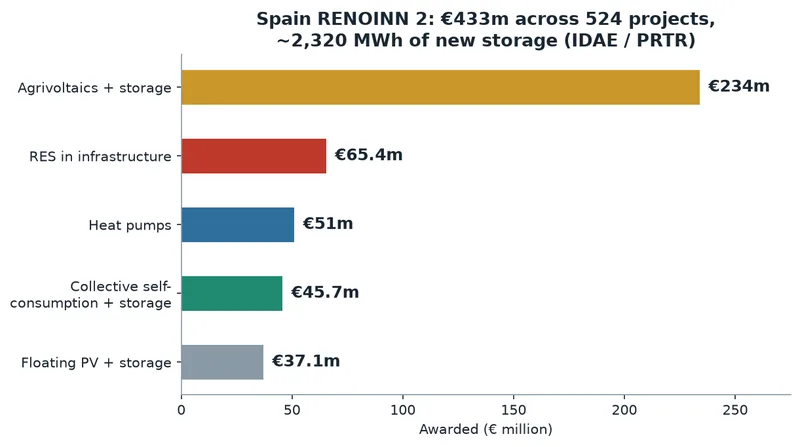
Spain’s recovery plan (PRTR) channelled storage money through IDAE’s renewable and storage innovation calls. The second round launched with a €202.5 million budget and an application window from 14 January to 19 February 2026; after 882 applications, the initial budget was expanded by 110% to roughly €433 million across 524 projects, adding about 2,320 MWh of storage (plan-de-recuperacion.gob.es). A dedicated line for collective self-consumption with storage committed €45.7 million to 274 projects expected to benefit more than 9,000 vulnerable consumers. IDAE signalled further storage, repowering and heat-network calls in the PRTR’s final phase, which ends in August 2026.
Greece: rooftop PV + storage at 45–75%
Greece’s “Greece 2.0” plan funds a rooftop programme covering 45–75% of the cost of a residential PV-plus-battery installation, one of the most generous household storage supports in the EU (HDB, greece20.gov.gr). For buyers it converts a €6,000–9,000 system into a two-to-three-thousand-euro project; for installers it has kept order books full into late 2026. Greece also opened its first “Apollo” CfD tender in February 2026, pairing 200 MW of PV with storage at a bid cap of €80/MWh.
The honest caveat: these are the survivors. Most earlier household RRF windows — Italy’s Superbonus-era ecobonus, several French and Austrian schemes — closed in 2024–2025, and what remained in 2026 skews towards collective self-consumption, agrivoltaics and grid-scale storage rather than single-family homes.
Decommitment: the word that decides whether “open” means open
RRF money expires, it does not roll over. If a milestone slips past 31 August 2026, the linked funds are simply lost — the mechanism officials call decommitment. That is why COM(2025) 310 pushed member states to strip out any measure they could not guarantee by the deadline, and why the menu of escape routes — transferring money to InvestEU, splitting projects to continue under national or cohesion funds — matters for buyers.
The pressure is visible in the data: €1.6 billion was suspended for Czechia, Romania and Spain alone (COM(2025) 637), and Slovakia’s final €647 million tranche was at risk in August 2026 over documentation gaps. For a household this means a subsidized scheme can shrink or be cancelled mid-flight if the national programme misses its milestone chain — and an installer’s promised grant can vanish between signature and commissioning. Money moved to national continuation funds usually survives, but always on new terms and new dates.
Who is actually paying: funding sources in eight countries
Because the funding stream determines the real deadline, always ask which budget backs a subsidy. The table below summarises the major home-battery-relevant schemes as of November 2026:
| Country | Programme (max support) | Funding stream | Status, Nov 2026 |
|---|---|---|---|
| Germany | KfW 442 closed; KfW 270 open for solar+EV | National (Climate and Transformation Fund) | Apply via KfW |
| France | MaPrimeRénov’ heat-pump tiers €5,000/4,000/3,000 | National budget | Refocused Sept 2026 (France Rénov’) |
| Italy | Conto Termico 2.0, up to 65%, €900m/yr | National (GSE) | Rebalanced Apr 2026 (GSE) |
| Netherlands | Net metering ends 31 Dec 2026 | National rule change | Buy storage now (Rijksoverheid) |
| Poland | PME 2: 30%, cap PLN 16,000 (~€3,700) | Modernisation Fund, PLN 1bn | Opens 20 Oct 2026, runs to 1 Oct 2027 (przydomowemagazyny.gov.pl) |
| Czechia | NZÚ battery CZK 75,000 (~€3,000) | Modernisation Fund | Paused (zelenausporam.cz) |
| Romania | Casa Verde: RON 20,000 (~€4,000) | National (AFM) | Annual window (afm.ro) |
| Greece | Rooftop PV + storage, 45–75% | RRF / Greece 2.0 | Must complete by Aug 2026 (HDB) |
Note that only one of the eight is RRF money. Poland’s and Czechia’s schemes draw on the separate EU Modernisation Fund, which runs beyond 2026 — a useful reminder that “EU-funded” does not mean “ends in August.” For the full national terms, see our France & Italy subsidy guide and Greece subsidy guide.
What replaces the RRF
Three successor streams matter for storage buyers.
First, the Social Climate Fund (Regulation (EU) 2023/955): €86.7 billion for 2026–2032, disbursed through national social climate plans to help vulnerable households and micro-enterprises with energy and transport costs (European Commission). It starts paying a year before ETS2 carbon pricing hits building fuels in 2027, and eligible measures — heat pumps, insulation, efficient electric equipment — can pair naturally with battery-backed self-consumption. We covered the economics in our ETS2 and home battery guide.
Second, the proposed European Competitiveness Fund — about €409 billion inside the 2028–2034 EU budget proposal of 16 July 2025 — which includes a clean-transition window where storage manufacturing and flexibility projects could land. The negotiating box was cut to €1.622 trillion in October 2026, so nothing is guaranteed yet. Third, national budgets and the Modernisation Fund now carry the household load: Poland’s PME 2, for example, runs to 1 October 2027, long after the RRF is gone.
What buyers and installers should do now
- Ask which fund pays. Any serious offer should state whether the subsidy comes from the RRF, a national budget, or the Modernisation Fund — each has a different end date.
- Respect the chain, not the brochure. If the grant is RRF-backed, your installation must be complete and documented in time for the national milestone, well before 31 August 2026. If it is national or Modernisation Fund money, later dates may be safe.
- Do not borrow against a promised grant. Financing should stand on its own; see our guide to battery financing and leasing options.
- Keep every invoice and commissioning report. RRF audits run for years after final payments, and clawbacks reach the beneficiary.
- Watch the social climate plans. National plans due under Regulation (EU) 2023/955 will define the 2027–2030 schemes; vulnerable-household storage could appear there.
The RRF era taught EU households that large-scale subsidy can appear fast — and disappear on a fixed date. From 2027 the money gets smaller, more targeted and more conditional. If a subsidized battery makes sense for your home at €0.28–0.37 per kWh of retail electricity, it should still make sense without the grant.
Planning a system in 2026 or 2027? Contact Insum Energy for a quote matched to your country’s live subsidy windows, or browse our LiFePO4 storage range. Learn more about us and explore practical guides on the Insum Energy homepage.