EU Capacity Mechanisms 2026: Can a Home Battery Get Paid?
Capacity markets just went mainstream — and battery owners are asking
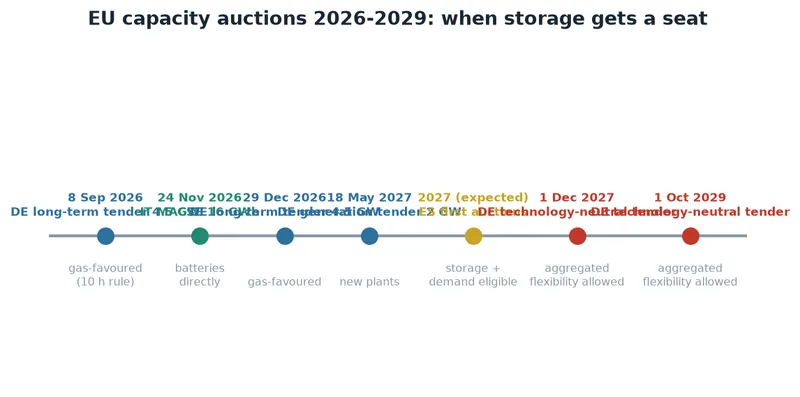
In a crowded few weeks, European capacity policy hit the front page. Germany’s first-ever capacity law passed in July 2026; its opening 4.5 GW tenders ran on 8 September, with a second round set for 29 December (BMWE power-plant strategy, January 2026 agreement with the European Commission). Italy’s Terna confirmed its second MACSE storage auction for 24 November 2026, contracting 16 GWh of new battery capacity for 2029 delivery (Terna, official MACSE notice). And Spain brought its first market-wide capacity mechanism into force on 18 September 2026 under Order TED/966/2026 (BOE-A-2026-19329).
If Europe now pays for firm capacity in euros per megawatt per year, a natural question follows for anyone with 10 kWh of lithium on the garage wall: can I collect? The honest 2026 answer is not directly, barely, and only through an aggregator — but the door is opening on a timetable now written into law.
What a capacity mechanism actually pays for
A capacity mechanism is a payment for being available, not for producing. Generators, storage and demand-side resources commit to deliver power during periods of system stress and receive an annual payment in €/MW/year on top of their energy-market earnings. The EU framework lives in Articles 20–27 of Regulation (EU) 2019/943: a member state must first prove a resource-adequacy concern, the mechanism must be technology-neutral and open to cross-border participation, and a 550 g CO₂/kWh emission limit excludes the dirtiest plants.
The 2024 revision changed the tone. Regulation (EU) 2024/1747 dropped the “last resort and temporary” framing, capped approvals at ten years, and added Article 19g: countries running a mechanism must consider adapting it to promote non-fossil flexibility — demand response and storage. The Commission’s own assessment confirms the direction: capacity mechanisms are becoming a permanent second market alongside energy (COM(2025) 65 final). ENTSO-E counts ten Commission-approved mechanisms since 2014 — four strategic reserves and seven market-wide markets, including Belgium, Greece, France, Ireland, Italy and Poland (ENTSO-E position paper, April 2025). These mechanisms insure against precisely the scarcity evenings — the Dunkelflaute events we analysed in depth here — that a home battery is built to ride through.
| Country | Mechanism & key date | Minimum size | Aggregation | Home-battery route |
|---|---|---|---|---|
| Germany | StromVKG; long-term tenders 8 Sep & 29 Dec 2026 (4.5 GW each); technology-neutral tenders 1 Dec 2027 & 1 Oct 2029 | Plant-level minimums | Yes — tenders allow aggregated flexibility & VPPs | Via aggregator from Dec 2027 |
| Belgium | Elia CRM, Commission-approved 2025–2034; Y-1/Y-2/Y-4 auctions yearly | 1 MW derated | Yes — participation units pooled | Via aggregator; heavy derating |
| Italy | MACSE auction 24 Nov 2026 (16 GWh, delivery 2029) + delivery-year capacity market | Project-scale | No | None yet — utility-scale only |
| Spain | Order TED/966/2026 in force 18 Sep 2026; first auctions expected 2027 | 1 MW firm power | Yes — storage & demand aggregators | Via aggregator once coefficients set |
| Poland | Capacity Market Act 2017; auctions per delivery year | 2 MW per offer | Yes — aggregated DSR units | Via aggregator (industrial today) |
Gate one: the megawatt floor
The first barrier is arithmetic. Belgium requires a participation unit of at least 1 MW of derated capacity at the delivery point (Elia, CRM rules). Spain’s order sets a floor of 1 MW of firm power but explicitly allows demand aggregators, storage aggregators — and self-consumption installations with surplus to participate (Garrigues analysis of TED/966/2026). Poland’s market only accepts offers of at least 2 MW, single or aggregated (PSE participation guideline). A 5 kW home battery is 0.005 MW — three orders of magnitude below every floor. Aggregation is the only bridge: roughly 200 similar houses pooled into one bidding unit.
Gate two: the de-rating haircut
Even past the floor, a battery is not credited with its nameplate power. Every mechanism multiplies installed capacity by a de-rating or firmness coefficient. Belgium’s published factors for energy-limited storage show the logic plainly: a unit guaranteeing one hour of delivery is credited with 11% of its power, three hours earns 28%, and only an eight-hour guarantee reaches 65% (Elia CRM product sheet).
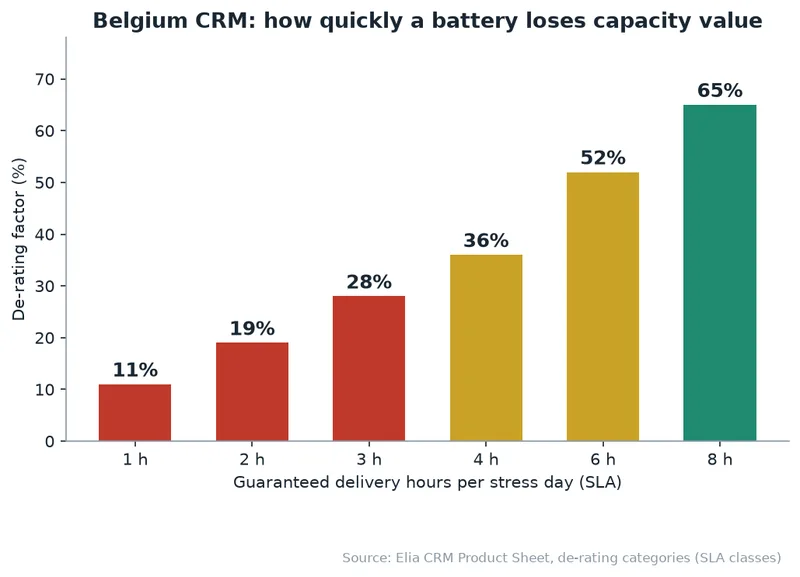
Italy’s 2026 parameter update cut recognised capacity for 4-hour batteries to 40% in the north and as low as 21% in the south and islands, because each additional battery erodes the marginal system value of the next. Germany’s first two rounds demand ten hours of continuous supply at 80% of installed capacity — a criterion that favours gas plants and excludes short-duration batteries from round one. De-rating is not bias; it is physics. A battery earns capacity revenue on its duration, not its size.
Gate three: obligations that bite
Capacity money comes with strings. Belgian participants must renounce other variable subsidies for the delivery period and face availability penalties. Spain’s mechanism puts verification in the hands of Red Eléctrica and the CNMC, with per-technology firmness coefficients and pay-as-bid settlement. Germany’s StromVKG adds a peak-price clawback whenever the spot price exceeds a strike price. For a household battery, the practical requirement is a guaranteed state of charge during stress hours — energy reserved that your household may want for dinner. Control, not capacity, becomes the binding constraint (we covered the control-loop side in our zero-export piece).
Do the math: what a 10 kWh battery would actually earn
Take Belgium, where prices are public. The Y-2 auction for delivery 2027–28 cleared at €25,100 per MW per year; the Y-4 round for 2029–30 cleared at €27,300, and the Y-1 round for 2026–27 at just €14,100 (auction results published by Elia). Applied to a 5 kW / 10 kWh system:
| Guarantee offered | De-rating | Firm power | Capacity payment (€25.1k/MW-yr) |
|---|---|---|---|
| 3 hours (10 kWh) | 28% | 1.4 kW | ≈ €35/year |
| 8 hours (would need ~60 kWh) | 65% | 3.25 kW | ≈ €82/year |
Now compare the same battery doing its normal job. EU household electricity averaged €0.2832 per kWh in the first half of 2026 (Eurostat, nrg_pc_204). Shifting roughly 6 kWh of solar or cheap-night energy into the evening peak, one cycle a day, is worth in the order of €450–500 a year — ten times the capacity payment before an aggregator even takes its share. In Germany the contrast is sharper: household prices remain above €0.36/kWh (Eurostat H1 2026), so self-consumption dwarfs any capacity revenue — which is why grid fees, covered in our German grid-fee guide, shape a battery’s return as much as any auction.
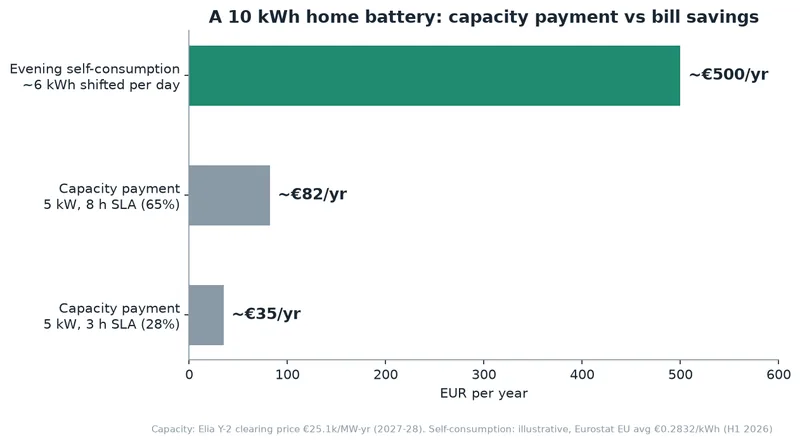
The conclusion is uncomfortable but useful: capacity payments are a rounding error for a home battery in 2026 — buy the battery for bill savings, not for the capacity cheque. The mechanism still matters indirectly: it finances the utility-scale fleet that keeps the grid up during the scarcity hours your battery is sized for. The broader market-design picture is covered in our EU market reform guide.
Where the door opens next
Watch three dates. 1 December 2027: Germany’s technology-neutral “capacity” tender explicitly admits existing plants, controllable loads and aggregated flexibility such as virtual power plants — the first big EU mechanism where pooled home batteries can, in principle, bid. 2027: Spain’s first auctions, expected once the independent-aggregator framework is finalised. Ongoing: Italy’s MACSE pipeline, whose second auction adds 16 GWh for 2029. And across all markets, Article 19g obliges countries with a mechanism to consider storage-friendly adaptations at each review.
What to ask your installer today
Buying in 2026 and want optionality later? Ask for:
- Aggregator-ready hardware. An inverter and cloud platform your country’s aggregators already integrate with; ask for named VPP programmes.
- State-of-charge reserve. The device must hold a guaranteed reserve during declared stress hours without your intervention.
- Telemetry. Aggregators need auditable, timestamped metering; a meter that drops data will cost you penalties.
- Contract clarity. Who keeps the revenue, what share do you get, who carries penalties, and can you exit without bricking your warranty?
Sizing advice stays the same: size for your evening load and future electrification, because that is where 90% of the value sits. A capacity payment is a future bonus layered on top by whoever aggregates your battery Our product catalogue lists LFP systems built for this dual life, and the team behind Insum Energy tracks every national mechanism as it opens.
Bottom line
Capacity mechanisms are now a permanent fixture of the EU power market — Germany, Belgium, Italy, Spain and Poland all pay for firm availability in some form, and storage is written into the EU rules. But between your garage and the auction sit a 1–2 MW floor, a brutal de-rating curve, and obligations designed for power plants. Until aggregation platforms mature, treat capacity revenue as small future upside: the battery’s real job remains turning cheap sunshine into expensive evenings.
Planning a system that is ready for both bill savings and the flexibility markets of 2027–2030? Insum Energy ships EU-wide and supports installers in 27 markets — contact us for a tailored quote.