Battery Storage O&M Costs in the EU 2026: What to Budget
Most European buyers compare battery quotes on price per kilowatt-hour and stop there. Yet over a 10–15 year service life, operating and maintenance (O&M) costs can add 30–50% on top of the purchase price of a home storage system. For EU homeowners, installers and commercial operators budgeting a 2026 project, knowing what a LiFePO4 battery really costs to run — not just to buy — is the difference between a payback that holds and a spreadsheet that quietly falls apart. This guide breaks down realistic O&M line items, country-by-country differences and the reserves you should build into every 2026 budget.
What O&M actually includes for a battery storage system
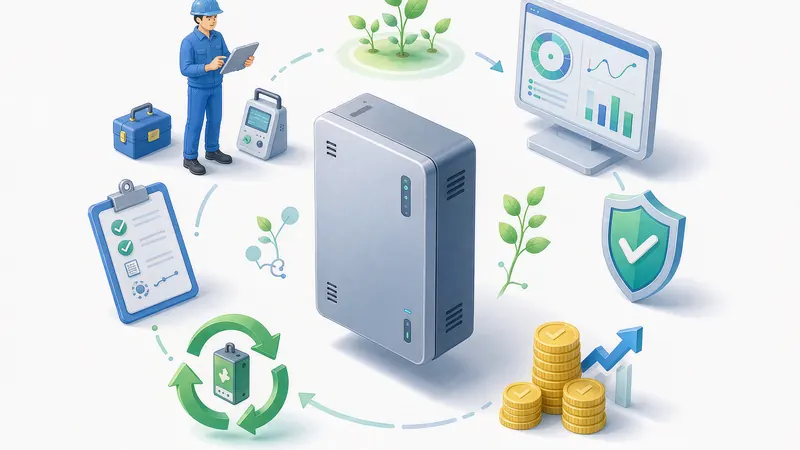
A modern LiFePO4 home battery is famously low-maintenance — there is no acid to top up and no equalisation charging. “Low maintenance” is not “zero cost”, however. A complete O&M budget covers:
- Monitoring and connectivity. Cloud platforms, LTE/SIM data plans and app licences, typically €0–€10 per month.
- Periodic inspection. A visual, thermal and torque check of the cabinet, cabling and ventilation every two years — often bundled with the PV system inspection.
- Insurance. An all-risk extension covering the battery, inverter and installation against fire, surge and water damage.
- Firmware, cybersecurity and compliance updates. Under the EU Battery Regulation (EU) 2023/1542, state-of-health data, removability and documentation obligations make software upkeep a genuine cost line, not a courtesy.
- Consumables. Cabinet air filters, fan cleaning and, for outdoor installs, gasket checks.
- Reserves. Money set aside for inverter replacement and capacity augmentation — the two costs most budgets forget entirely.
How much does battery storage O&M cost in 2026?
Across EU markets, a well-installed 10 kWh residential system costs roughly €300–€500 per year to operate, including reserves. A small commercial 30 kWh system typically lands between €1,500 and €2,200 per year, driven mainly by mandatory service contracts and higher insurance values.
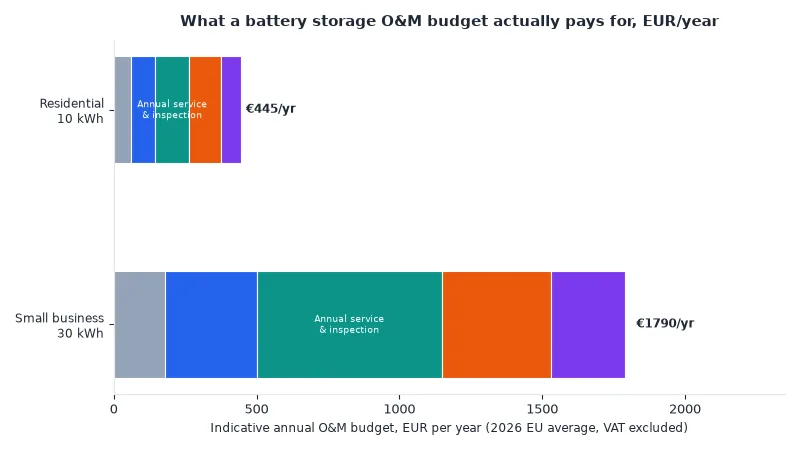
Indicative annual O&M budget, EU average 2026
| Cost item | Residential (10 kWh) | Small commercial (30 kWh) | Notes |
|---|---|---|---|
| Monitoring & connectivity | €40–€80/yr | €150–€250/yr | Some vendors bundle it free; check before you buy |
| Inspection & service visit | €100–€150 every 2 yrs | €500–€900/yr contract | Commercial operators usually need annual visits |
| Insurance | €60–€120/yr | €250–€450/yr | All-risk extension on the storage system |
| Inverter replacement fund | ≈ €100–€140/yr | €300–€500/yr | €1,800–€3,500 once every 10–15 years |
| Augmentation reserve | €60–€100/yr | €200–€350/yr | Top-up capacity around year 8–12 |
| Total | ≈ €445/yr | ≈ €1,790/yr | VAT excluded; reserves included |
If cash flow is the concern rather than the total, note that several EU banks and green funds now accept O&M reserves as a normal project cost — see our overview of battery storage financing and leasing options in the EU, where service contracts can be folded into a lease.
Why O&M costs differ across EU countries
The hardware is identical; the environment around it is not. Three factors drive the country gap:
- Labour rates. A two-hour service call costs around €160–€240 in Germany or the Netherlands, but closer to €90–€140 in Spain or Poland.
- Electricity prices and tariffs. German households still pay roughly €0.35–€0.40/kWh even after the 2025–2026 EPEX spot-price decline, which raises the value of every kWh the system keeps running — and raises the cost of any downtime. Spain’s hourly PVPC tariff regularly dips below €0.10/kWh in solar hours, so a stalled system costs less per idle day. In the Netherlands, day-ahead dynamic contracts reward owners who keep monitoring and firmware in top shape, and the salderingsregeling step-down from January 2027 makes every avoided grid import worth more each year.
- Regulatory overhead. Germany’s §118(6) EnWG grid-fee exemption for behind-the-meter storage charging (in force until 2029) keeps operating costs down; France and Italy add certification and inspection paperwork that nudges service prices upward.
Subsidy programmes — Germany’s KfW grants, France’s MaPrimeRénov’ 2026 rounds, Italy’s Conto Termico 2.0, Poland’s Mój Prąd, the Czech NZÚ programme, Romania’s Casa Verde 2026 and Greece’s €200 million battery scheme — cut CAPEX by 20–40%. They do nothing for O&M, so the running budget must be funded from savings alone. Our solar + battery ROI comparison across Germany, Spain, Italy and the Netherlands shows how this reshapes payback in each market.
The 15-year view: total cost of ownership
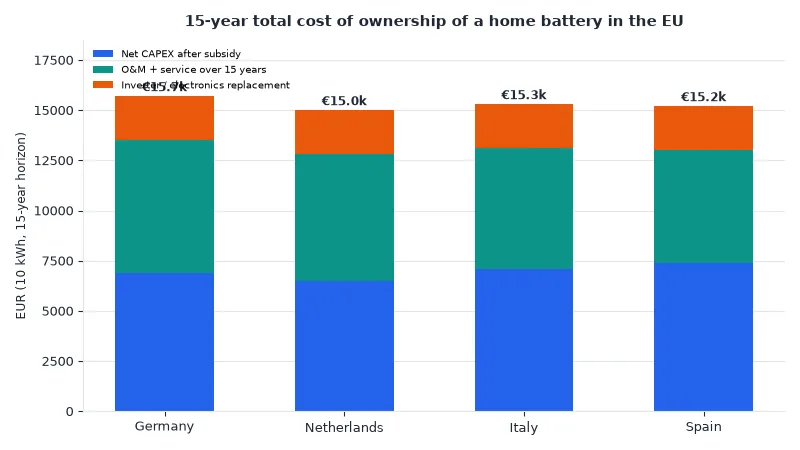
Spread over 15 years, O&M plus one inverter replacement typically adds €8,000–€9,000 to a residential project — comparable to the subsidised hardware cost itself. The chart above assumes a 10 kWh LiFePO4 battery, net CAPEX after typical national subsidies, and reserves that are actually spent rather than merely earmarked.
Hidden cost #1: the inverter dies first
LiFePO4 cells routinely outlast 6,000 cycles, but hybrid inverters are electronics with fans, relays and capacitors — realistic service life is 10–15 years. Budget €1,800–€3,500 installed for a residential replacement. Choose an inverter vendor with EU spare-parts stock and OTA firmware to avoid a full re-commissioning.
Hidden cost #2: capacity augmentation
Most manufacturers define end of warranty life as 70–80% of original capacity. The cheapest fix is usually adding one module in year 8–12, not replacing the pack. Plan the cabinet with 20–30% spare space and a BMS that supports mixed batches. When modules do retire, EU rules already govern their fate — our guide to battery recycling rates and EPR fees by EU country explains the take-back costs you may inherit as an owner or installer.
What warranties, insurance and service contracts actually cover
- Performance warranty: typically 70–80% capacity after 10 years or 6,000 cycles — but it covers the cells, rarely the labour to swap them.
- Product warranty: 5–10 years on the enclosure and BMS; exclusions for improper ventilation are the most common claim-killers.
- Service contracts: €150–€300 per year residential, and they mostly buy response time, not free parts.
Two EU-level changes are shifting risk back toward manufacturers: the Right to Repair Directive (EU) 2024/1799 and the repairability and spare-parts provisions of Battery Regulation (EU) 2023/1542. Our companion pieces on the home battery warranty guide for EU consumers and the EU right-to-repair rules for home batteries explain what to demand in the contract before you sign.
Six practical ways to lower your O&M bill
- Specify remote diagnostics. A BMS with cloud SoH reporting turns most site visits into remote resets — the single biggest saving available.
- Buy OTA-first inverters. Firmware that updates itself eliminates a whole class of truck rolls.
- Insure the system as one asset. A single all-risk policy on PV + storage costs less than separate device coverages.
- Bundle service with PV cleaning. One combined visit every two years can cut inspection costs by 30–40%.
- Watch SoH monthly. Catching a drifting module early is a warranty claim; catching it late is a capital expense.
- Buy from a supplier with EU stock. Spare parts shipped from inside the EU arrive in days, not months — and keep warranty claims inside the door. See the Insum Energy product range for LiFePO4 systems designed for European service networks.
Frequently asked questions
How much should a German household budget per year for a 10 kWh battery?
Plan on €350–€500 per year including reserves: German labour and insurance sit at the top of the EU range, but high retail prices (≈ €0.35–€0.40/kWh) mean every avoided grid import more than pays for it.
Does a LiFePO4 home battery need annual maintenance?
No. A visual check with your app plus one professional inspection every two years is sufficient for most indoor residential systems. Outdoor and commercial installations justify annual visits.
Who pays if the battery fails after the warranty ends?
You do — unless you built an augmentation reserve or carry all-risk insurance. That is precisely why reserves belong in the budget from day one, not as a surprise in year nine.
Get a realistic O&M budget from Insum Energy
A battery quote without an O&M line is an incomplete quote. Insum Energy supplies LiFePO4 storage systems built for the EU market — certified cells, EU-based spare-parts stock and documentation aligned with Battery Regulation (EU) 2023/1542 — and we help installers, distributors and homeowners model 15-year cost of ownership before the first euro is spent. Learn more about Insum Energy, browse our battery systems, or contact us today for a tailored quote and a complete O&M budget for your 2026 project. More practical guides are on our homepage.