
EU ETS2 Carbon Pricing and Home Battery Economics 2026
From January 2027, the EU begins early auctioning of allowances for its second emissions trading system, ETS2 — the first time carbon is priced on the fuels households burn for heating: natural gas, heating oil, LPG. Compliance surrender follows in 2028. For anyone considering a home battery, ETS2 matters indirectly but powerfully: it re-prices fossil heat, accelerates heat-pump adoption, and pushes national budgets toward renovation grants that pair with storage. Here is what ETS2 does to household energy economics, and how to size and subsidise a battery in this carbon-priced world.
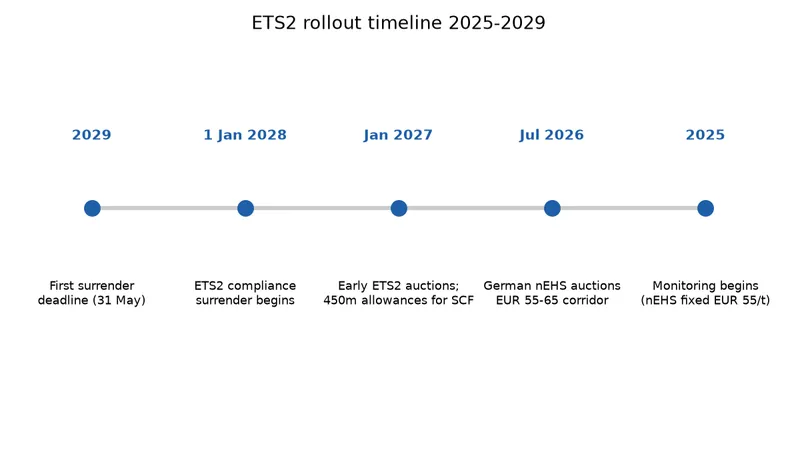
What ETS2 Actually Is — and the 2027–2028 Timeline
ETS2 was created by Directive (EU) 2023/959 and covers fuel combustion in buildings, road transport and small industry — roughly 35% of EU emissions not already priced by the main ETS. It is an upstream scheme: fuel distributors buy allowances and pass the cost into pump and meter prices. The 2027 cap is 1,036,288,784 allowances; early auctions begin in January 2027 with 450 million allowances sold for the Social Climate Fund (European Parliament briefing, 2025).
Two safety valves shape the near-term price. Under Article 30k, compliance was postponed by one year to 1 January 2028 while early auctioning proceeds in 2027; the Council also doubled the market stability reserve release to 40 million allowances above €45 per tonne (Agence Europe, October 2026). The Commission expects roughly €45–80/t over 2027–2030. Germany shows where this lands: its national fuel scheme auctions 2026 allowances in a €55–65 corridor (German Environment Agency (UBA)).
The Carbon Adder on Your Heating Bill
The pass-through is simple arithmetic: emissions factor × allowance price. Heating oil emits about 2.66 kg CO₂ per litre, natural gas about 0.20 kg per kWh burned. What each carbon price level adds before VAT:
| Allowance price | Heating oil | Natural gas |
|---|---|---|
| €45/t (expected ETS2 start) | ≈ €0.12/litre | ≈ 0.9 ct/kWh |
| €65/t (German corridor ceiling 2026) | ≈ €0.17/litre | ≈ 1.3 ct/kWh |
| €90/t | ≈ €0.24/litre | ≈ 1.8 ct/kWh |
| €160/t (possible long term) | ≈ €0.43/litre | ≈ 3.2 ct/kWh |
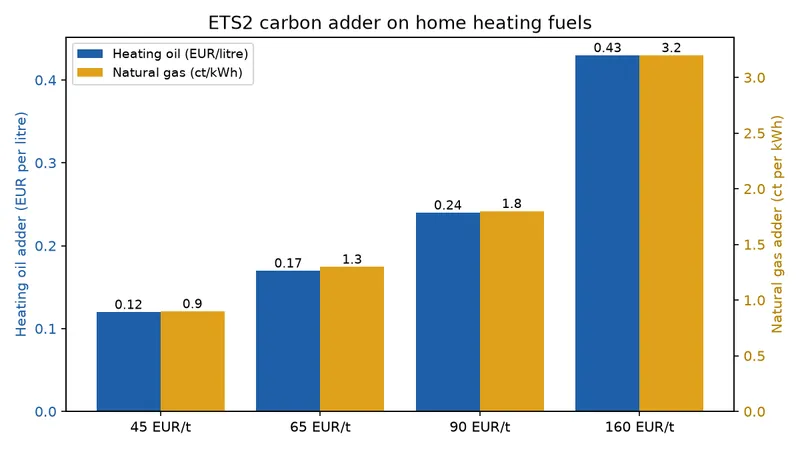
Long-term studies see prices up to €160/t as plausible, pushing fuel prices up around 30 cents per litre and gas by around 2.3 ct/kWh (DIW Weekly Report 27–28/2025). A gas-heated home using 20,000 kWh a year would pay roughly €180–360 extra annually at €45–90/t. Heating-oil households — common across Ireland, rural France, Belgium and eastern Germany — face the steepest proportional hit.
Why a Battery Hedges ETS2 — Honestly
Here is the uncomfortable truth: a battery does not save gas. ETS2 prices molecules, not electrons, so a standalone battery in a gas-heated home does nothing about the carbon adder. The hedge works through three effects.
First, electrification. Every oil or gas boiler replaced by a heat pump moves heating load onto the grid — where a battery plus tariff optimisation controls cost. A heat-pump household runs 4,000–6,000 kWh of winter heating through the meter, doubling annual electricity use and multiplying the value of every stored evening kWh. Household electricity in Germany averaged 37.2 ct/kWh in January 2026 (BDEW), against an EU average of about €0.2896/kWh in the second half of 2025 (Eurostat).
Second, price spread. As millions of heat pumps and EVs join the grid, evening peaks deepen. German day-ahead prices averaged €102.17/MWh in the first quarter of 2026 (SMARD), with hourly swings a well-controlled battery can arbitrage against a dynamic tariff — examined in Dunkelflaute 2026: What an EU Home Battery Can Really Cover.
Third, grant stacking. ETS2 revenue is legally tied to climate spending, and member states are restructuring renovation subsidies to favour electric heat. PV-plus-storage kits ride along because adding storage during a heat-pump retrofit costs far less than retrofitting later. For the fiscal side, see Battery Storage Tax Deduction: EU Country Guide 2026.
Where the Money Goes: ETS2 Revenues and the Social Climate Fund
ETS2 is expected to generate €342–570 billion between 2027 and 2032, of which €277–505 billion flows to member states for climate and social measures (European Parliament briefing, 2025). A dedicated Social Climate Fund adds about €86.7 billion from 2026 to 2032 for vulnerable households and small businesses (European Commission). For installers, that is a demand signal: carbon-priced heating fuel is being recycled into exactly the retrofits where batteries attach.
National Subsidies That Now Point Toward Storage
Grant landscapes shifted sharply during 2026, with one consistent pattern: the state pays for the electrification step, and storage either rides along free or attracts its own line item.
| Country | Scheme (2026 status) | Relevance for storage |
|---|---|---|
| Germany | No direct grant: KfW 442 (PV + storage + wallbox, up to €10,200) closed; KfW 270 loan still finances storage; 0% VAT under §12(3) UStG remains (KfW) | Cheap financing plus carbon-price pressure on millions of oil-heated homes |
| France | MaPrimeRénov’ 2026: air-to-water heat pump up to €5,000 (very modest income) to €3,000 (intermediate); single-action route refocused from September 2026 (ANAH) | Battery unfunded, but heat-pump retrofits raise self-consumption value; CEE bonuses stack |
| Italy | Conto Termico 2.0: up to 65% reimbursement for heat pumps and hybrids, €900m/year after the April 2026 rebalance (GSE); separate 50% Bonus Casa tax deduction in 2026, dropping to 36% in 2027–2028 | Next Conto Termico draft adds PV + storage alongside heat-pump replacement |
| Netherlands | Salderingsregeling net metering ends 31 December 2026 (Rijksoverheid); ODE levy keeps rising on gas and electricity | Storage turns from optional to near-essential once export is valued below import |
| Poland | Mój Prąd closed; successor PME 2 opens 20 October 2026: up to 30% of cost, max PLN 800/kWh, PLN 16,000 cap under net-billing (przydomowemagazyny.gov.pl) | First standalone national storage grant; thermal-modernisation relief (PLN 53,000) stacks |
| Czechia | Nová zelená úsporám: ~CZK 75,000 for storage alongside PV; paused early 2026 pending Modernisation Fund refinancing (SFŽP) | Relaunch call expected from mid-2026 — watch for the reopening |
| Romania | Casa Verde Fotovoltaice: up to ~RON 20,000 for PV, battery mandatory for the highest tier (Environmental Fund Administration) | One of the few schemes where storage is grant-funded by default |
| Greece | “Photovoltaics on the Roof”: 45–75% subsidy by income tier, €4,000–10,000 for PV + battery packages (Hellenic Development Bank) | Battery pairing required; island and non-interconnected demand highest |
The pattern is consistent: electrify heat first, store second. Even where grants exclude batteries — France and Germany most visibly — the carbon price itself is the engine, because ETS2 revenue must be spent on climate and social measures under Article 10(3) of Directive (EU) 2023/959.
Sizing and Payback Under Carbon-Priced Electricity
For a household planning a retrofit, sizing logic changes under ETS2 economics. A heat-pump conversion should size storage for evening heating load, not just baseload: 10 kWh covers a typical winter evening for a well-insulated house, while 15–20 kWh suits older envelopes or oil-to-heat-pump conversions. With a grant subtracting €3,000–8,000 depending on country, an installed 10 kWh system in the €6,500–9,000 range typically reaches payback in 7–10 years against a €0.28–0.38/kWh retail price — faster where net metering is ending, as in the Netherlands, or where dynamic tariffs reward evening discharge. If capital is the constraint, third-party options are compared in Battery Storage Financing & Leasing Options in the EU 2026.
System design matters as much as size: insist on full-home backup or a dedicated heat-pump circuit, and confirm the inverter supports high winter charging rates. Broader market-design effects are covered in EU Electricity Market Reform 2026: Home Battery Impact.
What Buyers and Installers Should Do Before 2028
- 2027 is a grant-timing year. Early auctions start in January 2027 while national schemes (Poland’s PME 2, the Czech relaunch, Greece’s next call) open or refill. Applying early beats waiting.
- Pair storage with any heat-pump project. The marginal cost of adding a battery during retrofit is lower, and ETS2 revenue flows into these packages through 2032.
- In oil-heated homes, prioritise conversion. The carbon adder on oil is the largest in the table; conversion plus storage hedges the carbon price and future boiler bans.
- In the Netherlands, act before 1 January 2027. Once salderingsregeling ends, every exported kWh sells below the import price — storage is the structural fix.
- For installers, build ETS2 literacy into sales. The honest answer — molecules priced, electrons optimised — is the best argument for a heat-pump-plus-storage package.
The Bottom Line
ETS2 does not price home batteries directly — but it puts a rising, legally mandated price on fossil heat, recycles hundreds of billions into electrification, and widens the electricity price spread that storage monetises. Households that electrify heat and add storage in the same project are aligning with the policy, and the table above shows where that alignment is cheapest right now.
Planning a heat-pump or PV project and wondering how storage fits? Contact Insum Energy for a tailored quote, browse the battery storage range, or meet our EU-wide installer network — and start with our storage knowledge base.