
Microinverters + Battery Storage in the EU: What Works 2026
Germany’s plug-in solar fleet has quietly become Europe’s biggest storage question. By September 2026, more than 1.49 million balcony and plug-in systems were registered in the Bundesnetzagentur Marktstammdatenregister, and most have no battery at all. Homeowners with microinverter arrays keep asking: can I add storage, and will it work? Yes — through three very different routes, with one efficiency trade-off and a set of 2026 German rules that decide what you may legally plug in.
Why microinverters change the battery question
A conventional string-inverter system puts the whole array on one DC bus, which is why hybrid inverters and DC-coupled batteries evolved around it. A microinverter system has no DC bus at all: every panel converts to grid-ready AC at the module, and everything downstream is ordinary household AC. That single architectural fact means a battery cannot hang off the panel side — it has to couple on the AC side, like any other appliance. As we explained in our AC vs DC-coupled storage guide, this is not a flaw; it is a design decision with its own costs and benefits.
Route 1: native AC ecosystems
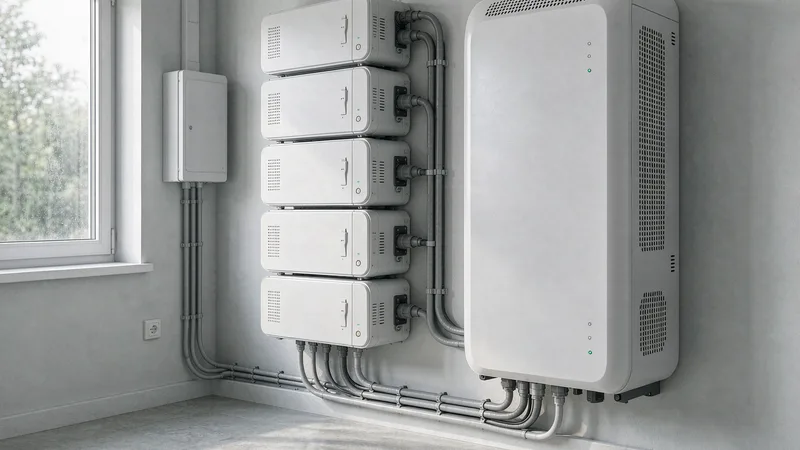
The cleanest path is a battery designed from day one to be a microinverter system. Enphase’s IQ Battery 5P with FlexPhase — now shipping to Germany, Austria, Switzerland, Luxembourg and Poland — embeds six grid-forming microinverters inside the enclosure, delivers 5.0 kWh usable per unit and up to 3.84 kVA continuous in single- or three-phase homes, and is warranted for 15 years and 6,000 cycles (Enphase official product page). Because the battery is itself a fleet of microinverters, commissioning, monitoring and warranty sit in one ecosystem and one app. The trade-off: you buy into that ecosystem, and prices carry the integration premium.
Route 2: retrofit an AC-coupled battery onto any microinverter array
Most AC-coupled batteries do not care what is on the roof. A bidirectional battery inverter with a consumption meter at the grid connection point charges from any surplus — microinverter, string inverter, even grid power on a cheap dynamic tariff. Enphase’s compatibility list for the 5P includes string inverters. The engineering that decides whether a retrofit works is the metering and control loop: the current transformer or energy meter must measure at the grid connection point, not at a sub-board, or the battery chases the wrong surplus signal. If your DSO has imposed a zero-export condition, the certified control hardware becomes a compliance object, not an accessory — see our zero-export control guide and our storage metering guide.
| Route | Hardware | Backup power | German registration | Typical cost (5 kWh class) |
|---|---|---|---|---|
| Native AC ecosystem | Brand battery + brand microinverters | Yes, with system controller | Standard PV/storage registration | €4,000–6,500 installed |
| AC retrofit | Any AC battery + grid meter | Only if inverter is grid-forming | Standard PV/storage registration | €2,500–4,500 hardware |
| Plug-in balcony storage | Stackable plug-in unit + 800 VA microinverter | No (grid-following) | MaStR + simplified grid-operator form | €1,200–1,800 (with 800 W PV) |
Route 3: plug-in balcony storage — now regulated, not improvised
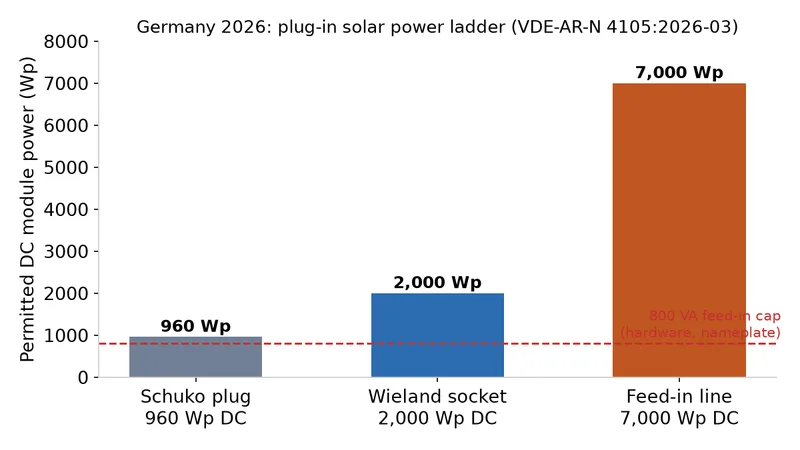
Plug-in storage is the fastest-growing corner of this market. German industry analysis attributes roughly a third of new home-storage units in 2025 to balcony-class products, and in June 2026 about 61 percent of new balcony systems were ordered with storage. What changed in 2026 is the legal footing. VDE-AR-N 4105:2026-03, in force since 1 March 2026 (VDE), explicitly recognises plug-in storage for the first time, allows grid charging — the door to dynamic-tariff arbitrage — and keeps the simplified registration path for systems feeding in at or below 800 VA. The product standard DIN VDE V 0126-95, effective December 2025, requires the inverter to stop converting within 0.1 seconds of the plug being pulled and to dissipate residual voltage below 34 V within one second. The power ladder: 960 Wp of modules on a Schuko plug, 2,000 Wp on a Wieland socket, and no DC-side module cap — although above 7 kWp a smart meter becomes mandatory and the system is treated like a conventional rooftop plant (summary via ESS News). One paperwork trap: any system with a battery must still be registered with the local grid operator. Our full walkthrough lives in the balcony solar and storage rules guide.
The conversion-chain tax
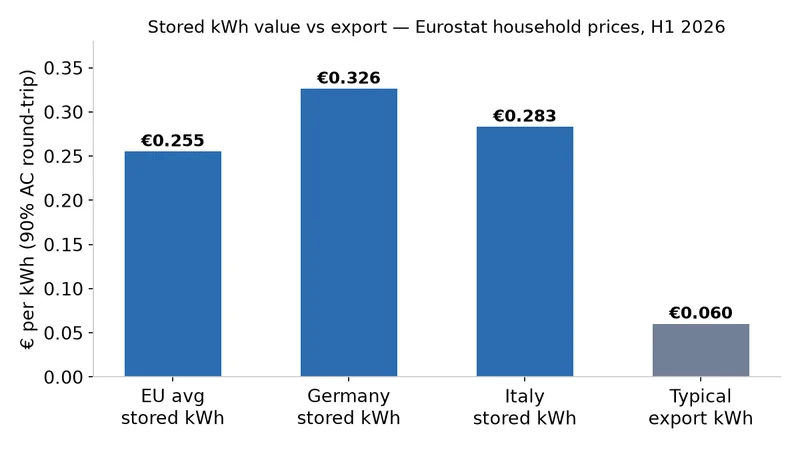
Here is the honest engineering price of AC coupling on a microinverter system. Energy from panel to socket crosses three conversions instead of two: DC to AC in the microinverter, AC to DC in the battery charger, then DC back to AC on discharge. Each hop costs a few percent. Enphase’s datasheet puts the 5P’s DC round-trip efficiency at 96 percent but the AC round-trip at 90 percent (Enphase) — and the AC figure is the one your bills see. Does that kill the economics? No. A stored kilowatt-hour is still worth roughly three to four times an exported one at today’s prices. But the tax is why microinverter batteries make most sense on arrays sized to self-consumption, not oversized feed-in machines — a distinction that matters even more in markets phasing out net metering, like the Dutch salderingsregeling in our net-metering phase-out analysis.
Backup power: what works and what does not
Grid-tied microinverters are anti-islanding devices: under EN 50549 they must disconnect within two seconds of a grid failure, so a plain microinverter array plus any grid-following battery delivers precisely zero blackout power. Backup exists only where a certified grid-forming path is added. In the Enphase ecosystem that means the IQ System Controller 3 INT, which lets the FlexPhase batteries form their own grid and start heavy loads — the batteries can discharge at twice their continuous rating for three seconds to get motors moving (Enphase). Generic AC retrofits gain backup only if the battery inverter is grid-forming and a compliant transfer switch is installed. Plug-in balcony storage, despite the marketing, follows the grid and offers no backup at all.
What German courts did to “Plug & Play” battery marketing
Treat plug-in storage marketing claims with caution this year. In May 2026 the regional courts of Bochum (20 May) and Osnabrück (27 May) issued injunctions against vendors advertising plug-in storage as “100 percent plug and play, no electrician needed” when devices did not meet DIN VDE V 0126-95; the courts treated the VDE standard, with the Product Safety Act, as binding market conduct, with fines of up to €250,000 possible (reported by photovoltaik.sh). The takeaway: check the device is certified, register it in MaStR and with the grid operator, and distrust anyone who calls paperwork optional.
What it earns at EU retail prices
Household electricity across the EU averaged €0.2832/kWh in the first half of 2026, with Germany at €0.3618 and Italy at €0.3142 (Eurostat electricity price statistics). Run that through a 90 percent AC round-trip and each stored kilowatt-hour displaces roughly €0.25–0.33 of retail purchase, while exported surplus earns €0.05–0.08. Even after the full conversion-chain tax, self-consumption pays three to four times more per kWh than export — which is why plug-in storage payback sits around three to five years on an 800 W balcony system, and why we recommend sizing storage to your evening load, as set out in our price outlook and sizing guide.
Country subsidy snapshot for 2026
| Country | Scheme | Support for storage | Status 2026 |
|---|---|---|---|
| Germany | KfW 270 + 0% VAT | Low-interest loan; 0% VAT with PV ≤30 kWp | Open |
| France | MaPrimeRénov’ | Storage not a direct line; PV aid restructured | Open (main residence) |
| Italy | Conto Termico 2.0 / Bonus Casa | Deductions for upgrades; Bonus Casa 50% | Open |
| Netherlands | Rijksoverheid energy | No battery grant; net metering ends 31 Dec 2026 | Phase-out |
| Poland | Mój Prąd / Magazyny 2.0 | 30% / PLN 800 per kWh / PLN 16,000 cap | Open |
| Czechia | NZÚ Zelená úsporám | Up to CZK 75,000 for PV + storage | Check window |
| Romania | Casa Verde Plus | Up to RON 20,000 PV + storage | Open |
| Greece | HDB programme | 45–75% for rooftop PV + storage | Open |
Buyer’s checklist before you order
- Confirm the route: native ecosystem, AC retrofit, or plug-in — they solve different problems.
- Size to evening load, not to the array: one daily cycle is the profitable one.
- In Germany, verify DIN VDE V 0126-95 certification and the hardware 800 VA cap on the nameplate.
- Check whether your DSO applies export limits, and where the control meter sits.
- Ask explicitly whether backup is included, which hardware enables it, and complete MaStR plus grid-operator registration — a battery always triggers both.
Microinverters and batteries work together in 2026 — through ecosystems, retrofits and now regulated plug-in units — but the winning setup matches your load profile, your connection rules and your country’s subsidy window. Not sure which route fits your home or installation business? Explore our home battery product range, learn more about Insum Energy, or contact Insum Energy for a tailored quote — and browse our European storage guides on the Insum Energy homepage.