Standby Generator + Battery Hybrid: EU Sizing Guide 2026
When the Iberian peninsula went dark on 28 April 2025, backup power stopped being theoretical. The final ENTSO-E expert report (March 2026) found cascading generator disconnections and voltage-control failures behind the largest European outage in two decades (ENTSO-E Expert Panel final report, March 2026). Since then, installers keep hearing one question: should a battery home also buy a standby generator? The honest answer: the two machines solve different problems, and a hybrid pays only when each unit is sized for the job the other cannot do.
How often the grid actually fails
Start with the data: it decides how much hardware you need. Germany’s network regulator reports a SAIDI of 11.7 minutes per connected customer for 2024: the average annual outage time at low and medium voltage, force majeure excluded (Bundesnetzagentur quality of supply; Monitoring report 2025). Across most of the EU, outages are short and rare; April 2025 changed the fear, not the statistics. A battery handles frequent short interruptions silently and instantly; a generator covers the long, fuel-hungry tail; a hybrid covers both, provided the switchover is engineered correctly.
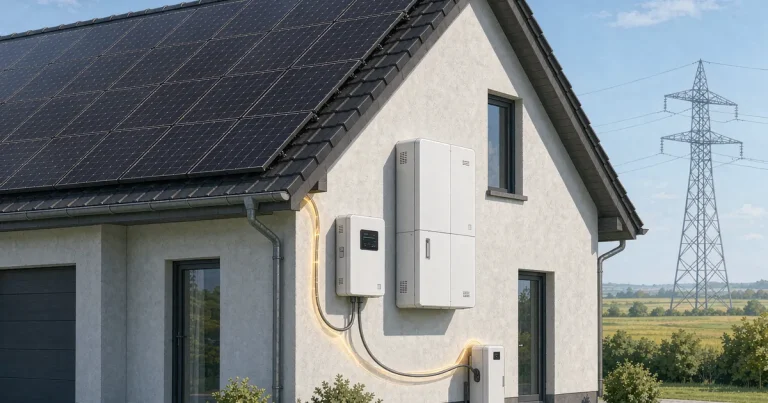
Three ways to connect a generator to a battery home
The architecture matters more than the brand. Three practical options exist:
- Manual changeover switch (open transition): you move the house supply by hand. €150–400 installed, but the break is measured in minutes.
- Automatic transfer switch (ATS): detects grid loss, starts the genset and switches within seconds: €400–1,200 plus installation.
- AC-coupled hybrid inverter with dual AC input: units such as the Victron Quattro offer two AC inputs and an integrated transfer switch that shifts in under 20 ms, current-limiting, battery assist and automatic genset start on state of charge (Victron Quattro datasheet).
Whatever you choose, the genset must never be wired straight into house circuits: a direct connection back-feeds the grid, lethal for line workers, and burns the alternator when mains returns. All three architectures isolate the house fully. Weighing full off-grid living instead? We compare the inverter types in our off-grid vs hybrid guide.
| Architecture | Break time | Indicative cost | Best for |
|---|---|---|---|
| Manual changeover | Minutes, by hand | €150–400 | Budget builds, rarely needed backup |
| Automatic transfer switch | Seconds | €400–1,200 | Absentee owners, holiday homes |
| Dual-input hybrid inverter | <20 ms, seamless | €800–2,500 | Homes with PV, heat pumps, daily cycling |
Sizing the generator: start with starting loads
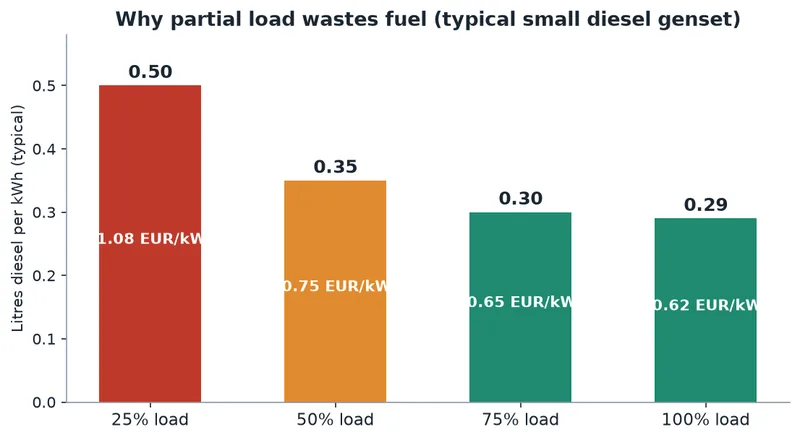
Generators are sized in kilowatts, and the trap is motor start-up. An inverter heat pump draws only 1.1 to 1.5 times its rated power at start, but a well pump or compressor can pull three to five times rated current for a moment. Add the continuous loads you genuinely want in an outage — fridge and freezer around 300 W, water pump, lighting, router, heat pump at a reduced setpoint — then add the largest starting load. For most EU single-family homes that lands at 4–6 kW with the heat pump included, or 3–4 kW without it. One rule matters more than the headline: small gensets hate low load. Hours below 40% cause wet stacking and glazing, so run 60–80% load for an hour or two, not all day at 15%.
Sizing the battery: kilowatt-hours of autonomy
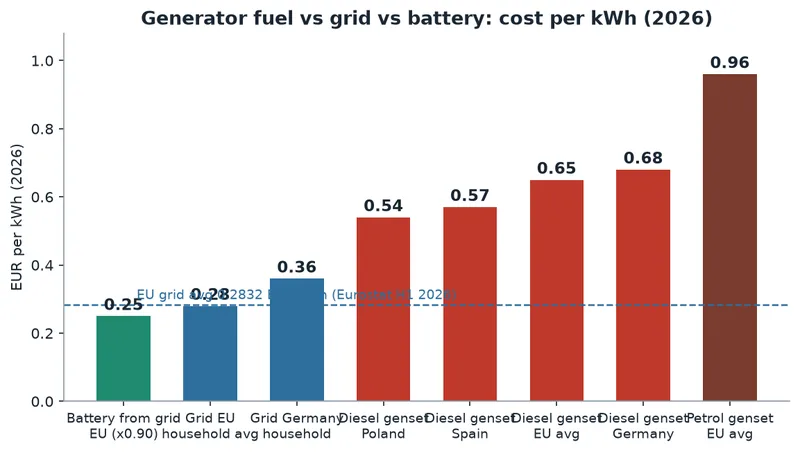
The battery is sized in hours: at a frugal 1 kW, 10 kWh buys roughly ten hours; at 3 kW, about three hours and one evening. Our Dunkelflaute analysis shows what different sizes really cover in dark, still winter weeks. In a hybrid the two are sized against each other: run the genset one or two hours daily at 70–80% load to bulk-charge the battery, and let it carry the house for the other 22 hours. Fuel use drops sharply versus continuous part-load running. Check the charge rate: the genset must cover charge power plus live house load, or set the inverter’s generator input limit accordingly. Since tariff spreads drive battery value year-round, our EU power price outlook shows where those spreads may go to 2030.
What a generator kilowatt-hour really costs
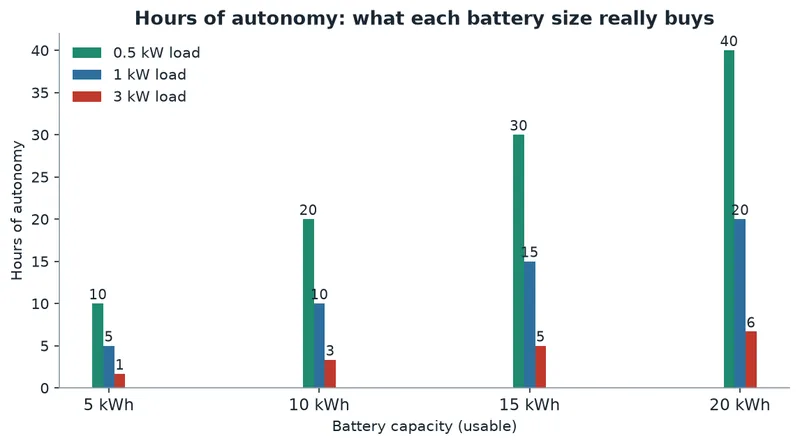
Fuel economics decide how often you will actually run the genset. A typical small diesel generator consumes about 0.30 litres per kWh delivered. With EU-average diesel at €2.154 per litre in the week of 2 November 2026 (European Commission Weekly Oil Bulletin), that is roughly €0.65 per kWh — about €0.68 in Germany, where diesel averaged €2.282 per litre. Petrol units are worse: at around 0.5 L/kWh and EU-average petrol of €1.929 per litre, expect close to €0.97 per kWh. Compare the EU household grid average of €0.2832 per kWh in the first half of 2026 (Eurostat, nrg_pc_204): generator electricity costs two to three times grid power. That is acceptable insurance for the rare long outage, and poor economics for daily use. A battery charged from the grid at 90% round-trip efficiency delivers stored energy at roughly €0.25–0.33 per kWh — and from rooftop solar, at little more than the panel’s cost per cycle.
| Source of electricity | Basis | € per kWh |
|---|---|---|
| Grid, EU household average | H1 2026 | €0.28 |
| Grid, Germany | H1 2026 | €0.36 |
| Battery from grid, EU | ×0.90 efficiency | €0.25 |
| Battery from grid, Germany | ×0.90 efficiency | €0.33 |
| Diesel genset, EU average | 0.30 L/kWh | €0.65 |
| Diesel genset, Germany | 0.30 L/kWh | €0.68 |
| Diesel genset, Poland | diesel €1.812/L | €0.54 |
| Diesel genset, Spain | diesel €1.898/L | €0.57 |
| Petrol genset, EU average | 0.50 L/kWh | €0.96 |
Fuel storage, siting and the rules you cannot skip
Fuel is where hybrids get regulated. In Germany, above-ground storage of more than 1,000 litres of diesel, including in a basement, must be notified to the water authority, and tanks must be built and serviced by certified specialist firms under the AwSV ordinance (AwSV, gesetze-im-internet.de). New fuel storage in floodplains is generally prohibited by §78c of the Federal Water Act — the same constraint we examined for batteries in our flood-zone siting guide (§78c WHG). Elsewhere the pattern is similar: diesel belongs in sealed, ventilated spaces away from drains; petrol is classified more strictly in most member states, so keep petrol gensets outdoors and refuel cold. Exhaust must disperse away from windows and intakes. Noise matters too: a small genset reads 55–70 dB(A) at 7 metres, far above the night limits we compared in our battery noise guide.
Grid codes: never parallel without permission
Any installation running a generator in parallel with the public grid falls under Regulation (EU) 2016/631, the EU network code for generators, applied nationally through standards such as EN 50549 (Regulation (EU) 2016/631, EUR-Lex). Open-transition transfer switches and dual-input hybrid inverters never parallel the two sources, which is precisely why they are the simpler compliance route. Buy gensets and inverters with CE marking under the Low Voltage and EMC directives, and have the installer document the isolation scheme — it is also what your insurer will ask to see.
What subsidies pay for, and what they do not
Be clear-eyed: member-state schemes subsidise solar and batteries, essentially never generators. Fund the genset privately; push the battery and PV through the local grant where one is open. The 2026 landscape:
| Country | Scheme for the battery / PV | 2026 status |
|---|---|---|
| Germany | KfW 270 loan for PV + storage | Open; KfW 442 grant closed |
| France | MaPrimeRénov’ via ANAH | Heat-pump-led; storage only within a package |
| Italy | Conto Termico 2.0 (GSE) | Up to 65% for efficiency works incl. PV + battery |
| Netherlands | 0% VAT on batteries | Salderingsregeling ends 31 Dec 2026 |
| Poland | PME 2 storage grant | 30%, PLN 800/kWh, PLN 16,000 cap |
| Czechia | NZÚ battery grant | CZK 75,000; intake currently paused |
| Romania | Casa Verde 2026 | RON 20,000 cap for PV + storage |
| Greece | Rooftop PV + storage grant | 45–75% by income category |
Grant eligibility almost always assumes the battery is charged by PV, not a fossil genset — one more reason to put solar first in the charging chain.
A buying checklist for 2026
- Size the genset to motor-start loads, not average consumption.
- Size the battery to hours of autonomy at a realistic reduced load.
- Match genset output to charge power plus house load, and set input current limits.
- Choose open transition or a certified dual-input inverter; never parallel with the grid without DSO approval.
- Plan fuel storage early: AwSV notification in Germany, flood-zone bans, ventilation and drains.
- Budget honest fuel costs of €0.54–0.96 per kWh and run the genset at high load, briefly.
- Test the whole chain monthly under real load, not just the genset on its own bench.
Hybrid backup is a design exercise, and getting the sizes right is worth more than any brand premium. The LiFePO4 battery range from Insum Energy integrates with dual-input hybrid inverters from all major brands; our team can review your load list and outage scenarios before you commit. Contact Insum Energy for a quote, learn more about us, or explore the latest guides on insumenergy.com.