Dunkelflaute 2026: What an EU Home Battery Can Really Cover
Every winter a high-pressure system parks itself over central Europe, the wind drops to nothing for a week, the sky turns the colour of a filing cabinet, and solar output becomes a rounding error. Germans call it Dunkelflaute — a dark lull. It decides whether a home battery is an investment or an ornament, and why a wholesale price can multiply tenfold in one evening.
What a Dunkelflaute Is, and What It Is Not
The definition is meteorological: a stationary winter high brings fog, low cloud and almost no wind. Wind fleets run at 10 to 15% of installed capacity for days, sometimes two weeks. Solar is negligible — short days, low sun angle, thick cloud — while demand climbs because every heat pump works harder.
What a dark lull is not is a blackout. The grid stays energised through imports, gas peakers and reserve plants. What breaks is the price, and that distinction matters: a blackout is a backup question, a dark lull is a tariff question.
ENTSO-E’s winter assessment puts numbers on the strain. Europe’s battery fleet more than doubled to roughly 28 GW, while the dispatchable thermal stack lost about 12 GW of coal, lignite and oil and gained only 4 GW of gas. Germany, Belgium, Denmark, Ireland and Finland are flagged as zones that may lean on imports when renewables are low. Batteries remain too small to buffer multi-day stress.
The Price Signal: What Still Air Costs
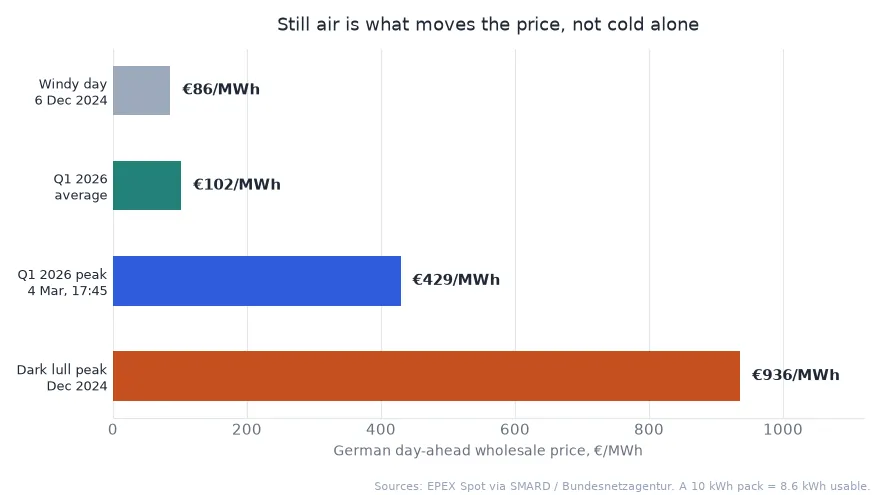
In December 2024 a dark lull pushed the German day-ahead price to €936/MWh on EPEX Spot, against €86/MWh on a windy day two weeks earlier — enough for the Bundesnetzagentur to open a market-abuse probe. Early 2026 was calmer but still spiky: the first quarter averaged €102.17/MWh, peaked at €429.36/MWh on 4 March and logged 172 quarter-hours below zero, per SMARD data.
The same year produced the opposite tail: on 1 May 2026 day-ahead prices hit −€499.99/MWh in Germany and −€498/MWh in France, and the exchange floor was later lowered to −€600/MWh. By 15 October, Spain had logged a record 951 hours at or below €0/MWh, France 681 and Germany 491. A battery can earn from both ends.
Retail prices move far less, which is where payback maths usually goes wrong. The German household average was 37.2 ct/kWh in January 2026, down from 39.3 ct, helped by a €6.5bn federal subsidy that cut transmission charges from about 11 to 9.3 ct/kWh. Network fees, levies and taxes are more than half the bill — one reason grid-fee avoidance often beats arbitrage.
Three price regimes, one battery
| Regime | Wholesale signal | Battery action | Value per 8.6 kWh |
|---|---|---|---|
| Wind or sun surplus | −€50 to €0/MWh | Absorb if tariff passes it through | €0.5–1.5 avoided cost |
| Winter evening | €80–150/MWh | Discharge 18:00–21:00 | €1.0–1.4 |
| Dark lull evening | €400–936/MWh | Discharge, keep reserve | €3.4–8.0 |
The Honest Maths: Hours, Not Days
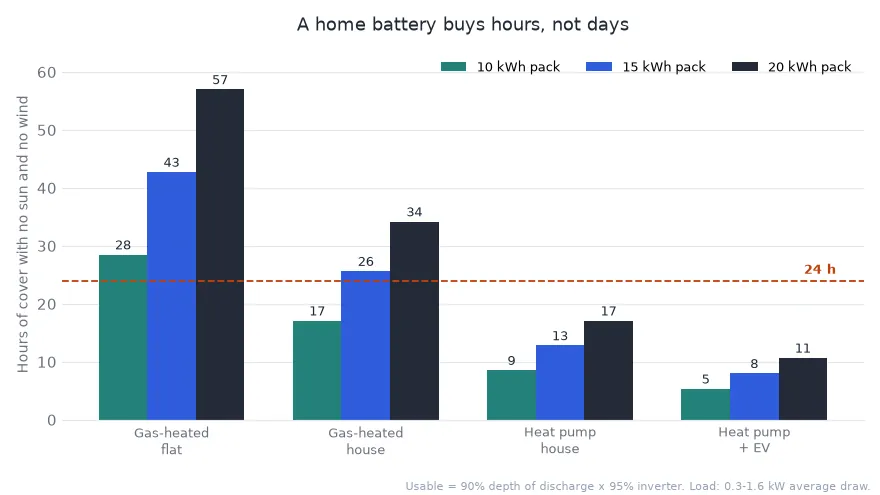
A nameplate kilowatt-hour is not a delivered one. A 10 kWh pack limited to 90% depth of discharge, behind a 95% efficient inverter, delivers about 8.6 kWh to the house. Divide by the average winter draw and you get the only number that matters in a lull.
| Household | Winter use | Average draw | 10 kWh | 20 kWh |
|---|---|---|---|---|
| Gas-heated flat, 2 people | 6–8 kWh/day | 0.3 kW | ~28 h | ~57 h |
| Gas-heated house, 4 people | 10–14 kWh/day | 0.5 kW | ~17 h | ~34 h |
| Heat pump, 120 m², insulated | 20–30 kWh/day | 1.0 kW | ~9 h | ~17 h |
| Heat pump plus EV, 40 km/day | 32–45 kWh/day | 1.6 kW | ~5 h | ~11 h |
Read the heat-pump row twice: 10 kWh is a one-evening product in an electrified house, 20 kWh a one-day product. Neither rides out a five-day lull. What the pack does well is move energy from cheap hours to expensive ones and keep the lights on when the fault is on your street, not in the weather.
Cold makes it worse: LiFePO4 loses roughly 10 to 20% of available capacity at −10 °C, and the BMS refuses to charge below 0 °C to avoid lithium plating. A frost-free indoor room avoids both; an outdoor cabinet with a heater spends energy instead. If the pack shares a room with a heat pump, that room is already warm.
Where the Money Actually Comes From
Four routes, by certainty.
- Evening shifting. On a German fixed tariff of 37.2 ct/kWh with 25 ct/kWh at night, 8.6 kWh per night is about €1.05, or roughly €210 over 200 nights.
- Event days. France’s Tempo tariff sets 22 red days a year, with a red peak of 70.60 ct/kWh from February 2026 and 72.95 ct/kWh from August, against 13.56 ct on a blue off-peak hour. A 57 ct spread makes a full cycle worth €6, but the calendar caps the year near €130.
- Flexibility markets. Aggregated home batteries now earn in balancing and ancillary products; the real per-kWh numbers are in our guide to VPP revenue for battery owners.
- Network charges. A battery registered under §14a EnWG in Germany can access reduced or time-variable grid fees. That is a fixed-cost saving rather than a trading gain, usually the largest single line.
One caveat on negative prices: the headlines oversell them. A German dynamic tariff adds about 10 to 12 ct/kWh of network fees and 6 to 8 ct of taxes, so a wholesale hour at −5 ct still costs 11 to 15 ct at the meter. Charging then is cheap, not free — which is why the charging strategies that matter key on the delivered price, not the exchange print.
Country by Country: Where the Lull Hits the Bill
| Market | Winter exposure | Verified figure | Main job |
|---|---|---|---|
| Germany | High: thin thermal backstop | 37.2 ct/kWh average; €429/MWh Q1 peak | Evening shift plus §14a fees |
| France | Concentrated in 22 Tempo red days | 72.95 ct red peak vs 13.56 ct blue off-peak | Cover the red-day peak block |
| Spain | Low prices, midday surplus | 951 hours at or below €0 by mid-October | Soak PV, cover the evening |
| Netherlands | Policy-driven, not weather-driven | Saldering ends 1 January 2027 | Raise self-consumption |
| Belgium, Denmark, Finland | Import-dependent when renewables are low | ENTSO-E winter assessment | Peak shaving, short backup |
| Poland, Italy | Marginal cost set by coal and gas | Winter evening peaks drive the spread | TOU shifting |
Settings That Decide the Outcome
- Winter reserve floor of 20–30%. A pack that ends the evening at zero cannot cover the 03:00 fault.
- Charge before the lull. Weather-aware control reads the wind and PV forecast and tops up the night before a still spell. Most 2026 inverters can; few are configured to.
- Daily depth of discharge at 90% or below. The last 10% buys a few euros and costs cycle life.
- Separate backup from arbitrage. A grid-tied pack with a backup circuit is not a whole-home UPS; our UPS versus battery comparison explains transfer times.
- Confirm grid-code ride-through. EN 50549-1/-2 and VDE-AR-N 4105 keep the inverter online through voltage and frequency excursions.
Why Brussels Is Watching Still Air
A dark lull is now a policy argument. Germany’s draft supply-security and capacity act would auction dispatchable capacity; the Bundesnetzagentur’s base case sees 20 to 22 GW of new gas by 2035, rising to 36 GW if renewables and flexibility slip. The solar association warns that poorly designed criteria could disadvantage batteries, and cites a Fraunhofer IEE estimate that 20 GW of four-hour storage would save about €3.9bn a year.
The installed base is large: 28 GWh across roughly 2.5 million German systems in early 2026, with 8.2 GWh added in nine months. How much of that fleet is paid for availability, not only for kilowatt-hours moved, depends on the EU market design reform and national capacity mechanisms now being drafted.
Sizing for a Dark Lull
- 5–10 kWh: a bill cutter. Shifts the evening peak and soaks PV surplus: 8 to 28 hours of cover depending on the house.
- 10–15 kWh: the sweet spot for a heat-pump household wanting evening autonomy and a red-day shield. Most EU subsidy caps sit here.
- 20–30 kWh: a full winter day for an electrified house with an EV, or a small commercial site.
- Beyond 30 kWh: only with a generator, VPP contract or genuine off-grid need. Storage is not firm capacity.
Size from winter consumption, not annual consumption; our capacity sizing guide walks through the calculation with real load profiles.
Bottom Line
A Dunkelflaute does not test whether your battery can power the house for a week. It tests whether the system was sized for the evening, configured for the forecast and connected to a tariff that rewards shifting energy by a few hours. Get those three right and 10 to 15 kWh earns its keep; get them wrong and even 30 kWh will disappoint.
Insum Energy supplies LiFePO4 storage for EU households, installers and distributors, with grid-code certificates and sizing support built for winters like this. Browse the home battery range or contact our team for a quote and a sizing review based on your own winter consumption. For background, see about us, or start from the Insum Energy homepage.