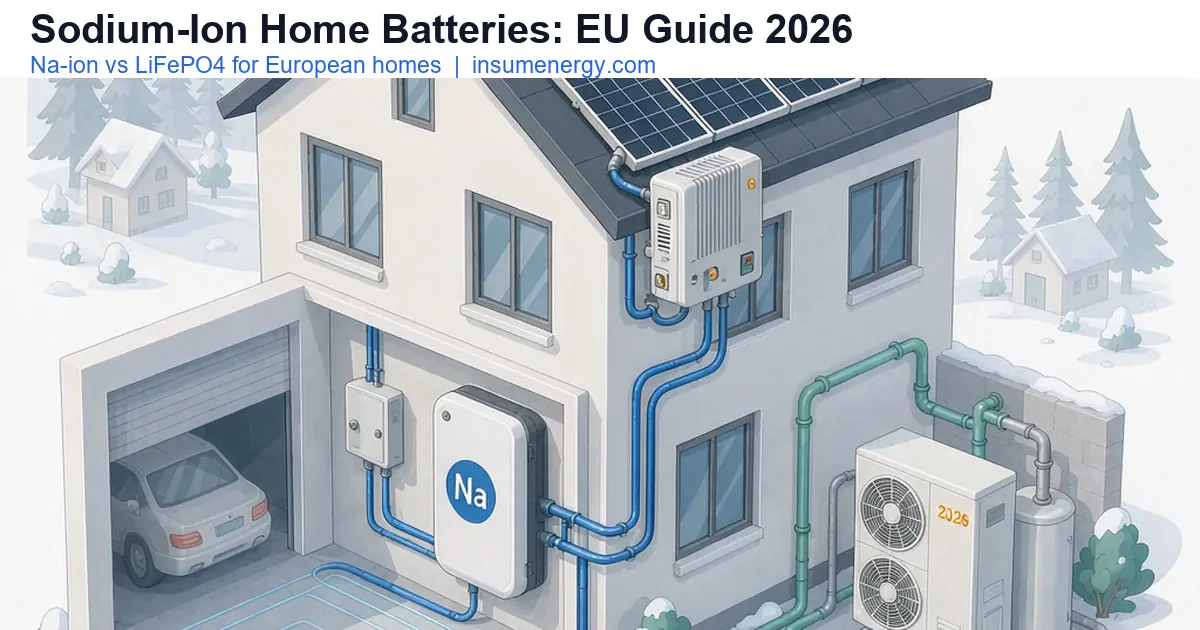
Sodium-Ion Home Batteries in the EU 2026: Should You Wait?
Every autumn, European homeowners ask the same question: is the battery I am about to buy still the right chemistry in three years? In 2026 a new answer entered the conversation. Sodium-ion (Na-ion) batteries moved from pilot lines to real deliveries in 2026: Munich hosting the world’s first field-validated sodium-ion grid storage launch in June 2026 and the first residential Na-ion units already installed in European homes. This guide explains what sodium-ion actually is, how it compares with the LiFePO4 batteries that dominate the EU market today, and whether buyers in Germany, the Nordics, Spain or Eastern Europe should switch now or wait for the second generation.
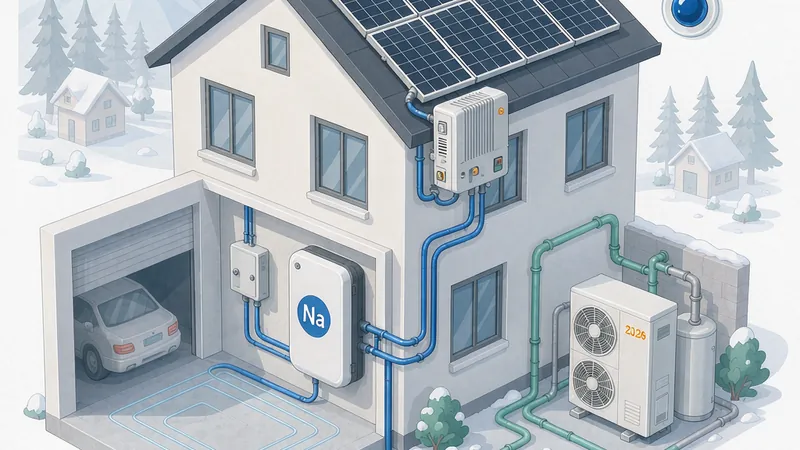
Why Sodium-Ion Is Suddenly Everywhere in Europe
The turning point came on 22 June 2026, when CATL unveiled the TENER Sodium energy storage system in Munich — the world’s first field-validated sodium-ion battery energy storage system (BESS). The company reported 15,000 cycles at 25 °C and over 92 percent capacity retention at −20 °C, with roughly 1 GWh of cumulative shipments targeted by the end of 2026 and global deliveries from June 2027. Within weeks, Dutch grid-equipment maker Alfen signed a 5 GWh sodium-ion partnership with CATL, and Bulgaria’s Solarpro agreed a 2 GWh deal to deploy the first large sodium storage projects in Eastern Europe.
Brussels has taken notice too. In early 2026 the European Economic and Social Committee (EESC) publicly backed sodium-ion storage as a way to cut the EU’s dependence on imported lithium, noting that sodium is roughly 1,000 times more abundant in the Earth’s crust and calling for dedicated funding in the next EU budget cycle. For a bloc that has watched lithium carbonate prices swing wildly since 2022, that argument lands hard.
What a Sodium-Ion Battery Actually Is
Sodium-ion cells swap lithium for sodium ions moving between a layered cathode and a hard-carbon anode. Three practical consequences matter for homeowners:
- No lithium, cobalt or nickel. Supply-chain risk and raw-material exposure shrink dramatically — a key reason EU policymakers favour the chemistry.
- Ships and stores at 0 volts. A sodium-ion pack can be fully discharged for transport and warehousing without damage, removing a whole class of logistics restrictions that apply to lithium cells.
- Similar safety profile to LiFePO4. Independent abuse testing in 2026 shows gentle, low-heat failure modes — no thermal propagation in the same sense as NMC cells.
The trade-off is voltage: a sodium-ion cell sits at roughly 3.1 V nominal versus 3.2 V for LiFePO4, with a sloped discharge curve that actually makes state-of-charge estimation easier — but only if the BMS and inverter understand the chemistry.
Sodium-Ion vs LiFePO4: The 2026 Numbers
Here is how the two chemistries stack up for a typical European residential installation in 2026:
| Metric | Sodium-ion (2026) | LiFePO4 (2026) |
|---|---|---|
| Energy density (cell) | 100–160 Wh/kg | 90–160 Wh/kg |
| Cycle life to 80% | 2,000–5,000 (latest BESS cells: 10,000–15,000) | 4,000–6,000+ (well-proven) |
| Usable capacity at −20 °C | 85–92% | 20–45% and cannot charge below 0 °C without a heater |
| Charge below 0 °C | Yes, with mild derating | No — BMS must block charge (lithium plating risk) |
| Nominal cell voltage | ~3.1 V | ~3.2 V |
| Ship / store at 0 V | Yes | No |
| Inverter & BMS ecosystem | Emerging, few certified profiles | Universal |
| Pack price per kWh | Promising 20–30% cell-level savings at scale, not yet realised at pack level | Still cheaper today thanks to gigafactory scale |
If you are already weighing lithium chemistries, our LiFePO4 vs NMC comparison explains why LFP became the default for home storage — and sodium-ion’s job in 2026 is not to replace it everywhere, but to win the niche where LFP is weakest: the cold.
The Cold-Weather Case: Nordics, Alps and Eastern Europe
This is where the comparison stops being close. A LiFePO4 battery must never be charged below 0 °C, because charging forces lithium metal to plate onto the anode and permanently degrades the cell. In an unheated Nordic garage or an alpine chalet, the BMS simply refuses solar charge until an internal heater warms the pack — wasting precisely the winter generation you installed the battery to capture. Sodium-ion cells accept charging well below freezing and hold 85–92 percent of rated capacity at −20 °C.
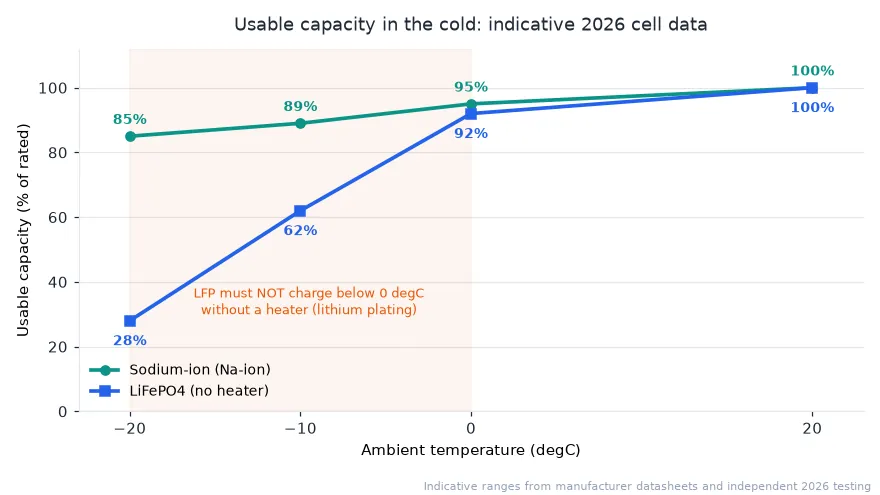
The economics amplify the physics. With German household electricity at around 37 ct/kWh and Nordic winter tariffs higher still, every kilowatt-hour of December solar that a frozen LFP battery refuses to store is billed at full retail price. For homes in Sweden, Finland, Norway, the Alpine arc or Romania’s Carpathian winters, a chemistry that works at −20 °C without heating load is not a luxury — it is the difference between a battery that earns money in winter and one that hibernates.
What EU Homeowners Can Actually Buy in 2026
Early residential products
The honest answer is: very little, and that is deliberate. Sodium-ion in 2026 is landing first in utility-scale and commercial storage, where cold tolerance and cycle counts matter most. The first genuine residential product, US-based UNIGRID’s Na+Casa, reached European homes in July 2026 — a 9.25 kWh, lithium-free unit rated from −40 °C to +60 °C and designed to work with most existing hybrid inverters. Dutch startup Moonwatt commissioned a pilot at Cleantech Park Arnhem in January 2026 and plans commercial-scale EU deployments from early 2027.
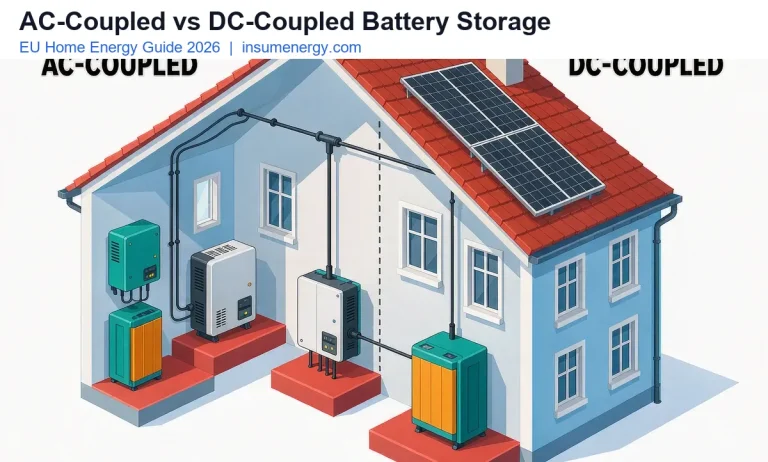
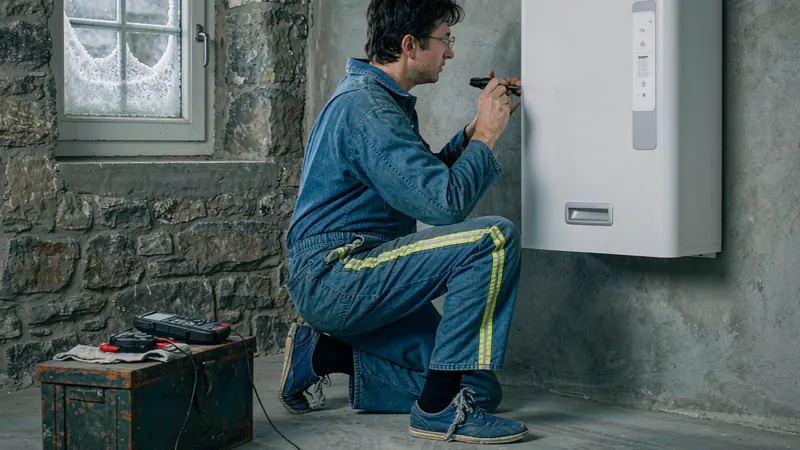
For most homes, the practical 2026 move is still a well-specified LFP system — ideally installed indoors, where the cold-weather argument disappears entirely. Our guide to AC-coupled vs DC-coupled battery storage covers the architecture choices that matter more than chemistry for a retrofit, and our product range lists certified LFP systems available across the EU today.
Europe’s Own Sodium-Ion Supply Chain Is Forming
Brussels wants more than imports. France’s Tiamat, a CNRS spin-off backed by Stellantis Ventures and Bpifrance, is building a 5 GWh cell plant in Amiens, with the first 700 MWh phase targeted for 2026 and full capacity by 2029. Sweden’s Altris supplies Prussian-white cathode material and in January 2026 partnered with Czech chemical group Draslovka to convert a plant in Kolín for up to 175 MWh of annual cathode output. Spain’s Bihar Batteries started sodium pilot production in summer 2026, and Austria’s Salzstrom will deliver a 7 MWh sodium storage system to a German industrial customer in Q3 2026.
Buyers should also weigh the cautionary tales. Northvolt — which announced its own Prussian-blue sodium technology in 2023 — went bankrupt in March 2025, and its sodium programme died with the sale of its assets to Lyten in February 2026. The IEA itself cites the case as evidence of how hard it is to build a sodium supply chain outside China. Whatever chemistry you choose, the same EU rules apply: the Battery Regulation (EU) 2023/1542 — covering safety testing, carbon-footprint declarations and the coming digital battery passport — is chemistry-agnostic. Our EU battery regulations guide explains what to check before any purchase.
Costs, Warranties and Subsidies in Euros
Cell-level estimates for sodium-ion in 2026 range widely — from optimistic claims near €50–100/kWh at scale to current commercial realities closer to LFP’s €80–120/kWh cell cost. At installed pack level, LiFePO4 remains cheaper in 2026: a typical 10 kWh European residential system still lands between €4,800 and €8,800 installed, and sodium-ion products do not undercut that yet. What sodium does eliminate is hidden cost: no battery heater, no insulated enclosure, no winter derating — line items that quietly inflate O&M budgets in cold climates.
Good news on incentives: every major national scheme — Germany’s KfW programmes, France’s MaPrimeRénov’, Italy’s Conto Termico 2.0, the Netherlands’ ODE framework, Poland’s Mój Prąd, Czech NZÚ and Romania’s Casa Verde — is chemistry-neutral. Eligibility depends on certification and grid compliance, not on whether your cells contain lithium or sodium. Our country-by-country tax guide details VAT rates and deductions, and if the upfront price is the blocker, financing and leasing options spread it over the payback period.
Should You Wait? A Decision Guide
- Buy LiFePO4 now if your battery lives indoors, you cycle daily for self-consumption in a mild climate (Spain, Portugal, most of France and Germany), and you want a proven 10-year warranty ecosystem.
- Consider sodium-ion now if your system sits in an unheated building, off-grid cabin or telecom-style cabinet in the Nordics, the Alps or Eastern Europe — and your installer can support the chemistry.
- Wait until 2027 if you want maximum cycle-life field data and wider product choice: CATL’s global deliveries start June 2027, Moonwatt’s commercial systems arrive the same year, and Tiamat’s EU-made cells follow.
- Either way, demand EN 62619/IEC 62619 certification, a chemistry-matched BMS profile and a written low-temperature charging spec in the contract.
Talk to Insum Energy
Sodium-ion will not replace LiFePO4 in 2026 — it completes it, winning the cold-climate and long-duration niches where lithium struggles while Europe’s own supply chain catches up. Whether you opt for today’s proven LFP systems or want to be first in line for sodium-ion when European stock arrives, Insum Energy helps homeowners, installers and distributors across the EU specify the right storage for their climate and tariff. Learn about our company and contact us for a free quote — our engineers will size the system, check your national subsidy eligibility and deliver a costed proposal within 48 hours.