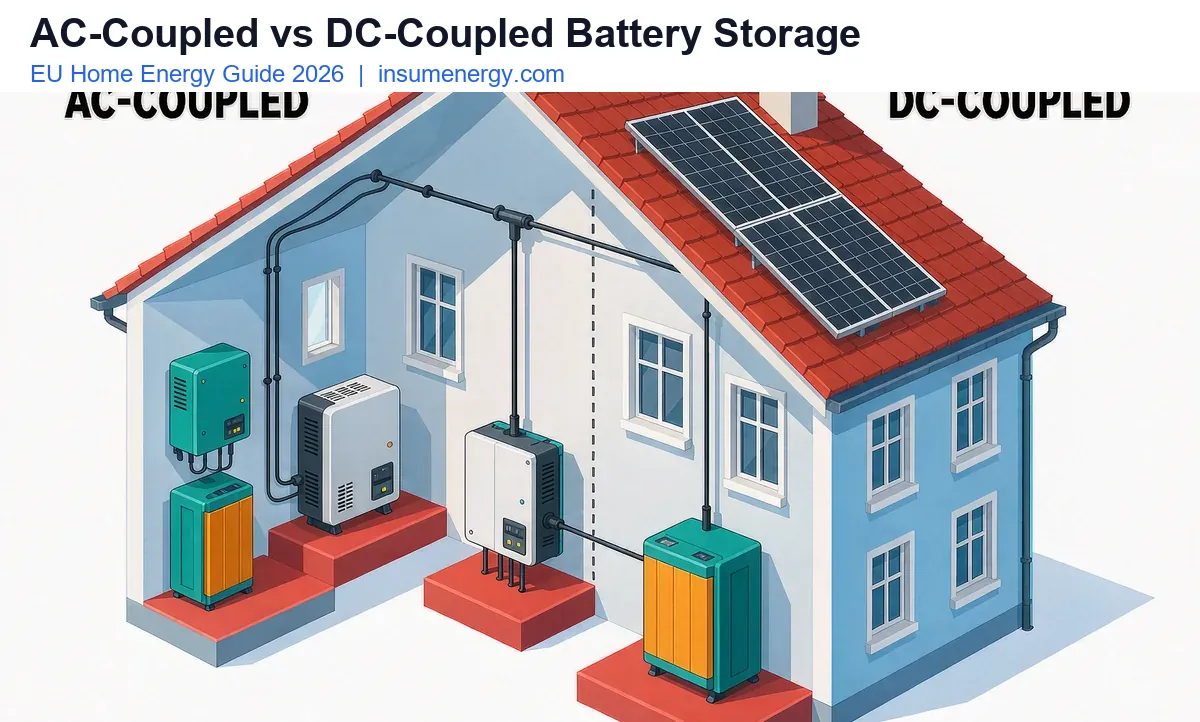
AC-Coupled vs DC-Coupled Battery Storage: EU Guide 2026
Europe added more solar in the last three years than in the previous two decades, but most of those rooftops were built without storage. Millions of homeowners from Munich to Milan now face the same question: how do I bolt a battery onto a PV system that is already humming away on my roof? The answer hinges on one technical decision that installers argue about daily — AC coupling versus DC coupling. This guide explains both architectures, compares real 2026 costs in euro, and shows which one fits your home, your grid connection and your national subsidy paperwork.
What AC Coupling and DC Coupling Actually Mean
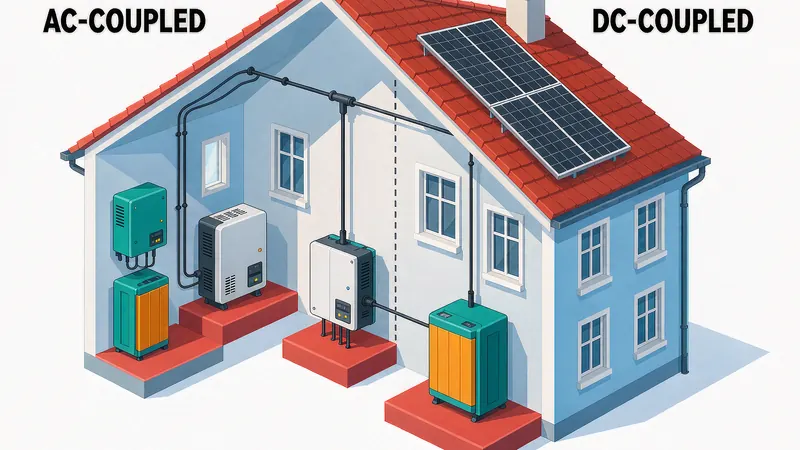
Every solar battery system is either connected to the DC circuit between panels and inverter, or to the AC circuit on the household side. That single wiring choice determines efficiency, cost, compatibility and even which grants you can claim.
AC-Coupled Systems
In an AC-coupled setup, the PV array keeps its own string inverter, and the battery gets a second, dedicated battery inverter (a bidirectional AC/DC converter). The two systems meet on the AC bus of your switchboard. The battery inverter converts AC power from the solar inverter back into DC to charge the cells, and converts DC back to AC to power your home. Because it works alongside any existing inverter, it is the default choice for retrofits on homes that already have solar.
DC-Coupled Systems
In a DC-coupled setup, a single hybrid inverter handles both the panels and the battery. DC power from the roof passes through an MPPT charge controller directly into the LiFePO4 cells — no extra conversion. On new builds, DC coupling is usually the cleaner and cheaper path. If you are still weighing overall system topologies, our comparison of off-grid, hybrid and grid-tie inverters in 2026 covers how hybrid units fit into each.
Efficiency: Where the Losses Happen
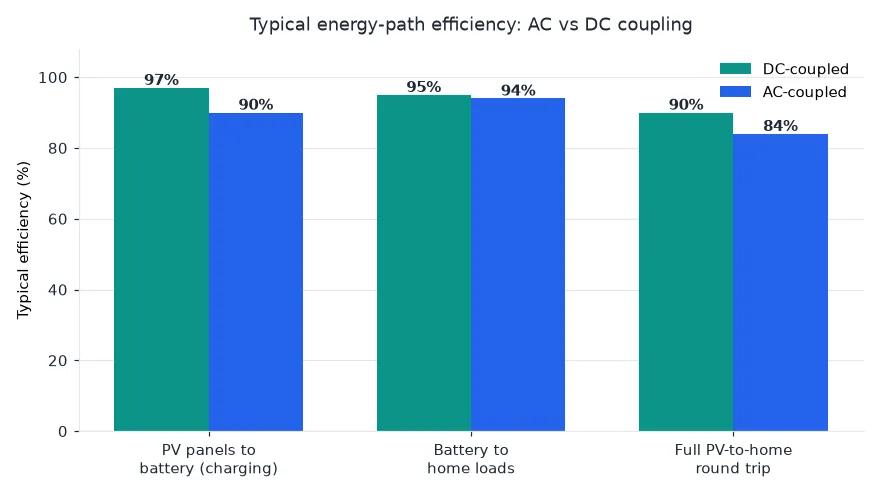
Each power conversion costs you energy. In a DC-coupled system, solar electricity reaches the battery after a single DC/DC conversion, typically at 97% efficiency or better. In an AC-coupled system the same energy is converted DC→AC by the solar inverter, then AC→DC by the battery charger, stacking two conversion losses and landing closer to 90% on the charging path. Over a full solar-to-home round trip the gap is usually 4–7 percentage points in the DC-coupled system’s favour.
Does that matter on your bill? For a 10 kWh battery cycling daily at German household prices of roughly 37.0 ct/kWh (BDEW, autumn 2026), a 5-point efficiency difference is worth about €60–70 per year. It is real money, but it is rarely the deciding factor — purchase price, retrofit complexity and subsidy eligibility usually dominate. Our deep dive on LiFePO4 round-trip efficiency for EU homes shows how to read manufacturer datasheets critically.
Retrofit or New Build: Which Architecture Fits Which Home
- Existing PV, no battery (the most common EU case). Germany alone counts close to four million grid-connected PV systems, many installed before batteries became affordable. An AC-coupled retrofit lets you add a 10 kWh LiFePO4 cabinet in one working day without touching the existing inverter or re-certifying the DC side.
- Existing PV, aging inverter. If your string inverter is past its 10–12 year design life anyway, replacing it with a hybrid inverter and going DC-coupled kills two birds with one stone.
- New installation. DC coupling with a hybrid inverter means fewer boxes on the wall, less wiring, a single warranty partner and the best charging efficiency.
- Backup power priority. Many AC-coupled battery inverters can form their own grid during an outage; check whether your chosen hybrid inverter offers equivalent backup output before committing.
What a Retrofit Costs in 2026
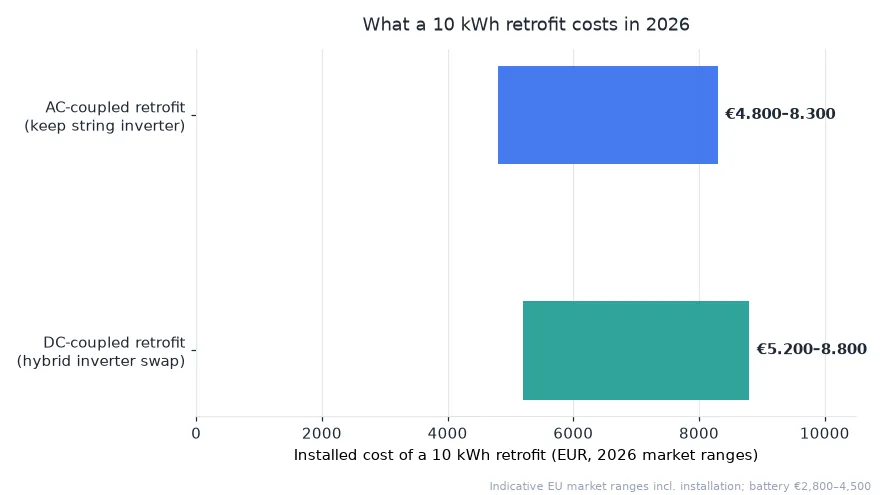
Indicative EU market ranges for a 10 kWh LiFePO4 system, fully installed:
| Component | AC-coupled retrofit | DC-coupled (hybrid swap) |
|---|---|---|
| 10 kWh LiFePO4 battery | €2,800–4,500 | €2,800–4,500 |
| Battery inverter (AC) / hybrid inverter | €1,400–2,600 | €1,600–2,800 |
| Existing string inverter | kept (€0) | discarded |
| Installation & wiring | €600–1,200 | €800–1,500 |
| Total | €4,800–8,300 | €5,200–8,800 |
AC coupling wins on upfront retrofit cost because nothing on the DC side changes. DC coupling wins on lifetime efficiency and simplicity. If your battery cabinet will feed a three-phase property, note that coupling architecture interacts with phase balance — see our guide to three-phase vs single-phase home batteries.
Grid Connection and Certification Rules
Whichever architecture you choose, every grid-connected inverter must comply with EN 50549-1/-2 (the EU’s requirements for generating plants connected to the LV/MV network), with national derivatives such as VDE-AR-N 4105 in Germany, and with inverter safety standard IEC 62109. In an AC-coupled system two separate devices must each hold these certificates; in a DC-coupled system one hybrid inverter carries the whole approval. Practical consequences:
- Registration with the local DSO is typically required whenever a storage unit is added — even AC retrofits.
- AC-coupled systems need careful export-management coordination between the two inverters to avoid exceeding your approved feed-in limit.
- Batteries and inverters must carry CE marking under the EU Battery Regulation and Low Voltage Directive before sale.
What This Means for Your Electricity Bill
Coupling architecture only pays off if every stored kilowatt-hour displaces expensive grid power. The economics in 2026 are strong across the EU:
- Germany: household prices average about 37 ct/kWh (BDEW, autumn 2026), while EPEX day-ahead wholesale prices swung between negative values and over 30 ct/kWh within single days in October 2026 — exactly the volatility dynamic batteries monetise.
- Netherlands: net metering (salderingsregeling) ends on 1 January 2027, so every stored kilowatt-hour self-consumed from 2027 onward saves its full value instead of a shrinking credit.
- Spain: PVPC-regulated hourly pricing rewards shifting midday solar into the evening peak, which an AC or DC coupled battery does automatically.
Do Subsidies Treat AC and DC Differently?
Most EU support schemes subsidise the battery (and sometimes the inverter) regardless of coupling type, but paperwork differs:
- Germany: KfW and Länder programmes fund battery storage; VDE-AR-N 4105 conformity of each inverter is required, so both architectures qualify.
- France: MaPrimeRénov’ 2026 and local schemes focus on solar-plus-storage packages; AC retrofits on existing arrays are explicitly eligible.
- Italy: Conto Termico 2.0 incentives for efficiency upgrades can be combined with storage additions on existing PV.
- Netherlands: the 0% VAT regime (KOR) applies to the full installation either way.
- Poland, Czechia, Romania: Mój Prąd, NZÚ and Casa Verde programmes all accept storage retrofits; check whether the battery inverter must appear on the grant application.
- Greece: recovery-fund residential programmes pair rooftop PV with subsidised storage per kWh installed.
One rule of thumb everywhere: keep both inverters’ datasheets and certificates in the application file — the extra device in an AC-coupled system is the most common documentation gap that slows grant approval.
Decision Checklist
- Already have solar with a healthy inverter? AC-coupled retrofit — fastest, cheapest, least disruption.
- Inverter due for replacement or new build? DC-coupled hybrid — best efficiency, single warranty, tidier install.
- Need whole-home backup? Verify black-start and backup output for the specific product, not just the brand.
- Confirm EN 50549 / national grid-code certification and DSO registration before ordering.
- Compare usable energy (kWh) and cycle warranty, not just gross capacity and headline price.
Build It Right with Insum Energy
Whether you are retrofitting an existing array or specifying a new hybrid installation, Insum Energy supplies certified LiFePO4 battery systems engineered for European grid codes and EU subsidy programmes. Browse our battery storage product range, learn more about our company and certifications, or contact Insum Energy for a tailored quote — our engineers will size the right AC- or DC-coupled system for your home and help you claim every available grant.