Energy Poverty in Europe 2026: Can Home Battery Storage Help Vulnerable Households?
Europe’s energy transition has brought unprecedented renewable capacity — yet it has also created a paradox. Wholesale electricity prices across the EU have stabilised, but retail tariffs remain elevated, leaving 34 million Europeans trapped in energy poverty according to the European Commission’s 2025 Energy Poverty Observatory report. These are households spending more than 10% of their disposable income on energy bills.
Why Energy Poverty Persists Despite Falling Wholesale Prices
Three structural forces keep energy bills high for vulnerable consumers:
- Grid infrastructure charges now account for 30–40% of residential electricity bills in Germany and the Netherlands, costs that wholesale price declines cannot offset.
- Capacity-based network fees in Spain (PVPC tariff structure) and Italy (BTLU) disproportionately penalise low-income households who cannot invest in self-generation.
- Static vs. dynamic pricing: households on flat tariffs cannot benefit from the grid arbitrage that time-of-use (TOU) tariffs create for flexible consumers.
The result is a growing divide between those who can access flexible energy markets and those locked into static, expensive tariffs — a divide that battery storage can begin to close.
EU Policy Response: Social Climate Fund and National Mechanisms
The EU’s Social Climate Fund (SCF), established under Regulation (EU) 2023/839, allocates €65 billion through 2027 specifically to support energy-poor and vulnerable households. Member states must use SCF funds for:
- Energy efficiency retrofits (insulation, heat pumps)
- On-site renewable generation (solar PV)
- Battery storage systems for households without access to net metering
- Bill subsidies decoupled from consumption
Critically, Directive (EU) 2023/1791 on energy efficiency now mandates that member states identify energy-poor households and include them in renovation support schemes — a legally binding obligation from 2025 onward.
How Home Battery Storage Addresses Energy Poverty Directly
Battery storage is not only for affluent prosumers with rooftop solar. For vulnerable households, it delivers measurable savings in three ways:
1. Shaving Peak Demand Charges
In Spain, households on the PVPC regulated tariff face volatile hourly prices. In August 2026, prices on EPEX SPOT Spain ranged from €0.08/kWh (solar midday) to €0.34/kWh (evening peak). A 5 kWh LiFePO4 battery charged at €0.08/kWh and discharged at €0.34/kWh saves approximately €1.30 per full cycle per kWh — without any solar panels.
2. Maximising Low-Cost Grid Window
Netherlands households on the Salderingsregeling phase-out trajectory benefit from time-shifting self-consumption. But for households without PV, a battery charged during the cheap night hours (€0.11/kWh on Eneco’s daltarief, Q2 2026) and discharged during peak evening hours (€0.28/kWh) generates savings of €0.17/kWh per cycle. Over 300 cycles per year, a 5 kWh system saves €255 annually — a significant sum for a low-income household.
3. Reducing Exposure to Price Spikes
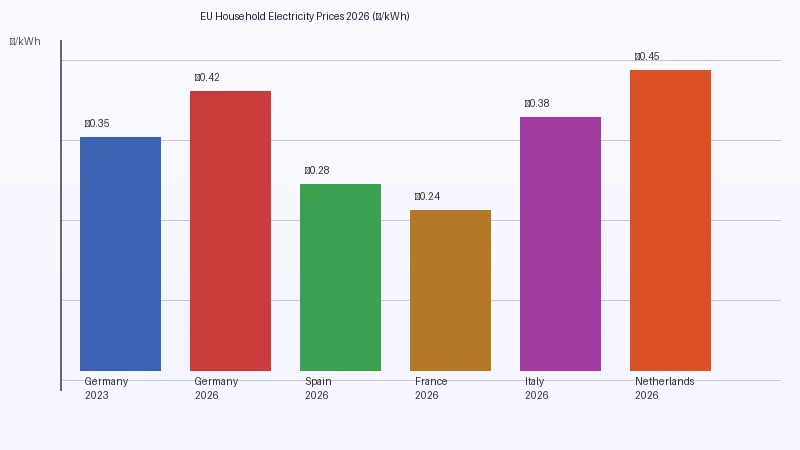
The winter of 2025/2026 saw German day-ahead prices on EPEX SPOT reach €0.42/kWh on several cold evenings. Households with a LiFePO4 battery storing 5 kWh at off-peak rates of €0.12/kWh avoided €1.50 in grid costs per day during these events — totalling €45–€60 in savings over a typical winter month.
2026 National Subsidy Programs for Energy-Vulnerable Households
Several EU member states have designed subsidy programs specifically targeting low-income households:
| Country | Program | Subsidy Detail | Eligibility |
|---|---|---|---|
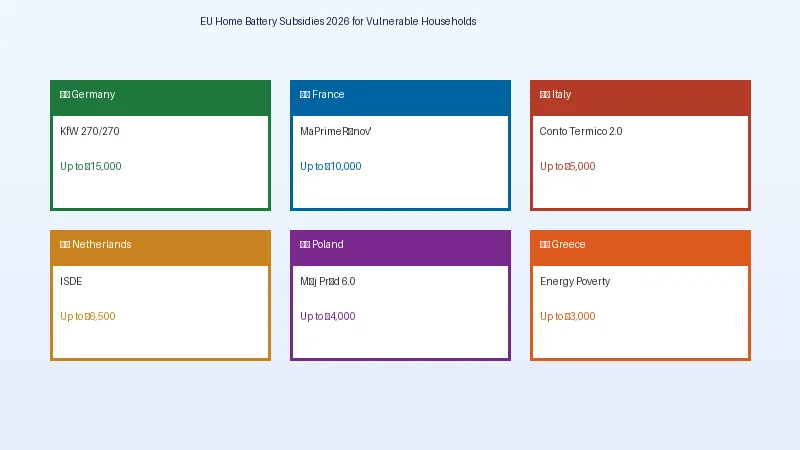
| Germany | KfW 270 / KfW 458 | Up to €15,000 for PV + storage (KfW 458); up to €17,500 for energy efficiency + storage combo | Income-based (Bundesförderung für effiziente Gebäude) |
| France | MaPrimeRénov’2026 | Up to €11,000 for heat pump + battery; €3,000 for standalone storage with verified income criteria | Income tier (Bleu/Vert/Jaune/Violet) |
| Italy | Conto Termico 2.0 + PNRR | Up to 65% of system cost for energy-poor households under PNRR (Piano Nazionale di Ripresa e Resilienza) | ISEE income indicator below €15,000 |
| Netherlands | ISDE (Investeringssubsidie Duurzame Energie) | €400–€700 per kWh for battery storage; income supplement of €200 for low-income applicants | Homeowners with ISEO indicator |
| Spain | Plan IRA + RD 244/2019 enhancement | Up to 40% rebate on PV + storage through regional autonomy programs (Comunidad de Madrid: €2,500 cap) | Households below 2x IPREM index |
| Poland | Mój Prąd 2026 | Up to €5,000 for PV + storage; additional €1,500 for battery-only retrofits in energy-poor regions | Income-based, with priority for rural areas |
| Romania | Casa Verde 2026 | Approximately €4,000 for PV + storage systems for low-income homeowners | Means-tested by ANAF certificate |
These programs collectively represent the most significant policy-driven demand stimulus for home battery storage in EU history — and the energy poverty segment is at the centre of it. For a deeper dive into Germany’s KfW subsidy mechanics, see our comprehensive KfW subsidy guide.
The Hybrid Approach: Tariff Optimisation + Battery Storage
The most effective poverty-alleviation strategy combines a time-of-use electricity tariff with a home battery system. Here is a practical example for a German household:
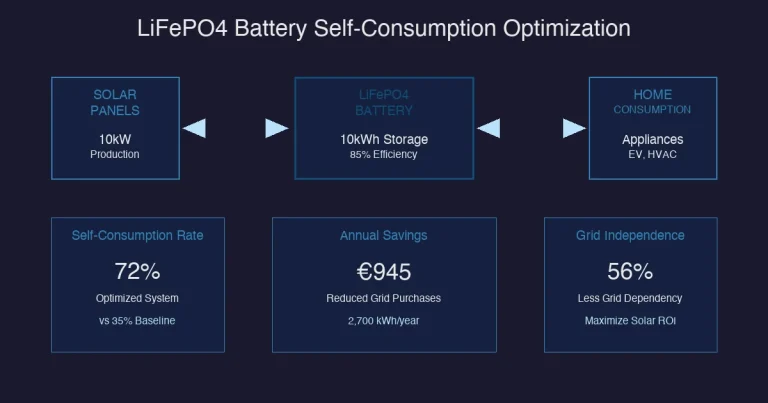
- Current annual spend (flat tariff, 3,000 kWh): €1,200/year (€0.40/kWh average)
- Switch to AGCM/EPEX dynamic tariff + 5 kWh LiFePO4 battery: annual spend drops to €780/year
- Annual savings: €420 (35% reduction)
- With KfW 458 subsidy (€5,000 grant for storage system): payback period under 4 years
To understand how dynamic tariffs work in practice, read our detailed guide on EU dynamic electricity tariff structures and LiFePO4 optimisation strategies.
Barriers That Must Be Addressed
Despite the savings potential, several structural barriers prevent energy-poor households from accessing battery storage:
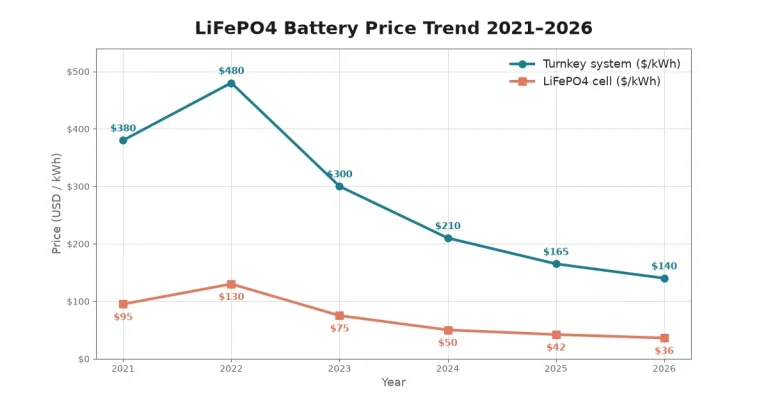
- Upfront cost: Even with subsidies, a 5 kWh LiFePO4 system costs €2,000–€4,000 after grants. Many vulnerable households cannot access credit.
- Home ownership requirement: Most EU subsidy programs require property ownership, excluding the 30% of EU households in rental accommodation.
- Grid connection complexity: In Poland and Romania, lengthy grid approval processes (6–18 months) deter adoption.
These barriers are not insurmountable — but they require coordinated action from policymakers, utilities, and installers working together. For a broader perspective on how EU battery regulations are shaping the market in 2026, see our EU battery regulations overview.

What Comes Next: The 2027 EU Energy Poverty Target
The EU has committed under Directive (EU) 2023/1791 to reduce the number of energy-poor households by at least 25% by 2030. Battery storage — particularly when bundled with solar PV under Social Climate Fund programs — is emerging as one of the most scalable tools to meet this target. For installers and distributors in the EU market, the energy-vulnerable household segment represents both a commercial opportunity and a meaningful impact pathway.
When a LiFePO4 battery reaches end of life, it still retains approximately 70–80% of its original capacity — making it ideal for second-life stationary applications. Explore EU battery recycling and second-life options for sustainable end-of-life management.
Ready to Explore Battery Storage for Your Community or Household?
If you are an installer, municipality, or housing association looking to deploy battery storage solutions for energy-vulnerable residents, contact Insum Energy today. We supply professional-grade LiFePO4 battery systems to EU partners with full CE certification, competitive wholesale pricing, and technical support for subsidy applications across Germany, France, Italy, the Netherlands, and beyond.
You can also browse our complete range of LiFePO4 battery products or learn more about our company.