Australian CEC Battery Standards 2026: Compliance Guide
Installing a home battery in Australia in 2026 is not as simple as choosing a brand and plugging it in. The Clean Energy Council (CEC), distributors, insurers and state rebate authorities all look at the same paperwork — and if anything is missing, your installation can be rejected, your rebate denied, or your warranty voided.
This guide explains the three standards every Australian installer and homeowner should know in plain English: AS/NZS 5139, AS/NZS 4777.2, and the CEC Approved Battery List. By the end you will know what each rule covers, how to check whether a specific product qualifies, and which paperwork has to be in place before the system is switched on.
Why Australian Battery Standards Are Strict
Australia adopted a tighter regulatory framework after several high-profile residential lithium battery fires in 2018–2022. Because homes are often built with timber frames, lightweight cladding, and limited fire separation, a single cell failure cannot be allowed to escalate. The result is a compliance regime that mirrors the rigor of commercial energy storage — applied to any system roughly above 5 kWh or above 50 V DC.
The framework is built around three documents:
- AS/NZS 5139:2019 + Amd 1:2022 — installation safety for battery storage systems.
- AS/NZS 4777.2:2020 — grid-connected inverter requirements (which the battery is paired with).
- CEC Approved Battery List & Approved Inverter List — the practical gatekeepers for rebates and accredited installs.
AS/NZS 5139:2019 — Where a Battery May Be Installed
AS/NZS 5139 defines the physical rules for siting, mounting, ventilation, clearances, segregation, signage, and the fire safety add-ons expected around lithium battery systems. Most homeowner questions (“can I put it in the garage?”, “is it okay in a cupboard?”) are answered here.
Key Clearance Rules (Indicative)
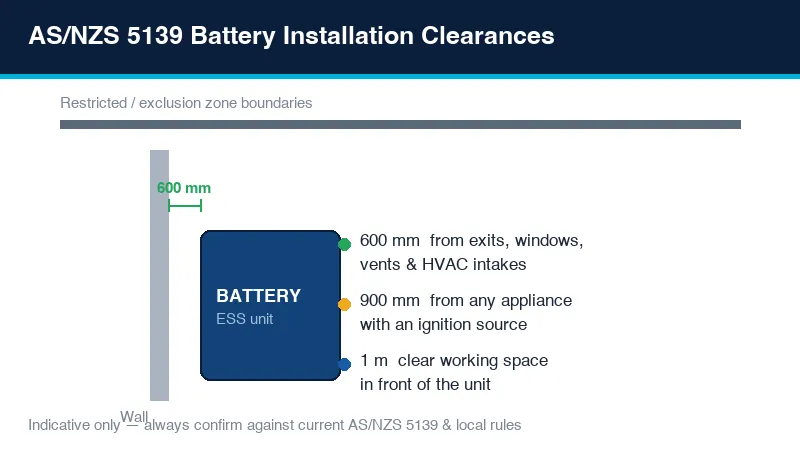
The standard’s typical requirements include:
- 600 mm minimum clearance from any opening window, door, vent or HVAC intake.
- 900 mm minimum from any ignition source (water heater, gas meter, oven, switchboard with unprotected arcs).
- 1 m clear working space in front of the unit for first responders.
- Wall mounting rated for ≥ 1.5× the mass of the heaviest cell module when fully charged.
- A fire-rated barrier where the unit sits less than 600 mm from a habitable room boundary, or less than 300 mm from any structural member that could spread flame.
- Mandatory warning signage, lockable isolation, and an emergency shutdown procedure document left at the site.
These numbers are the most commonly applied defaults; always defer to the manufacturer’s installation manual and your local Distribution Network Service Provider (DNSP) requirements, which can be stricter in some postcodes. If you are planning a multi-unit system, you should also read our guide on multi-stack battery parallel circulating current before finalising the layout.
AS/NZS 4777.2:2020 — The Inverter Side
Batteries need an inverter to interact with the grid, and the inverter is governed by AS/NZS 4777.2. The 2020 revision tightened grid-support functions, anti-islanding, and Volt-Watt / Volt-Var response curves. Since August 2021, any new install must use an inverter on the CEC Approved Inverter List — there is no grandfathering.
What 4777.2 Means for Battery Owners
- Your inverter must support the new grid protection settings (frequency, voltage, RoCoF) for your DNSP region.
- Export limits must be configurable — typically 5 kW single-phase or 15 kW three-phase per phase, depending on your DNSP.
- If the system is paired with solar, the inverter must be configured for the new multiple-mode operation rules — see our three-phase vs single-phase home battery guide for related sizing questions.
- Replacement inverters must also come from the approved list, even if the rest of the system stays the same.
CEC Approved Battery List — The Practical Gatekeeper
Even a perfect AS/NZS 5139 install with a 4777.2-listed inverter will not pass muster if the battery itself is not on the CEC Approved Battery List. The list is maintained by the Clean Energy Council and is the single document most installers check first.
What the CEC Actually Checks
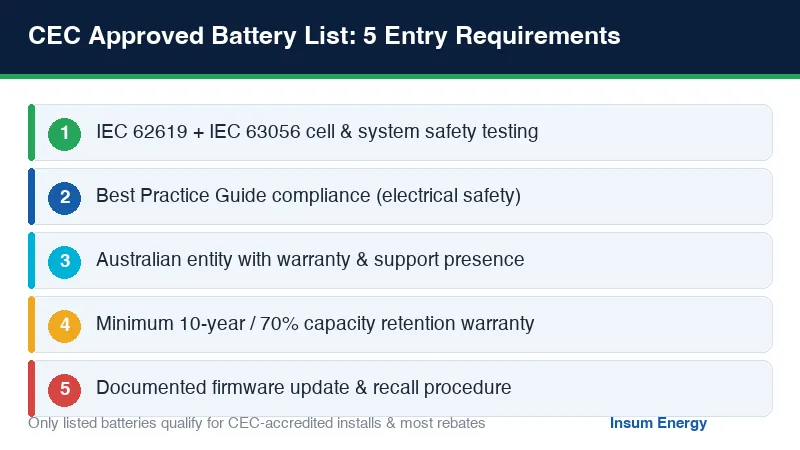
To get onto the list, a manufacturer must demonstrate five things:
- Cell & system safety testing to IEC 62619 and IEC 63056 (or equivalent UL 1973 + UL 9540A results).
- Best Practice Guide compliance — electrical safety, BMS behaviour under fault, thermal runaway containment documentation.
- Australian entity with warranty and technical support presence onshore.
- Minimum 10-year or 70% capacity retention warranty (whichever is shorter), with a clear performance degradation curve.
- Documented firmware update and recall procedure — including how the manufacturer will reach every owner.
The same philosophy applies to inverters. If a competitor tries to sell you an inverter “that works the same as a CEC-listed one”, check the list first. Off-brand inverters can also affect international certification claims and grid approvals.
Installer Accreditation — CEC Battery Endorsement
Only a CEC-accredited installer with the battery endorsement on their accreditation can sign off a battery install. A general PV accreditation alone is no longer sufficient since July 2023. The endorsement requires:
- Completion of the CEC Battery Storage Endorsement training course.
- Evidence of practical experience with at least two supervised battery installs.
- Annual currency of accreditation and public listing on the CEC Find an Installer directory.
Homeowners should always confirm the installer’s endorsement is current before booking. A retrofit or upgrade on an existing solar system also requires the same endorsement — see our UK G99/G98 grid connection guide for similar rules in the British market.
State Rebates & Compliance Links
Most Australian rebates — including the federal Cheaper Home Batteries Program and various state schemes — flow through CEC-approved products and CEC-accredited installers. The paperwork chain is consistent across states:
| Step | Document | Issued by |
|---|---|---|
| 1. Pre-install | DNSP pre-approval (where export > 5 kW) | DNSP |
| 2. Pre-install | CEC inverter + battery match confirmation | Installer |
| 3. Install | AS/NZS 5139 site compliance record | Installer |
| 4. Sign-off | CEC compliance certificate (ESS + PV) | Installer |
| 5. Rebate | Battery model serial + STC assignment | CEC / REC registry |
If any step is missing, the rebate claim is typically denied and the installer’s accreditation can be reviewed.
Common Compliance Mistakes (And How to Avoid Them)
1. Buying a Battery Off-Brand
The single most common reason installs fail audit is a battery that is not on the CEC list at the moment of installation. Some factories grey-import cells that were listed last year; check the live list on the day of install, not the marketing brochure from the seller.
2. Wrong Mounting or Location
Garage walls are fine — but only if the mass rating, clearance, and fire separation are met. Cupboards and under-stair voids are usually rejected unless fully fire-rated.
3. Missing DNSP Paperwork
Several DNSPs (Ausgrid, Energex, Essential Energy, CitiPower, etc.) require pre-approval for systems above 5 kW export or in three-phase configurations. Skipping this is the number-one cause of post-install disputes.
4. Mixing Old & New Inverters
If you retrofit a battery to an existing string inverter, that inverter still has to be on the current approved list. If it predates 4777.2:2020, the system is non-compliant — full stop.
For broader international context on safety, our guide to LiFePO4 battery fault diagnosis lists the symptoms that trigger mandatory shutdown under any standard.
Pre-Install Checklist for Homeowners
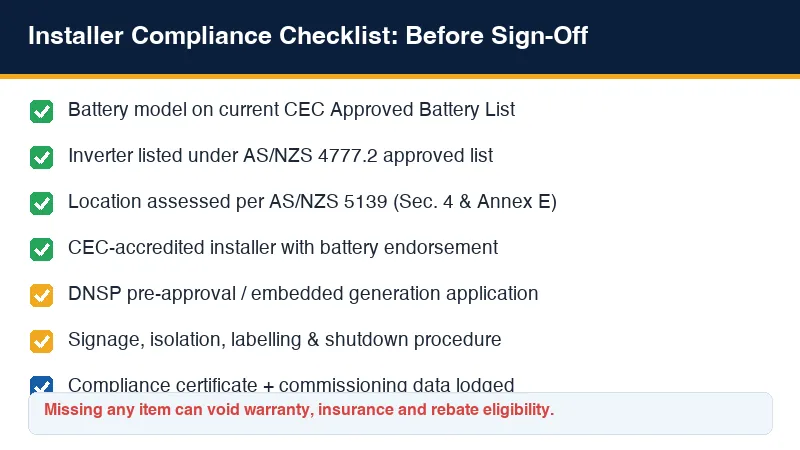
- ☐ Confirm the battery model is on the current CEC Approved Battery List.
- ☐ Confirm the inverter is on the CEC Approved Inverter List (4777.2).
- ☐ Confirm your installer holds a current CEC battery endorsement.
- ☐ Confirm the proposed location meets AS/NZS 5139 clearances.
- ☐ Confirm DNSP pre-approval is in place (if required in your area).
- ☐ Confirm the warranty document, firmware update policy, and Australian support contact are all in writing.
How Insum Energy Supports Australian Compliance
Every Insum Energy home battery sold into the Australian market is listed on the current CEC Approved Battery List and ships with full AS/NZS 5139 installation documentation, including mounting mass ratings, fire separation details, and emergency-shutdown procedure sheets. Our partner network is built exclusively from CEC-accredited installers with the battery endorsement, so sign-off and rebate paperwork stay clean.
Browse our LiFePO4 battery range, read more on home energy storage, or visit about Insum Energy to learn how we support installers across Australia and New Zealand. For questions on a specific install, send details through our contact page — we’ll respond within one business day with a compliance summary and a quote.
Need a CEC-compliant battery pack sized for an Australian home or small business? Contact Insum Energy for a tailored quote — we ship to all Australian states with full AS/NZS 5139 documentation.