Netherlands & Belgium VAT on Home Batteries: 2026 Guide
Ask ten European homeowners what VAT they pay on a home battery and you will get ten different answers. The confusion is understandable: the Netherlands applies a headline 0% VAT rate to residential solar panels, and Belgium has a well-known 6% reduced rate for home renovations. Many buyers assume batteries automatically ride along with those benefits. In most cases, they do not.
This guide from Insum Energy explains how VAT actually lands on home battery purchases in the Netherlands and Belgium in 2026, why the way your invoice is written can change your final price by hundreds of euros, and what to check before you sign.
The short answer: what you actually pay in 2026
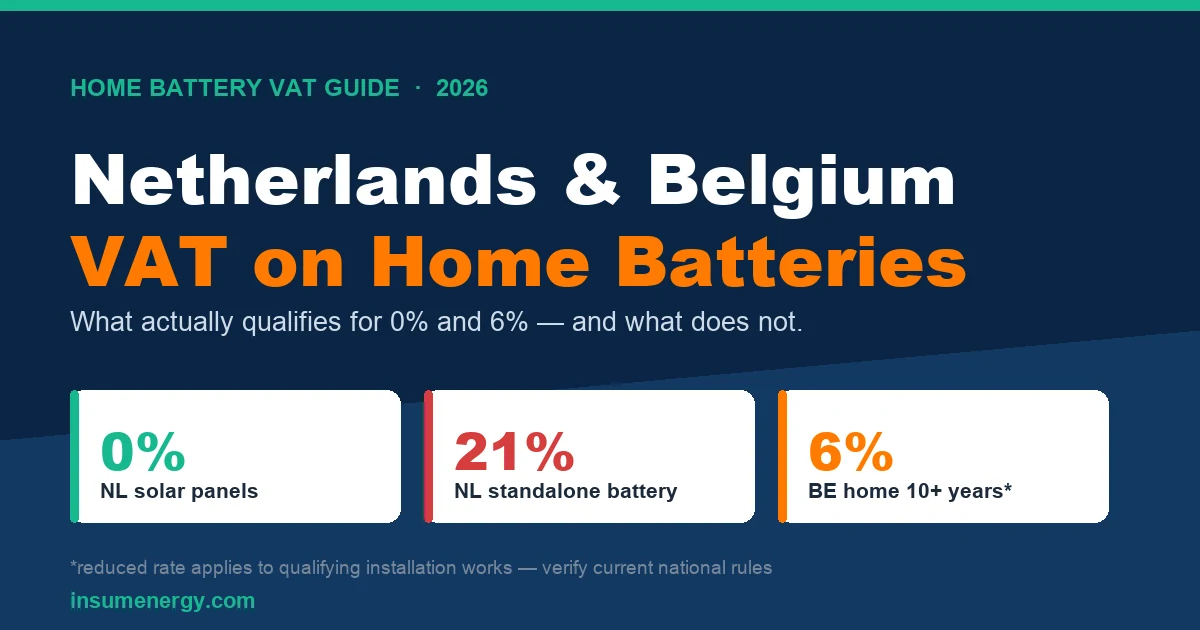
Both countries have a standard VAT rate of 21%. The reduced and zero rates are carve-outs with narrow conditions attached. Here is the practical picture:
| Supply type | Netherlands | Belgium |
|---|---|---|
| Solar panels on a residential dwelling | 0% | 6%* |
| Home battery bought as a product only | 21% | 21% |
| Home battery supplied and installed under one contract | 21% | 6%* |
| Hybrid inverter installed as part of a solar system | 0% | 6%* |
| Standard rate (everything else) | 21% | 21% |
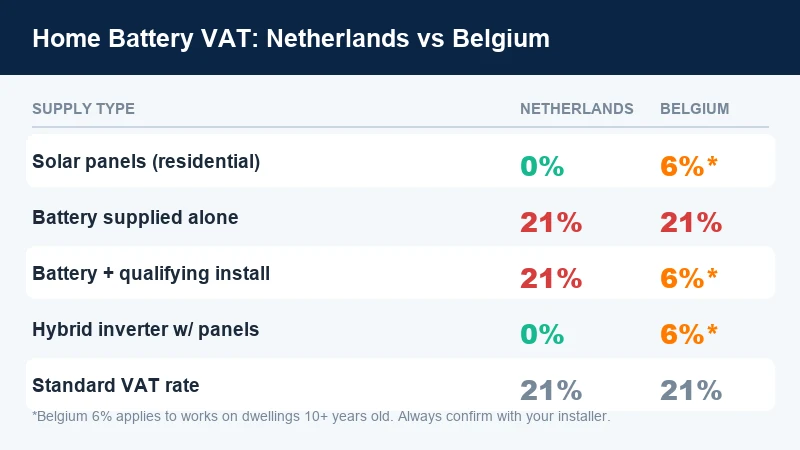
The pattern is worth internalising: the Netherlands gives a benefit to a product category (solar panels), while Belgium gives a benefit to a type of work (renovation of older homes). That single distinction explains almost every VAT surprise buyers run into.
Netherlands: 0% on panels, 21% on batteries
Since 1 January 2023, the Netherlands has applied a 0% VAT rate to the supply and installation of solar panels on or near residential dwellings. This was made possible by an EU-level change to the VAT Directive that allowed member states to zero-rate residential solar.
Why the 0% rate does not automatically cover storage
The Dutch zero rate is written around solar panels and the components needed to make those panels work — mounting systems, cabling, and the inverter that converts DC to AC. A battery is not needed to make solar panels function; it is an optional addition that stores output for later. Dutch practice has therefore consistently treated home batteries as falling outside the zero rate, taxed at the standard 21%.
There are two nuances worth knowing:
- Hybrid inverters are a genuine grey zone. Where an inverter is installed as an integral part of the solar system, it typically follows the panels. Where it is bought separately as a storage upgrade, it usually does not.
- Retrofits are treated as standalone supplies. Adding a battery to a system installed two years ago is a separate transaction — there is no panel installation for it to attach to.
Because rulings and guidance in this area do shift, treat the above as the general position and ask your installer to confirm the rate in writing on the quote.
The 2027 net metering deadline changes the maths
The bigger financial story in the Netherlands is not VAT at all — it is the end of salderingsregeling, the net metering scheme, which is scheduled to be abolished from 1 January 2027. Under net metering, exported solar was offset one-for-one against imported electricity, which made batteries hard to justify economically.
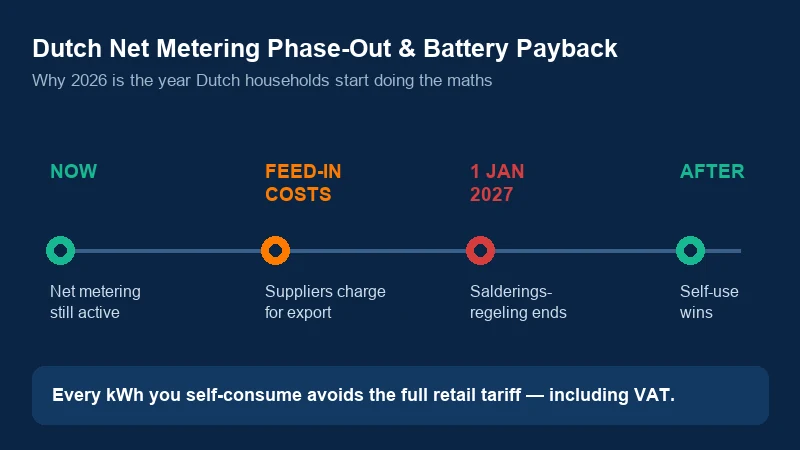
Two things are already eroding the value of exporting power:
- Feed-in charges. Many Dutch suppliers now levy terugleverkosten on customers who export significant volumes, directly reducing the return on unstored solar.
- The 2027 cliff edge. Once net metering ends, exported electricity is paid at a low market-linked rate while imported electricity still carries the full retail tariff, energy tax, and VAT.
The consequence is straightforward: every kWh you store and use yourself avoids the full retail price of electricity, including the 21% VAT on that energy. Paying 21% VAT once on the battery hardware buys you an asset that dodges 21% VAT on imported energy for the next decade or more. If you want to model this properly, our home battery ROI analysis walks through the payback calculation step by step.
Belgium: the 6% rate is about works, not products
Belgium takes a different route. Instead of zero-rating a product, it applies a 6% reduced rate to renovation and improvement works on residential property, provided a set of conditions is met.
The 10-year rule
The core conditions for the 6% rate are:
- The dwelling must be at least 10 years old at the time the works are carried out.
- The property must be used wholly or mainly for private housing.
- The work must be supplied and installed by a registered contractor.
- The invoice must be issued directly to the end user and carry the required statement confirming the conditions are met.
Homes younger than 10 years fall back to the standard 21% rate. This is a hard cut-off, not a sliding scale.
Why buying the battery yourself is the expensive option
This is where most Belgian buyers lose money. If you order a battery online and pay a separate electrician to fit it, the battery is a supply of goods at 21%. If the same battery is supplied and installed by a registered contractor under a single contract, the whole job can be treated as works — potentially at 6%.
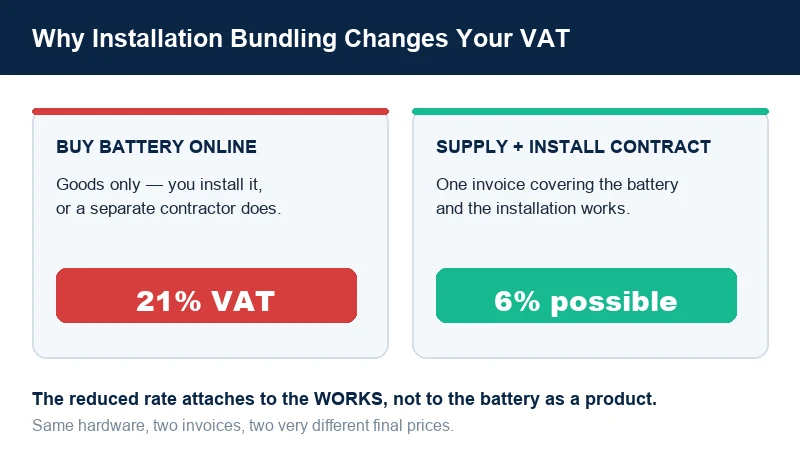
Same hardware. Same house. Two invoices, two very different totals.
Belgian buyers should also factor in the Flemish capaciteitstarief, the capacity-based grid tariff in force since 2023. Because part of your network charge is driven by your monthly peak demand, a battery that shaves peaks reduces your bill independently of any solar self-consumption benefit. Note that the earlier Flemish home battery premium has ended, so the tariff structure — not a subsidy — is now the main driver.
Worked example: the same battery, two invoices
Take a 10 kWh LiFePO4 system with a hardware price of €3,000 excluding VAT, plus €800 of installation labour, on a 15-year-old Belgian home. These figures are illustrative, but the mechanism is real:
- Route A — DIY purchase: €3,000 of goods at 21% (€630 VAT) plus €800 labour at 6% (€48 VAT). Total VAT: €678.
- Route B — single supply-and-install contract: €3,800 of qualifying works at 6%. Total VAT: €228.
A difference of roughly €450 on a mid-sized system, created purely by how the transaction is structured. On a larger multi-stack installation the gap scales accordingly.
Five steps to secure the correct rate
- Establish the age of the dwelling first. In Belgium this single fact decides 6% versus 21%. Have documentation ready.
- Ask for one contract covering supply and installation. Split invoices are the most common reason buyers lose the reduced rate.
- Get the rate stated on the quotation, not just the final invoice. A quote showing “6% VAT, works on dwelling over 10 years” gives you something to hold the contractor to.
- Confirm your contractor is properly registered. The reduced rate depends on the supplier’s status, not only on your property.
- In the Netherlands, budget for 21% on storage. Do not build a business case that assumes the solar zero rate will cover the battery.
Common mistakes we see
- Assuming EU-wide harmonisation. VAT rates and conditions are set nationally. A German, Dutch, and Belgian buyer purchasing identical hardware can each pay a different rate — as our guide to the German KfW solar battery subsidy illustrates.
- Importing directly to save VAT. Buying from outside the EU does not avoid VAT; it is collected at import, and you also take on compliance and warranty risk.
- Ignoring documentation. Reduced rates are conditional. If an audit finds the conditions were not met, the difference is typically recovered from the supplier — and often passed back to you.
- Overlooking upcoming compliance duties. VAT is only one layer. From 2027, digital record-keeping obligations arrive under the EU Battery Passport framework, which affects what documentation your battery must ship with.
What this means if you are sourcing batteries
For installers and distributors, VAT structure is a commercial lever, not just an accounting detail. In Belgium, positioning yourself as a supply-and-install contractor rather than a box-shifter lets you quote a materially lower delivered price on the same hardware. In the Netherlands, the honest pitch is not a VAT break — it is the 2027 net metering deadline and the self-consumption economics that follow it.
Either way, the hardware needs to be documented well enough to survive scrutiny: proper CE marking, complete technical files, and traceable cells. Our LiFePO4 home battery systems are built with European compliance requirements in mind, and you can read more about our manufacturing background on our About Us page.
A necessary disclaimer
VAT rules change, and the treatment of energy storage specifically has been under active discussion in several member states. This article is general information, not tax advice. Before committing to a purchase, confirm the current position with the Belastingdienst (Netherlands) or FOD Financiën / SPF Finances (Belgium), or with a qualified accountant.
Get a quote with the VAT position spelled out
Insum Energy supplies LiFePO4 home battery systems to installers and distributors across the Netherlands, Belgium, and the wider EU. We can provide the technical documentation your accountant and grid operator will ask for, and structure quotations so the applicable VAT treatment is clear from the start.
Contact Insum Energy for a quote — tell us your market and project size, and we will come back with pricing, lead times, and the compliance pack.