

Home Battery ROI Calculator: Does Solar Storage Really Pay Off?
Thinking about adding a home battery to your solar system but wondering if it actually pays off? You are not alone. In 2026, with electricity prices rising across the globe and solar feed-in tariffs shrinking, the question of home battery ROI has never been more relevant. This guide breaks down exactly how to calculate your return on investment and shows you real-world payback periods across different countries.
What Is Home Battery ROI and Why Does It Matter?
Return on Investment (ROI) for a home battery measures how long it takes for your energy savings to cover the upfront cost of the system. Unlike solar panels alone — which typically pay back in 5–8 years through feed-in tariffs — a battery lets you store excess solar energy for self-consumption during peak evening hours when electricity is most expensive.
In 2026, several market shifts make battery ROI especially important:
- Electricity rates have risen 15–25% since 2024 in most developed markets
- Solar feed-in tariffs continue to decline (as low as $0.03/kWh in some regions)
- Battery pack prices dropped below $100/kWh at cell level for the first time
- Government incentives in Germany, the US, and Australia remain strong
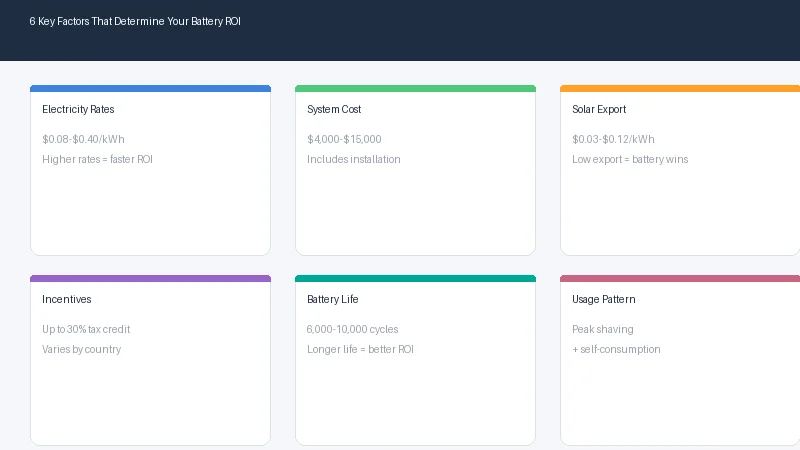
The 6 Key Factors Driving Battery ROI
1. Electricity Rates (Peak vs Off-Peak)
The single biggest driver of battery ROI is the gap between peak and off-peak electricity rates. In markets like Germany ($0.40/kWh peak) and California ($0.45/kWh peak), every kWh you shift from grid consumption to battery discharge saves significant money. In regions with flat rate structures, the ROI calculation shifts toward self-consumption optimization.
2. Total System Cost
A complete home battery system in 2026 ranges from $4,000 for a basic 5 kWh system to $15,000+ for a 20 kWh whole-home backup. The cost includes the battery pack, inverter, BMS, installation labor, and any electrical panel upgrades. Prices vary significantly between markets — Insum Energy offers competitive pricing on high-quality LiFePO4 systems starting at competitive wholesale rates.
3. Solar Export Tariffs
When your utility pays you very little for exported solar power (e.g., $0.03–$0.08/kWh in the UK and Australia), it makes far more financial sense to store that energy and use it yourself. A battery can increase your self-consumption rate from 30% (solar-only) to 70–80%.
4. Government Incentives & Subsidies
Incentives dramatically shorten payback periods. Key programs in 2026 include:
- USA: Federal ITC (30% tax credit on battery systems with solar)
- Germany: KfW grants covering up to 25% of battery system cost
- UK: 0% VAT on battery installations (reduced from 20%)
- Australia: State-level rebates (e.g., Victoria Solar Battery Rebate up to $4,174 AUD)
- Netherlands: VAT exemption from 2026 on home battery systems
5. Battery Cycle Life & Warranty
A quality LiFePO4 battery rated for 6,000–10,000 cycles at 80% depth of discharge (DoD) will last 15–20 years under daily cycling. A shorter-lived battery (e.g., NMC with 3,000–5,000 cycles) must be replaced sooner, reducing total lifetime ROI. Always check the throughput warranty — a 10-year warranty with unlimited cycles is the gold standard in 2026.
6. Your Usage Pattern
Households that are home during the day (remote workers, retirees) naturally use more solar power directly, reducing the need for a large battery. Households that are empty during the day benefit most from batteries since they can store daytime solar for evening consumption — peak shaving during expensive rate periods.
Home Battery ROI: Real-World Calculation Methodology
The basic formula for annual battery savings is straightforward:
Annual Savings = (kWh stored per day × peak rate savings per kWh) × 365
Let us walk through a real example. A 10 kWh battery in Germany with daily cycling:
- Usable capacity at 90% DoD: 9 kWh
- Peak rate savings: €0.40/kWh – €0.08/kWh (feed-in tariff) = €0.32/kWh saved
- Daily savings: 9 kWh × €0.32 = €2.88
- Annual savings: €2.88 × 365 = €1,051
- System cost after KfW grant: €7,500 × 0.75 = €5,625
- Simple payback: €5,625 ÷ €1,051 = 5.4 years
ROI Comparison by Region
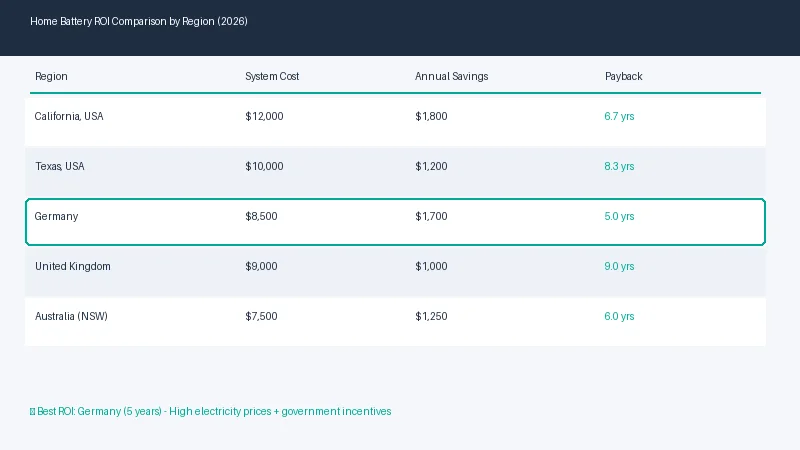
ROI Comparison Table: Home Battery Payback by Region
| Region | System Cost | Annual Savings | Payback Period | 20-Year Net Savings |
|---|---|---|---|---|
| California, USA | $12,000 | $1,800 | 6.7 years | $24,000 |
| Texas, USA | $10,000 | $1,200 | 8.3 years | $14,000 |
| Germany 🇩🇪 | $8,500 | $1,700 | 5.0 years | $25,500 |
| United Kingdom | $9,000 | $1,000 | 9.0 years | $11,000 |
| Australia (NSW) | $7,500 | $1,250 | 6.0 years | $17,500 |
Note: Assumes 10 kWh usable LiFePO4 system, daily cycling, 2026 pricing including installation. Incentives applied where applicable.
When Does Home Battery Storage Make Financial Sense?
Based on the data above, here is when a home battery makes clear financial sense:
- High electricity prices (>$0.25/kWh) — every stored kWh saves significant money
- Low feed-in tariffs (<$0.08/kWh) — storing beats selling back to the grid
- Strong incentives available — 25–30% off the system cost changes the math
- Time-of-use rates — 3×+ peak vs off-peak spreads maximize arbitrage
- Frequent grid outages — backup value adds non-financial ROI
If your situation matches 3+ of these conditions, a battery is likely a smart investment in 2026.
Beyond Financial ROI: The Value of Energy Independence
Not all ROI is measured in dollars. Home battery owners consistently report peace of mind from:
- Backup power during outages — keep fridges, lights, and WiFi running
- Energy independence — reduced reliance on grid price hikes
- Environmental impact — maximize self-consumption of clean solar energy
- Grid services revenue — some markets now pay batteries for frequency regulation
How to Maximize Your Home Battery ROI
Follow these strategies to get the fastest payback on your battery investment:
- Right-size your system — a 10–15 kWh battery covers most households without oversizing. Contact Insum Energy for a free sizing consultation.
- Choose LiFePO4 chemistry — longer cycle life (6,000–10,000 vs 3,000–5,000 for NMC) means better lifetime ROI
- Optimize charge/discharge settings — program your inverter to charge from solar and discharge during peak rate periods
- Layer incentives — combine federal, state, and utility programs where possible
- Use a quality BMS — a BMS with active balancing extends battery pack life by ensuring all cells stay balanced
Frequently Asked Questions
How long does a home battery last before needing replacement?
A quality LiFePO4 home battery lasts 15–20 years, typically backed by a 10-year warranty. Most batteries maintain 80% of original capacity after 6,000 cycles.
Can I add a battery to my existing solar system?
Yes. Most modern inverters support AC-coupled battery retrofits. If you have an existing solar system, an AC-coupled battery like the SEPLOS or JK BMS-based system can be added without replacing your current inverter.
Is battery storage worth it without solar panels?
Generally no — the ROI is much harder to justify without solar, since you would be charging from the grid at retail rates. However, in markets with large peak/off-peak spreads (>3×), grid-charged batteries can still generate savings through energy arbitrage.
What is the best battery size for ROI in 2026?
A 10–15 kWh LiFePO4 battery offers the best balance of upfront cost and usable capacity for most households. Systems this size cover evening loads for 3–4 bedroom homes without significant waste.
Conclusion: Is Home Battery Storage Worth It in 2026?
For most households with solar panels in markets with reasonable electricity rates and incentives, home battery storage is a solid investment in 2026. With payback periods of 5–9 years and a system lifespan of 15–20 years, you enjoy 6–15 years of effectively free electricity after breakeven.
The key is getting the right system at the right price. That is where Insum Energy comes in — we supply premium LiFePO4 battery systems, BMS solutions, and complete energy storage components at wholesale prices direct from top-tier manufacturers.
Ready to calculate your exact home battery ROI? Contact the Insum Energy team today for a personalized system design and quotation. Our experts will help you size the perfect battery for your home and budget.

One Comment